

If you’ve ever spent hours drowning in open browser tabs—trying to cross-reference travel logistics, hunt down a specific interview quote, or compare complex business options—you know how research can turn into a cognitive drain.
Recently, I managed to bypass this frustration.
“I love your prompting skills,” my friend Lu said as we opened the door to our vacation getaway. We breathed in the smell of wood, taking in the sight of architecturally beautiful cabins that were, conveniently, right en route to her already booked flight at a nearby airport.
We were both thrilled as we sneaked a peek into what would be our home for four days of reflection, long walks, reading, and being with nature.
The cabins were a hidden gem in a region I am originally from, yet I’d had no clue they existed. But this was no outlier. A week before, I had found another secret spot—again, perfectly en route between a festival and the airport I was taking another friend to—requiring only a 5-minute detour from our original route.
But rather than drifting into a summery travel blog, this post today is about how to best use Large Language Models (LLMs), like ChatGPT, Claude, and Gemini, for deep research. We’ll explore:
How the three major AI models differ in their deep research approach.
The trade-offs between speed, depth, and accuracy.
When to use which tool based on your requirements.
How to prompt for Deep Research (including the prompt I used to find the cabin).
Whether you are navigating complex company logistics, hunting down obscure data for a high-stakes project, or just trying to plan your next vacation, these tools can handle the heavy lifting.
I’ve relied on them to scope tax and legal requirements for international business partnerships, to unearth highly specific podcast quotes for an interview with a school founder, and, of course, to find hidden gems like that Eifel cabin.
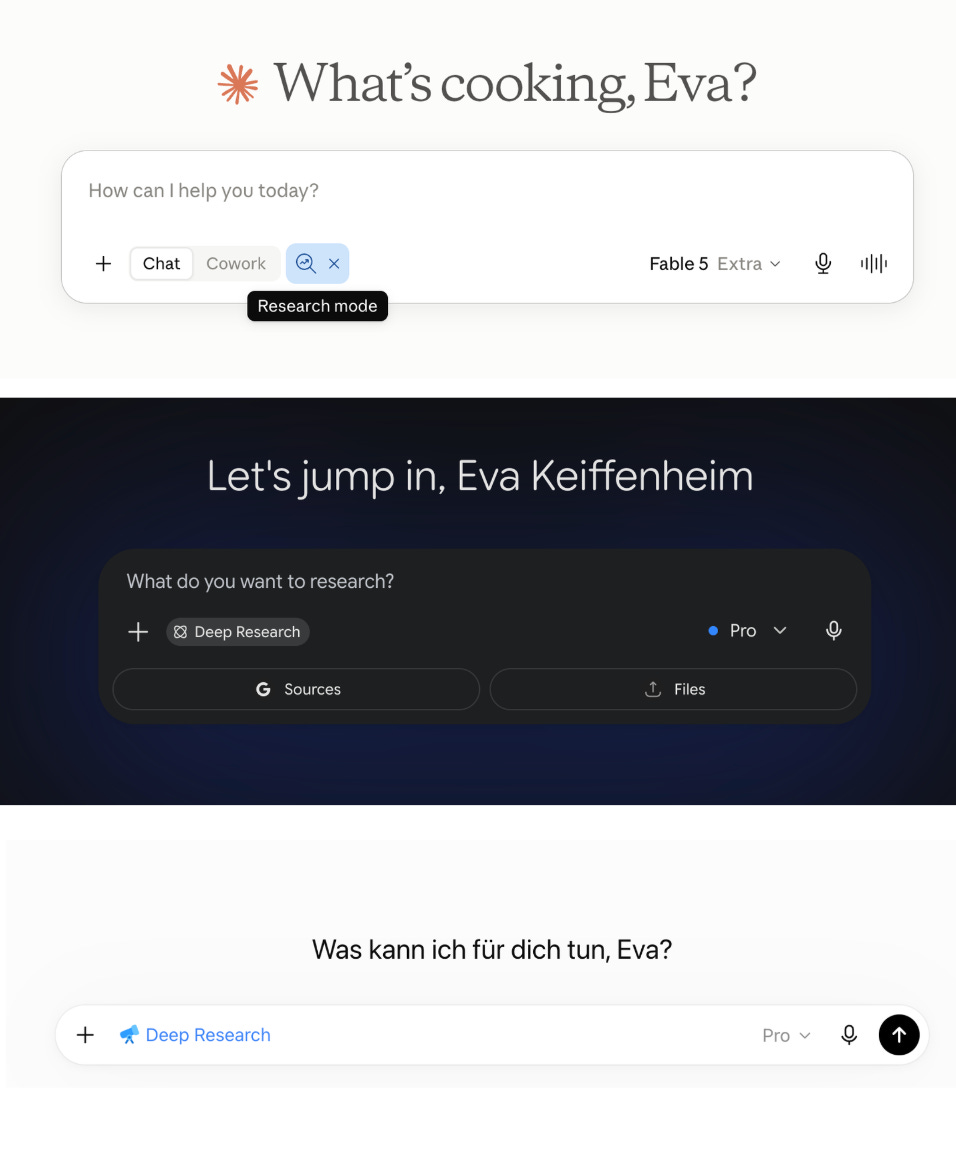
At first glance, Claude, Gemini, and ChatGPT’s deep research modes look similar. You prompt the LLM with a question, it suggests a research plan, searches through multiple sources, and returns a cited report.
But while all of them are a form of agentic research systems, they are built around different product priorities. Understanding these underlying mechanics helps you choose the right tool for your project.
Claude uses a multi-agent structure where one primary agent develops the strategy, then delegates parts of it to specialized sub-agents that run research in parallel and evaluate the findings.
A separate citation agent then links claims in the final report to their sources. It’s a bit like a swarm that works fast, but also burns through a lot of computational power. According to Anthropic, this multi-agent system uses roughly 15 times as many tokens as a normal chat interaction.
Gemini Deep Research runs on Google Search and follows an asynchronous cycle of planning, searching, reading, reasoning, and iterating. Google estimates that a typical standard Deep Research API task may run around 80 searches, while Deep Research Max may use up to roughly 160. Depending on your needs, standard is optimized for speed and efficiency, while Max is designed for exhaustive, long-running investigations.
ChatGPT Deep Research is best described as a staged research agent. It may first ask clarifying questions and turn your request into a detailed research brief. The model then breaks the task into sub-questions, opens web pages, reads uploaded files, and can even use code for calculations or data analysis before synthesizing the final report. Its biggest advantage is user control: you can edit the proposed plan, follow the investigation in real time, interrupt it, and change which sources it accesses.
So, how do you choose your researcher? It comes down to identifying your primary bottleneck.
Comments
Nothing yet. Say the first thing.
Sign in to join the conversation.