
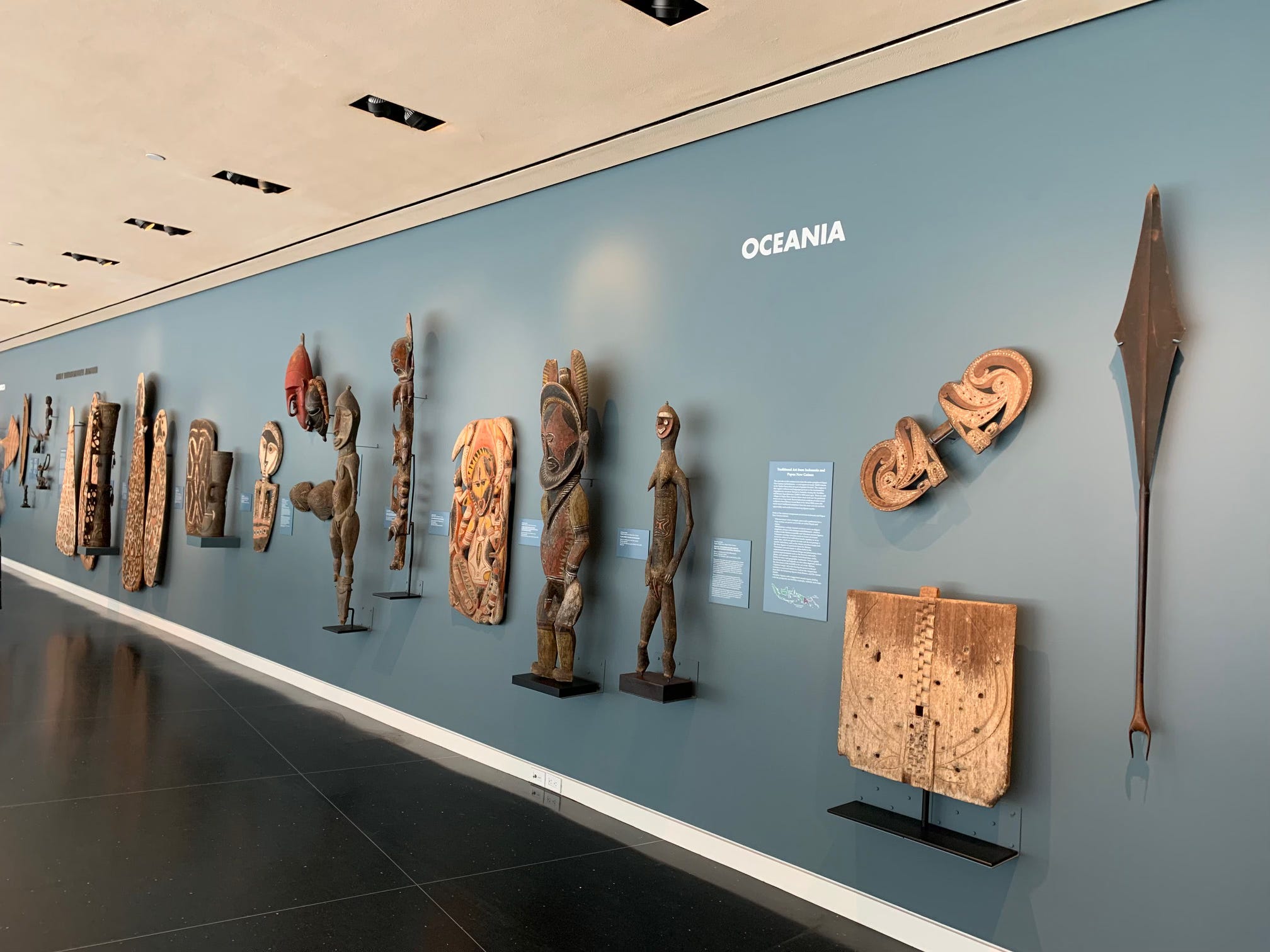
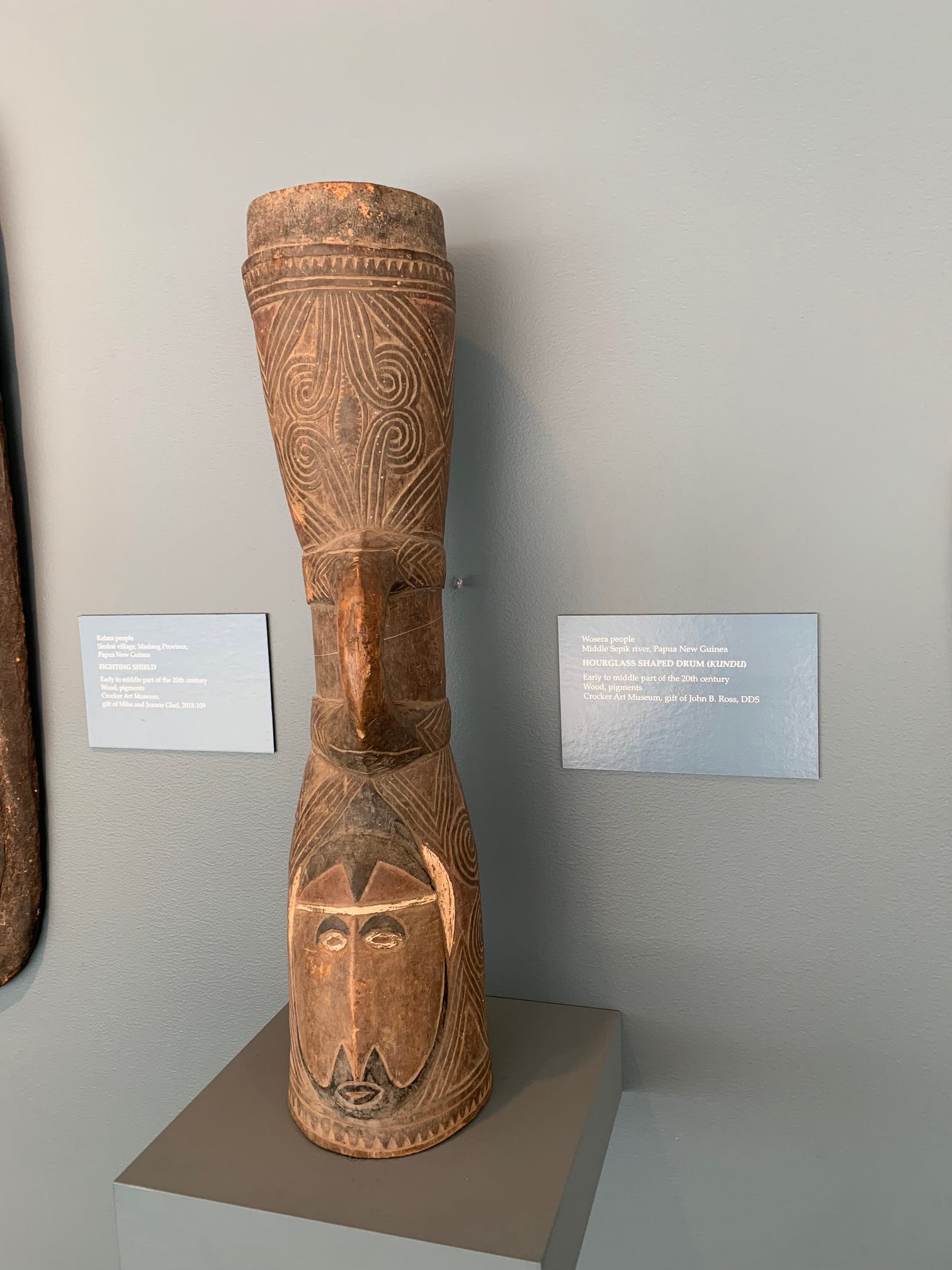
And now for something wildly different, as an intermission from all the northern European art from my recent trip. (Though there’s still more to come!) I took the kids to the Crocker Museum of Art in Sacramento. One kid was particularly drawn to the spears, shields, and masks in the Oceania Gallery. Upon seeing this drum, he immediately informed me that its name was Gerald. No hesitation, without a doubt, he opined that “Gerald” was the name of the drum.
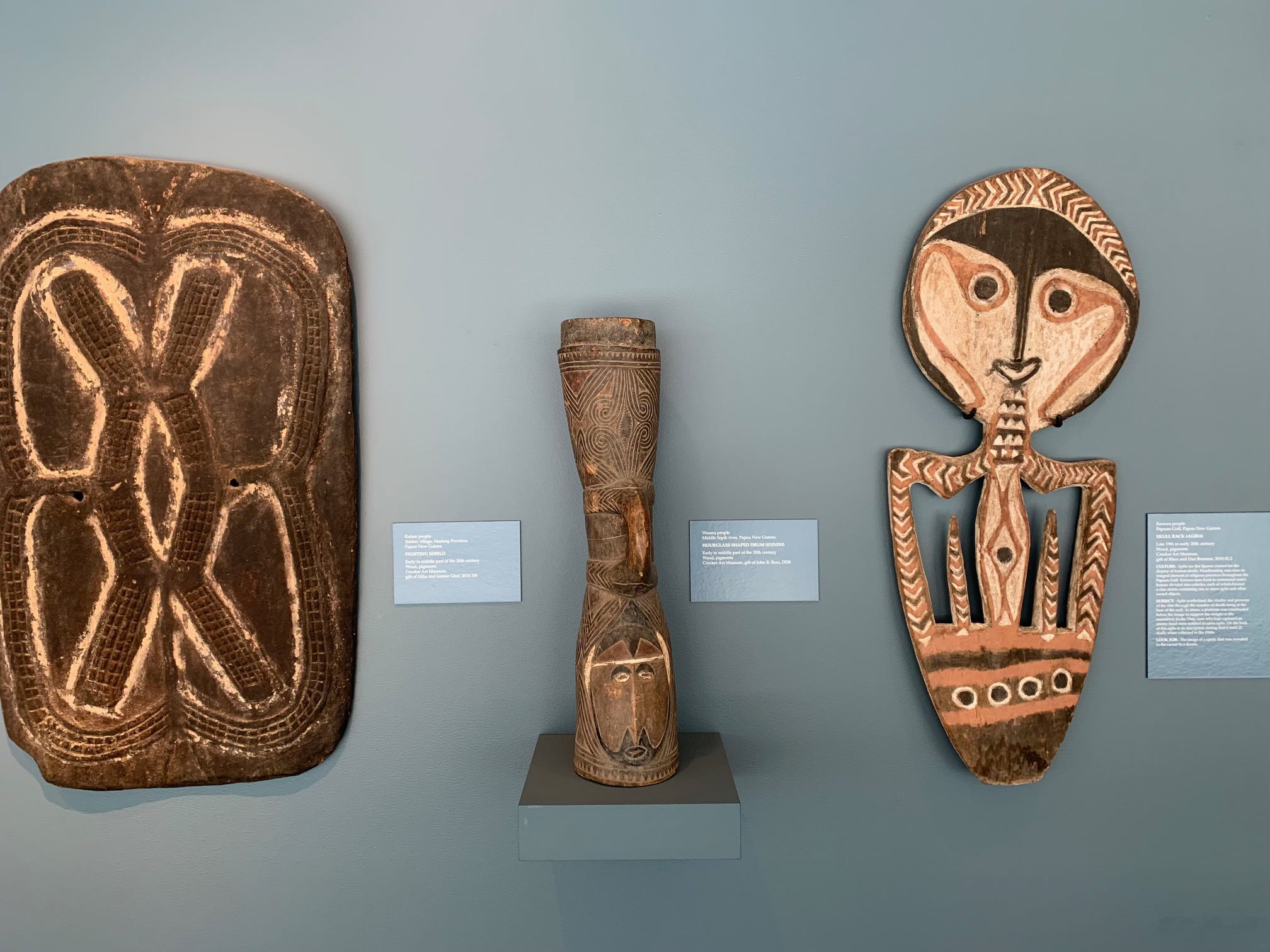
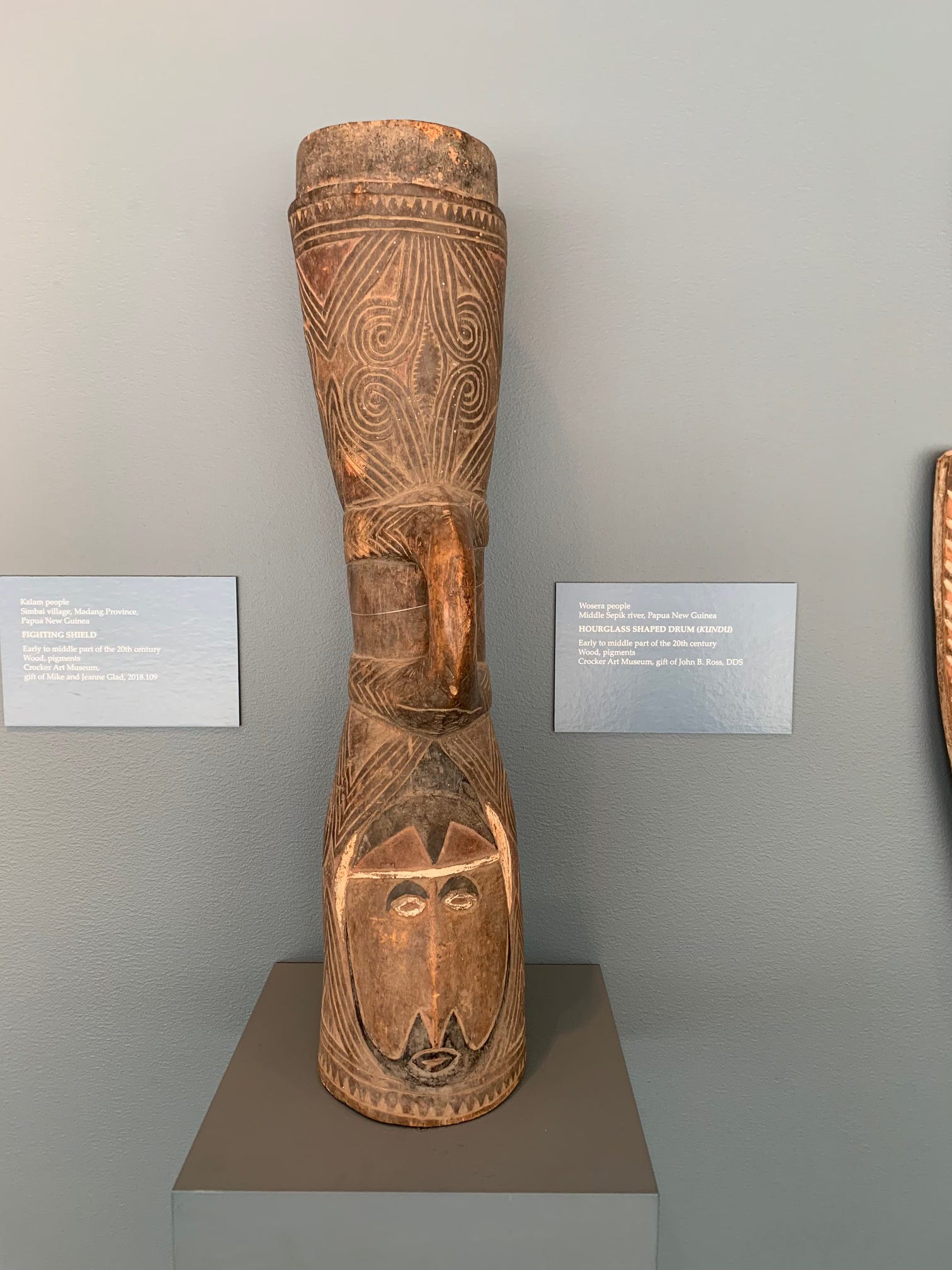
Curious about what would spark a child to name a drum, I gave it a closer look. Obviously, it has a face, friendly and vibrant enough to imagine an individual personality. Though the artist conveyed the face with only an arrangement of lines and geometric shapes, it was unlike all the other faces in the galleries we had wandered through. The long oval with the jagged M-triangle hair and beard lines, the two eyes placed close together and the crescent eyebrows, the long nose that ends at the mouth. Seeing this likable character, my kid chose a Boomer or Muppet name for this bearded guy, as though adopting it—or at least befriending it.
The liveliness and unique qualities extend beyond the face, because of the carved and lined striations that decorate the drum shape. This artist used the overall shape of the object to inform the decorative patterns. Wide at each end and narrowed in the middle, its so-called hourglass shape (though that is the end of its resemblance to an hourglass) is echoed by the triangles coming together at their points and widening out, at the top and bottom of each half of the drum.
So, where do you start when you know really nothing about an artwork?
When, as here, I cannot claim any authority about the cultures or background of an artwork or object, I ask how the overall exterior form of the object relates to its internal decoration. Whatever that relation, it is observable and interesting even to a first-timer, like myself. Let me know if this strategy works as a meaningful first approach for you, too!
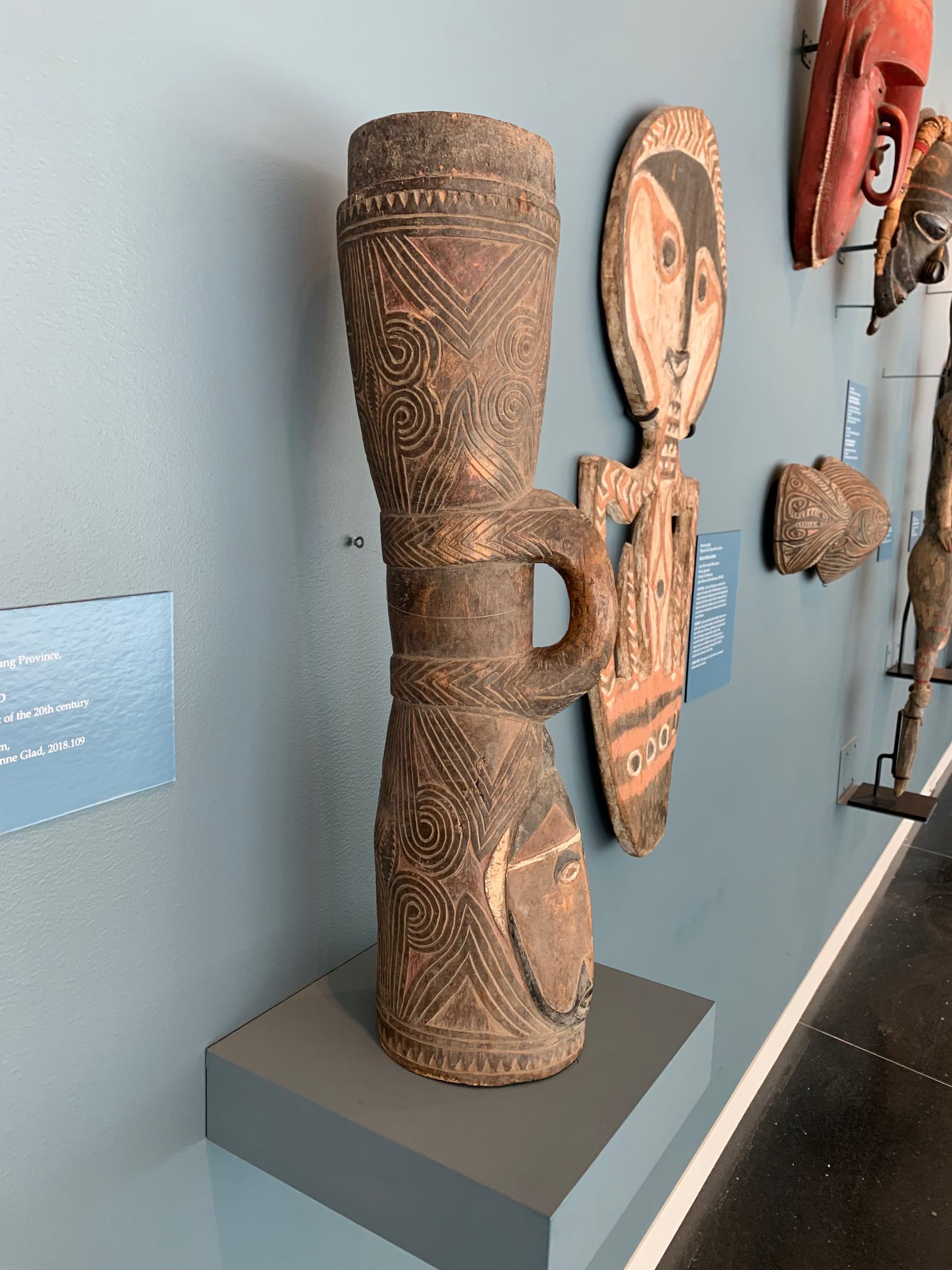
The repeated stripes and swirls and pattern and notches repeat in many of these objects in the Oceania gallery. The striped P-swirls that fill the spaces on both halves of this drum remind me of logos from the 1970s like on Trapper Keeper notebooks—if that’s before your time, google “retro stripe” and you’ll see what I mean.
Made from wood, the most readily available resource in a heavily forested and isolated nation, the drum was hollowed, carved, and originally painted with earth-sourced pigments. You can tell that this was an object that was used and carried around. Some of the brighter ruddy pigments have worn off, and the handle of the drum is smooth and polished from hands that held and rubbed it, like a raw-wood banister.
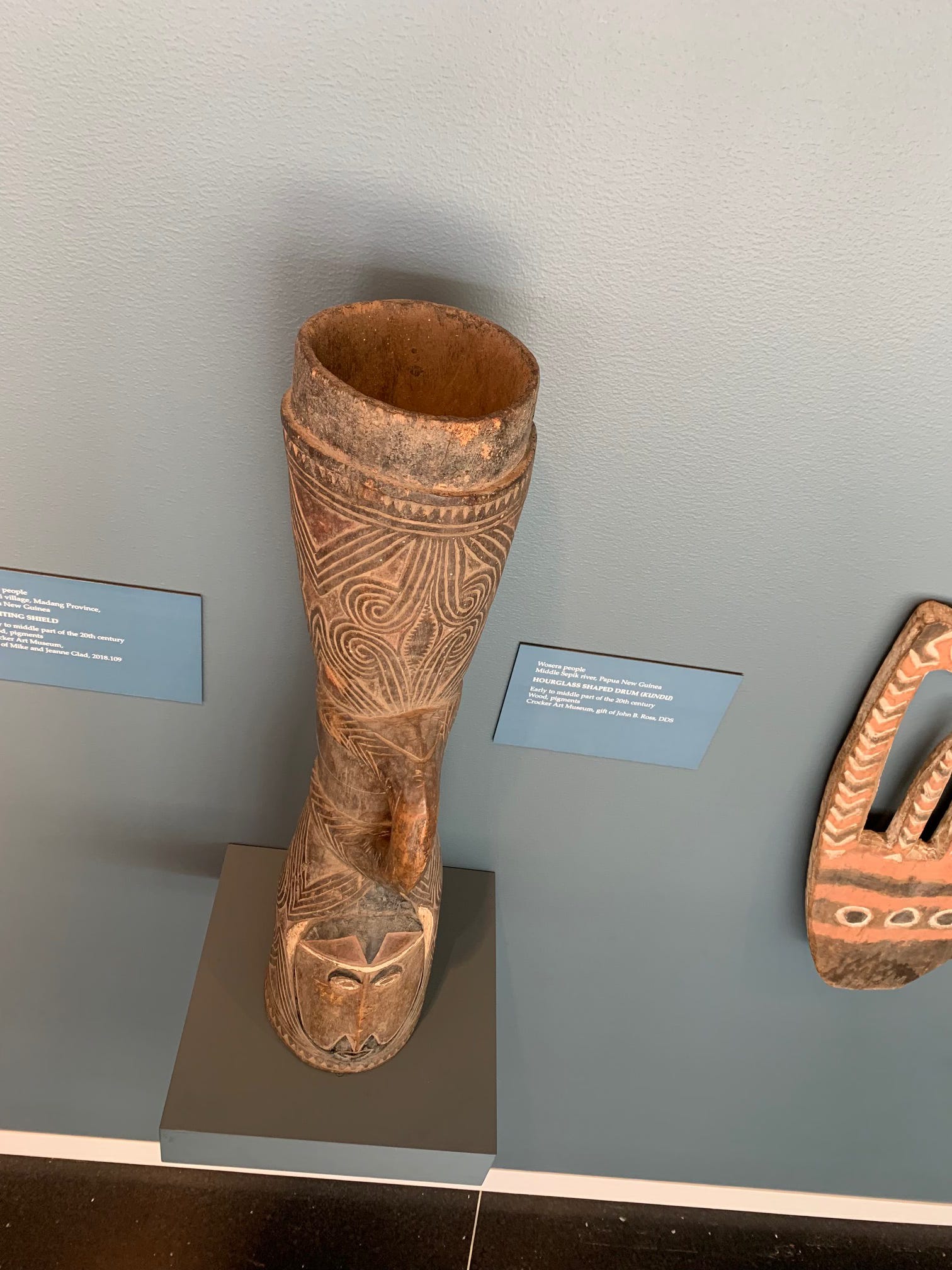
We often consider musical instruments in relation to the human voice—a drum can “speak” if not melodically sing. My brief online research tells me that the name of the drum type is a Kundu, and is associated with the musical and ritual traditions from several cultures in Papua New Guinea; they can represent a voice of the spirits or ancestors. Could the face of Gerald be one of those ancestors?
Gerald’s face features an open mouth, as though enacting the drum’s sound and equating it to a human presence. The instrument provokes our sense of hearing in our imagination, augmented and pictorialized by the energizing rhythmic zig-zag patterns on the outside of the drum, which appeals to our sense of sight. Gerald’s eyes and mouth both take the same open, pointed-oval shape. And on the top half, you can see a similar shape between the striated swirls, where it is toothedly notched in light over dark.
An animal skin, possibly from a lizard or opossum, would have been stretched over the top, and one of my sources said that it could have been glued to the drum using human blood. Could this sanguine material have also linked the drum to a human-spirit presence, or did it signify power over defeated enemies? Or does human blood make a particularly good coagulating glue? (Shudder.) If any of my readers know more, please let us know in the comments.
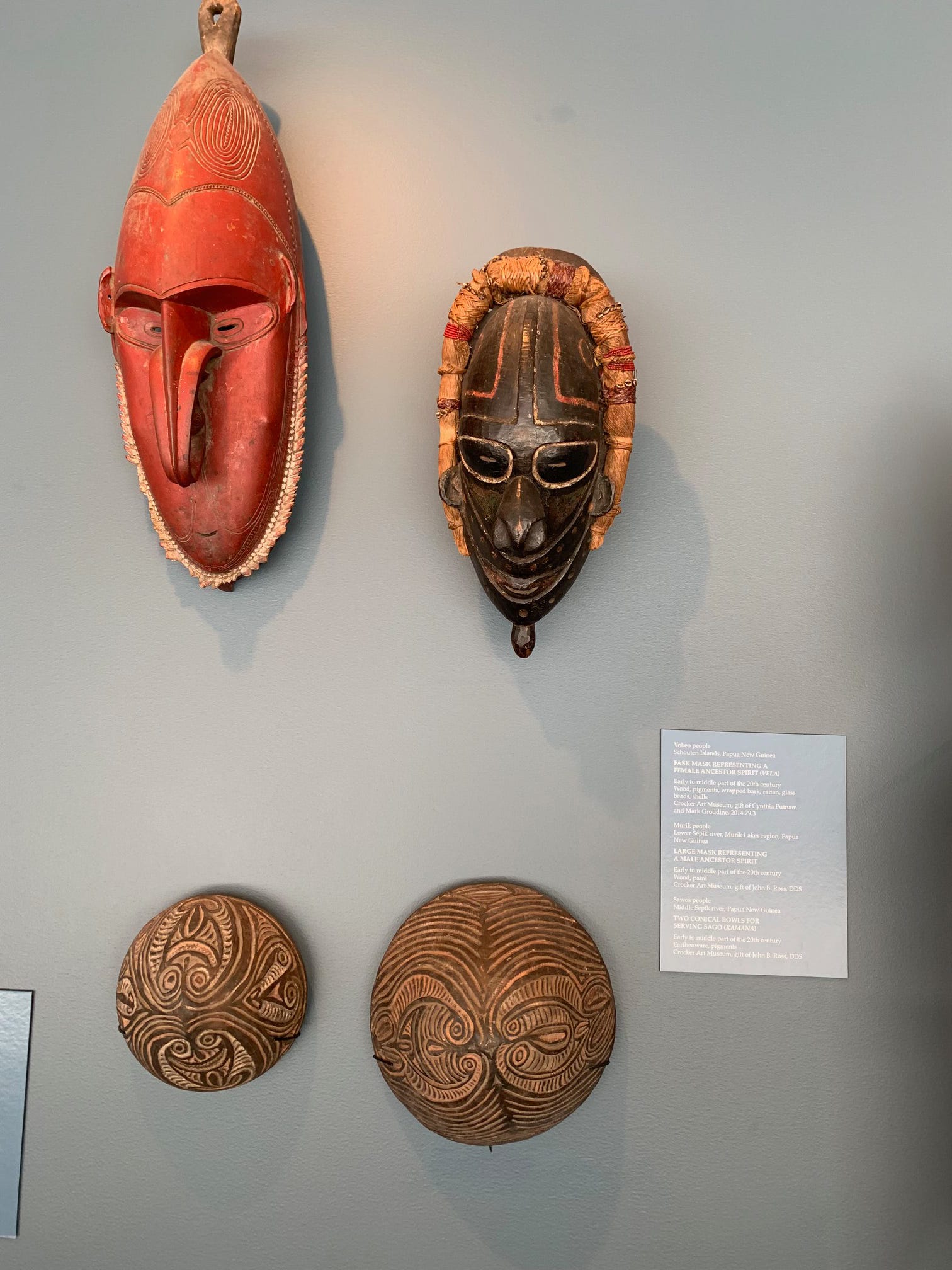
The museum literature traces the drum as coming from the Wosera people, a name that might have been imposed on them, possibly by antagonistic rivals or by colonial taxonomists. Humans do enjoy naming things, even (often) without asking permission. I sincerely ask that none take offense by my kid giving this drum a fully Western Germanic name. At least Gerald means “spear-wielder,” which, judging by the several spears in the same gallery, mightn’t have been out of place—not that my kid made that connection at all.
The irony is not lost on me that we don’t know the name of the person who carved this drum. But they gave it enough of a vital, energizing aesthetic presence for it to be included in an art gallery, and a face that prompted a child to give it a name.
I hope you find it invigorating that I chose to feature something completely unlike the usual prints and paintings of my expertise. There is still so much that no outsider knows about the island nation of Papua New Guinea—it is home to scores of remote, isolated societies because of its mountainous and thickly forested terrain. For the people, flora, and fauna of the country, this resulted in Papua New Guinea possessing more biological and linguistic diversity than anywhere else in the world—Wikipedia reports that its peoples speak a mind-boggling 840 languages! Wow, Gerald, and thanks!
No posts
Comments
Nothing yet. Say the first thing.
Sign in to join the conversation.