
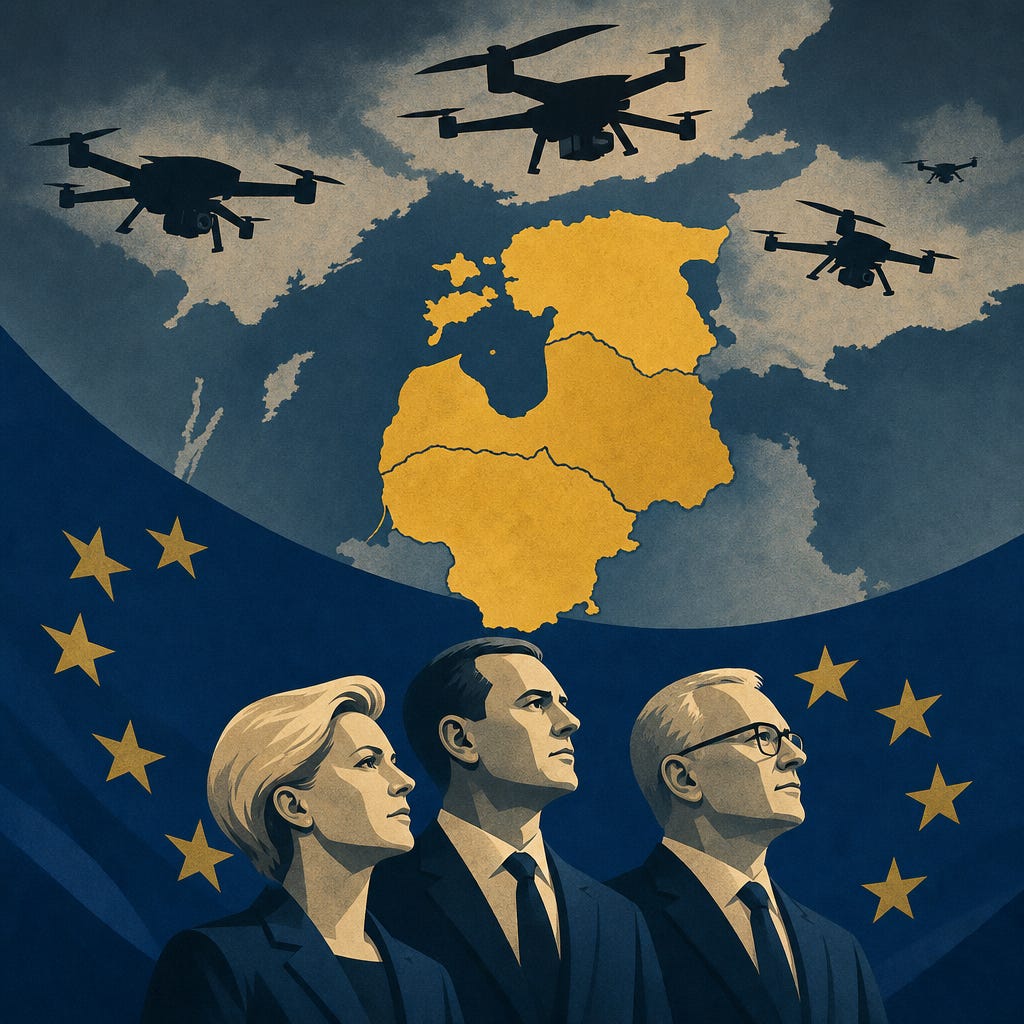
Ursula von der Leyen flew to Vilnius on Tuesday and stood beside the presidents of Lithuania, Latvia and Estonia to say something that capitals in the region have been saying since 2007: the drones crossing into Baltic airspace are not accidents. "This is a deliberate strategy from Russia trying to destabilise our democratic societies," she told the press conference, according to Euronews. At least six incursions have been recorded since the start of May. One forced the Lithuanian president and prime minister into a bunker and instructed civilians to shelter — the first such order issued by an EU and NATO member state. The vocabulary in Brussels has finally caught up with the reality on the eastern border. The machinery has not.
That is the position this column wants to defend: Europe is now articulating the threat correctly, and that is precisely what makes the absence of operational capacity harder to disguise. Naming Russian hybrid pressure as a strategy rather than a series of incidents raises the political temperature; it does not, on its own, intercept a drone over Šiauliai.
The institutional asymmetry is plain once stated. NATO has standing Baltic air policing since 2004, Quick Reaction Alert procedures that scramble jets in minutes, and integrated command. The European Union has none of these. Its defence competences under Article 42 TEU remain intergovernmental and unanimous; the Commission's legal foothold on air defence runs through Article 173 TFEU industrial policy — financing and procurement, not command. When von der Leyen speaks of mobilising twelve billion euros for air defence, she is describing a legislative ambition that requires a proposal, qualified or unanimous voting depending on the legal base, and Parliament approval. Until that process closes, the only actor that can respond to a drone over Tallinn in operational time is the alliance whose rotational fighters are already there.
The scaffolding for European action does exist, and it is fair to acknowledge it. The SAFE instrument adopted in 2025 created a pooled-procurement envelope; the European Defence Industry Programme and the ammunition-production act provide industrial-policy bases that could absorb part of the Vilnius ambition without inventing a new fund. The bottleneck is no longer whether the legal architecture is built. It is disbursement speed, member-state co-financing, the political economy of joint procurement, and whether counter-drone systems, ground-based air defence and integrated sensors are bought at European scale or in twenty-seven national variants. The European Sky Shield Initiative, launched by Germany in 2022 and bringing together a large group of participating states outside the Union's framework, already points to the direction of travel. The question is therefore not whether Europe can act, but whether the Commission's instruments will standardise what intergovernmental coalitions are already assembling, or whether they will add another layer of fragmentation paid for in common money.
This is where Mafalda's recurring pattern returns. In trade defence she has argued that tariffs without factories harden into permanent taxes; the same sequencing problem applies here. An air-defence envelope without binding milestones on capability — interceptor stocks, radar coverage, counter-UAS integration with NATO's air picture — risks becoming the political artefact that closes the debate while leaving the operational gap intact. "Solidarity in words alone is no longer enough; Europe must take swift and concrete action," Gitanas Nausėda said, according to LRT. The Baltic leaders have understood that the danger is not insufficient sympathy. It is the European reflex of substituting a fund for a structure.
The distributional politics will be uncomfortable. A twelve-billion-euro instrument primarily benefits the eastern flank; the burden falls on member states whose voters do not live under shelter orders. The European Council on Foreign Relations argued this week, in an analysis by Alejandro Romero and Jonathan Nelson, that the Union's response to airspace disruption requires faster coordination across institutions, not louder declarations. That is the operational test. Burden-sharing inside an asymmetric Union has produced fragile outcomes before — in sovereign debt, in migration, in the partial mutualisation around Ukraine. Each cycle ends with an instrument that names the problem and a delivery curve that does not match it.
Lithuania's State Security Department director Remigijus Bridikis told reporters that Moscow is also running an information campaign designed, in his words, to pressure the Baltic states into reducing support for Kyiv. The hybrid pressure is therefore stacked: drones to test thresholds, jamming to obscure attribution, narrative to fracture coalitions. None of this is answered by a press conference, however well calibrated. It is answered by procurement contracts, by integrated command-and-control, by sequencing protection to capacity rather than treating them as alternatives.
Vilnius has done its part. The vocabulary is now European. What follows belongs to the Council, the industry, and to whichever member states are willing to accept that an eastern sky is a European sky.
Sources of truth consulted: 27
No posts
Comments
Nothing yet. Say the first thing.
Sign in to join the conversation.