
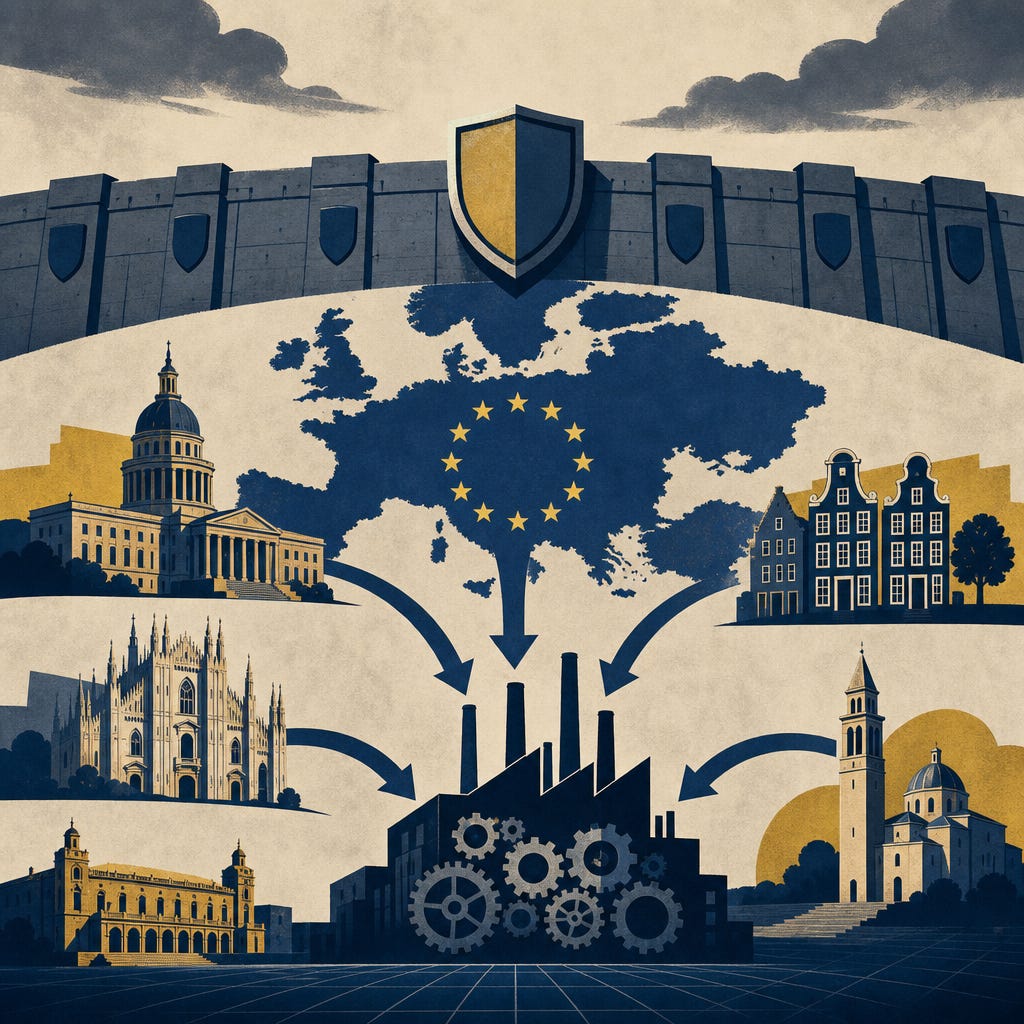
On 22 May, five governments — France, Italy, Spain, the Netherlands and Lithuania — sent the European Commission a non-paper asking Brussels to use tariffs more aggressively, open more investigations into unfair trade practices, and design new defensive instruments against China. The document, reported by Politico, lands four days before the College of Commissioners is due to hold an internal strategy debate on 29 May. In parallel, the Commission is preparing what officials describe as an "instrument of excess capacity" to cap imports of certain Chinese products. None of this is yet a decision. All of it is a direction. The direction is correct; the architecture behind it is not yet built, and the difference between the two is what will determine whether Europe is shifting from openness to autonomy or, more likely, to a more expensive form of dependence.
The coalition matters because of who is in it. France, Italy and Spain pressing for protection is the familiar configuration; the Netherlands joining is the rupture. Dutch trade preference has historically aligned with Berlin's — open markets, scepticism of defensive instruments, a presumption that the single market is leverage enough. Its presence on the non-paper isolates Germany inside the Council on a file Berlin used to set the terms of. Lithuania's signature adds a different weight: a small open economy that has spent the last six years on the receiving end of Chinese coercion, and that this week is also dealing with a leak of more than 600,000 entries from national registers which the prosecutor's office attributes to a foreign state. The linkage between trade exposure and security exposure no longer needs to be argued. It is being lived.
The institutional mechanism is narrower than the political noise suggests. Trade defence is an exclusive EU competence under Article 207 TFEU; member states cannot impose tariffs on their own. The non-paper is therefore not a decision but a pressure instrument aimed at the College's internal balance. The Commission alone proposes; the Council decides by qualified majority; the Parliament co-legislates. The five capitals do not have the formal power to compel a new instrument — they have the political weight to make it harder for Brussels to defer one. That weight is real, but it ends at the point where a proposal must survive a blocking minority in the Council and a coherent legal design at the Commission's legal service.
And the legal design is where the problem begins. The EU already has an unusually dense toolbox: the anti-dumping and anti-subsidy regulations, the Foreign Subsidies Regulation of 2022, the International Procurement Instrument, the Anti-Coercion Instrument adopted in 2023 and never once used. WTO trade-law specialists point out that "structural overcapacity" is not a recognised injury standard under GATT Article VI or the SCM Agreement, which require firm-level dumping or subsidy plus material injury. A standalone overcapacity instrument framed at the macro level would be an immediate target for dispute settlement — and the EU would defend it in a system whose Appellate Body Washington has paralysed. The question is therefore not whether Brussels adds another layer, but whether the new layer enforces anything the existing ones cannot.
The deeper objection comes from inside the German export bloc, and it deserves to be taken seriously rather than dismissed as commercial reflex. After the Commission's provisional countervailing duties on Chinese electric vehicles in 2024, Beijing opened anti-dumping investigations into European pork and brandy, targeting France and Spain with precision. Retaliation is sector-selective and politically calibrated. German auto and chemical exports to China remain a structural pillar of EU manufacturing employment. The argument from Berlin is not that Europe has nothing to defend; it is that Europe has production to lose, not just production to build, and that defensive tools must be sequenced against the cost of losing what already exists. Absorbing this concern does not weaken the case for action. It sharpens it: durable autonomy is a question of sequencing, not just of instruments.
The recurring European mistake is visible in the record. Anti-dumping duties on Chinese solar panels in 2013 did not repatriate solar manufacturing. Steel safeguards extended through 2018 and beyond did not halt the contraction of European steel capacity. The EV countervailing duties of 2024 were imposed on a market where the battery supply chain had already been lost. "Europeans can only successfully deal with the China problem when industrial protection and economic deterrence are combined into a comprehensive agenda," writes Tobias Gehrke (ECFR). The instrument arrives; the factory does not. The clean-tech case makes this sharpest: European module manufacturing remains a small fraction of installed demand, the Net-Zero Industry Act's 40% domestic benchmark for 2030 is not on the current investment trajectory, and tariffs imposed before capacity exists function as a tax on the green transition rather than a bridge to autonomy.
What the 29 May debate will reveal is whether the Commission has internalised this, or whether the excess-capacity instrument is being designed as the next reactive patch in a thirty-year sequence of reactive patches. Protection can buy time. It cannot manufacture capacity. The five capitals are right that the multilateral environment is gone and that the German argument for unconditional openness has expired. They will be wrong if they treat the non-paper as the answer rather than the prologue.
The tariff wall is the easy part. What sits behind it is the harder one.
Sources of truth consulted: 27
No posts
Comments
Nothing yet. Say the first thing.
Sign in to join the conversation.