
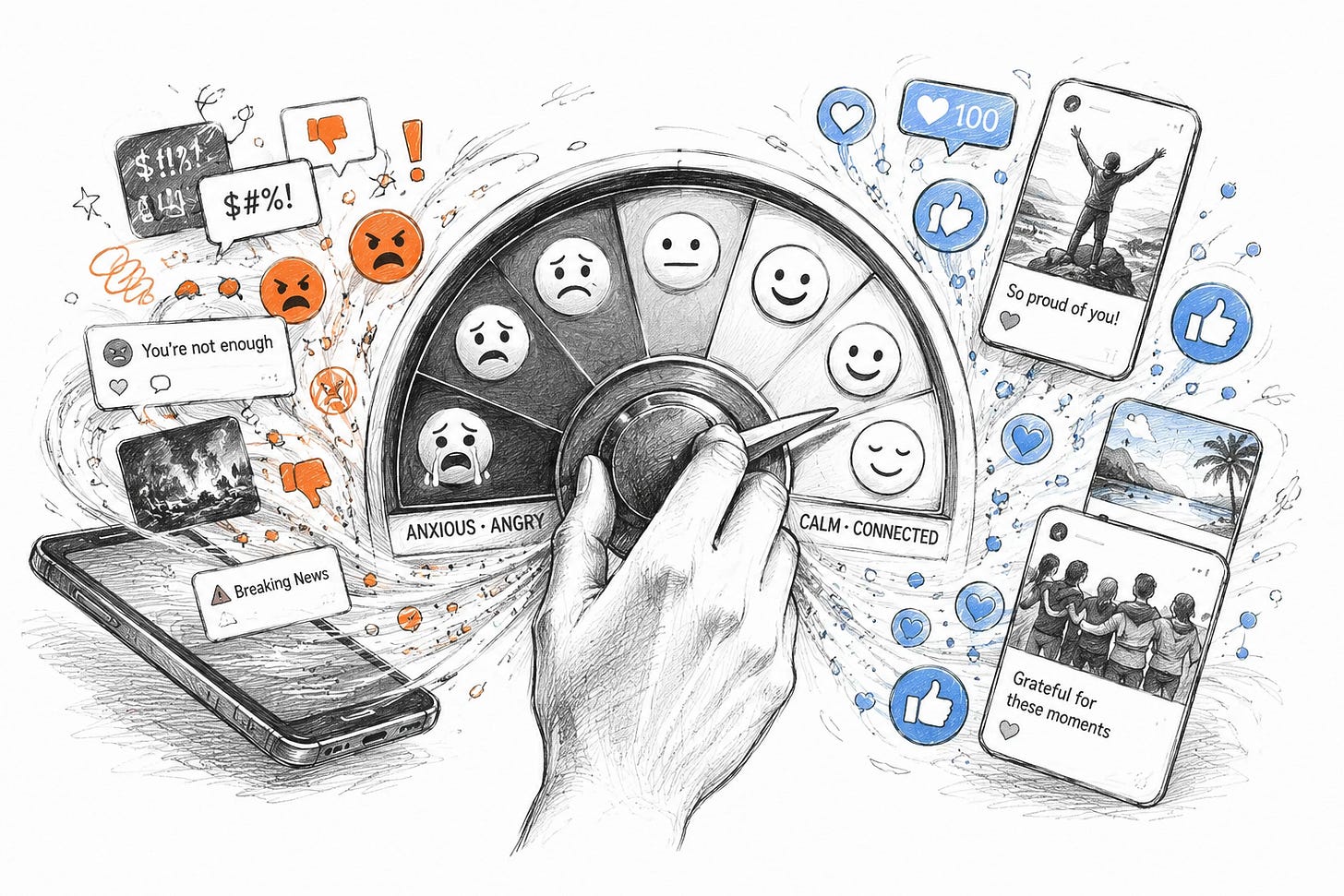
Imagine that somewhere inside your brain is a dial.
On one end: calm, connected, hopeful.
On the other: anxious, angry, inadequate, afraid.
Now imagine that every time you open Instagram, TikTok, Facebook, X, YouTube, or another feed, thousands of tiny hands get an opportunity to nudge that dial.
That is the idea behind the image above: your feed can shape your feelings.
This does not mean social media is inherently bad, nor does it mean an algorithm can simply “control” your emotions. Human psychology is far more complicated than that. But a growing body of research suggests that what we repeatedly see online can influence emotion, comparison, attention and well-being. (American Psychological Association)
And there is an important distinction here:
It isn’t only how long you scroll. It is what you are scrolling through.
Emotions can travel through a screen
One of the most famous demonstrations came from a large Facebook experiment involving hundreds of thousands of users.
Researchers slightly changed the amount of positive or negative emotional material appearing in people’s News Feeds. People exposed to relatively less positive material subsequently used slightly fewer positive words themselves; reducing negative material produced a corresponding shift in the other direction.
The individual effects were small, and the study generated substantial ethical controversy about consent. But scientifically, it offered evidence that emotional expression can spread through online networks even without face-to-face interaction. (PNAS)
In other words, emotion is not confined to the person who created the post.
You consume it.
You process it.
And sometimes you echo it.
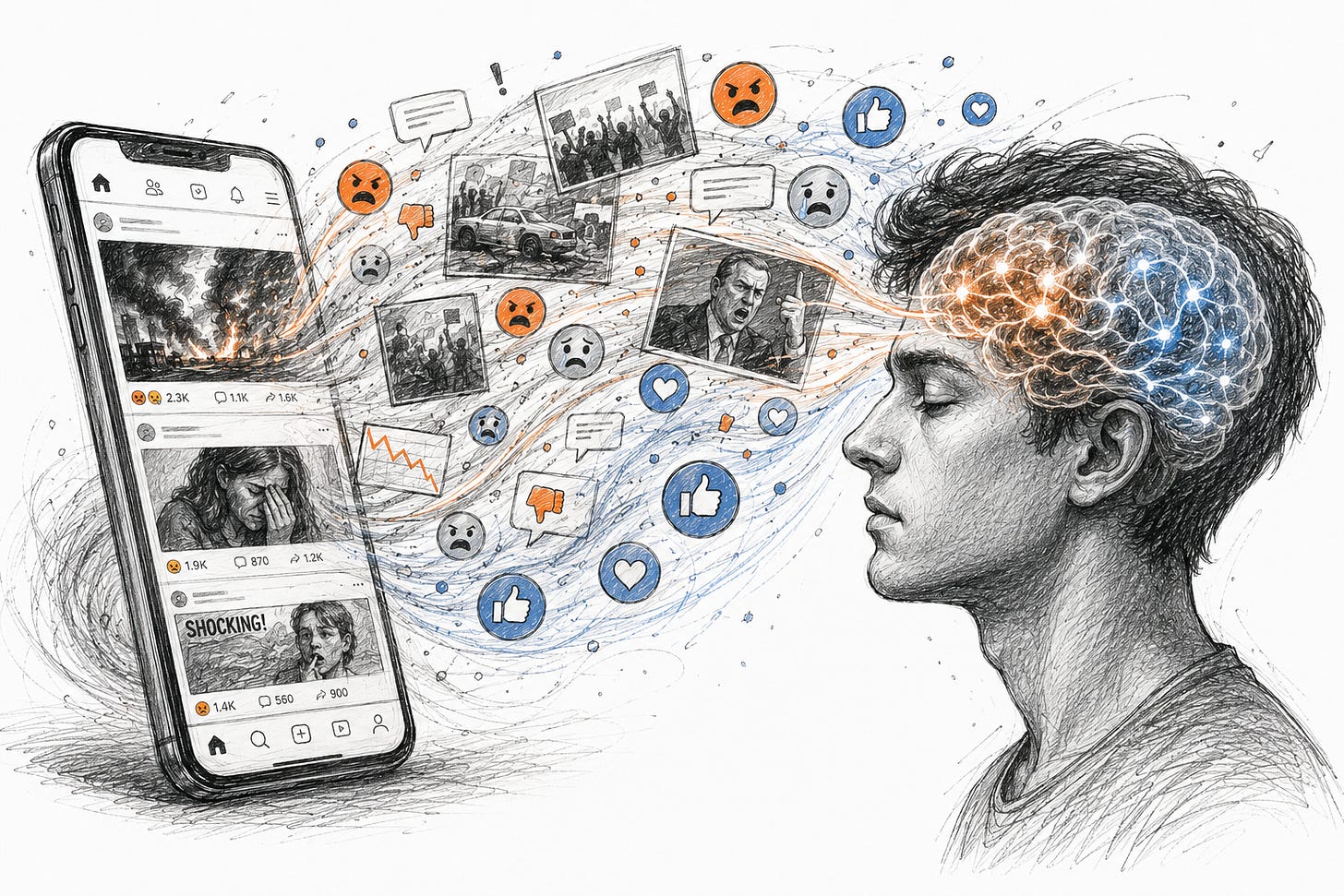
More recent work continues to find evidence of emotional contagion in online environments. A 2025 study examining social feedback and online emotional language found that peer interaction could exert a powerful influence over emotional expression. (Nature)
Think about what this means over hundreds of exposures a day.
One frightening headline probably will not determine your mood.
One angry comment probably will not either.
But twenty frightening headlines, fifty angry comments, three videos about catastrophe and a stream of strangers telling you that the world is collapsing?
Your nervous system does not experience those exposures as mathematical abstractions.
They become part of your environment.
Then comes comparison
There is another hand turning the dial: social comparison.
Humans have always compared themselves with other humans. Social media simply gives us an extraordinarily efficient machine for doing it.
The problem is that we often compare our ordinary lives with someone else’s edited highlights.
Their vacation.
Their body.
Their relationship.
Their career announcement.
Their perfect kitchen.
Their apparently perfect children.
Their 100,000 likes.
Research examining Instagram has found a bidirectional relationship between depressive symptoms and upward social comparison: people with more depressive symptoms may engage in more upward comparisons, while upward comparison itself can contribute to worsening depressive symptoms. (ScienceDirect)
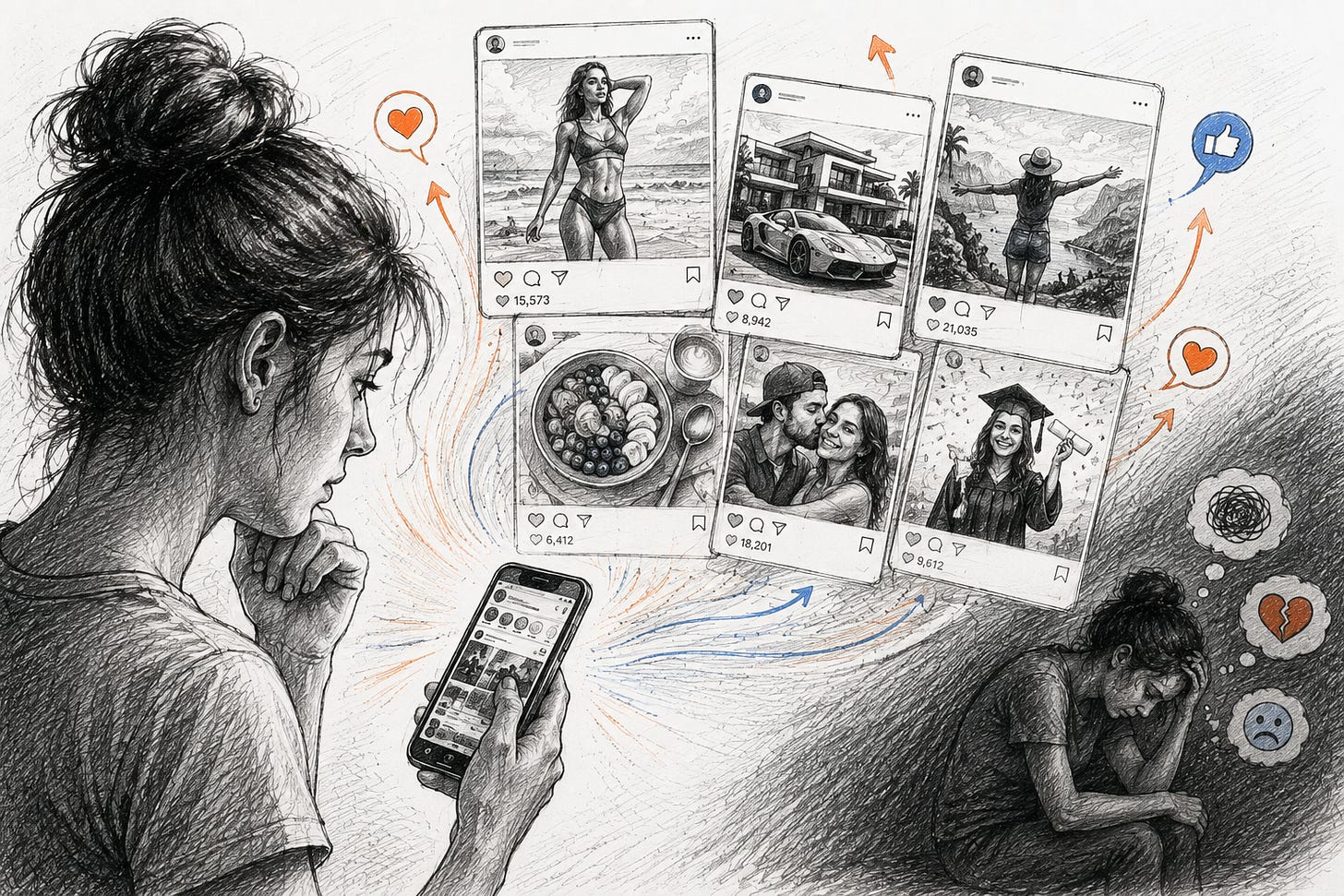
That creates a potentially nasty feedback loop:
Feel bad → scroll → compare → feel worse → scroll again.
The phone becomes both the source of discomfort and the place we instinctively return to for relief.
The feed doesn’t have to insult you to affect you
This is important.
The content does not have to say:
“You aren’t good enough.”
It can communicate the same idea indirectly.
You see a person with a seemingly perfect body.
Your brain supplies the comparison.
You see someone celebrating another achievement.
Your brain asks what you have accomplished.
You see a party you weren’t invited to.
Your brain notices exclusion.
You see a terrifying news story.
Your attention searches for the next threat.
And because scrolling makes the next stimulus immediately available, there may be very little natural stopping point between one emotional stimulus and the next.
Research on doomscrolling has linked the behavior with factors including fear of missing out, problematic social-media use and greater time spent on social platforms. These findings are largely associative, so they do not prove that doomscrolling alone causes a particular psychiatric disorder, but they reinforce the idea that repetitive negative consumption and psychological state can become intertwined. (PubMed Central (PMC)
What happens when we turn the volume down?
One way to test the relationship is surprisingly simple:
Reduce the exposure and see what happens.
In a randomized 2018 study, University of Pennsylvania researchers assigned participants either to continue using social media normally or to limit Facebook, Instagram and Snapchat to approximately 10 minutes per platform per day.
After three weeks, the limited-use group showed reductions in loneliness and depression compared with the control group. (Guilford Journals)
A separate large randomized experiment examined what happened when people deactivated Facebook for four weeks before the 2018 U.S. midterm election.
Facebook deactivation increased offline activity and produced small improvements in subjective well-being, although it also reduced people’s knowledge of current news. (American Economic Association)
That trade-off matters.
This is not an argument that everyone should abandon social media.
Social media can provide information, friendship, support, education, entertainment and communities that might otherwise never exist. The American Psychological Association specifically emphasizes that social media can produce both benefits and risks, particularly for younger users, depending on individual vulnerability, content and patterns of use. (American Psychological Association)
The goal isn’t necessarily no social media.
The goal is better control over the emotional environment you’re building around yourself.
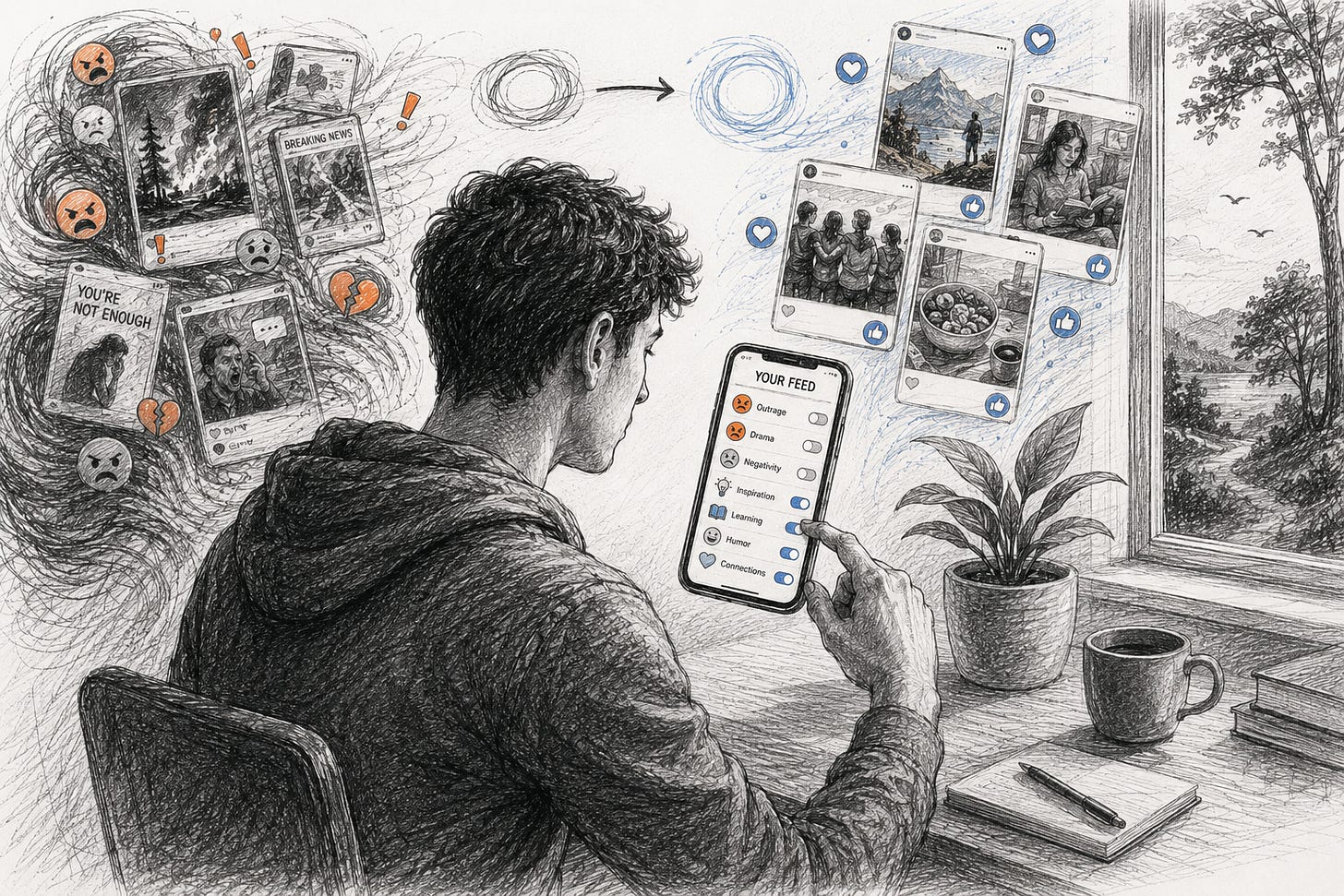
Train your feed instead of letting your feed train you
For one week, become unusually conscious of what happens immediately after you consume content.
Ask yourself:
Did that post make me calmer or more agitated?
Did I learn something—or did I simply become angry?
Did that account motivate me, or make me feel inadequate?
Am I following this person because the content improves my life, or because I cannot stop watching it?
When I put the phone down, do I feel better than when I picked it up?
Then act on the answers.
Unfollow accounts that repeatedly make you miserable.
Mute sources that manufacture outrage.
Stop repeatedly watching material simply because it frightens you.
Seek out people who teach, inspire, make you laugh, challenge you intelligently or connect you with people you actually care about.
And occasionally turn the entire thing off.
Because every click, watch, pause and scroll helps determine what you expose yourself to next.
Your attention is an input into your emotional environment.
We spend enormous amounts of energy thinking about what we eat.
We worry about pollutants in our water.
We think about what medications enter our bodies.
Perhaps we should become equally thoughtful about what we repeatedly put into our minds.
Your phone is not simply a window through which you observe the world.
For hours every week, it becomes part of the world your brain is experiencing.
Choose that world carefully.
Kramer ADI, Guillory JE, Hancock JT. Experimental evidence of massive-scale emotional contagion through social networks. Proceedings of the National Academy of Sciences. 2014;111(24):8788–8790. (PNAS)
Hunt MG, Marx R, Lipson C, Young J. No More FOMO: Limiting Social Media Decreases Loneliness and Depression. Journal of Social and Clinical Psychology. 2018;37(10):751–768. (Guilford Journals)
Allcott H, Braghieri L, Eichmeyer S, Gentzkow M. The Welfare Effects of Social Media. American Economic Review. 2020;110(3):629–676. (American Economic Association)
Aubry R, et al. Depressive symptoms and upward social comparisons on Instagram: Examining a reciprocal relationship. Personality and Individual Differences. 2024. (ScienceDirect)
Satici SA, et al. Doomscrolling Scale: Its Association with Personality Traits, Psychological Distress, Social Media Use, and Wellbeing. Applied Research in Quality of Life. 2022. (PubMed Central (PMC)
American Psychological Association. Health Advisory on Social Media Use in Adolescence. 2023. (American Psychological Association)
Luo Y, et al. Social feedback amplifies emotional language in online interaction. Communications Psychology. 2025. (Nature)
Whether you’re a parent, teacher, healthcare professional, student, or simply someone seeking a healthier relationship with technology, your voice matters. Share the message, and help protect the human brain in the digital age.
This essay is part of a larger conversation.
Watch and subscribe one YouTube for the biology behind PTSD, digital toxicity, and the modern mind.
No posts
Comments
Nothing yet. Say the first thing.
Sign in to join the conversation.