
Over 30-some years I’ve spent a lot of money and time investing, mostly as an angel investor. Because I followed the standard advice to spread the risk and distributed small amounts among a number of bets, my portfolio grew enough for me to continue and eventually prosper. Though I really had no way of predicting what would succeed financially, I discovered that I could (mostly) pick companies and founders that I could learn from. And because it was my own money (unlike during my 5 years working on Wall Street, long ago), I could afford to take chances on unusual opportunities or people without having to apologize to anyone for my mistakes. I also often had the chance to get more directly involved, either as a director or just informally, as a friend or advisor. In short, I’ve learned in addition to earning financial returns.
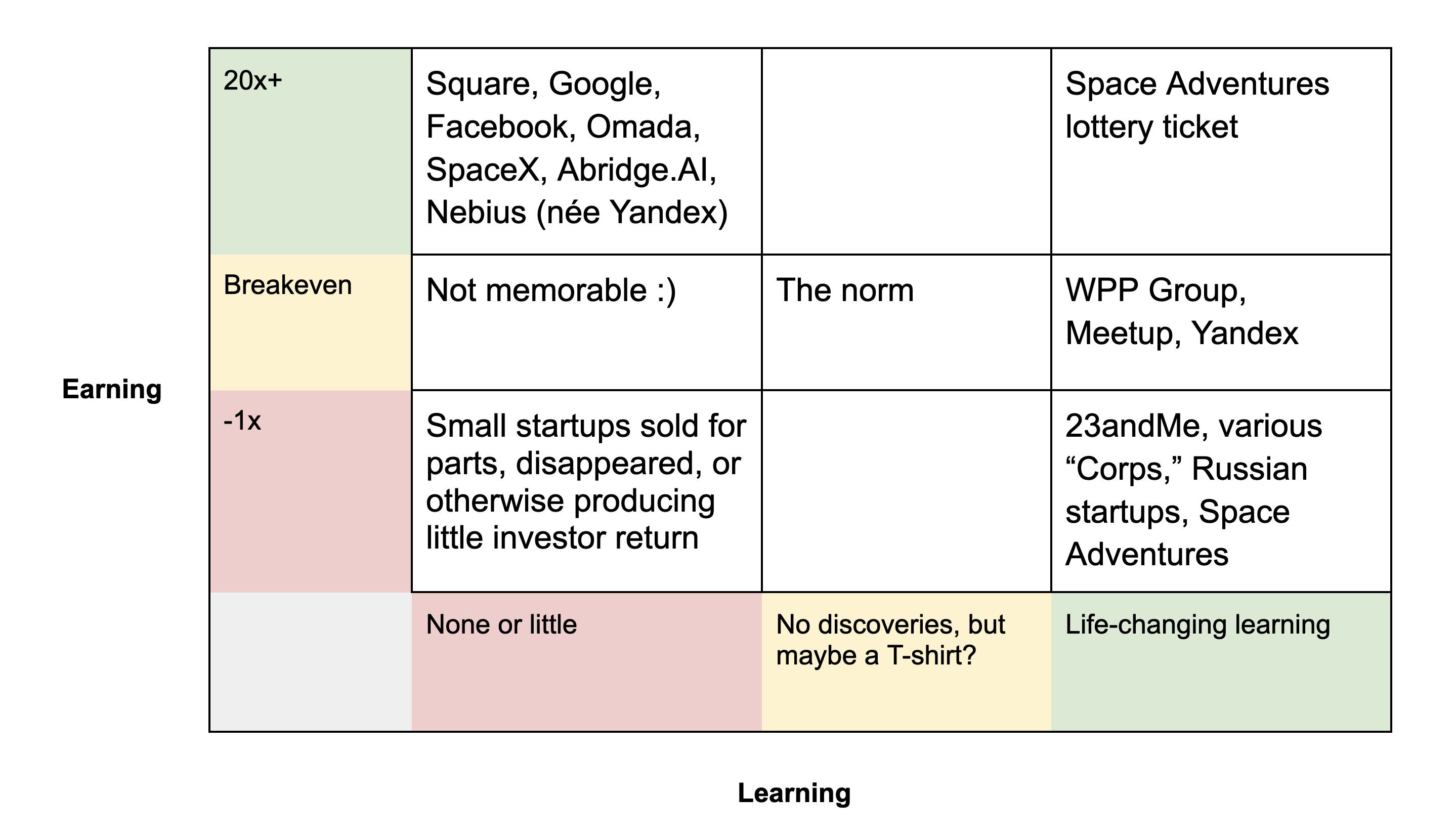
The chart below shows some key investments from which I learned or earned, but it also reflects a fundamental underlying pattern: At least for me, learning and “earning” (i.e. getting a financial return) are inversely correlated. Instead of the usual, up-and-to-the right, increasing-goodness of a typical quadrant chart, the trajectory of the chart below is down-and-to-the-right. It shows that usually, the less money I made, the more I learned - often from fixing (or even just observing) mistakes. Both benefits are life-changing, of course: The money has allowed me to continue to invest in new companies or nonprofits, ideas and people, but I’m just as satisfied when my “return” is learning something new. Perhaps that balance is the real value.
Here are some of the stories behind the boxes, which are purposely imprecise.
LOWER RIGHT: I’ll start with the low-earning/high-“learning return” experiences. For example, I invested in 23andMe and joined the board in 2007 because I knew I would learn a lot about genetics - which at that point was a new and speculative field. I had already had my entire genome sequenced courtesy of the Personal Genome Project, but no one really explained to me what the results meant. 23andMe had the mission of reaching a much broader public with clear messaging, and ultimately building a robust dataset of both genetics and so-called real-world evidence (RWE) that could support medical research and find good targets for new or even old, re-purposable drugs. To do that honorably, we had to win regulatory approval for what the FDA considered medical advice - i.e. intelligible explanations of the data. We learned a lot when our general counsel left and the board did not pick up the slack and respond to the FDA’s complaints about various issues. After we finally made amends and started working closely with the FDA, I realized that however pointless some of its requirements, the agency (and regulation in general) was actually protecting us from less scrupulous competitors - at least in those days!
Meanwhile, in 2018 the company made a deal with GSK for drug development research. I left shortly after that in 2019, as the company upgraded its board and brought in more pharma expertise. But in retrospect that deal was a mistake: It was a joint venture in which each side would own half, but each side would also pay half, even though GSK - with revenues around $40B - was 200 times our size and had profits, while we had no corresponding earnings to support our side of the deal long-term. For 23andMe that deal was part of our future: Huge benefits to humanity from drug discovery using what would be the largest genetics-plus-RWE database in the world.
We missed the reality that for us, this was our mission; for our counterpart GSK, it was just one project among many. In 2023, as the biotech funding market collapsed and GSK faced stalling revenues, 23andMe couldn’t afford to continue its 50 percent contributions, and so it stopped contributing its share and would receive only royalties. Beware of misaligned motivations and resources! (This message might be useful for some companies contemplating partnerships with AI hyperscalers right now!)
But the underlying idea makes sense: Use the aggregated, unidentified data to discover genetic associations with diseases/conditions or responses to new drugs, and to understand how the biology works - or could be fixed with new or re-purposed drugs. That is proceeding; for example, the new 23andMe Research Institute recently published a paper in Nature identifying genetic predictors for GLP-1 weight loss efficacy and side effects for certain GLP-1 drugs.
From outside, I have followed the company’s trajectory into bankruptcy and beyond…into what is now a nonprofit acquired and run by 23andMe founder Anne Wojcicki that I hope can continue to carry on with its mission. One more clear learning: It’s really hard for a mission-driven company to survive in a profit-driven world. Thank you Anne for taking it forward!
Another great learning experience came from what I’ll call “Corporation X” (why be unkind?), a space startup that taught me something about space, but also about founders who refuse to let go. Through this company I got to visit a lot of interesting space facilities, try out some amazing flight simulators, and understand the intricacies of space travel from the ground up - even though I have not yet experienced them from LEO (low-earth orbit) down. However, once the founder’s ideas had gained traction, the company needed someone better equipped to run a company; brilliant engineers are often not the best managers. The company ended up going bankrupt, courtesy of that over-controlling founding CEO and a divided board.
And then there was Corp Y, where I learned how to address that problem. This one also had a tech CEO/founder who deserved veneration for founding the company, but didn’t have the management skills to run it. No one on the board - a bunch of techies - was willing to tell him so, and I rashly volunteered. It was really awkward. I didn’t know what to say, so I just told him the truth: “You’re amazing; you started this thing. We want you to be happy. But we think you’d be happier and more effective with someone else doing the boring part, so that you can continue to be smart and amazing.” After a few conversations like this he was smart enough to grasp the truth. We kept reassuring him that we loved him and loved the company. Thus I learned the value of telling the truth, even - or especially - when it’s hard. And it takes follow-up after a single step to remove a stuck-in-place founder and keep them on for the rest of their talents.
Then there was Corp Z - where a new CEO kept claiming he was the founder, and the rest of the board refused to challenge this un-truth. I did - and the CEO pre-emptively handed me a letter accepting my offer to resign. I signed it; the other directors were silent, and I had no interest in staying. A year or so later one of the directors approached me at an event and said he wished they had listened to me. Here I learned that there are some battles you cannot win as the only dissenter, and that it’s probably better to leave early than too late. I also learned to pay attention to the best way to spend - or invest - my time.
These “Corp” stories were not unique experiences, and if you think you know which companies they represent, rest assured that there are several possibilities for most of them. Through them, and quite a few more, I learned the basics of corporate governance and the necessary transition from founders, who make all the decisions and carry them out, to leaders who guide discussions, build consensus and delegate to a team who collectively know more than a single founder/CEO ever could. (And no, that team cannot be replaced by AI - especially not for the task of telling the CEO when they are wrong.)
CENTER BOX: The center box, with average learning and average returns, was a large part of my investing life - and of most people’s lives in many pursuits. If you spread the risk you can make a decent return, if you avoid the worst failures. But this was where I neither earned much nor learned much.
UPPER LEFT: These are the noteworthy financial winners that helped me offset the losses of my “learnings” and achieve or even beat the overall positive statistics of risk-spreading in venture capital (among 100+ bets overall).
Most relevant and interesting right now, I invested in SpaceX through an intermediary (like so many people, but much earlier than most). Though I can’t exactly figure out how much I own (let alone its valuation) because the intermediary thing is complicated, it was early enough that I’m pretty sure I’ll be a big financial winner - with luck a few million, though not trillions (LOL). Through this I got to meet Elon Musk a few times, but I had nothing to do with his success - however you define it! Likewise, I acquired early shares in Google and Facebook, through investments with funds such as Kleiner Perkins.
There were several more where I invested early directly with the founders as a small angel - Omada Health, Abridge.AI and Square - but they grew rapidly without any need for my help, so I neither contributed to their success nor learned a lot. But thank you, nonetheless!
LOWER LEFT: Here are the no-surprises negative outcomes: Invest a little, lose a little, but no real outliers. Fortunately, you cannot lose more than you invested - as long as you don’t try any clever tricks!
CENTER RIGHT: These companies helped me learn for free: a very small amount of money invested - mostly offset by director’s fees, options or office space - plus a lot of time. They also stand out because I was actively engaged with each for years (you do need to invest time as well as money in order to learn): WPP Group, Yandex and Meetup. I joined the board of WPP Group back in 1999, when it was basically just a few friends of the founder. At the first board meeting I showed up wearing my usual Silicon Valley uniform of blue jeans and T-shirt (though at least no hoodie); as I recall, the others all wore ties. This was my first serious board, and I learned a lot. I watched the company transform from a small, founder-mode concern to a larger, more bureaucratic outfit focused on the corporation rather than the whims of the leader. As the company grew, the board transformed as well: from that small group of friends into a formal affair, with committees, lawyers…and the usual tension. I was lucky to leave at the end of 2013, before things got really ugly with the awkward departure of de-facto founder Sir Martin Sorrell. One of the biggest things I learned is that term limits are a good thing - both for me and for Sir Martin. The world we started in had changed, and there were other ways and places for us to be useful.
I also learned a lot about the rest of the world from my perch at WPP. Suddenly I was on all kinds of invitation lists, and attended interesting events outside the tech world that I knew so well. We had six board meetings a year, typically a couple each in London and New York City, and one or two others in interesting places, with employees to meet and local dignitaries and customers to impress. Among those I remember best: Silicon Valley and Moscow (I felt like the host in both places!); Dubai; Cape Town, South Africa; Château Touffou (a castle in France near Poitiers); Cannes, France, for the annual June advertising week; Greece, Thailand and Indonesia for WPP’s ad-customer-centric Stream events; and a private tour of WPP customer De Beers’ main diamond mine in Botswana (where you get searched at the exit). Then there was the upstairs/downstairs experience at the London Olympics in 2012, which I later wrote about for LinkedIn. Best of all was that almost anywhere I went, I could find a local WPPer to introduce me to the local culture and give me a sense of what was going on locally. Over the years, I met country managers for Russia, Sweden, India, Russia and so many other places. While I didn’t make much money on the stock, the experiences and the education were priceless.
Then there are my Russian experiences, from 1989 to 2022. I got to know the country and especially its tech world intimately as an investor in and member of the board of Yandex (known as the Google of Russia). I also invested in a number of other Russian startups - solidly in the middle or lower-left quadrants - each with its own story reflecting Russia’s unique adaptation of mostly-corrupt communism into idealistic capitalism under a still-corrupt government. In the early 2020s, after spending some time contemplating Yandex’s transformation into a vehicle for Russian propaganda, I finally submitted my resignation at a meeting in Moscow the week before Russia invaded Ukraine, when the “special military operation” was still just rumors. (It took a couple of weeks for the resignation to be formalized with legal paperwork, but in retrospect I’m still proud of that date.) Meanwhile, the stock got frozen, and though it had appreciated, I had never sold a share.
Finally, there was Meetup, where I sat not only on the board but in the office for most of 2007 until 2019, about a year after it was acquired by WeWork. I saw up close - and once again - the challenges of a for-profit company devoted to serving a mission. For 23andMe the mission was (broadly) science; at Meetup it was community cohesion - and avoiding at least one board member’s wish to turn the company into a more lucrative dating service. From my seat on the board, I benefited from working alongside an amazing group of people dedicated not just to supporting communities of all kinds, but to training people on how to organize and sustain those communities. (That’s not something you get in the average high school, unfortunately.) At a certain point it needed further funding, so it sold itself to WeWork; sadly, it is now just one of many meeting-planner services.
LOWER RIGHT: This is the rest of the story of Yandex: The non-Russian part of Yandex got miraculously transformed into Nebius, based in Amsterdam. (Most such things in Russia happen in the passive voice, the result of unseen forces…) It resumed trading on the NASDAQ in October 2024 and is now one of the hottest AI stocks around. Someday I’ll go into the story in detail, but for now, just know I stayed on the board briefly before I resigned (due to Dutch governance requirements) - though I kept and still have all my Nebius (née Yandex) stock.
There’s one final story that has made all of this possible: Space Adventures, a small private company where I was a small investor. Its business was basically as a tour operator for trips on the Russian Soyuz spacecraft to the International Space Station. While NASA refused to let untrained people (except for a senator or two) fly into space, the Russian response was “Verrry deefficult….!!” followed by “How much?” For a few tens of millions, Space Adventures could arrange it. That was way beyond my financial capacity, but they kept inviting me to train as a backup…you never know! Finally, I decided to say yes, and for just a few million I got the chance to live and train as a backup in Star City for half a year, from September 2008 to March 2009. The lottery ticket of flying to the space station did not pay off, but I did get exactly what I had bargained for: training in space medicine and space plumbing, and a true immersion in Soviet Russia. Though things had changed dramatically since I first went to Russia in 1989, Star City was still a Soviet-style government facility; I needed a “propusk” - a government pass - to go in and out. As an American, I could not get a map; one of my worst days was when I could not find my classroom in one of the many nondescript buildings and arrived half an hour late. (Of course, the CIA knows the layout intimately, but that was not the point.) I would not volunteer to spend six months like that again, but I am so glad I did it once. Whenever I watch a space travel movie, it feels familiar enough that I have to remind myself I have not actually been up there. Some day - but not too soon! - I would definitely like to use my stock market winnings to retire on Mars.
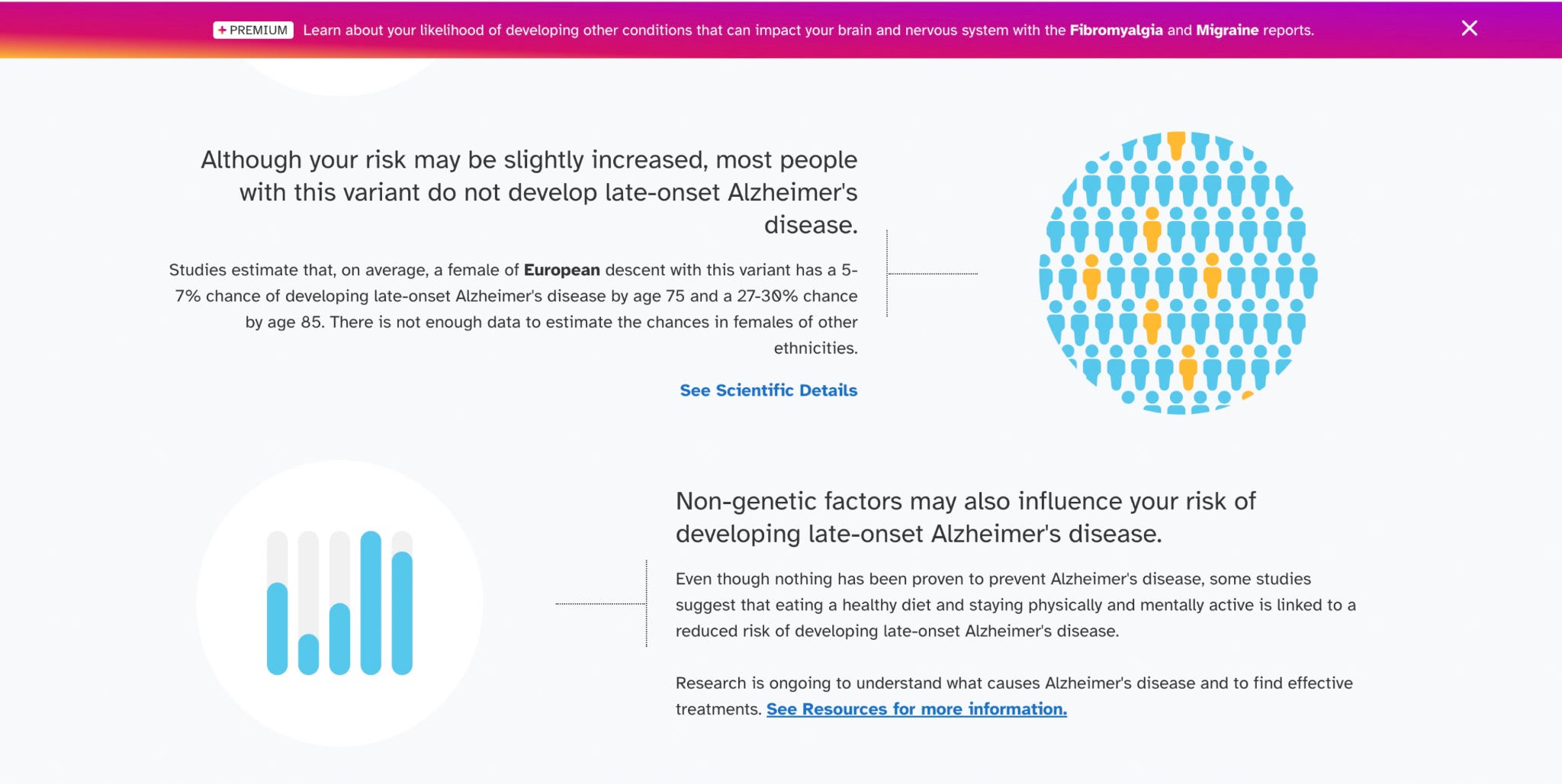
UPPER RIGHT: But wait: One more thing! A totally different lottery ticket from Space Adventures actually did pay off. It’s really bad PR for someone to die on a space tour, so the Russians and Space Adventures together had every part of me inspected carefully, including a Russian-style endoscopy with valium only, plus a pleasantly anaesthetized confirmation courtesy of the Johnson Space Center. They found Barrett’s Esophagus, a precursor to cancer of the esophagus. No immediate danger, but after my return from Star City I followed medical advice and got checked regularly; in 2016, my US doctors found that I had stage 1 esophageal cancer. Stage 1 is easy to treat but is rarely discovered; without that space adventure, I probably would have died a few years ago.
That story reveals the most meaningful thing I learned from all these experiences - the 3rd-dimension Z axis of this chart, reflected but not visible: the importance of luck. In this case, I was lucky to earn a return of immeasurable value - some unknowable number of extra years of life. Indeed, I now focus on investing as spending on something or someone I believe in and believe I can learn from… but knowing that there may also be a lottery ticket attached. This explains the outlier from inverse correlation that you see in the upper right - where I paid a lot to learn a lot but got that return much later…through sheer luck.
No posts
Comments
Nothing yet. Say the first thing.
Sign in to join the conversation.