
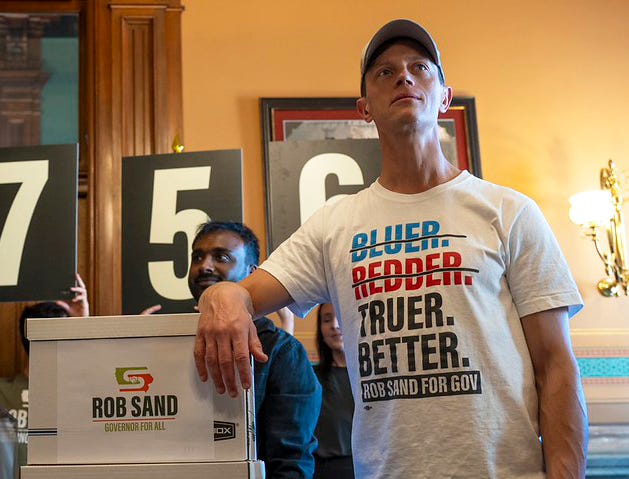
I first heard about approval voting more than a year ago, from my friend Rob Sand. A former independent who registered as a Democrat in college to vote in a Democratic primary, Sand is now running for governor of Iowa and campaigning broadly to all comers. At town hall meetings he hosts throughout Iowa, he routinely asks those present to raise their hands in sequence if they are a Republican, Democrat, or independent - with applause for each. Then someone leads the crowd in singing the first verse of America the Beautiful. He wears a wonderful T-shirt emblazoned with
“Not bluer
Or redder,
But truer
And better.”
Read these words and smile…and then weep! We are so far from that ideal. How can we fix the country’s (and even the world’s) polarization? This challenge faces us while both US parties are engaged in an escalating re-districting war that will silence the voices of each state’s out-groups, instead of encouraging all voices to band together and flourish. This gerrymandering is structural change in the wrong direction.
What is the right direction? Sand’s campaign might offer a clue. He is appealing directly to all voters - not just to Democrats but also to Republican and non-partisan voters - with the message that we have a lot more that unites us than divides us. He says he’s loyal to Iowa rather than to the Democratic party, and part of his message to voters is about the need for structural change in elections: The current two-choice electoral system, he says, has led to a decade of one-party rule that has left Iowa families behind. In short, he’s running as if the rules of approval voting already applied.
To describe approval voting, let’s start with some context, beyond the current, rightful fuss about re-districting (which is further eroding trust in the whole system). The current rules assume a good side and a bad side - usually defined by two powerful political parties - and ask where voters and candidates sit based on that single dimension.
But the real world of people’s voting preferences is closer to complex, unique-to-them decision matrices - like the table below, with the factors and the way the voter assesses them unique to each voter. Approval voting recognizes this complexity, and is structured to find the single candidate that the most voters - each with their own decision matrix - approve of. It’s like a Doodle poll for candidates (vs. time slots): “Which of these candidates (or time slots) would work for you? Pick all that meet your criteria - whether only one, or two, or even most of them.” The candidate “approved” by the most voters gets the role.
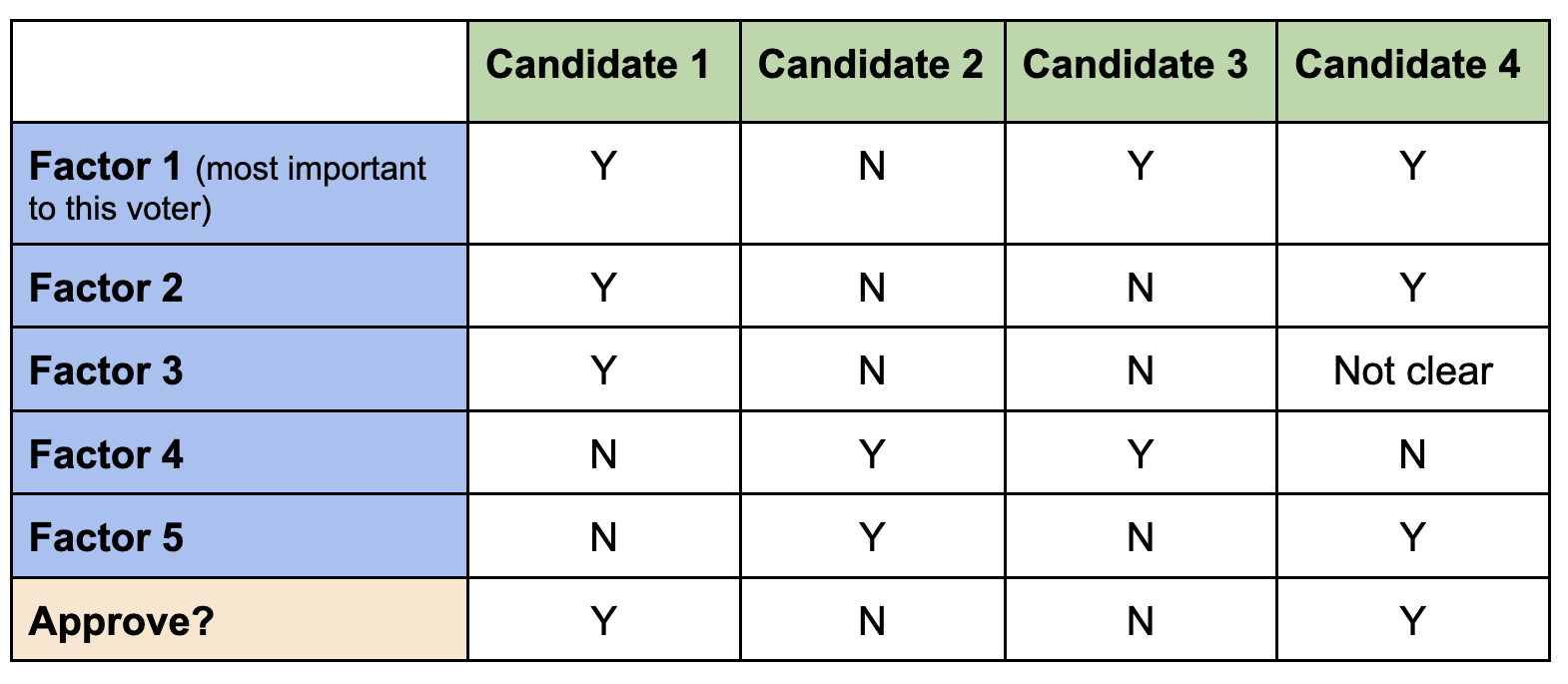
For an individual voter, one factor might trigger approval of a candidate automatically… or an automatic rejection. But the more candidates a voter approves of, the more likely they are to help get one of their approvable candidates elected.
The process is akin to ranked-choice voting, but much simpler and more likely to earn voter trust: Each approval vote for a candidate has equal weight, making things easier to explain and to implement, without multiple rounds or complex calculations for either voters or election officials. Your approval vote for a candidate carries weight; your failure to approve of others is silent, for better or worse. In short, the system rewards both candidates and voters who compromise, and ignores the rest.
All this process underlies a fundamental issue: Politics in general - and voting in particular - shouldn’t be just about who gets a seat. It should be about how they compete, how they earn favor, whom they pay attention to - both during the election and afterwards. It’s about returning to a focus on policies and services, not promotions and surfaces (another clever rhyme!). It’s about building a coalition, not destroying opposition. In short, it’s about culture and the rules public servants should operate by….
This is the spirit animating Sand. He is firmly focused on Iowa, and so he should be: underfunded public schools (partially due to $8K vouchers for private schools), rampant corruption, and Republican one-party rule over a Democratic minority and silenced independents. His approach seems to be working: Sand leads all candidates in a recent statewide poll (conducted by a Democratic outfit) and has a reasonable chance of coming out ahead in the general election as a de-facto independent candidate. Enough Republicans and independents - some privately and some publicly - have indicated their willingness to support him in the general election, in effect registering their disapproval of most of the Republican slate.
In response to my question about a broader future, he replies: “I want copycats! It’s not just about me and Iowa. Other states have to elect people like me [i.e. coalition builders] for themselves…Of course, right now that’s most likely in the middle of the country, not on the coasts”…
For now, approval voting can work at the state or local level; it’d be too complex (dealing with the electoral college, for example) to implement in federal elections right now. But my hope is that approval voting would lead to other, broader changes. First, the path to getting elected would not be to excite the most fanatic, extreme followers, but rather to reach out and meet the basic requirements of the largest number of voters. The overall pitches would be more positive, vs. bruising battles that push people to extreme positions and to demonize anyone who disagrees. Second, the approval process would incentivize candidates to appeal to - and ultimately serve - the greatest possible share of the population, rather than to stake out an extremist position on a single good-bad line.
The idea is not to use approval voting to find candidates for each party, but to use approval voting to make elections run for the people rather than by the parties, empowering the entire population rather than filtering candidates through the tight funnel of party approval - or through gerrymandered districts designed for the same purpose. (Note that even when term limits exist, they apply only to people; there are no term limits on the parties, which tend to focus more and more on their own self-perpetuation.)
At its best, approval voting makes people feel that their leaders value their opinions and voices, not just their votes or party affiliation. Sand’s town halls are a great model: They are not sales pitches; they are listening sessions.
But most important of all, approval voting surfaces leaders who aim not to rule but to serve the people. A role as governor, or president, or town crier, is not a prize or even an honor, but a duty to fulfill - an obligation.
Just as the obsession with money is ruining our businesses, leading to enshittification (H/T Cory Doctorow), so are the rewards and incentives of our electoral system contributing to the enshittification of our political system and the culture it produces. You could call approval voting an honorable business model for politics: address the largest TAM (Total Available Market) instead of a tiny, fanatic niche that gets you territory no one else wants. And focus on satisfaction and retention, not customer acquisition!
If implemented in a number of states, approval voting could improve political culture locally and prepare both candidates and voters for its expansion to federal elections. Consider the wisdom of U.S. Supreme Court Justice Louis Brandeis who said in a dissent in New State Ice Co. v. Liebmann in 1932: “...a single courageous State may, if its citizens choose, serve as a laboratory; and try novel social and economic experiments without risk to the rest of the country.”
What will produce broad approval of approval voting? Beyond Sand’s hope to bring it to Iowa, it has been tried in a few places, including Fargo, ND (2020), and St. Louis, MO (2024). Both of these experiments…well, they were learning experiences more than amazing successes - more or less shut down by the party leadership in North Dakota, and continuing in St. Louis - but only for primaries, not the final elections.
But generally, the idea makes sense - and now it has a powerful advocate. Many voters in the country yearn for a focus on policies over parties; indeed, both major parties are coming apart at the seams. Gallup reports that over the last 30 years the number of adults who identify as independent has soared, reaching a new high of 45 percent in 2025, up from the low 30s in 1990. Meanwhile, Democrats and Republicans are evenly matched at 27 percent.
In the current environment, any fix would be welcome; a larger number of people who feel they had a positive say in the outcome of an election has got to be a good thing, as would a system that helps good candidates prevail and avoid getting corrupted/mangled by it once they get elected.
Approval voting would help the system attract more people like Rob Sand and fewer like… well, the whole point is that I’m not going to name names. I’m encouraging more people to follow Sand’s lead. And yes, I have donated to him and his broader cause, even though I am a New Yorker.
Spoiler reveal - You may or may not have noticed, but I carefully wrote this whole post without using the word “win.” No, I don’t delude myself that we can totally eliminate it from politics, but I would still prefer to see it relegated to sports, gambling and TV contests. For more information on approval voting, see https://electionscience.org/ and https://ballotpedia.org/Approval_voting. For more on political trends, https://news.gallup.com/poll/700499/new-high-identify-political-independents.aspx. And for more on Rob Sand, https://robsand.com/issues/accountability-for-all/.
No posts
Comments
Nothing yet. Say the first thing.
Sign in to join the conversation.