
When I visited Vienna last month, I expected to eat my body weight in schnitzel, walk, and admire its museums. What I didn’t expect was the romance built into this city. And in experiencing it, I realized how we’re losing our ability to see the world through our own eyes because of having access to pixels on demand thanks to our phones.
Upper Belvedere is a landmark Viennese museum famous for its collection of Gustav Klimt’s paintings. Upon arriving at the stunning museum, I explored the halls until I finally arrived at the Klimt collection. There, I was met with a crowd of people, phones in the air, taking turns to capture a photo of the paintings.
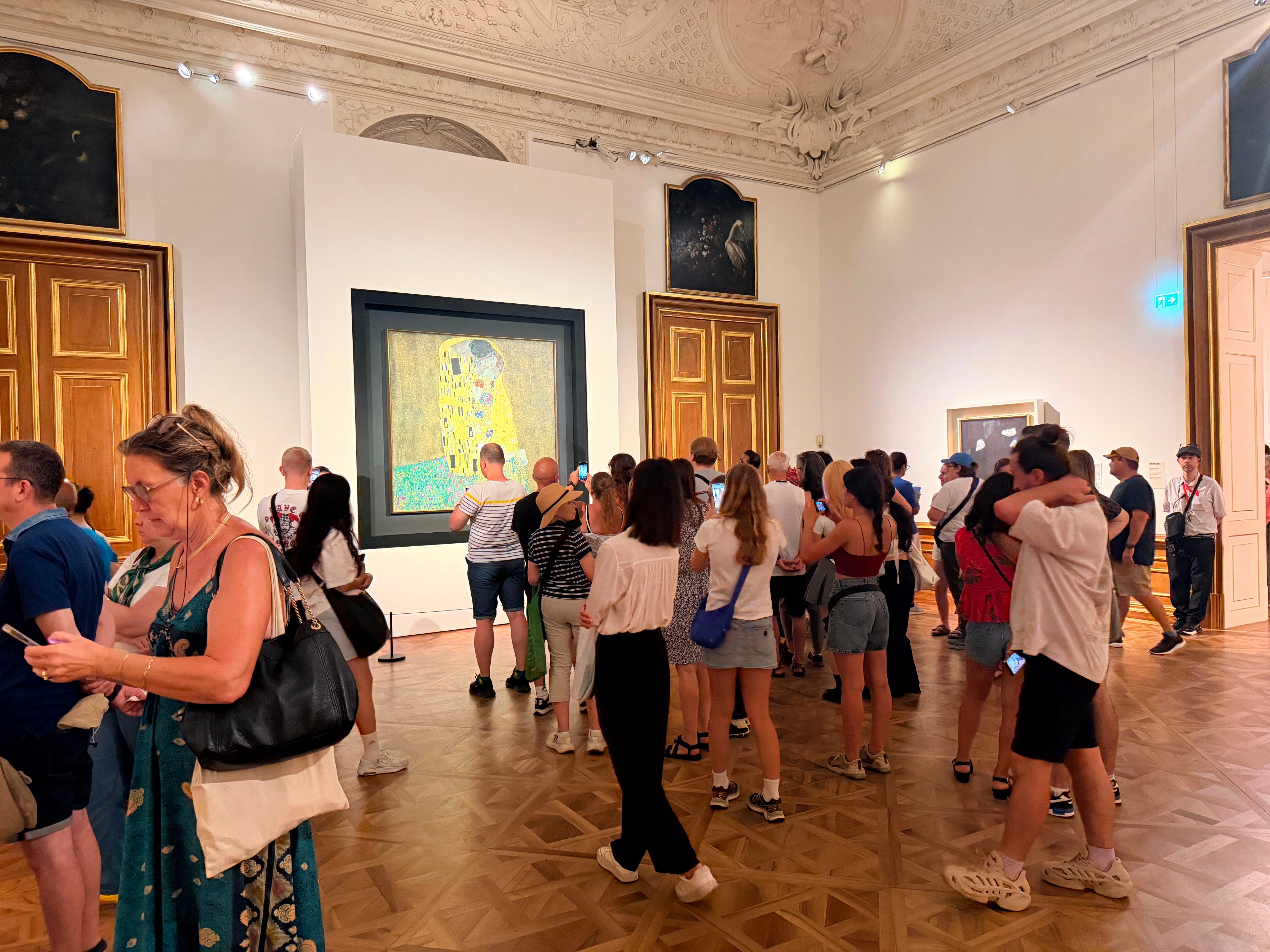
Like those around me, my first instinct was to whip out my phone to snap a picture. I had journeyed thousands of miles and now this painting was in front of me — I needed to remember it and have something to post on my Instagram story. Then I heard a mother beside me chide her teenage son, telling him to get off his phone and look at this painting in front of them. Without skipping a beat or looking up from his phone, he said:
“I already have it on my phone.”
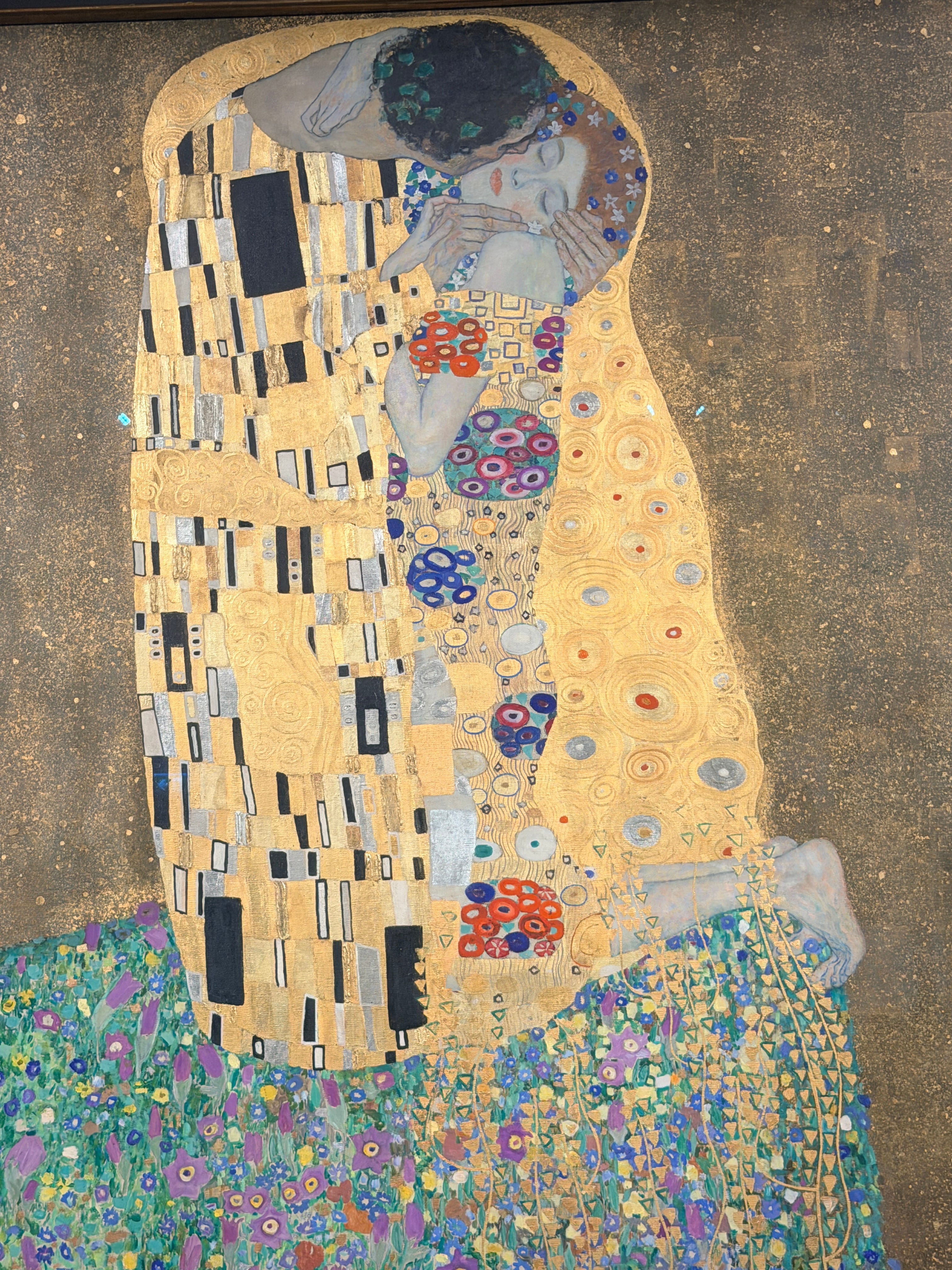
He’s right: The Kiss is available online. As long as you have internet access, you can see it whenever you want even in high resolution. I’d argue that feeling of easy access distorts the power of seeing the real thing. In person, you see the piece as the artist intended it, the culmination of the painstaking time spent drawing, revising, and applying gold leaf to turn canvas into a story that has transcended time.
As I put my own phone down to think about that comment — I already “have” it, I thought about how our digital age can give us access to replicas and how that abundance in access has altered our ability to see the artistry that can and will shape our future. I thought about how our environments can shape our interest and view on the power of the arts. If a picture is worth a thousand words, a painting’s essence cannot be contained by them. I’ve seen this painting before on my phone and thought it was fine. In person, I had the same feeling of “THIS is why we have art” that I experienced seeing Michelangelo’s David in Florence a few years back.
The Kiss makes you feel the power and universality of falling in love as Klimt captured the energy of two intertwined lovers falling over one another in love, their flowing glittering attire folding into one ethereal robe. The man, focused on his love, shuns the viewer to focus on his lover. Up close, you see the gold leaf-laden canvas. You can see the sparkle from the florals and the verdant fields cushioning the lovers in their embrace. As you stroll through the gallery, you notice how the sunlight and the viewing angle alter what glistens and glows. To see it in person is an experience that can never be replaced by mere pixels. Even within the room, where you stood and how the lighting was configured could alter how you felt soaking in the light and gold of the painting. It’s no wonder this centennial work captivates audiences to this day, inspiring people to come from everywhere to be in its presence. Despite my best efforts, my phone could not and would never be able to capture the sensation and love pouring from that image sitting feet from it in Vienna.
When it finally came time to wave these lovers farewell and continue my museum visit, I couldn’t get that remark out of my mind:
“I already have it.”
What does it mean to ‘have’ something when technology has made the world’s art and information accessible almost anywhere? When that teen blithely remarked he had it on his phone, he was saying it is not important for him to look at this painting right now. He could come back to it whenever he wanted thanks to technology. Technologists have brought the world’s information to within a few taps. That’s incredible, but it’s altered our ability to appreciate our present. Sure, you can look up this painting on your phone. Will you?
As a technologist, computer science grad, and frequent AI user, I’ve created technology to help women in emerging markets feel safe on social media, built tools to help students across schools connect over coffee, cultivated friendships around the world, and built platforms to help artists reach new audiences through the internet. The idea that any painting could be a few taps away sounded ludicrous half a century ago; technology has broken down silos and unleashed human history and creativity. You can have almost the entirety of the world’s knowledge in a click, you can download books to an e-reader and have thousands in your pocket. And most of all, for over a billion of us, we have a miniature computer in the form of a smartphone in our pocket or purse that with a few taps can give us whatever we want.
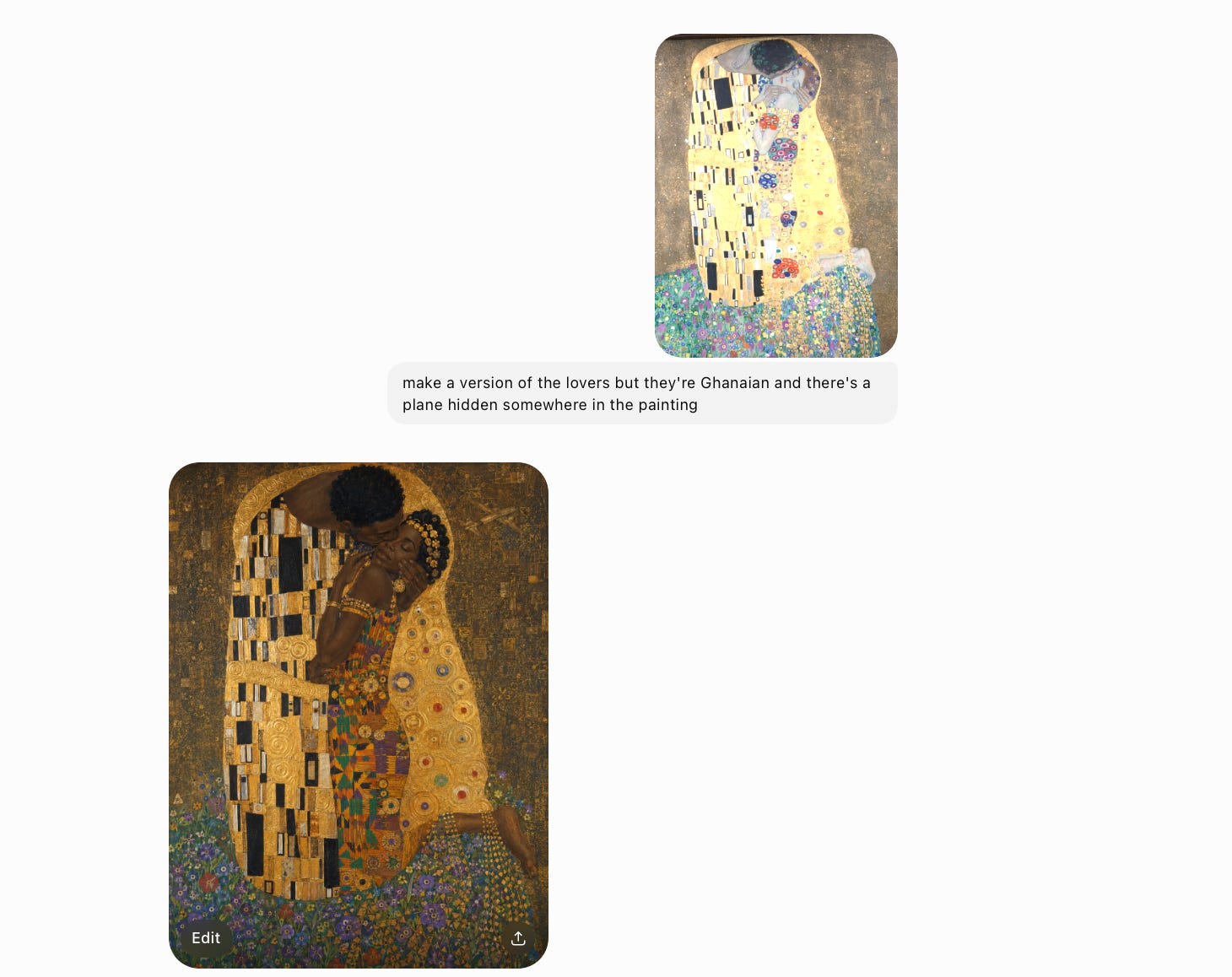
In the age of AI, we now must reckon with the collapse of craft when we can go from seeing a piece in a few taps to creating pieces with a sentence. Before, making a painting required years of training and rigorous practice. Now? I can screenshot a Klimt painting and throw it into an AI assistant with the modifications I want and get a result back in seconds and turn the art into whatever I want it to be, scrubbed of the original context and artistic message.
If you have a question, you don’t need to read a book. Ask an AI assistant about the topic and it’ll probably answer the question you had citing the book in seconds. Heck, I used AI to help create my own font recently, something that before would’ve required arduous practice, labor, and iteration (or hiring an expert) to get right. I have art generation in my pocket. I did not have to dive into the complexities of typography or learning from experts since AI could abstract the complexities away. Any question I have or anything I’m thinking about I can use AI now and have an answer. What does it do to us when creation no longer requires effort? Good things come to those who wait, unless you have an LLM, in which case they come in seconds.
Art tells us stories of past, present, and future. Klimt famously faced rejection and criticism in Austria for a series of paintings the public viewed as “pornographic.” Those same pieces today would at best be described as showing the human body or love. But records of this art and the reactions to it allow the work to inspire future artists while bearing witness to our societal evolution. The process and context in creating The Kiss are central to its identity, something that is lost in computer-generated art that is devoid of this context and history.
Technologists, especially in the AI space, are further pushing us away from appreciating the moment and artistry by feeding our desire for immediacy. The newest tools encourage us to smooth over the complicated histories, edits, and mistakes that make something art in favor of typing to hear and receive exactly what we want. As we see AI reshape our society and where we invest, have we as technologists become so enamored with applying technology to solve problems that we’ve forgotten our humanity?
Why did Vienna and Klimt fill my mind with romance? Standing in the Belvedere, I imagined the world when The Kiss was first exhibited, the people who saw it and went to tell their friends with no phone to show them a picture, just their words and emotions describing how the piece made them feel. There was an experience in accepting that for just a moment, you would be in community with other patrons taking it in, seeing the details, and experiencing two lovers come together on a canvas. I imagined the year Klimt spent creating this piece and how he had to sweat the details to turn a feeling into a reality millions have since experienced. Throughout Vienna, I saw physical manifestations of love everywhere, from the Albertina, whose founding couple shared a love for one another and for art, to the city’s architecture that has endured for centuries.
When history looks on this moment when the AI servers and GPUs we built have become obsolete and gone quiet, the office buildings where AI workers toiled 12-hour days, six days a week, to create these tools have shuttered, and the AI assistants of today have given way to the next great thing, what will we have to show? I can have Klimt or any remix of it now in seconds thanks to AI, but that doesn’t bring me any closer to understanding the craft required to create the art my descendants will view in the decades and centuries to come. I can generate a version of The Kiss by typing a sentence. That doesn’t mean I’ve created anything like The Kiss.
No posts
Comments
Nothing yet. Say the first thing.
Sign in to join the conversation.