
We have a theory at Esses that people want beautifully composed storytelling where every detail is thought through and argued over. Let me tell you: it’s not cheap or streamlined or optimized for ROI. But it creates beautiful, lasting work that connects with readers.
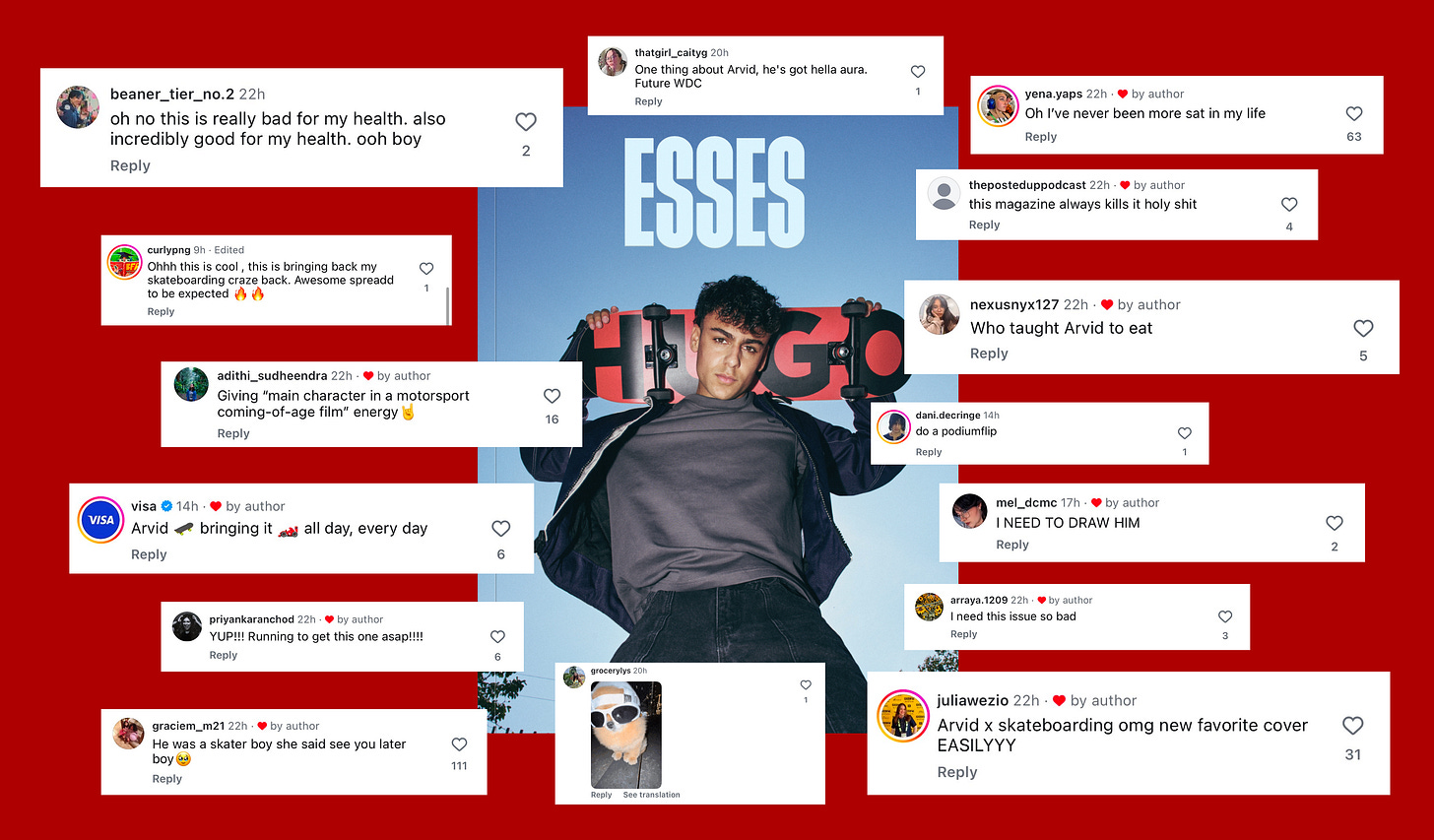
For our Arvid Lindblad cover shoot, about 5,000 emails and Slacks and WhatsApp messages were sent. Every aspect, from lighting to locations to wardrobe to angles, was considered. And then Esses founder Ojus Jain and I flew to Tokyo for right around 24 hours each to make sure everything went perfect. You’ll be the judge of that when you get Issue 06 in your hands at the end of the month, but, in this editor’s opinion, the cover story, the shoot, and the design are some of the best work we’ve done.
This week, we revealed our Issue 06 cover: the VCARB rising star atop a quarter-pipe at a skatepark in Tokyo. It’s a beauty and the response has been so fun to track.
One thing that stuck with me during my conversation with Lindblad in Tokyo was how excited the 18-year-old was to have a few days to explore a city he’d never visited as a tourist. The racing on track is interesting, but the global reach of F1 makes it something more than a sport. What other league touches five continents and has diehard fans from Australia to Austria, Shanghai to São Paulo?
In recent years, the fandom in Mexico has been steadily rising. Esses regular Alan Chazaro, who now lives in Xalapa, took a trip out to Mexico City to visit the globe-trotting Formula 1 Exhibit, which will be at Yama Punta Museo near Frida Kahlo’s Casa Azul through the end of the month. Alan has long been fascinated by his adopted country’s fandom; what he saw in Coyoacán, months before any race weekend, convinced him that CDMX’s love for F1 is here to stay.
All the way out in Coyoacán, Mexican fans are flocking to celebrate Formula 1.
By Alan Chazaro
Upon first glance, it might not seem like the Formula 1 Exhibition — the globetrotting Formula 1 showcase that originally premiered in Madrid, Spain, in 2023 — is in the proper location.
The GPS will send you to a mixed-use residential building and shopping center in a relatively sleepy part of Coyoacán, one of Mexico City’s southernmost neighborhoods. With a charmingly small town feel, it’s mostly known as being the site of Frida Kahlo’s home-turned-museum, Casa Azul. It’s not where you’d think to go for a luxury sporting event.
And yet, once you arrive, you’ll see it: hordes of Mexican motorsports fans wearing Ferrari jackets, McLaren hats, and Red Bull racing shirts, all lingering with a swirl of excitement, taking selfies in their matching gear, and chismeando about the latest pole positions. It’s in that moment that you’ll know, for certain, that F1 truly has no borders.
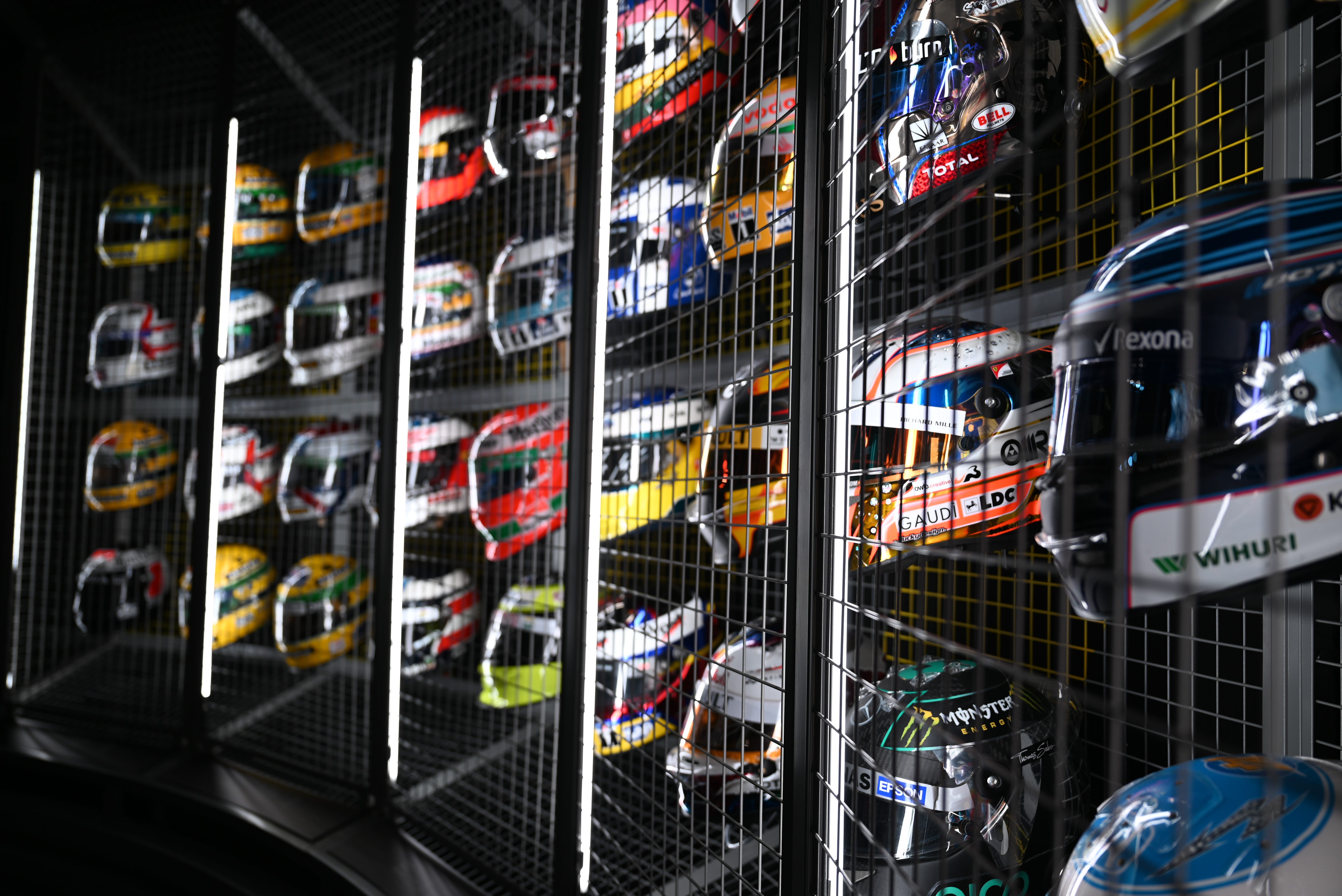
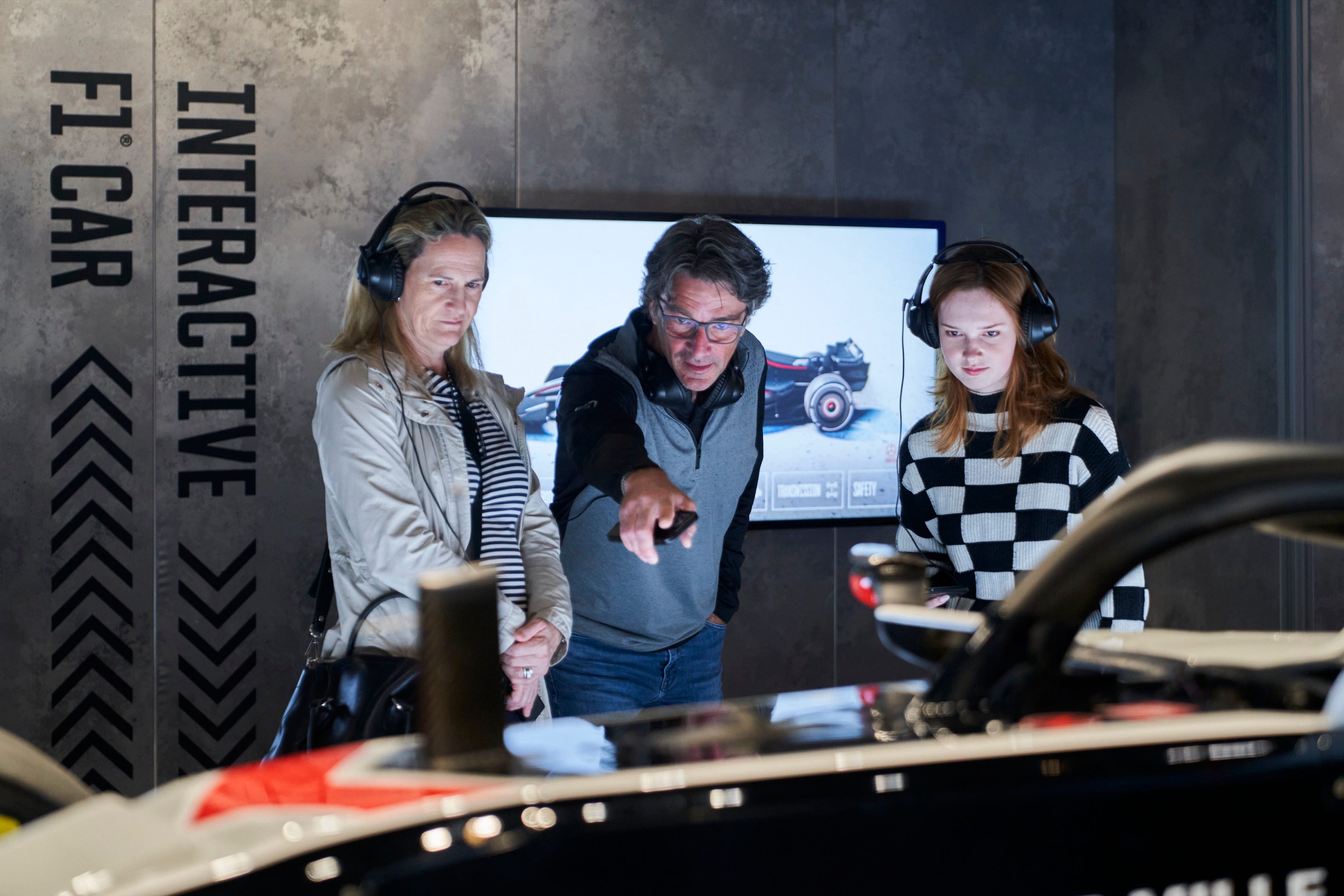
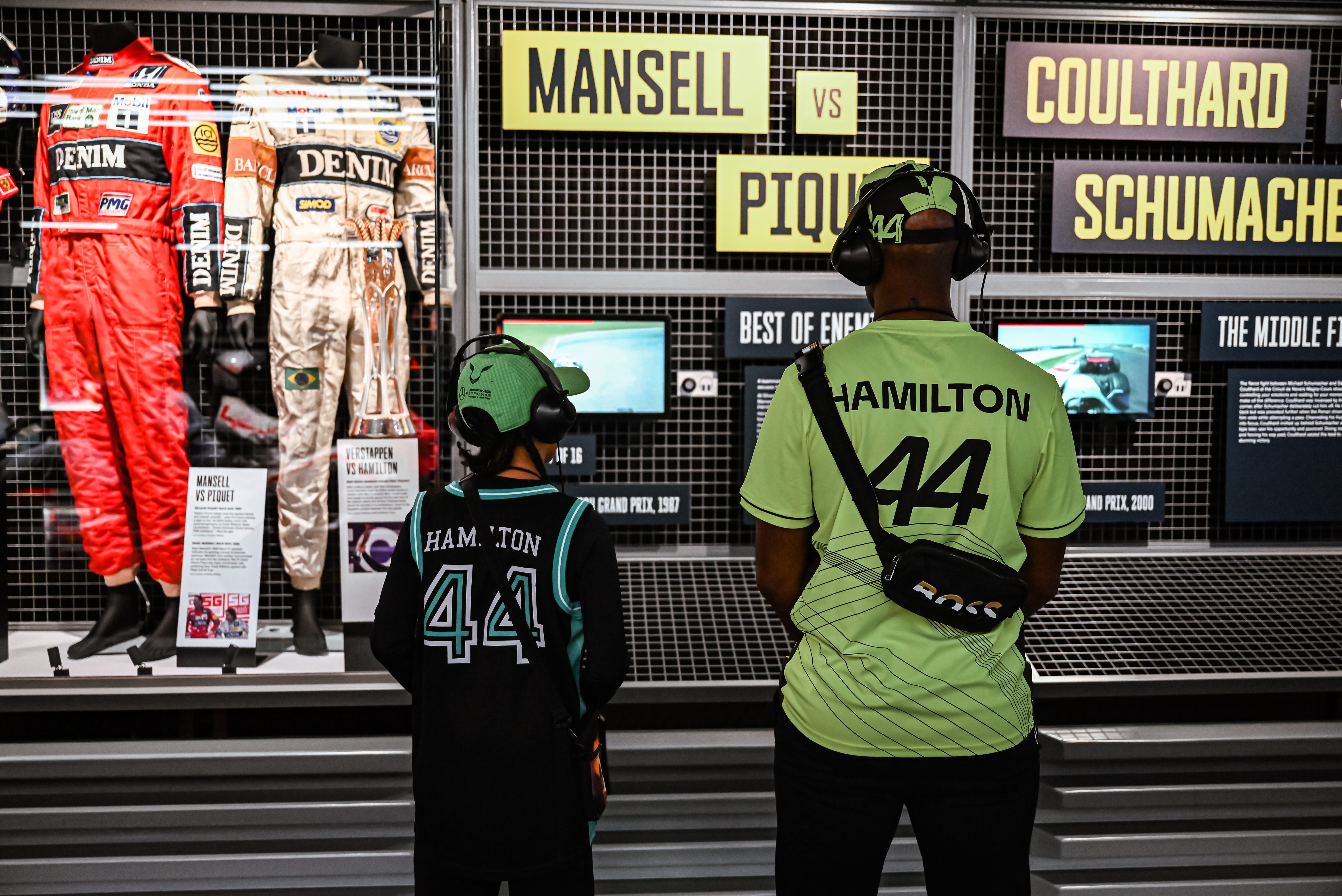
With more than 21,000 square feet of galleries, rooms, and walkthroughs, the Spanish-language F1 Exhibition provides more than enough zing for fans of all ages and backgrounds. The immersive experience includes driving simulators, galleries that display crucial elements of F1’s complexities (the way engine cooling systems function, the cultural analysis of diversity in the sport, and much more), and rare memorabilia. Ever wanted to design your own F1 helmet, or have wondered about how carbon fiber became modified for vehicles that can top out at over 200 miles per hour? It’s all there.
But here’s the thing: as Latin American F1 loyalists are flooding into Coyoacán months ahead of the Mexico City GP, the road to get there has been longer and at times more aching than contemporary fans might recall.
The sport has a storied history in Mexico, dating back to 1962, when F1 introduced the Aztec nation as a potential racing destination with a non-championship event at Magdalena Mixhuca Circuit. The track was later renamed to Autódromo Hermanos Rodríguez, in honor of the brothers Ricardo and Pedro Rodríguez, two of the most heralded Mexican racers of all-time.
During the ’60s and ’70s, the Rodríguez siblings helped to establish Mexico’s global stature on the F1 stage, having both competed in the racing series with notable triumphs. Ricardo became the youngest Ferrari driver ever at the time, and Pedro was a pilot with Cooper-Maserati and British Racing Motors. It was Pedro who became the first Mexican racer to claim victories in F1, with first-place finishes at the 1967 South African GP and the 1970 Belgian GP.
Those highs were marred by lows, though. Tragically, prior to the F1 exhibition in ’62, the younger Rodríguez brother died at just 20 years old during a high impact collision with the barrier while making a practice turn in his hometown racing debut.
As a cloud of mourning loomed over Mexican motorsports fans, F1 doubled down: In 1963, the first World Championship Mexican Grand Prix was inaugurated, in which British driver Jim Clark was the victor. The Mexican GP would go on for another seven years, before fan safety concerns, rowdiness, and a stray dog wandering onto the race track — which the British racing legend Sir Jackie Stewart couldn’t avoid at top speeds — resulted in the track’s removal from Formula 1 in 1970. Sadly, in 1971, the elder Rodríguez sibling would lose his life behind the wheel while competing in Norisring, Germany.

In the wake of the deaths, Mexico’s passion for F1 became muted. During a 16-year hiatus, F1 would go elsewhere, and Mexico’s racing profile in the open-wheeled circuits was virtually non-existent.
You wouldn’t know that today.
“While soccer remains the most popular sport in Mexico, Formula 1 has gained significant ground, largely due to the success of our national representative [Checo Pérez], but also thanks to the sport’s natural growth,” says Alejandra Villegas, a Mexico City reporter whose coverage highlights popular culture and lifestyle trends in the city of 25 million. She notes F1 as one of the fastest growing segments of fandom and sports culture in Mexico’s metro capital.
Villegas began watching F1 in the early 1990s, when her father first introduced her to it. Back then, despite lacking a Mexican national pilot in the series, she rallied behind Scuderia Ferrari and Michael Schumacher. Around then, F1 began to broadcast their events on Mexican television with more regularity, allowing her generation to experience the stylish glamour and competitive ferocity for themselves, and stoking the possibility for Mexico’s fandom to reignite. F1 briefly revisited Mexico City from 1986 to 1992 as part of their championship tour, but would again exit, leaving Mexican fans without a live F1 event of their own for another 16 years.
In 2011, F1 experienced the first wave of its new-age Mexican renaissance: Guadalajara’s Checo Pérez appeared with Sauber at the Australian GP. He had already drummed up interest in the prior season, when he signed as a member of the Ferrari Driver Academy after his runner-up finish in the GP2 Series, and speedily rose to become a fan favorite. Shortly after, in 2013, Esteban Gutiérrez would also launch his career at the Australian GP under Sauber’s banner.
“I became passionate about F1 again when Checo and Esteban arrived in the sport, and even more so during Pérez’s stints at Force India, Racing Point, and Red Bull,” says Villegas. “There is a clear ‘before and after’ when it comes to Checo Pérez. In Mexico, Checo’s story has had a massive impact. There was a surge of interest in racing, in Checo himself, and in the Mexican Grand Prix. Enthusiasm has kept soaring among both fans and brands alike, and from a commercial standpoint, it has become something truly monumental.”
Outside of Checo and Esteban’s ascension, Mexico City would gain another monumental victory in 2015, when the Mexico City GP was fully re-introduced, renamed, and revamped. In preparation for its anticipated return, F1 enlisted German engineer, racer, and course designer Hermann Tilke to modify the formerly dormant Autódromo Hermanos Rodríguez. Tilke would trim the circuit’s length and speeds for safety, reconfiguring the track’s notoriously high-speed Peraltada corner, a banked 180-degree turn which had taken the life of Ricardo Rodríguez in ’62 and was long seen as a lethal hazard.
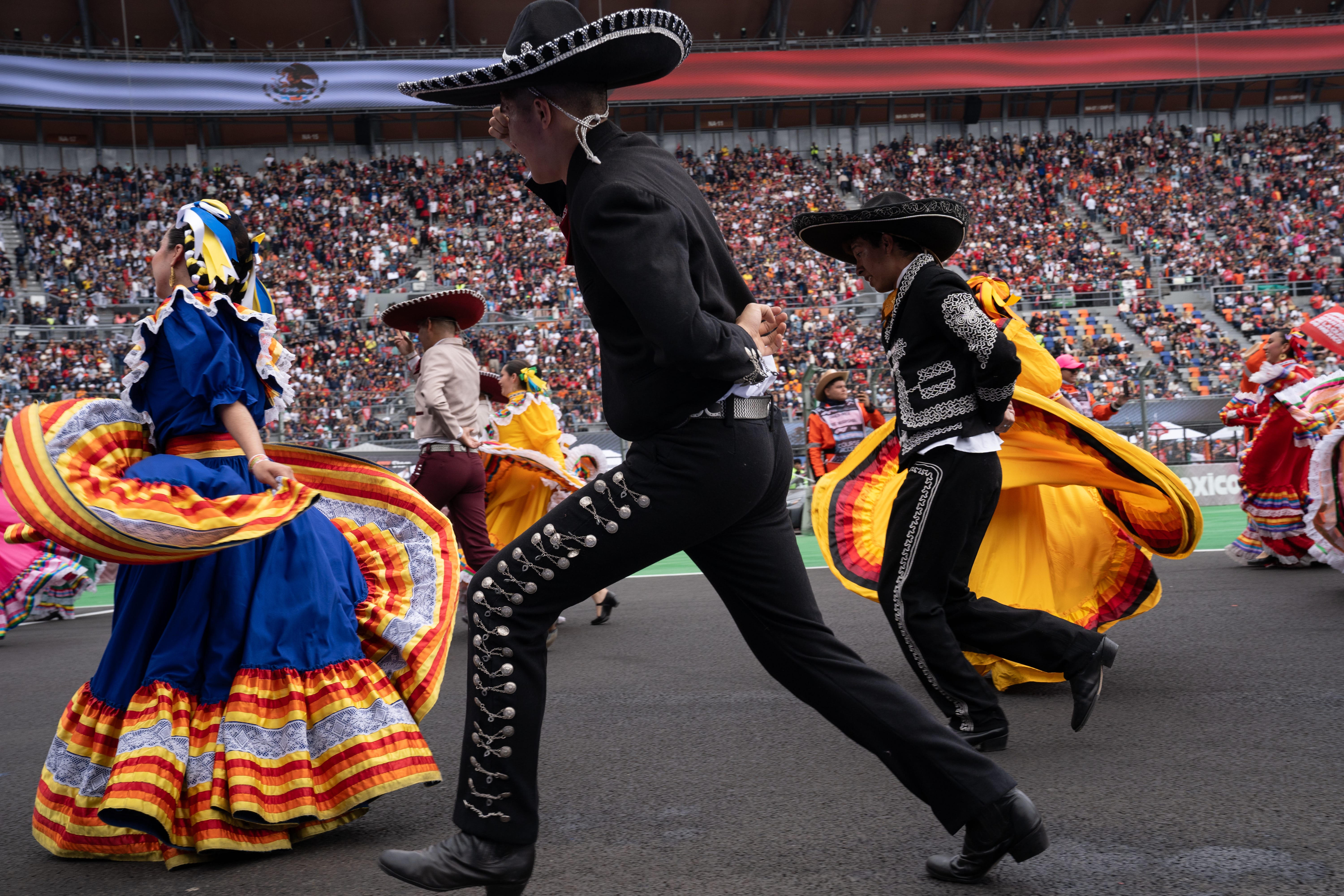
When the Mexico City GP returned on Dia de Muertos weekend 2015, the race was accompanied by a literal parade of cultural festivities. That has become part of the draw of the GP, which regularly ranks among the most watched and attended F1 events. Since 2021, Mexico City GP has eclipsed 350,000 attendants for five consecutive calendars, topping out at 404,958 in 2024.
In a post-Rodríguez world, Mexico’s relationship with F1 has slowly healed; now, it has completely outgrown itself. For Villegas, it has all been the result of an alignment in the racing cosmos, largely mapped by Checo’s time with Red Bull Racing — whom he piloted for from 2021 to 2024 next to four-time World Champion Max Verstappen — as well as the boost that followed from the international Drive to Survive phenomenon in 2019.
Having attended a handful of Mexico City GPs in the past decade, Villegas confirms the burgeoning sport’s importance in local circles, particularly as a mainstream business that generates its own micro economy.
“I recall that during the early years of the Mexican Grand Prix, press activities were few and far between,” Villegas says. “For several years now, however, that entire week has been packed with engagements involving drivers and teams, as well as public events, all of which demonstrate that this is a profitable sport that continues to grow and captivate more people every day.”
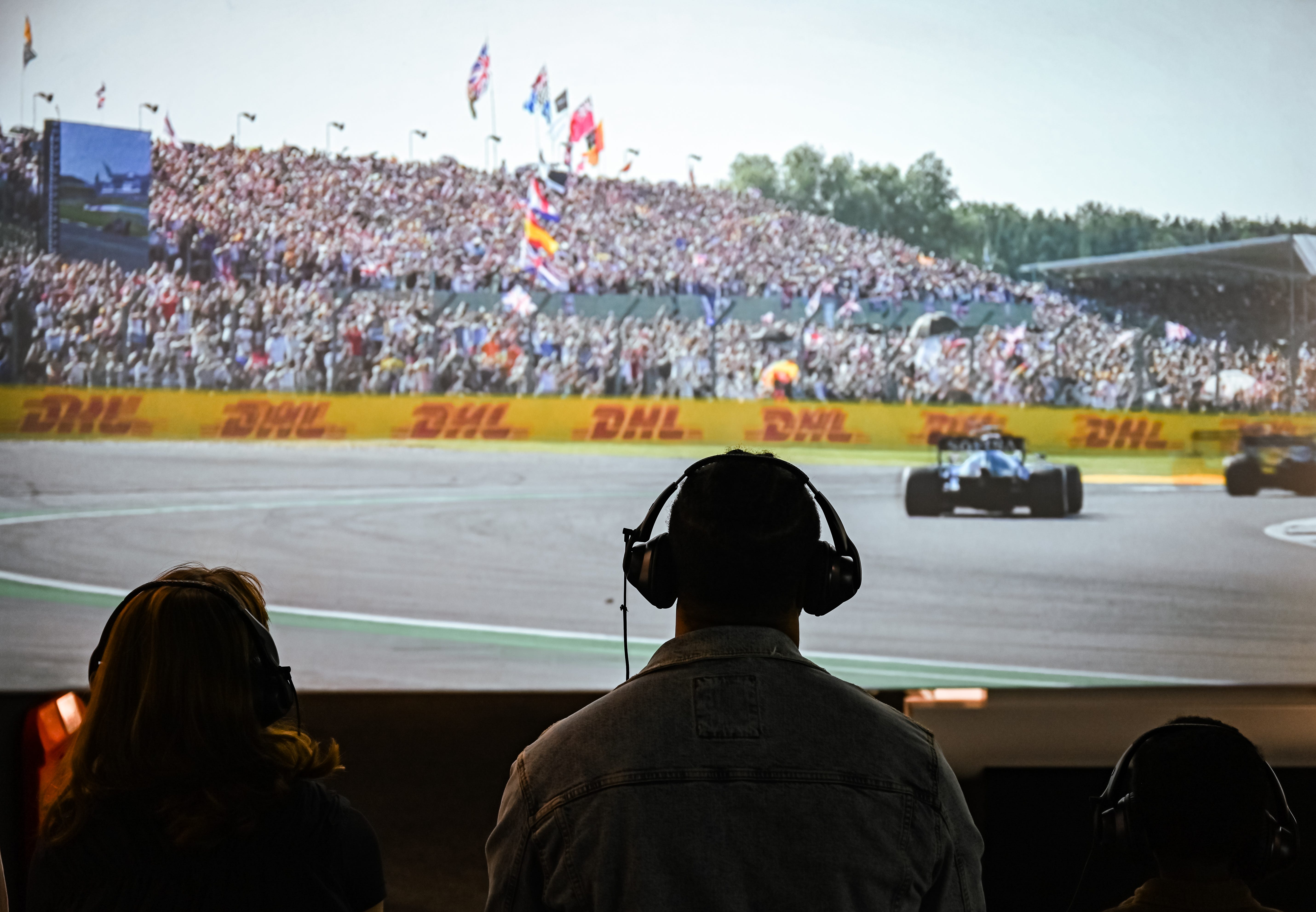
A spin through Coyoacán’s F1 Exhibition drives her point home.
Mexico City’s version, in particular, provides an exclusive wing dedicated solely to the country’s unique contributions to the sport. Since 1961, six Mexican drivers have appeared across 48 GPs in F1, totaling 8 victories and 46 podiums; a timeline traces the winding history of it all for local fans, while also featuring original, rare artifacts. The Sauber C30 that Checho raced with during his rookie season — and which he signed with a personalized message for his team as a 21-year-old — is parked beside a trophy case that carries a magnum bottle of Moët from the 1992 Mexico GP, once held by Nigel Mansell. The show’s attendants say that it’s an aspect they are particularly proud of, since not every host nation is able to generate the kind of regional history and interest that Mexico can.
Only a handful of countries are given this special treatment from F1’s event organizers: that is, a nation-specific portion within the larger international exhibit and context. Mexico is among those few.
So, yes, go to Mexico City for the tacos, tequila, and mariachis in Plaza Garibaldi. Just don’t stay asleep at the wheel when it comes time for the checkered flags and overtakes to be had, both on and off the grid.
The F1 Exhibition will be at Yama Punta Museo in Coyoacán until May 31, 2026. The ticketed exhibit is open daily from 9 a.m. to 8:30 p.m.
No posts
Comments
Nothing yet. Say the first thing.
Sign in to join the conversation.