
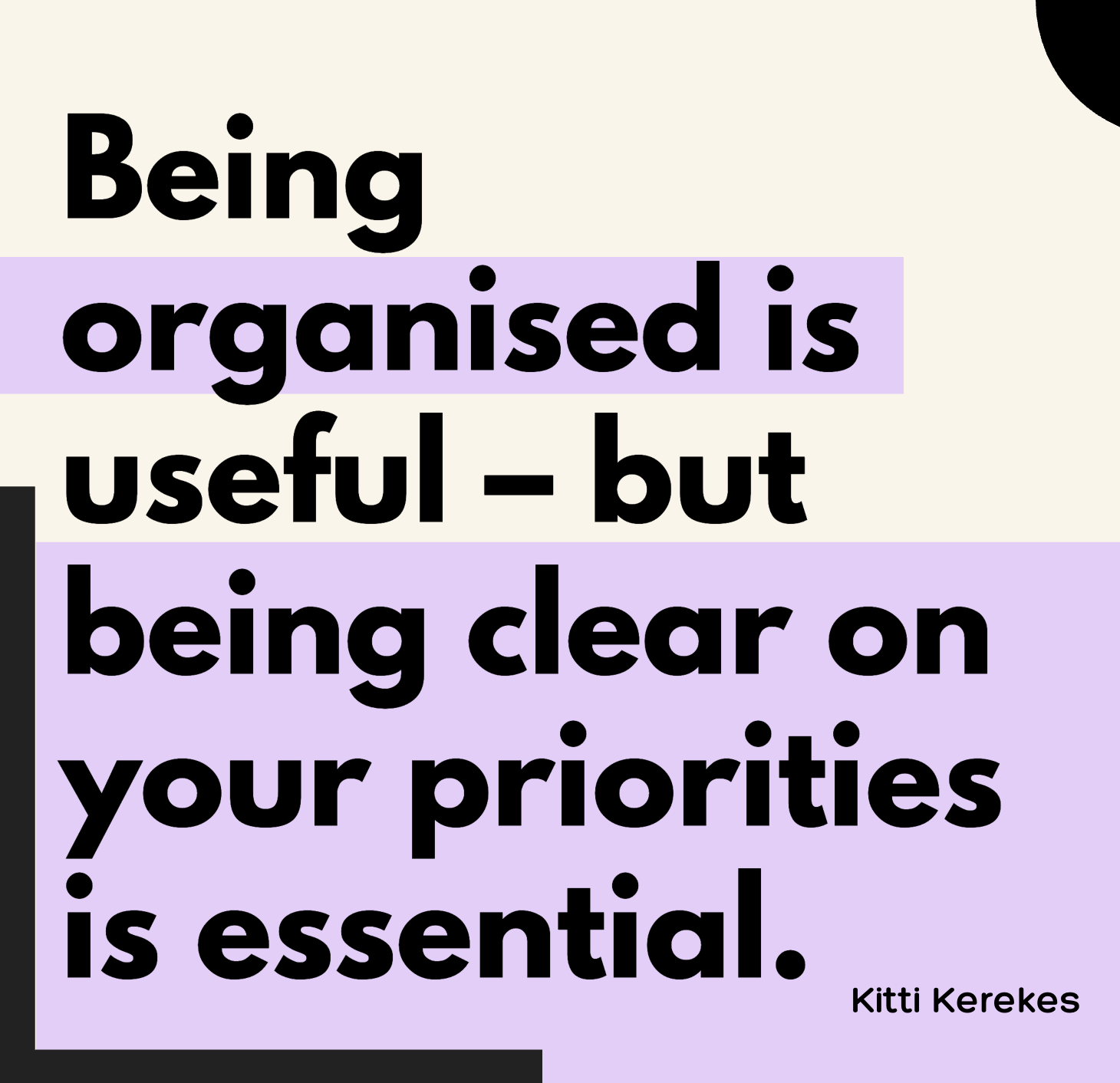
Being organised feels productive. Colour-coded calendars, detailed to-do lists, inbox zero—it all signals control, competence, and preparedness. And it is useful. But there’s a risk hidden in that sense of order: confusing organisation with progress.
It’s possible to be beautifully organised and still completely out of alignment with what actually matters.
The danger lies in mistaking structure for strategy. You might be busy, efficient, and even calm—but if you’re focusing on the wrong things, none of that energy is moving the needle.
Organisation is about how you manage your workload. Prioritisation is about what you choose to work on in the first place. And they don’t always go hand in hand.
You can spend hours structuring your day, colour-coding your tasks, or blocking out time to work—only to realise at the end of the week that you’ve avoided the one project that actually matters most.
This is what Greg McKeown calls “the undisciplined pursuit of more” in Essentialism. We do too much, chase too many goals, and optimise our time for speed rather than impact.
There’s a quiet satisfaction in reorganising your workspace or rewriting your to-do list. It gives the sensation of progress without the discomfort of actual progress—which usually involves confronting complexity, ambiguity, or risk.
We often prioritise what’s easy to complete over what’s important but uncomfortable. This is the essence of Tim Urban’s idea in his viral TED Talk Inside the mind of a master procrastinator: we gravitate towards instant gratification—even in our task lists.
Being disorganised can cause chaos. But being over-organised can mask avoidance. If we’re honest, sometimes we tidy the house because we’re putting off the hard work.
True prioritisation is uncomfortable because it means making trade-offs. It means choosing to let some things slide in service of doing fewer things better. It’s not always tidy or polite.
It’s saying no to meetings that don’t move your goals forward. It’s protecting deep work time even when your calendar tells you you’re “free”. It’s being clear with your team or manager about what won’t get done—and why.
In Four Thousand Weeks, Oliver Burkeman argues that we’re not suffering from a time management problem, but a prioritisation one. We can’t do everything, so we need to get better at choosing.
Organisation is a tool. But it needs to be pointed at the right targets.
A good week isn’t necessarily one where everything was clean and planned.
It’s one where the most important thing got done—even if the rest was a bit messy.
A few practical habits that help bring the two together:
Start the day by identifying one high-impact task you’ll prioritise—no matter what.
Revisit your goals weekly. Are your tasks aligned to them, or just convenient?
Limit your top priorities to three per day or week. If everything’s a priority, nothing is.
Protect time for strategic thinking. It’s not optional—it’s essential.
If this tension resonates, here are a few resources worth digging into:
Essentialism by Greg McKeown is a modern classic on doing less but better.
Make Time by Jake Knapp and John Zeratsky is full of practical ways to focus on what matters.
Oliver Burkeman’s Four Thousand Weeks offers a deeply philosophical but grounded take on how to think about time, trade-offs, and meaning.
The Deep Life podcast by Cal Newport often explores the balance between productivity systems and intentional living.
At its best, being organised helps us feel in control. But if we mistake control for clarity, we end up doing more to feel better—instead of choosing better to do less.
Prioritisation will always feel slightly more chaotic than organisation. It’s not as tidy. But it’s where the real progress lives.
How do you balance staying organised with staying focused?
What helps you choose the right priorities when everything feels urgent?
I’d love to hear your thoughts :)
No posts
Comments
Nothing yet. Say the first thing.
Sign in to join the conversation.