
0:00
-5:21
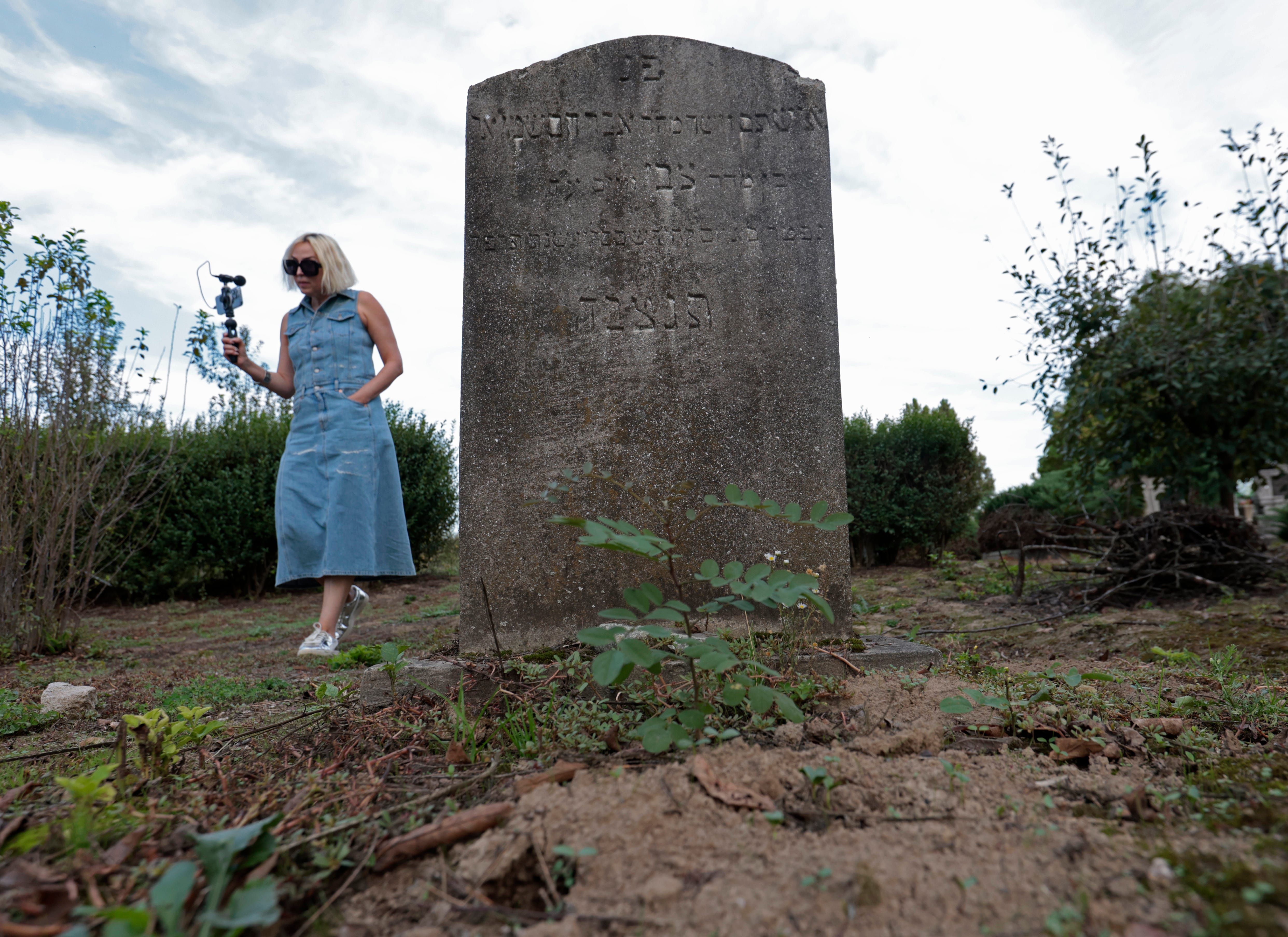
(A photo of me in the cemetery in Beregdaroc, or The Village at the End of World.)
The monthly cost of subscription is roughly equivalent to a Starbucks latte in 1998. Let’s imagine us drinking one together. Thank you for your support.
A couple of years ago, I decided to finally write a book about my grandmother, an Orthodox woman and Holocaust survivor who helped raise me. In the late 1990s, I interviewed her and kept the tapes with me everywhere I went. For 20 years they were my prized possession. But I could never bring myself to listen to them. It just hurt too much.
When I started writing a memoir about her life — and mine — I continued to resist listening to the tapes, but I needed more information. I couldn’t even recall where she was born or the names of her parents. I had snippets of stories in my memory and was desperate to know more. Specifically, I wanted to find out what happened to her mother, a woman she cried about in my interview so many years ago. And her brother, whom she said was shot to death in front of her when they arrived in Auschwitz.
This being the information age, where anything you need is a Google search away, I assumed someone else had already done the work for me. All I needed to do was unlock the DNA hiding in my saliva and all the information I desired would begin to flood in, like an advanced Google search of my body. I joined Ancestry.com, spit in their test tube and sent it in.
I waited impatiently. Maybe my grandmother’s brother didn’t die? Maybe he had a wife, and she survived? Maybe they had a child that no one knew about? Post-war Europe was a confusing time; people got lost, either intentionally or by accident. I grew up with such a small family that it sometimes felt like I was living on a tiny island. I wanted to find someone, anyone, to add to the island.
A few weeks later, I received my DNA results:
“You are 100 percent Central and Eastern European Jewish.”
One hundred percent. For the first time in my life, I didn’t want to get 100 percent. I wanted a hint of grey, a smidge of hope.
The site began populating possible genetic relatives. My father’s sister popped up and was listed as sharing 24 percent of my DNA. Makes sense, I thought. I refreshed my browser and refreshed it again.
Nothing.
The closest relative had just over 2 percent of my DNA. Most had between 1 and 2 percent. I recognized no names, and even fewer places.
Okay give it time, I told myself. Refresh. Refresh. Refresh.
I’d get emails. From the UK. From the U.S. From Australia. “It looks like we share some DNA. Do you have any idea how we are related?” people kept asking me. They were between the ages of 30 and 90, and I never did. Every day more appeared on the list. There were hundreds of us, with just a tinge of shared genetic material – enough to make us distant cousins. But how was anyone’s guess. My lost family now appeared truly gone. I uploaded my DNA onto a different site and received similar results, labeling me as “100 percent Ashkenazi.”
I began mulling. What does Ashkenazi DNA mean, anyway? So, I reached out to Dr. Shai Carmi, Associate Professor of the Hebrew University of Jerusalem.
I had read about Dr. Carmi before. He led a team of international scientists analyzing DNA from a medieval Jewish cemetery found in Erfurt, Germany. They discovered that Jews in Europe, 600 years ago, were more genetically diverse than they are today. An analysis of the ancient DNA in Erfurt found that half of these Jews traced their lineage back to the Middle East, the other half appeared more European. As the years went on, those genetic differences evaporated.
Dr. Carmi describes this as a genetic “bottleneck” or “founder event.” In other words, if you take two Ashkenazi Jews today, and go far enough back, they likely had a common ancestor. He explained:
“You had just a few hundred people living back then and every one of them became a father or mother of tens of thousands of people today because the population was very small and grew very, very fast since the end of the Middle Ages.
“If you look at the genomes of Ashkenazi Jews today, their population is homogenous. So, it doesn’t matter if you take 50 Ashkenazi people from Jerusalem or from Tel Aviv or from New York or from Toronto. They all clearly belong to a single population… this is kind of unexpected because the geographic range of Ashkenazi Jews before let’s say the 19th century was enormous. It was anywhere from Russia to Germany to France, thousands of kilometers apart. But in Ashkenazi Jews this difference is almost nonexistent.”
The end result, Dr. Carmi explained to me, is that every pair of Ashkenazi Jews share as much DNA as roughly third cousins.
So, my DNA test didn’t help me find my immediate family. At least, not yet. But I found something else: that 10 million of us are related. And somehow, after this year of upheaval, that brings me comfort.
(This piece first ran in Jewdicious.)
Comments
Nothing yet. Say the first thing.
Sign in to join the conversation.