
When the world flares up in war, I find myself returning to this helpful book on the topic by David Loy1. Given recent events, I’ve unfortunately had to pick up the book more than I’d like to. But there are a ton of valuable nuggets that I feel compelled to share, and I swear I will tie it into sleep & dreams, and also send you off with some reason for some optimism.
In Money, Sex, War, Karma: Notes for a Buddhist Revolution, David Loy explores how our collective attention—what we love, what we obsess over—is a mirror of the inner workings of our individual minds. He argues that one of our most dangerous delusions is seeing the world in terms of good vs. evil. We love war because we’re drawn to duality of black and white, right and wrong, us vs. them.
This shows up everywhere. Star Wars, Harry Potter, The Lion King, and on and on, this good vs. evil trope is embedded into endless stories that we love.
What’s ironic is that this dualistic logic of good vs. evil is equally shared across enemies. Loy points out that this framework was embraced both by the Bush administration and by Osama bin Laden back in the early 2000s.
That same structure applies to what we see today: Israel and Hamas both see themselves as defending what’s good and just, and both see the other as evil incarnate.
In a lighter context, it’s also seen in the quote that everyone seems to hate from Star Wars:
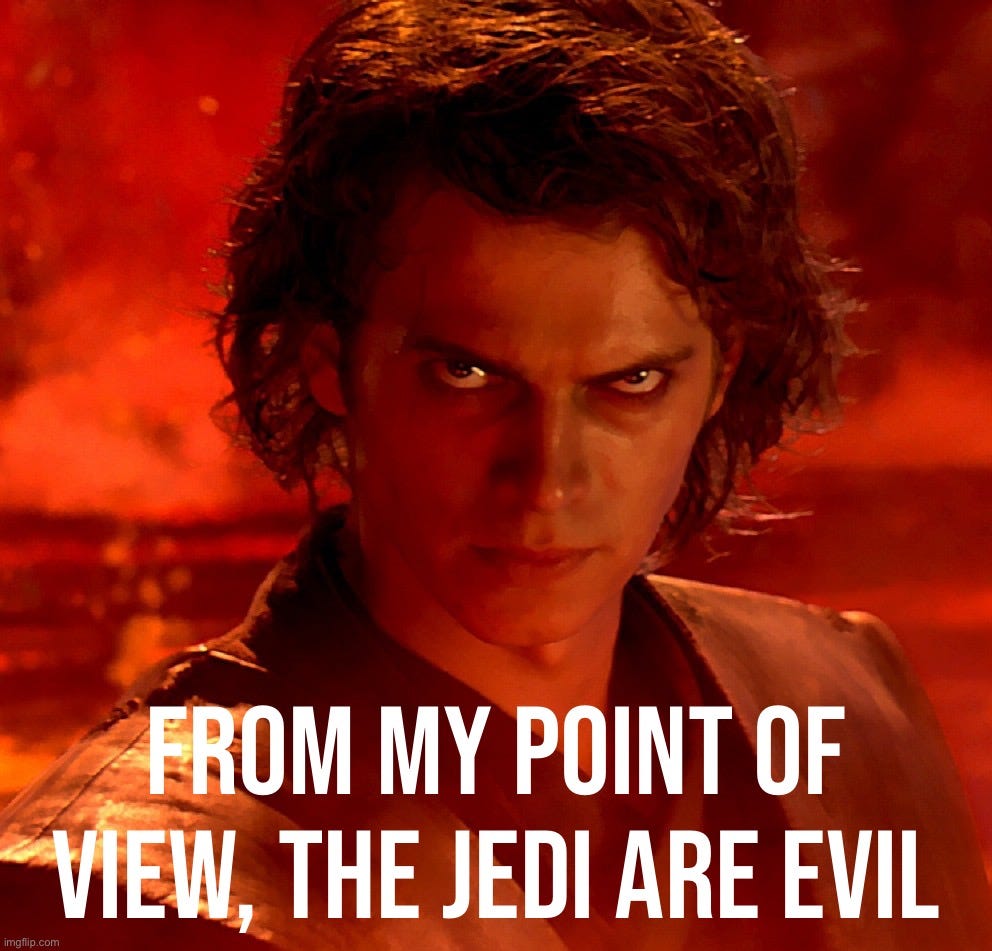
Say what you will, he’s not wrong.
What we call evil, like everything else, is the result of causes and conditions, perspectives and experiences. And if we want to reduce suffering, we need to understand those causes.
This is also depicted pointedly in the 2018 movie The Joker.
In most Batman movies, the Joker is just an evil villain who likes to do horrible things.

But in the origin story, we see that the Joker actually never really had a chance.
If you haven’t seen the movie, the Joker was born as Arthur Flack into an abusive, home with a negligent single mother living in a failed society around them. On top of that he has a rare condition that casts him out. His family, his community, his genes, his environment, his government & leadership—every factor failed him. Any one of us, placed in the same circumstances, might have become a monster too. He then goes on to do horrible things, the likes of which we see in the Batman movies
Does that excuse what he does? Of course not. But it shows us that everyone contributes to the world we live in, that no one stands outside of the system. It shows that we are more interconnected than we may normally view and some people are dealt the most unfortunate hand in life. Before he did these unspeakable acts, he was a broken soul, and someone most of us would probably try to avoid on public transportation.

This same dualistic tendency shows up in sports, too. We love watching our team beat the other guys. “We” won the game (or the fight before, during, or after). It’s the Good Guys versus the Bad Guys. It unites us, gives us a sense of belonging and shared purpose.

Loy writes:
“While such stories entertain us, they reinforce this worldview. What do they teach us? That if you want to hurt someone, it’s important to demonize them first—to fit them into a good-versus-evil story by labeling them as evil. Even school bullies usually begin by looking for some petty offense to justify their own penchant for violence.”
Loy then goes on to quote history’s best (worst) propagandist Hermann Göring:
“The people can always be brought to the bidding of the leaders... Just tell them they are being attacked, and denounce the pacifists for lack of patriotism and for exposing the country to danger.”
It becomes problematic because once someone or something gets labeled “evil,” the only moral thing to do is to fight it and do whatever it takes to destroy it.
We are suckers, easily sold on the next “just” war because we believe in this “good vs. evil” duality. And this is why, Loy says, the first casualty of war is truth. The media must sell a story:
“In order to defend ourselves, we must…”
Every war is marketed to us as a “just” war.
But Loy points out that this is simply how propaganda works, and that the actual reason we love war goes even deeper than this. He believes it is actually a spiritual problem that comes from living in a secular world that denies any deeper meaning or spiritual dimension. He breaks it down simply: we grasp at things like hate, greed, and delusion because we haven’t truly come to terms with something fundamental. That our sense of self, of being a solid, lasting, independent self is simply a construct, an illusion. Our existence feels tiny and fragile.
There is a scene from Everything, Everywhere, All at Once that captures this incredibly well:
“Please. We’re all stupid. Small, stupid humans. It’s like our whole deal. For most of our history, we knew the Earth was the center of the universe. We killed and tortured people for saying otherwise. That is, until we discovered that the Earth is actually revolving around the Sun, which is just one sun out of trillions of suns. And now look at us, trying to deal with the fact that all of that exists inside of one universe out of who knows how many. Every new discovery is just a reminder- We’re all small & stupid. And who knows what great new discovery is coming next to make us feel like even smaller pieces of shit.
Discoveries in neuroscience, artificial intelligence, quantum physics, or astrophysics, can completely uproot any sense of “ground” that we have as humans.
Because our sense of self is actually ungrounded. It’s a psychological and social construct, and as such, it is intrinsically insecure.
The groundless truth is that our time on this earth is limited, and most of us aren’t exactly encouraged to contemplate the reality of our own mortality (but shout out to those that do:
This existential hole is the most important thing.
War gives us a sense of purpose and (temporarily) fills it.
Similarly we attempt to fill the hole with money, power, and sex. Collectively, corporations can never be profitable enough. Nations can never be secure enough. Technology can never be advanced enough to satisfy us for long. We can never have too much end of life care, and biohackers think they can hack death itself.
Loy says,
The modern world can keep many of us alive longer and sometimes make death less physically painful, but it has no answer to the groundlessness that plagues us...
Our unwillingness to look inward—and society’s failure to prepare or support us in that journey toward acknowledging our own spiritual or existential groundlessness—spills out into collective behavior that becomes violent, and often tragic.
It becomes essential then, to learn to work with this groundlessness, and to make peace with it if we want to create real change in the world and avoid falling into the subtle traps of dualistic thinking.
As Thich Nhat Hanh said: you can’t have world peace without inner peace. We need to understand how our minds work if we’re going to change the world. There’s personal2 work to be done—transforming greed into generosity, hate into loving-kindness, and delusion into wisdom.
How does all this connect to sleep and dreams?
If you’re carrying even the tiniest amount of anger, despair, or helplessness about the current state of the world, it helps to know this: when you value your sleep and dreams—when you practice dream yoga, for instance—you touch into this natural, inner peace.
Lama Yeshe says the result of these practices is to become more awake, more aware, and more kind. And while the scientific research is still catching up to “prove” that dream yoga has this effect, if I were a gambling man I would bet the farm on the idea that advanced dream practitioners are showing something remarkable happening in their brains.3
And simply getting the sleep you need supports this idea; each night your body carries out essential physical recovery during Slow Wave Sleep, and emotional restoration during REM. But there’s more to it than that.
I’ve written before that sleep is a homecoming to our true nature, which is fundamentally good and pure. This is a fundamental view, or mindset, that comes from Tibetan Dream Yoga. In sleep and dreams, we’re tapping into our divine nature.
When we tap into something deeper than ourselves and experience that basic goodness, it can chip away at the sense of lack. It helps us understand and experience that this “groundlessness” is actually something beautiful and loving. That beyond our limited sense of self is something wise and transcendent.
Sleep as a spiritual practice—one way to define dream yoga—can offer a path toward understanding and coming to terms with the groundlessness that plagues us individually and collectively.4 It can make us more aware of our interconnectedness. More responsible for the world we’re shaping together—something we could use a lot more of right now.
Money, Sex, War, Karma, by David Loy. I wrote another article on the chapter on Attention, which also offers a lot of great insights.
There is of course collective work too, and the near-enemy of spiritual bypassing can happen if we focus only inwardly in an effort to escape the suffering that exists on a collective scale.
Gabriella Torres at Northwestern University’s Paller Lab has ongoing research into Tibetan Dream Yoga. For a deeper dive check out this article and this conversation.
Dream Yoga can be practiced by anyone from any faith or metaphysical belief system. Although it comes from the Tibetan Buddhist Tradition, the Dalai Lama has said that you do not need to be a Buddhist to practice it.
Comments
Nothing yet. Say the first thing.
Sign in to join the conversation.