
I’m back for another lesson in localization and in today’s post explore a missed opportunity to be an ambassador for localization professionals everywhere, and how changing our perspective from salesman to educator can help us better serve our customers. As customer-facing professionals, we have an incredible opportunity to educate our colleagues and peers about localization and localization technology. By doing so, we can help mold unrealistic expectations into realistic and attainable ones, ultimately leading to more successful sales and satisfied customers. Let's dive in!
During a recent sales call, the customer expressed interest in upgrading from an Excel-based workflow to using a modern TMS to improve translation quality and turnaround time of their localizable strings. Their localization workflows were in a bad state, manually generating Excel files for strings localization and sending them out to bilingual team members via email with no system for tracking completion, progress, or job acceptance.
Their TMS requirements were straighforward:
Track changes made at the key level and automated alerts to PMs of modifications
Integrate with their repository and automate the push/pull of resource files
Built-in CAT tool for translation workflows with intuitive UI for internal reviewers and task assignment
In short, I had the perfect tool for their needs.
However, towards the end of our conversation, just when the deal was about to close, the customer moved the finish line by adding the requirement of a fully automated machine translation workflow without sacrificing translation quality. This topic is the Holy Grail of translation technology, and while the FAHQUT model provides a visualization of the practicality of MT, high-quality machine translation for unrestricted text is an oxymoron, like healthy donuts and easy exercise.
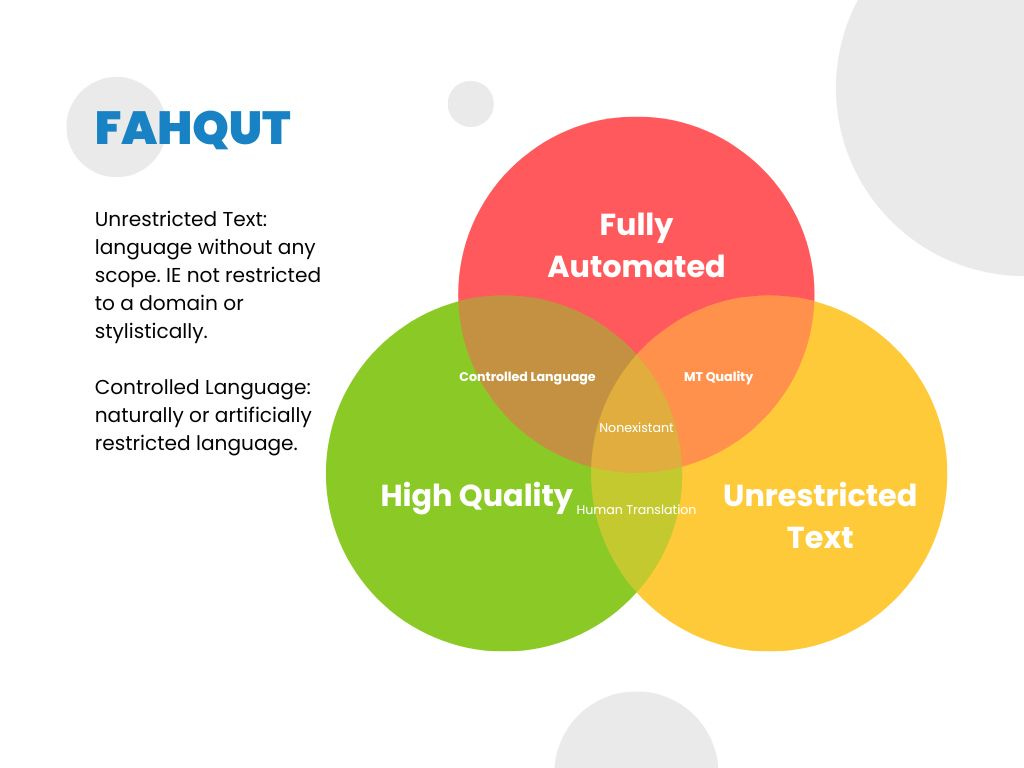
When fully automated translation meets unrestricted text you don’t get human quality, you get machine quality translations. This quality is useful for getting the “gist” of something.
However, gisting has its use cases:
deciphering love messages in French from the Parisien you met on your last trip
analyzing large volumes of text from foreign news outlets to flag for potential security threats
translating a web page in another language to get an idea of what it says
To gist consumer-facing copy like developer documentation, email campaigns, patents, or app UI is the same as gisting your customer experience. Not ideal.
However, high-quality machine translation can be achieved when the domain and style of the text's language are restricted naturally or artificially. This is also called a controlled language. A great example of an artificially controlled language is Simplified Technical English (STE), created to standardize language in aeronautics manuals for translation purposes. Naturally controlled languages include nutrition labels, pharmaceutical labels, and weather reports.
Read more on STE and controlled languages here.
At the intersection of high quality and unrestricted text, human translation is required. There's just no way around it, and this is where the customer's unrealistic expectations needed to be molded into realistic and attainable ones. The lesson learned here is that localization is often misunderstood by outsiders, and it's essential to educate customers and peers about localization and localization technology.
Back to the point of this post: a lesson in localization born from a customer’s misguided assumptions about the localization process.
Localization is often misunderstood by newcomers. For many, translation and localization is a black box because past experiences with LSPs didn’t go beyond the sending and receiving of content for translation.
After the call, I realized I have the incredible opportunity to educate colleagues and peers about localization and localization technology. If I could have just changed my perspective from salesman to educator, I could have done a much better job of selling the product by molding the buyer's unrealistic expectations into realistic and attainable ones.
Comments
Nothing yet. Say the first thing.
Sign in to join the conversation.