
Abraham Lincoln sat hunched at the small writing table in his room at the Tremont House. He had his shirtsleeves rolled high, and his long legs cramped beneath the desk. Spread before him lay disheveled papers covered in spidery notes for the case of Parker versus Hoyt. The evening hours passed quietly as Lincoln studied his case.
A floorboard creaked behind him.
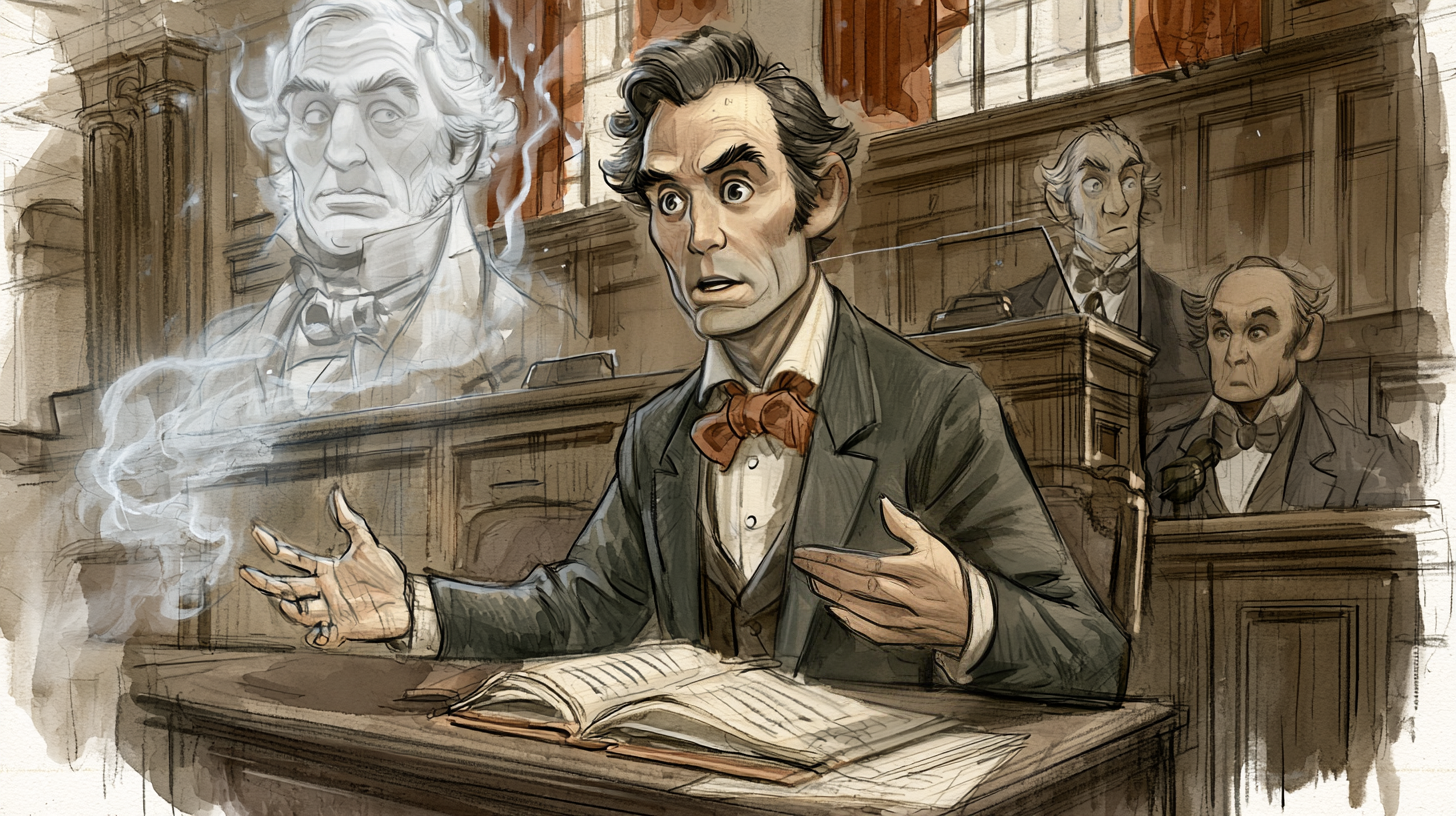
Lincoln turned. There in the corner by the washstand stood a stocky man in a fine dark coat and an imposing bearing. The figure looked solid enough to cast a shadow. Except the lamplight seemed to pass straight through at the edges of his form.
“You there. Tall fellow.” The apparition spoke with the crisp authority of command. “What makeshift office is this? Are you the new hire on Reverdy Johnson’s staff? Speak up. A great number of pressing matters require my attention.”
Lincoln stared. His heart hammered against his ribs. He had been working too hard on the case. That was it. The growing fatigue and pressure of the trial had gotten to him. Now his mind was playing tricks. He rubbed his eyes hard. The figure remained. The face was unmistakable. The stubborn jaw. The steady gaze. This was Zachary Taylor.
“Mr. President,” Lincoln said, voice low and careful. He had read the headline of the evening edition only a few hours prior. Taylor had died this morning in Washington after a sudden illness. Yet here the man stood. Lincoln felt a surge of honest duty. The dead President, or what remained of him, deserved truth. “Sir, this is Chicago. This is not Attorney General Johnson’s office.”
Taylor frowned. “Chicago? Nonsense. What would I be doing in Chicago? You lawyers always complicate simple matters. Direct me to the Attorney General’s office. We have urgent matters to discuss.”
Lincoln picked up his copy of the Chicago Daily Journal from the table. He held it out to the deceased President. Taylor reached for it, and his hand passed straight through the paper. He tried again with the same result. “The light is dim in here,” Taylor muttered. “Hold it steady for me to see.”
Lincoln held the sheet open. Taylor leaned in and read the headline. PRESIDENT TAYLOR DEAD. Underneath it, the article described the President’s sudden illness and passing only five days after the Fourth of July celebrations. The ghost straightened, still detached. “The utter refuse they allow to be printed these days. I would think I should know if I am dead. I feel fine. A little hollow, perhaps, but that is the burden of office.”
Lincoln dropped the paper back onto the table. The President, or what remained of him, refused to accept his death. And while this haunting still left Lincoln astonished, he did not want to spend the rest of his evening arguing with a spectre.
“Mr. President,” Lincoln said, “I appreciate your visit, but I must prepare for court tomorrow.”
Taylor perked up. “What is the case, counselor?”
“It’s nothing as important as matters of state,” Lincoln conceded. But the ghostly President was still intrigued, so he continued, “It’s a patent dispute. My client, Charles Hoyt, is defending against the accusation that he stole Zebulon Parker’s novel design in his improved sawmill wheel.”
“Waterwheels? A practical matter.” Taylor’s stern face broke into what must have served for a smile. “All the wheels of state would come to a halt without the wheels of industry and commerce turning. Proceed. I will observe.”
Hesitantly, Lincoln returned to his notes as the ghost of President Taylor hovered over, studying the files for himself with great interest. In the morning, upon waking at the desk, Lincoln discovered the ghost still haunting him. He had little time to consider if he truly had gone mad, though, for he was due at court within the hour.
The air hung thick and hot in the U.S. Circuit Court. Judge John McLean presided. Lincoln rose for the defense and began his opening. The patent was old, the principle employed was ancient, and Hoyt had merely improved upon what every miller already knew. Taylor floated above the jury box with a stern but approving glare.
The trial progressed over the following days, and the former president remained by Lincoln’s side in its entirety. Parker’s legal team presented their case with confidence. Lincoln cross-examined carefully. Taylor offered his own pointed observations and seemed to have a keen ability to read people’s thoughts. During a key moment with the expert witness, when the man equivocated on the novelty of Parker’s design, Taylor leaned in. “Force their hand, counselor. Make them produce the original specifications and correspondence. No half measures. Give them no quarter.”
The words struck Lincoln’s mind like a spark. He straightened and requested the plaintiff’s production of the full original patent documents and related correspondence. Parker’s team resisted. Judge McLean, after argument, ordered the materials produced. The papers revealed that key elements of the so-called novel reaction percussion mechanism had been in common use on the Mississippi for decades. Lincoln drove the point home in his closing. The jury saw it clearly. Hoyt’s wheel was an honest improvement without infringement.
The jury returned a verdict for the defendant. Charles Hoyt clapped Lincoln on the back. Lincoln accepted the congratulations with a tired smile. Yet his eyes kept drifting to the corner where Taylor stood watching. The ghost looked quieter now.
That evening in the hotel room, the ghost of President Taylor was circumspect, thoughtful even. “The Fourth of July,” he told Lincoln, “the heat that day was tremendous. I drank iced milk and ate cherries to cool myself. Such a simple thing.” His voice grew heavy with melancholy. “I faced Santa Anna on the battlefield. I expected a bullet to bring my end to an honorable conclusion. Instead, it was a bowl of cherries that undid me.”
Lincoln felt the weight of the moment, the old soldier confronting an undignified end. “Sir, you faced every challenge with the same courage, whether on the battlefield or in the Executive Mansion. Duty is not always tidy or glorious. And now you must embark on a new challenge that awaits beyond this mortal coil.”
“There is so much I still could have done. So much left undone.”
“It is the way of the earth. It is time to trust your banner in another’s hands. One generation plants, and the next tends the crop. The spirit moves forward. You carried it far. Others will carry it farther because you showed the way.”
Taylor was quiet a long time. The melancholy lingered, but Lincoln’s words seemed to steady him. “The spirit,” he repeated. “I suppose that is something worth leaving behind.”
Chicago’s City Hall was packed with mourners on a few weeks later. A memorial for the fallen president was held there, and many prominent Whigs asked to contribute to the event, including the lawyer Abraham Lincoln. He stood at the lectern in his best coat and cast his eyes over the sullen crowd. Standing with them, unnoticed by all except Lincoln, was the ghost of the man he was about to eulogize.
“Zachary Taylor is dead. He has gone to the grave with the same stoic courage that carried him through the fields of Mexico. He was a soldier who never flinched. A President who placed duty above party. A man who, even in his last hour, could say he had always tried to do right.”
Lincoln spoke of the Battle of Buena Vista, and of the rough honesty that earned Taylor his nickname, and of the way one leader’s work ends so another’s may begin. The torch passes from one generation to the next. From old battles to new frontiers. Yet the American spirit burns brighter for every hand that carries it forward.
Taylor listened. When Lincoln finished, the audience rose first in silence, then in applause. Taylor walked forward through the crowd. Unseen. Untouched. Until he stood directly before the lectern.
“Thank you,” he said. His voice was quiet. Almost kind. “You gave me a good send-off, Mr. Lincoln.” Then with an old soldier’s salute, he said, “Now the work is left to you and those with you. The country will need steady hands in the years ahead.”
The ghost smiled once, an actual smile. The old presidential bearing softened into quiet satisfaction. “I am ready now.” And in a moment, he vanished from sight like smoke clearing from a dying campfire.
Lincoln stepped down from the platform and left the stuffy hall. Outside, the summer evening smelled of the lake and horses and new-cut lumber. He felt lighter than he had in weeks. Lincoln walked back toward the Tremont House, hands in his pockets, whistling a tune he had known since childhood. His mind was already full of thoughts about the long ride home to Mary and the boys, and the work that awaited him there.
This short story is a part of my growing collection of weird tales of Presidents of the Uncanny States of America. They are available for purchase at Amazon.
Comments
Nothing yet. Say the first thing.
Sign in to join the conversation.