
These days Christianity is a religion of power. Today Christianity in most places is aligned with political power, military power, and cultural power. That’s not to discount the places in the world where Christianity sits on the underside of power, but more often than not—and especially in places like the United States—Christianity is more likely to be the religion of the oppressors than the faith of the oppressed.
For those of us who live inside circumstances like that, this dynamic produces a skewed view of the Bible’s relationship to power. These days many people seem to read the Bible as a law-and-order kind of book, citing chapters and verses like Romans 13 and 1 Timothy 2 to argue that we all ought to submit to our governments and 2 Chronicles 7 to argue for a national form of Christianity. Far-right folks like to quote Nehemiah 2:17, which is about building a wall around the temple in Jerusalem, as proof that God likes it when we build walls. It’s easy to get the idea, if we pay attention to biblical exegesis on the American right, that Christianity is a religion for frontrunners, for border-defenders, and for American patriots. It’s easy to get the idea that the Bible supports whoever is in power (as long as its Trump), and that Christianity itself ought to be aligned with the kinds of violence, exploitation, and oppression that empires tend to dole out.
Nothing could be further from the truth.
Most of the biblical tradition—aside from a few cherry-picked passages that often don’t even mean what right-wingers think they mean—is staunchly anti-authority. The Bible from start to finish is suspicious of political power. It condemns oppressors, and it celebrates the people who stand up to pharaohs, kings, and governors. The Bible celebrates resistance.
I have been writing a lot about resistance lately, because those of us who live in the United States are living through a moment that calls for a lot of resistance. And the Bible offers plenty of help for the task. My latest book linked at the beginning of this paragraph is about resistance and the Book of Acts, but the lectionary for this Sunday offers another fantastic example of resistance, from a completely different part of the Bible. The first reading in the lectionary this week comes from the book of Exodus—the book of the Torah that offers perhaps the most sustained criticism of powerful people and the most vivid examples of resistance. This section comes from the beginning of Exodus, which takes up the story of Joseph from where Genesis left off. Now, at the beginning of Exodus, Joseph has died and the Egyptians have forgotten him, and out of fear and greed they began to oppress Joseph’s people, the Israelites. Their oppression took several forms, including enslavement and harsh conditions. But this week’s passage lingers longest on a particularly cruel and vivid form of oppression: the murder of baby boys.
If a Hebrew woman gives birth and it is a son, the Pharaoh said, kill him, but if it is a daughter, she shall live. This policy existed, presumably, to lessen the strength of an enslaved people, and to keep them in a permanent state of subjugation, where they could be exploited and controlled. It is not so different from other forms of oppression that we have seen across history: violence meant to weaken and to keep oppressed people underfoot.
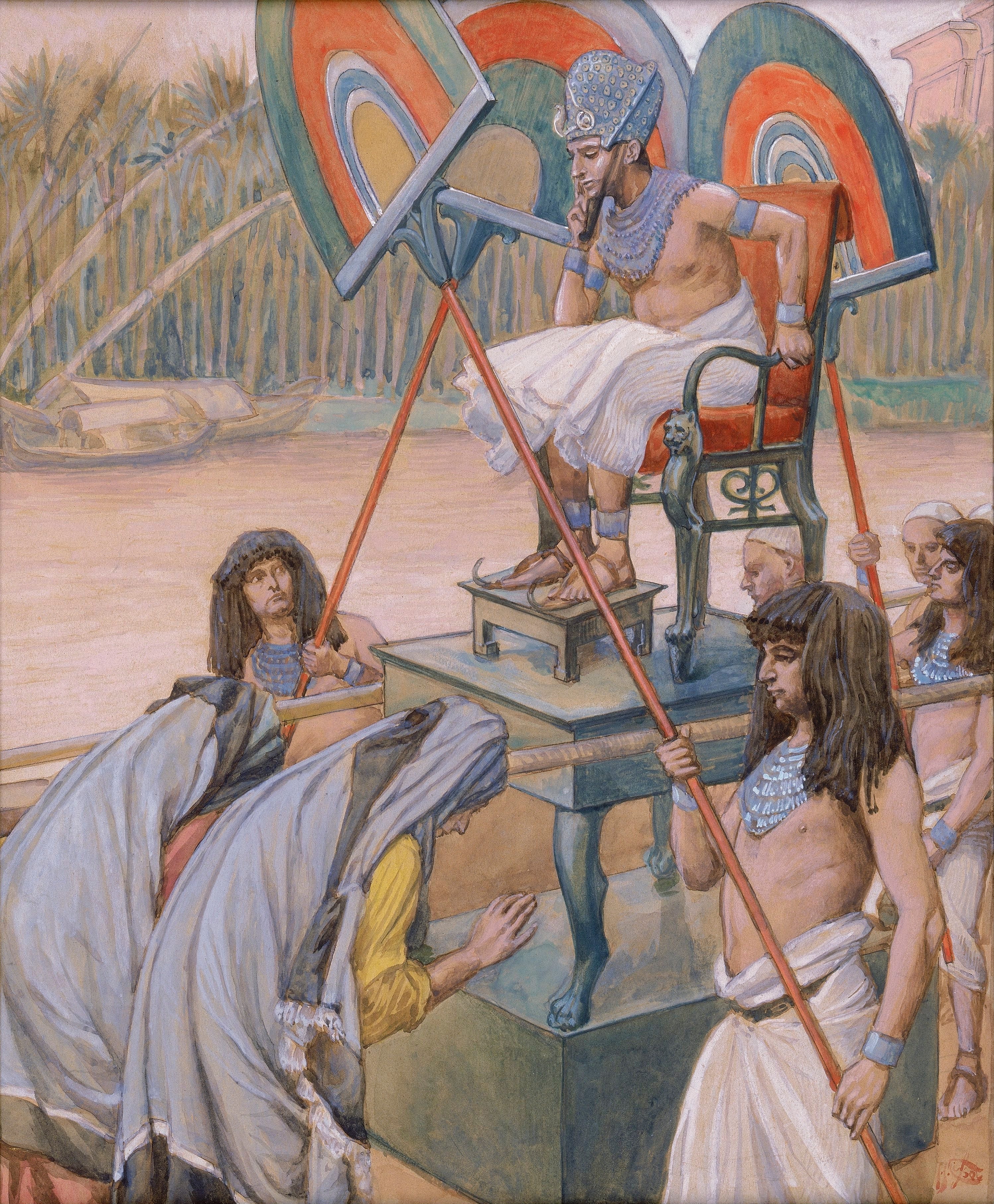
Although the American Christian right often reads the Bible as if it protects and celebrates political power, this story from Exodus is a clear example of how the Bible sides with oppressed people against oppressors. Because the policy of killing all the baby boys was supposed to be carried out at birth, Pharaoh and his empire enlisted the midwives to help carry it out. Two of the Hebrew midwives, named Shiphrah and Puah, were charged with the doing the deeds. They were summoned to the Pharaoh’s presence and told in no uncertain terms what they were expected to do. They were recruited into complicity and collaboration.
Before we get to the midwives’ response to this imperial demand that they conspire to commit murder, let’s pause to think about the structure of political oppression. The text of Exodus is actually pretty straightforward and honest about the Egyptian motivation to oppress the Israelites, in a way that many empires are not. In 1:9, the first and perhaps greatest motivation to oppression is fear: the fear that some underclass of persons will rebel against their conditions and seize power. In Exodus, as it is in many cases like this, the fear is grounded in ethnicity and otherness. The underclass in this story is composed of a different ethnic group than the ruling class, and so the Egyptian overlords feared their Hebrew slaves. At the same time, the overlords feared the loss of their labor underclass as well, fearing that they would escape from the land and leave the Egyptians without anyone to exploit.
In the United States, we can see the way ethnic difference fuels fear and paranoia on the part of the ruling class (which in America is, substantially, a ruling ethnicity or race). President Donald Trump often construes ethnic difference in terms of economic competition, arguing that immigrants take American jobs. He has made a version of this argument since his first days as a candidate, but in the last campaign his rhetoric took a strange twist that doubly proves the point. In a debate during the 2024 election, then-candidate Trump argued that immigrants were taking “Black jobs” and “Hispanic jobs” from Black and Hispanic Americans, deploying a kind of double marginalization. Not only were immigrants coming to steal American jobs, in Trump’s imagination, but they were even coming to steal American jobs that were already reserved for ethnic and racial sub-classes of Americans. Trump was saying that Black and Hispanic workers (who were immigrants) ought to be despised, in one sense, and kept out of the country. But he also wanted to play on the fears that America might lose its own population of those same ethnically-defined workers, and therefore a cheap source of labor.
That’s why multi-racial democracies are impossible without racially integrated economies: because even if citizenship is afforded to people of all races and ethnicities equally, discrimination and oppression still happen if some ethnicities and races are consigned to a permanent economic underclass, as has been substantially true in the United States throughout its 250-year history. Imagine if Egypt had grudgingly agreed that Hebrews would be allowed to vote for the next Pharaoh, but kept oppressing them with forced labor and kept imposing conditions that meant that the Israelites stayed in the economic underclass. It would not have turned out much differently than the story turns out in Exodus. Economic liberation is political liberation, and political liberation has to be economic liberation, and that liberation was precisely what the Egyptians feared from the Hebrews. That liberation was what they sought to forestall by forcing the Hebrews to do hard labor and by murdering their baby boys, making it harder for the Hebrews to rebel against their conditions. They feared the ethnic underclass because of its power and numbers, but they also feared it because without that underclass to exploit, Egyptians would not be able to sustain their way of life and standard of living.
So they gave the orders: work the Israelites to the bone, and kill all the baby boys. It was a grotesque example, but fully in line with the logic of empires. The circumstances of each empire are different, but empires have a way of playing out similar patterns across time. Empires tend to adhere to certain structures of oppression: they loot the periphery to feed the center, they export violence to the edges to bring peace to the empire’s core, and they create internal Others—often ethnic Others—that they oppress for labor while also vilifying.
How do you resist such a structure of oppression? Shiphrah and Puah offer some strategies.
The first thing to notice is that Shiphrah and Puah did not offer a moral argument for their actions. They did not attempt to convince the Egyptians that murdering baby boys was wrong, and they did not appeal to the better angels of the Egyptians to treat the Hebrew people more humanely. We aren’t told what the two midwives said during their audience with Pharaoh, but we can presume that they were quiet and compliant; they probably didn’t argue. Instead, they went out from the palace and promptly disobeyed. They resisted by their actions, and by their refusal to comply with the Pharaoh’s orders. They did this at great personal risk, because the survival of a baby boy was not something that could be hidden very well or for very long, as the ending of this week’s lectionary passage demonstrates. Someone was bound to notice that the midwives were not killing all the boys.
Someone did notice. In 1:18, Pharaoh summoned the women back to the palace to ask why they had disobeyed him. They didn’t fess up and take on the stance of a martyr. Instead, they lied. The Hebrew women are not like the Egyptian women, the midwives said, playing into the Pharaoh’s ethnic prejudices, for they are vigorous and give birth before the midwife comes to them. They weaponized the Egyptians’ bias against them, and used it to protect the innocent.
There is no sense of deference to power in this story, and there is no inkling at all that God is on the side of Pharaoh. Instead, the whole story is constructed and aligned so that the reader cannot help but understand that the political power in the story is corrupt, debased, and evil, and that the midwives are intervening on behalf of the innocent and on behalf of God. In fact, we can read this passage as a story about resistance as a spiritual practice—resistance as a way of honoring God, and of doing God’s work. The women were taking actions that in some forms of ethics would be considered wrong; they were lying. But their ostensibly wrong actions were morally correct, because they were performed in the service of God and in the service of society’s most vulnerable people. In this story, resistance is a spiritual practice that places moral good over the much more limited good of obedience to laws or political leaders.
That’s the stance that the Bible takes more often than not. Frequently when kings and Pharaohs and governors show up in the Bible, it’s as cartoonishly evil figures who are there mostly to be resisted by the people of God. Pontius Pilate isn’t noble just because he’s a governor; he’s there to show how righteous Jesus was. The Ninevite powers-that-be weren’t supposed to be respected simply because they were in charge, they were there so that Jonah could preach against them. The Pharaoh of the Exodus wasn’t sanctioned by God simply because he was the Pharaoh, but he was meant to be overcome in God’s deliverance of the Hebrew people into liberation.
If you read the Bible as a handbook for power, you’re very much doing it wrong. Nevertheless, people in power seem to always read it that way. Despots everywhere will quote Romans 13, misreading it as a paean to strongmen. Nationalists and supremacists will always cherry-pick passages like 2 Chronicles 7, about special divine favor for one nation, ignoring the fact that it has nothing to do with them. They’ll even cite Jesus’ words about paying taxes to the emperor, conveniently forgetting Jesus’ dismissive tone in that story and his obvious disdain for the emperor who pilfered the people for revenue. People seeking power will make themselves the hero of any story, and twist themselves into contortions to make it stick.
But the Bible tells a different kind of story, with different kinds of heroes. In this passage from Exodus, the hero isn’t the Pharaoh, and it isn’t the people working for him either. Instead the heroes are midwives who ignored direct orders from the highest authority in the land and then lied about it to his face. The heroes are everyday people, resisting authority and undermining the violence and cruelty of empire. We can learn something from heroes like that, which is good news, because the Bible is full of them.
No posts
Comments
Nothing yet. Say the first thing.
Sign in to join the conversation.