
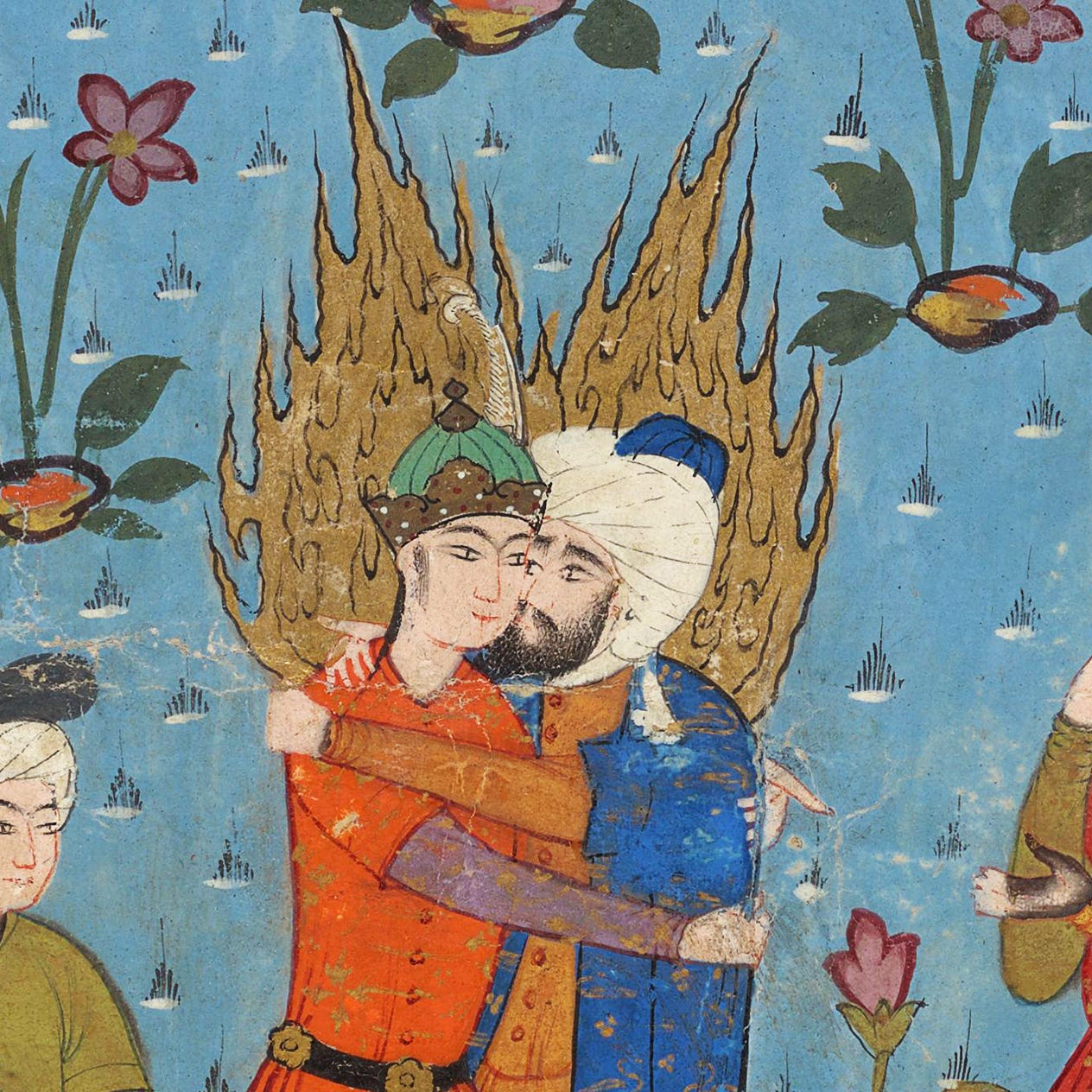
Belonging is one of the most powerful human cultural forces. Human beings are collective creatures, and most of the time we like to feel like we are a part of something. We organize ourselves into families, into communities, into clubs, and into political structures. We think of ourselves as part of ethnicities and political parties, religions and fandoms. There’s something intoxicating about finding people who share something with you—people who in some small way mirror back to you an aspect of yourself.
The flip side of that powerful sense of belonging is the sense of otherness or estrangement. Most of us know what it feels like to not belong. We know what it’s like when we don’t fit in, or when we don’t share whatever common trait everyone else does. Maybe we have been traveling far from home, or maybe we have been the new person in a family, or maybe we ended up in the wrong college class with people who were deeply invested in something we didn’t care very much about. Maybe we tried something new and immediately knew it wasn’t for us, but we still had to see it through, feeling out of place the whole time. The feeling of not belonging is just as powerful as the feeling of belonging, and it can be unsettling and disorienting, too.
The lectionary this week collects a handful of texts about belonging and not belonging. That theme runs through all the passages this week, in one way or another, and together they form a meditation on what it means to belong together, and what we might owe to people with whom we do not share belonging. Specifically, the lectionary this week is asking us to think about political and ethnic belonging, and what kinds of relationships we might form across those boundaries.
The first reading is from Genesis, continuing the story of the patriarchs from the last several weeks, and picking up Joseph’s life a number of years after last week’s story. Now Joseph is a powerful court official in Egypt, and his brothers—who in last week’s lectionary passage had sold their little brother into slavery—have shown up, driven by famine to seek aid in Egypt. In a dramatic scene, Joseph reveals himself to his brothers, tells them not to fear any retribution from him, asks them to bring his father Jacob to see him, and embraces them. This is a story about familial reconciliation, certainly. But it is also a story about displacement and foreignness. Joseph, having been forsaken by his own relatives, has made a home among the Egyptians, and has done very well for himself there. His brothers have traveled to a new land seeking food and security. None of them is quite at home in Egypt, but they all find a place there in the end, creating new belonging out of the tatters of an old one.
The Isaiah passage is also playing with ideas about human migration, but from a different angle. Here, the prophet is thinking about “foreigners”—non-Israelites who live in the same land as the Israelites—and the way they can be a full part of Israelite belonging. Isaiah here is speaking to what was probably a live question at the time: the question of whose God the God of Israel could be. In antiquity most divinities belonged to a specific place or a specific people, so it was not necessarily obvious that foreigners could participate in the cultic life of another people. Isaiah is being clear here, and emphatic even, that everyone is welcome at Israel’s altars. My house, Isaiah says, speaking for God and referring to the temple, shall be called a house of prayer for all peoples. And later, in the next verse, Thus says the Lord GOD, who gathers the outcasts of Israel: I will gather others to them besides those already gathered.
It’s worth pausing here for a moment and noticing that while Christianity often acts as if it invented the idea of a universal God—a God of all people—strains of Judaism had already been proclaiming this same idea for centuries by the time Jesus came along. Sometimes Christians cast Judaism as a parochial or tribal religion, inwardly-turned and self-obsessed, but that is a bad old stereotype that fails on several counts. Here, Isaiah makes it clear that ethnicity is no barrier to participation in the worship of Israel’s God, and foreignness is not disqualifying to being gathered up alongside Israel as God’s people. I wish I knew—maybe I will ask some colleagues—what social or historical circumstances might have led Isaiah to write an oracle like this one. It almost reads like a rebuke to specific ideas or people. If you read this as a response to someone else’s idea, you can extrapolate the idea that someone was out there saying that foreigners could not participate in the worship of Israel’s God, and Isaiah felt the need to repudiate them. We who are living through a time of intense bigotry and xenophobia in the United States can recognize the kind of people to whom Isaiah might have been responding here, and we can smile at the force with which Isaiah refutes them. God is God for everyone, Isaiah is saying, foreigners or not.
Centuries later, Paul found himself in a similar conversation. Writing to the churches in Rome and trying to thread a needle on the question of Jewish and gentile belonging, Paul was considering a different version of the same question as Isaiah. As I wrote last week, in Romans Paul was probably trying to navigate the tricky politics of Roman churches where both Jews and gentiles belonged worshipped side by side. Romans is famously convoluted for that reason—because Paul was trying so hard to make some very subtle points. And in particular Romans 9-11 is dense, twisty, and confusing.
Here, though, Paul goes on a bit of a run. He asks a rhetorical question: has God rejected his people? By that Paul means, has God forsaken the Jews, the nation of Israel in favor of gentiles?
Paul’s own response to his rhetorical question is mildly profane: in Greek, this next phrase means something like hell no. It always gets translated as by no means or let it not be so or some other equally milquetoast phrase, but it really means something closer to hell no. Paul then goes on to offer a defense of Jews: God has not rejected his people whom he foreknew; for the gifts and the calling of God are irrevocable. Here, like in Isaiah, we can imagine the arguments that Paul was arguing against. Someone must have been suggesting that gentiles had taken Jews’ place as the people of God, and Paul could not have reacted more strongly against that position. Hell no, he said, absolutely not. Jews and gentiles would be the people of God alongside each other, for Paul. They would both belong together.
If Paul was emphatic about God’s welcome of both Jews and gentiles, then Jesus was sometimes less so. The gospel reading in this week’s lectionary is one of the least-flattering stories about Jesus in the New Testament. Beginning in 15:21, Jesus and the disciples travel to Sidon, a coastal city a short journey away from Jerusalem and Galilee. There he encountered a Canaanite woman, which marks her as an ethnic other—a foreigner. When she approaches Jesus for help with her demon-tormented daughter, Jesus demurs, saying I was sent only to the lost sheep of the house of Israel. But the woman persisted, and she and Jesus had a back-and-forth in which Jesus compares her and her daughter to dogs, and the woman turns his words back on him. In the end Jesus recognizes the woman’s great faith, and heals the daughter.
Many people have observed that Jesus comes off poorly in this passage, and that he acts sullenly or petulantly. Others have noted that this Canaanite woman seems to teach Jesus something about himself—that she seems to help Jesus recognize that his own sense of mission needed to be expanded. In any case the woman has out-maneuvered Jesus, dueling him verbally and helping him realize that he had been unduly limited in his imagination about who belongs with the people of God.
Even the Psalms for this week participate in the theme of belonging and foreignness. Psalm 133 is a celebration of unity and togetherness, and Psalm 67 looks outward to the whole world, celebrating like the Isaiah passage the possibility of an expansive kind of belonging. Let all peoples praise you, and let all the ends of the earth revere him.
It is shocking to me sometimes, the degree to which Christianity in the United States has come to be associated with a xenophobic, close-the-borders kind of nationalism. (You can find some fascinating survey results on the subject here). White Christian nationalism is surging in the United States, and it has found welcome at the highest levels of the Trump Administration. Many Christians now advocate for a kind of ethnic nationalism that centers Whiteness and denies American belonging to many kinds of people—immigrants, certainly, but also non-White people who are already citizens and who have been a part of this nation from the beginning. This is all shrouded in Christian theology and justified using the same Bible that this week’s lectionary readings come from. As with so many things, the conservative Christian perspective often gets lifted up as if it were the mainstream Christian perspective, or as if it were a biblical perspective, which it is not.
If you want to find a biblical perspective on belonging—on who can be welcome and who can be God’s people—this week’s lectionary is a thorough argument for full inclusion. From all across the Bible—from the Torah and the prophets and the Psalms and the gospels and the letters—this week’s lectionary gathers passages that argue that God is a God of everyone, that our belonging should never exclude anyone, and that we should all be able to find welcome together. It’s a refreshing rebuttal to the selfish and fearful rhetoric that passes for public Christian theology these days—the stuff that argues for closed borders and a Christian nation and privileges for White people above everyone else. Some Christians might argue that stuff, but the Bible certainly does not, and the Bible is clear that God doesn’t believe in that stuff either.
If you think God is only for some people and not others, and belonging is the kind of thing that should be hoarded and guarded, then you’ll have to argue against the Bible, and you’ll have to take that up with God.
No posts
Comments
Nothing yet. Say the first thing.
Sign in to join the conversation.