
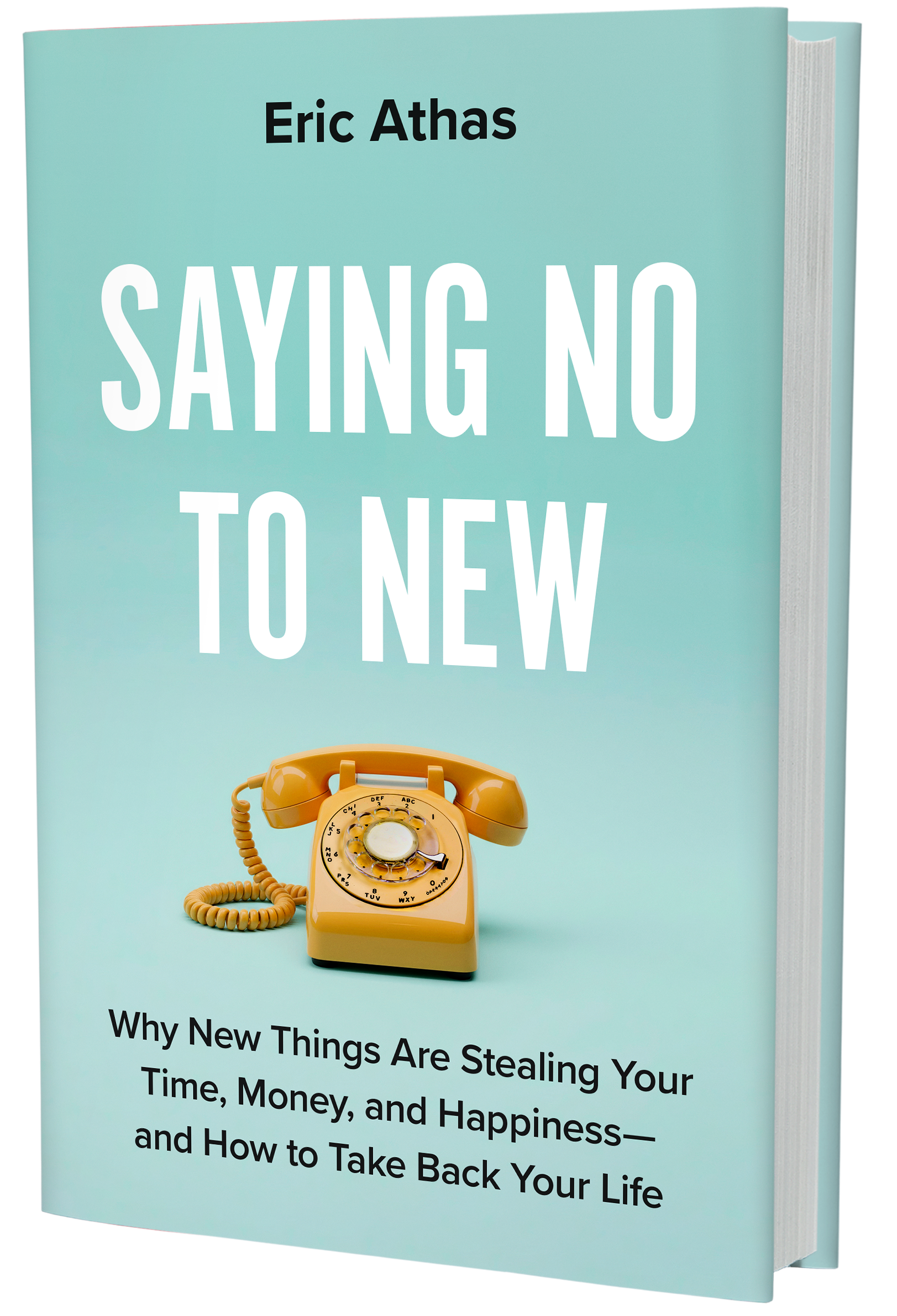
In my book, I write about a groundbreaking paper published in the 1980s by a researcher named Russell W. Belk. In the paper, Belk described the power our possessions have over us. Our possessions, he wrote, represent our extended self. The paper opened with this doozy of a quote by Ernest Dichter:
“Hollow hands clasp ludicrous possessions because they are links in the chain of life. If it breaks, they are truly lost.”
I was fortunate enough to interview Belk, a marketing professor at York University’s Schulich School of Business. We spoke about how ownership of stuff is changing and our drive for new things.
One of the most interesting insights that Belk shared with me was a concept known as psychological ownership, which says that merely touching an object can make you feel ownership over it.
Let’s say you walk into a store and pick up a new thing, like a new water bottle. By holding it in your hands, you can begin to feel attached to the item—as if you already own it. This is one reason why retailers are happy to have you browse their shops. They want you to walk around, touch and hold their products. The same goes for test-driving a new car.
“Touch leads to increased perceived ownership, and this increase in perceived ownership then leads to an increase in valuation of an object if the object provides neutral or positive sensory feedback,” is how a paper in the Journal of Consumer Research explained the phenomenon.
But where it gets really interesting is how this applies to digital spaces. Belk told me that a touch screen could have a similar effect. When you go to Target.com and swipe through products, psychological ownership may be in effect because you’re using your fingers to “touch” the product—rather than clicking with a mouse.
Read on for more snippets from our conversation. This material did not make it into the book, so I’m glad to share it with you.

“If you give someone something to hold, they become attached to it, and they’re more likely to buy it and less likely to give it up and unwilling to sell it back at a profit and so forth. That means also that we’re becoming attached to things simply by virtue of proximity. And this even works on a touch screen, that if we’re touching and moving objects around on Amazon, or whatever it might be, we become more attached to them than if we’re just operating a mouse … in this case, not even with the real thing, but with an image of it.”
“We get on the bandwagon, or the Gartner Hype Cycle, for the next new iPhone, or whatever it is that is coming along each year, only to be disappointed and realize that it’s not the wonderful, incredible, life-changing new thing that we thought it would be. But then we throw all that overboard again and have selective amnesia about what happened last time, and we get riled up again for the next new thing.”
“We have access rather than ownership, and that’s a pretty fundamental change, it means that we can live in smaller apartments, or we can have more little new things, as opposed to bigger new things that we build into collections that people can see. And we find ways online to still flex and show off.”
“It may mean that we’re headed toward becoming a post-ownership society.”
“In the wealthier, older wealth families, there’s something called inconspicuous luxury, which is taking off because you’re not trying to really tell those far beneath you that you’re wealthy. You’re rather trying to signal it to people in your social class that will be able to discern these subtleties in design and stitching and so forth to know just what brand it is. And so that’s a different kind of one-upmanship that still exists competitively, but it’s competing within a narrow circle.”
“There is self-seduction, that it’s not all the advertisers and the promotion and the glittery displays in the stores that attract us. We want to want new things, because it’s a source of hope, and hope for a better life or a better magical object.”
My publisher is giving away 20 copies of my book in a Goodreads Giveaway. The giveaway runs until July 1. Enter at Goodreads for a chance to win.
I was recently a guest on the Millennial Minimalists podcast with Kelly Foss. We chatted about how our brains are wired for novelty, the cost of over-consuming new things, and the tricks that businesses play on our minds.
Listen here or wherever you listen to podcasts.
Thanks for reading.
Eric
No posts
Comments
Nothing yet. Say the first thing.
Sign in to join the conversation.