
These are just some thoughts I have tried to organize regarding interpretability in simulation. This topic is prominent because scientists, especially those mathematically inclined, have leaned on well-behaved, scrutable equations for a long time and there is a healthy ecosystem of techniques by which to interrogate these.
The flexibility offered by ML models comes at the cost of the ability to deploy those techniques in general.
However, differentiable simulators offer you a way out
The following diagram is an attempt at summarizing what I mean.
Disclaimer: I am biased because I work on differentiable simulators…
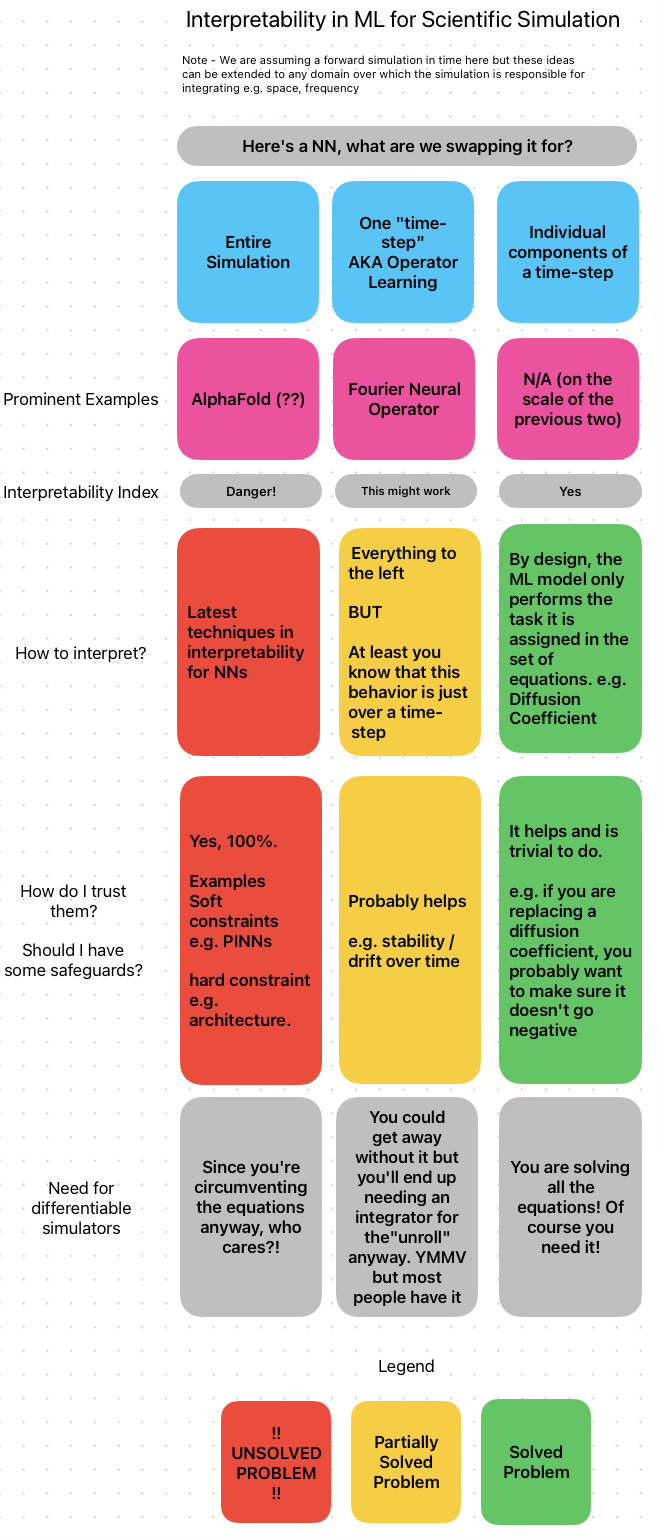
At Ergodic, we mostly spend our time on the right.
However, there are many applications for the left and middle as well. And to some extent, the right side, when probed deeper, ends up becoming an opaque object anyway! But hopefully, at that level of depth, you don’t really care because you are using it for a greater purpose.
Would you put AlphaFold here?
Isn’t it strange that the FNO went so viral? PDEs have been solved spectrally for a very long time. I am sure that both before and after the FNO, people have applied ML to the spectral domain and converted back and forth.
Spectral solver <> Fourier Operator Learning
Finite Volume / Finite Element <> Dense/ConvNet Operator Learning
What techniques do you use on the left? I spend my time on the right so I am curious
No posts
Comments
Nothing yet. Say the first thing.
Sign in to join the conversation.