
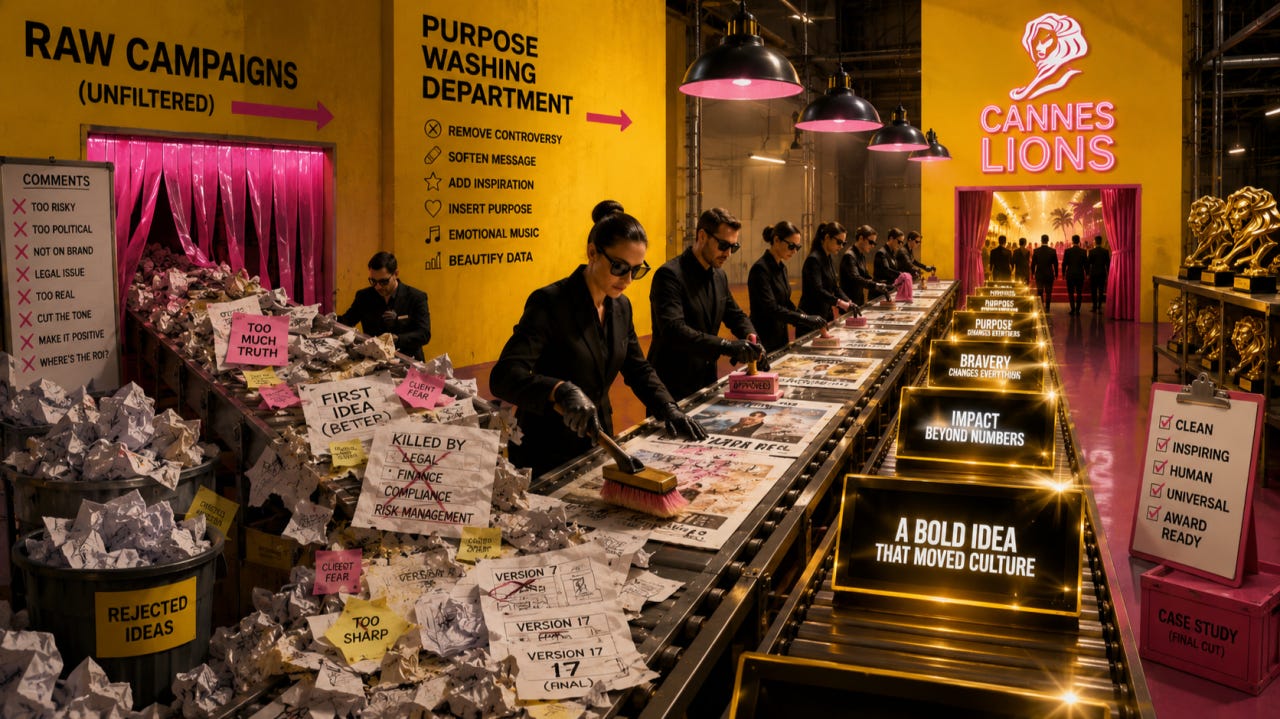
The case study is advertising’s most successful fiction format.
Not because it invents everything. That would be too crude. Its genius is more elegant. It rearranges what happened until the mess begins to look inevitable.
A campaign goes through the usual slaughterhouse: a vague brief, a better first idea, several nervous meetings, a client who wants courage without consequence, Legal removing anything with a pulse, procurement shaving off ambition in the name of discipline, and someone senior asking whether the whole thing could feel “a little more positive.”
Then the work reappears months later in a Cannes case study, clean, confident, almost moral.
The room is dark. The music is tasteful. The problem is clear. The insight is precise. The solution feels brave. The results arrive like divine confirmation. Culture, we are told, moved.
Culture is always very cooperative in case studies.
Anyone who has spent enough time inside agencies or marketing departments knows the distance between that film and the actual process. The real story is rarely a straight line from insight to impact. It is usually a series of reductions. One sentence cut. One image softened. One claim made safer. One market excluded. One internal panic disguised as alignment.
Alignment is often just fear with a better haircut.
That is what the case study removes. Not only the boring parts. The revealing parts.
It removes the hesitation. It removes the politics. It removes the cowardice that entered the room politely and stayed until the final approval. It removes the fact that many campaigns do not become what they were meant to become. They become what an organization can tolerate.
This is why the case study is so seductive. It gives everyone innocence.
The agency gets to believe it made culture. The client gets to believe it bought courage. The holding company gets a short film in which creativity looks measurable, scalable and commercially well-behaved. The young creative watching from the back of the room gets to believe that the business still rewards dangerous ideas, provided they are edited beautifully enough.
Nobody has to look at the corpse of the first version.
I do not hate case studies. Some are brilliant. Some help good work travel beyond the tiny window the media plan gave it. Some protect an idea from being swallowed by the feed and forgotten by Tuesday. But we should stop pretending they are neutral documents.
They are not evidence. They are alibis with music.
And I do not have a problem with Cannes.
Quite the opposite.
Cannes is still one of the few places where this industry is forced, even if only for a week, to behave as if craft matters. As if taste matters. As if the difference between an idea and content shaped like an idea still deserves a room, a jury, a fight, a hangover, a dinner nobody can expense without lying slightly.
There is something almost touching about it.
The rosé. The panels. The badges. The beach conversations dressed up as thought leadership. The sudden return of the word “brave” to the mouths of people who spent the rest of the year asking whether the work could be made safer, warmer, shorter, cheaper, more inclusive, less specific, more ownable, less likely to upset Germany.
Fine.
Every industry needs its rituals.
Fashion has Paris. Cinema has Venice. Advertising has Cannes, which is appropriate because advertising has always preferred sunlight when discussing its sins.
The festival is not the problem. The problem is what we bring to it.
Cannes does not invent the lie. It gives the lie a theatre, a screen, a jury, and excellent sound design. It did not create the industry’s appetite for self-absolution. It only stages it with unusual efficiency.
Maybe that is why Cannes still matters. Not because it always rewards the best work. It does not. Not because it proves what changed culture. It often cannot. Not because every Lion is a moral certificate. Please.
Cannes matters because it reveals the industry to itself with almost indecent clarity.
You can see, under the linen shirts and the branded cabanas, the old hunger of advertising: to be admired, to be forgiven, to believe that the compromises of the year can be redeemed by one beautiful film in June.
The structure is almost always the same. There is a business challenge, though in real life it may have been a PowerPoint fog. There is a human truth, though in real life it may have been found after the campaign already existed. There is a bold intervention, though in real life the boldest part may have been killed in round three. Then come the numbers, the headlines, the social reactions, the convenient screenshots, the graph that rises at the right moment.
By the end, the work no longer looks made. It looks destined. That is the lie.
Not that every number is false. Not that every campaign is undeserving. Not that Cannes is meaningless. The lie is the cleanliness. The suggestion that creativity moved through the system without losing blood.
Advertising likes to talk about bravery, but most of the industry is built to neutralize it before it becomes expensive. We have invented processes that protect organizations from the very thing they claim to want. We ask for disruption, then invite fourteen people to approve it. We ask for fame, then remove everything that might make the work memorable. We ask for culture, then panic when culture answers back.
It tells us the campaign was always meant to happen this way. It says the team saw what others did not. It says the client was brave. It says the audience cared. It says the brand entered the conversation.
That phrase should probably be retired for a few years. Advertising has entered so many conversations that one starts to wonder why most people outside advertising never seem to remember being in them.
Maybe because “changing the conversation” is often what we say when behavior did not change enough to be measured honestly. Maybe because a spike in mentions is not a movement. Maybe because a few headlines and a good edit can make almost anything look culturally significant.
The industry has a dangerous habit of learning from its own edited myths. Young teams watch award films and believe bravery has a repeatable formula. Clients watch them and ask for the same effect without the discomfort that produced it. Agencies sell courage as if it were a workshop deliverable. Everyone starts believing that great work follows a clean arc: problem, insight, idea, execution, impact.
It doesn’t.
Good work usually survives by negotiation, luck, stubbornness and fatigue. Sometimes one person in the room protects the only interesting part. Sometimes a client forgets to be afraid for ten minutes. Sometimes the budget cut accidentally improves the idea. Sometimes the campaign works because nobody managed to completely ruin it before launch.
That would be a more useful story.
Show the first deck. Show the stronger version that never ran. Show the email where the fear enters. Show the legal note that kills the best line. Show the meeting where “too sharp” becomes “not quite on brand.” Show the difference between the work that was imagined and the work that survived.
I would watch that case study. I might even believe it.
The best work carries the bruise of the rooms it passed through. You can feel where it resisted. You can sense the argument inside it. It has dents, fingerprints, an aftertaste of trouble. It does not arrive like a perfect moral fable. It arrives slightly damaged, which is usually how anything interesting arrives in business.
Too many case studies now feel dead because they are too smooth. They have no doubt in them. No friction. No smell of the room. No trace of the negotiations that shaped the work. They present creativity as a clean act of leadership, when in reality it is often an act of smuggling.
And maybe that is the part we should stop hiding.
A more honest case study would not make everyone look heroic. It would make the process visible. It would show the distance between ambition and approval. It would admit that compromise did not always improve the work; sometimes it only made the work survivable. It would understand that bravery is not a mood, a line in a manifesto, or a voiceover in the final thirty seconds.
Bravery is what remains after the organization has tried to make the idea harmless.
That is the metric I would like to see.
Not how many impressions. Not how many headlines. Not how many people “joined the conversation.” Show me what the idea was before the system touched it, and show me what survived. Show me what was lost. Show me what was protected. Show me who fought for it and who looked away.
Cannes will always need theatre. Advertising will always need myth. Fine. This is an industry that sells desire and then acts surprised when reality looks vulgar. But perhaps the mythology could become a little less hygienic.
The next creative revolution may not come from AI, data, retail media, creator commerce, or another panel about bravery held by people who spent the rest of the year approving beige work.
It may come from telling the story less beautifully.
The process was messy. The room was frightened. The first idea was probably better. The final work kept one dangerous thing alive. That one thing was enough.
That would not be the usual case study. It would be something stranger.
A document.
Comments
Nothing yet. Say the first thing.
Sign in to join the conversation.