
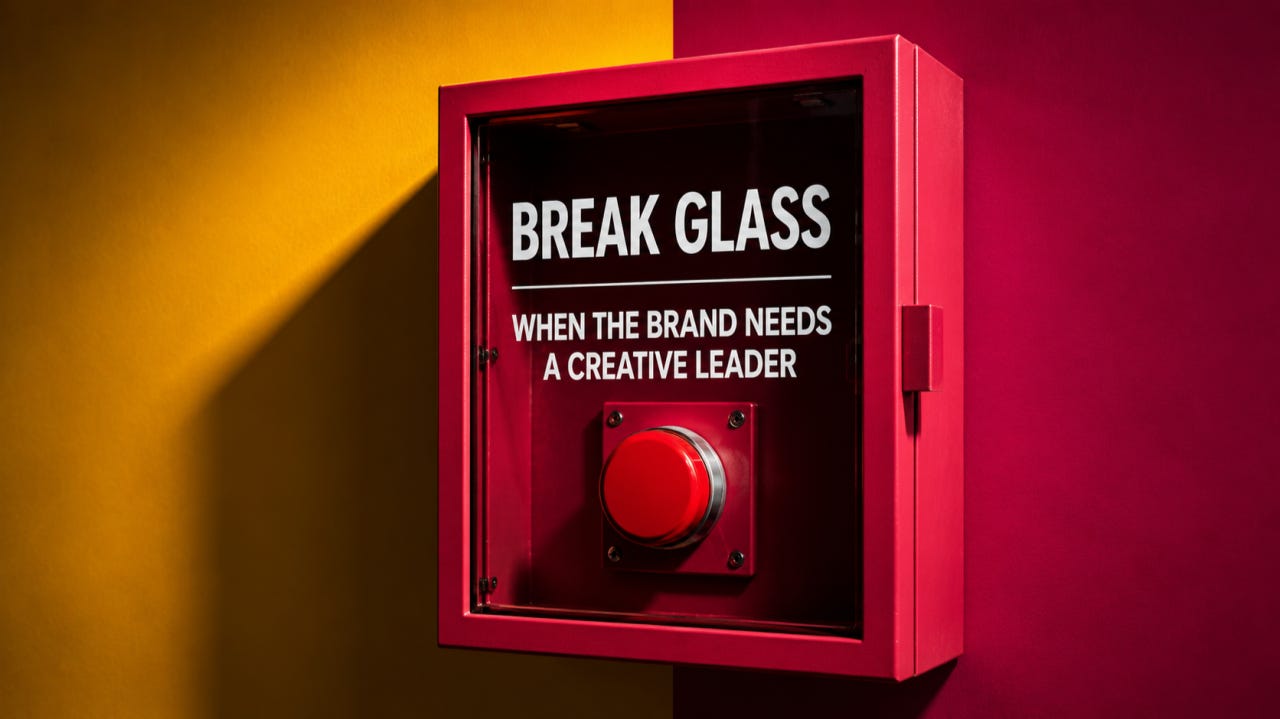
Creative leaders are already inside the building. The problem is that most important decisions are made before they enter the room.
Creative leaders have not disappeared.
You can find them running teams, reviewing campaigns, managing agencies, building internal studios, defending budgets and trying to create a coherent brand from the decisions of twelve departments that rarely have lunch together.
They are everywhere. Authority is harder to find.
By the time a creative leader enters the conversation, the strategy has often been approved, the product defined, the commercial priorities fixed and the budget divided. Research has established the acceptable territory. Technology has decided what can be built. Media has begun reserving the space in which the idea will eventually be required to live.
Then somebody turns to the creative leader and asks for the magic.
Preferably by Thursday.
This arrangement is so common that its absurdity has become invisible. Companies hire experienced creative people, give them impressive titles and place them in charge of expressing decisions they were never allowed to influence.
They are expected to make the brand distinctive after everyone else has made it safe.
I have sat in versions of that room in Milan, Dubai, Moscow, London and New York. The furniture changes. The sequence survives.
A large group spends several weeks discussing audiences, platforms, customer journeys, growth opportunities and cultural tensions. Eventually, the creative team receives a brief containing three strategic pillars, seven mandatory messages and the instruction to produce something simple.
The work arrives.
Everyone asks why it lacks an idea.
There is usually an idea somewhere inside it. The idea has simply been weakened by the time it reaches the people expected to make it visible.
The 2025 State of Creativity study from LIONS, based on a global survey of more than 1,000 marketers and creatives, found that only 13 percent considered their companies friendly to creative risk. Another 29 percent described their organizations as highly risk-averse. More than half of brands said they struggled to react quickly to cultural moments, with excessive approval layers named among the barriers.
That does not describe a shortage of creative leaders.
It describes an environment built to neutralize them.
Creativity enjoys enormous ceremonial respect inside companies. It appears in annual reports, conference speeches and recruitment films populated by attractive employees writing brave words on glass walls. Senior executives praise imagination with great seriousness, usually from a stage where every sentence has been approved in advance.
Actual creative authority receives a colder welcome.
Creativity introduces judgment, and judgment belongs to somebody. It may be questioned. It can be wrong. It often disturbs the warm protection of consensus.
Process feels safer. A process has no taste, no ego and no career to damage. When the result is forgettable, everyone can agree that the correct steps were followed.
This is how creativity was slowly removed from leadership without anybody formally deciding to remove it.
Strategy became a separate function. Performance inherited the numbers and, with them, a growing share of power. Content turned into a supply operation feeding channels whose appetite became confused with consumer demand. Customer experience created maps of every encounter. Technology brought platforms, vendors and an expanding vocabulary of transformation.
Creative remained responsible for making the outcome interesting.
The company divided the brand into disciplines, made each discipline more sophisticated and then wondered why the whole thing no longer felt whole.
Every team may be performing well according to its own measures. Media reaches the audience efficiently. Social publishes on schedule. The interface has fewer clicks. The campaign passes testing. The content engine produces enough material to cover every day of the year, including several days when the brand would have benefited from keeping quiet.
Yet the work carries no recognizable view of the world.
There is movement everywhere and direction nowhere.
The problem is not specialization. Large organizations need people who understand technology, data, media, design, product, experience and operations in serious depth. The cheerful generalist who knows a little about everything is often just a person who has attended too many panels.
Someone still has to connect those disciplines around an ambition larger than their individual targets.
That is the work of creative leadership. It begins long before the advertisement.
A creative leader should be present when the company decides what it wants to become, what it is prepared to change and which promises it can honestly make. They need access to product conversations, commercial decisions and customer experience because the brand is being created there, whether marketing is in the room or not.
Customers do not experience an organizational chart. They encounter a price, a store, a package, an interface, a delivery, an employee, a sentence written by Legal and sent from an address that does not accept replies.
Those fragments become the brand.
Advertising may dramatize the experience. It cannot permanently contradict it.
When creative leadership arrives late, its role becomes cosmetic. The product is ordinary, the service indifferent and the internal culture frightened, but somebody still expects an emotionally powerful campaign about courage.
The creative leader is asked to perform plastic surgery on corporate behaviour.
Sometimes the work is good enough to hide the scars for a quarter.
The old model of creative leadership was hardly perfect. Advertising history contains plenty of brilliant men who behaved as though talent entitled them to frighten junior staff, ignore budgets and convert personal eccentricity into organizational philosophy.
There is no need to bring that creature back.
The industry confused intimidation with standards for far too long. It mistook charisma for leadership and allowed successful work to excuse conduct that would now empty a Slack channel in seconds.
Removing the mythology was healthy. Removing the influence was not.
The modern creative leader should understand business rather than resent it. Commercial literacy is part of the job. Revenue, margin, growth and execution are not vulgar interruptions to the purity of an idea. They are the conditions that allow the idea to leave the room.
Business language, however, cannot become the only language available.
A brand lives partly in numbers and partly in the less obedient territory of memory, appetite, status, emotion and cultural meaning. These forces do not fit neatly inside quarterly reporting. They still determine what people notice, desire and forgive.
Someone has to hold both realities without flattening either one.
That person needs more than taste. Taste is useful, especially now that entire categories appear to have agreed on the same typography, the same muted palette and the same expression of tasteful concern.
Taste alone is merely an opinion wearing good shoes.
Creative leadership requires synthesis. It connects the commercial problem to the human one. It sees when the requested campaign is covering a product weakness, when the positioning contains no genuine choice and when research has produced reassurance instead of insight.
This may lead to an uncomfortable recommendation.
The company might not need a new brand platform. It may need to behave differently.
The campaign could be unnecessary because customers already understand the offer and simply do not find it interesting.
The innovation story may need to wait until the product has done something innovative.
These are difficult messages to deliver inside organizations where budgets, careers and months of work have already attached themselves to the preferred answer.
A creative leader without authority can notice the problem.
One with authority can prevent the company from spending millions decorating it.
The distinction between creative leadership and creative management matters here.
Creative management keeps the department functioning. Work is briefed, reviewed and delivered. People are hired, budgets defended and agencies managed. This is necessary work, often difficult and almost always underestimated by people who have never tried to make a global campaign survive regional feedback.
Leadership concerns the quality and direction of the choices themselves.
A manager can make the machine run smoothly. The leader has to determine whether it is producing anything worth releasing into the world.
Companies tend to reward the first task because it is easier to measure. Delivery creates evidence: deadlines met, assets completed, costs reduced, channels filled.
The second question is more dangerous. It might reveal that the activity was unnecessary.
Modern organizations are uncomfortable with unnecessary activity because activity protects the appearance of control. A full calendar looks responsible. Empty space suggests somebody made a decision.
Creative leadership creates empty spaces.
It determines what should not be made, which trend deserves to be ignored and when the brand has nothing useful to add. This restraint appears inefficient inside a content system that measures productivity by volume.
Outside the company, restraint may be the only evidence that an adult is present.
Artificial intelligence will make this conflict sharper.
Brands can already produce more words, images, concepts, variations and presentations than any human audience could absorb. Production is becoming faster and cheaper. The old excuse that every channel requires endless material is no longer limited by the number of people available to create it.
AI can feed the machine indefinitely.
What it cannot provide is an organizational reason to stop.
Abundance increases the need for creative authority because the central problem is shifting from generation to selection. A thousand plausible options are useless when nobody has the confidence to choose one and accept what that choice excludes.
Without a clear point of view, AI will give brands industrial quantities of polished uncertainty.
The output will look professional. The calendar will be full. The company will remain invisible.
This is where the creative leader becomes commercially important rather than culturally decorative.
They establish a standard against which the abundance can be judged. That standard cannot live only in guidelines. It must come from an understanding of the business, the audience and the company’s character.
A distinctive brand is not simply consistent. Consistency can be achieved by repeating the same dull answer in forty markets.
Distinctiveness comes from a chain of choices that reveal a recognizable intelligence.
The design, product, language, service and communication do not need to look identical. They need to feel as though they were produced by the same conviction.
That conviction is difficult to manufacture through committees. Committees are useful for gathering information and distributing blame. They are less successful at developing a point of view.
An idea requires somebody to choose.
Choice creates exposure. The person choosing may be wrong. Their taste becomes visible. An unsuccessful decision cannot be hidden behind a long list of options and an alignment workshop.
Organizations often claim to want brave thinking while building systems that ensure nobody has to make a brave decision alone.
They ask creative leaders to take responsibility for impact without giving them comparable influence over the conditions producing it.
This is the corporate version of inviting someone to captain a ship after the route, speed and iceberg policy have already been agreed.
Letting creative leaders lead means involving them while decisions are still alive.
It does not require giving them a veto over the company or replacing evidence with instinct. The best creative organizations contain productive tension. Imagination is challenged by commercial reality. Data is interpreted rather than worshipped. Strategy provides direction without dictating the execution before anyone has had an idea.
Nobody gets everything they want.
The work becomes better because the conflict happens early, among people with enough authority to change the answer.
Too often, organizations postpone that conflict until production. By then, every challenge feels expensive. The safest route wins because deposits have been paid, media has been booked and somebody senior has already mentioned the launch date to the board.
The creative leader spends the final weeks protecting fragments.
A line survives. A scene stays. The ugliest compromise receives better typography.
Then everybody calls the process collaborative.
Real collaboration does not mean allowing everyone to edit the work. It means bringing different forms of intelligence into the decision before the work exists.
A creative leader belongs in that early conversation because creativity is not a finishing department. It is a way of discovering possibilities the current structure cannot see.
This may influence the product, the experience, the business model or the story. Sometimes it will produce a campaign. On other occasions, advertising should be the least interesting part of the answer.
Brands do not need to hire another generation of creative leaders and hope that a more impressive title repairs the structure.
They understand the company, know the teams and have spent years watching good ideas become smaller as they travel upward. Many have learned to speak the language of business while leadership has made little effort to become fluent in theirs.
Give them access before the brief.
Allow them to question the decision rather than merely illustrate it.
Measure their contribution beyond the number of assets produced and the smoothness of the approval process.
Most importantly, grant them enough authority for “creative leadership” to stop being a decorative phrase attached to a management job.
The problem was never that brands ran out of creative leaders.
They stopped letting them lead.
Comments
Nothing yet. Say the first thing.
Sign in to join the conversation.