
This article was first published by Law.com International on 29 April 2026
Kirkland & Ellis is expected to pay Joshua Feltman of Wachtell Lipton Rosen & Katz more than $20 million a year for several years to switch firms. That number tells you a lot about how AI is reshaping the economics of law.
Conventional wisdom is that AI will flatten the value curve in law firms. Routine work goes to the machines, prices fall, the pyramid compresses, and the pricing power of the best lawyers — so the story goes — erodes alongside everyone else’s.
But that’s not what’s happening. AI is not lowering the price of the top lawyers. It is raising it.
As AI absorbs the lower and mid-level work — drafting, research, document review — the scarce human-partner layer becomes more valuable, not less. Judgement under high-stakes uncertainty. Trust. Advocacy. Negotiation. The orchestration of real complexity. None of that is going anywhere. As the rest of the pyramid commoditises, the firm’s economic value migrates upward into a thinner band at the top.
Chart 1 — The Steepening Value Curve
AI compresses the value of work performed by associates and counsel. Value concentrates more sharply at the senior partner and rainmaker level. Below the crossover point, AI erodes individual value; above it, AI amplifies it.
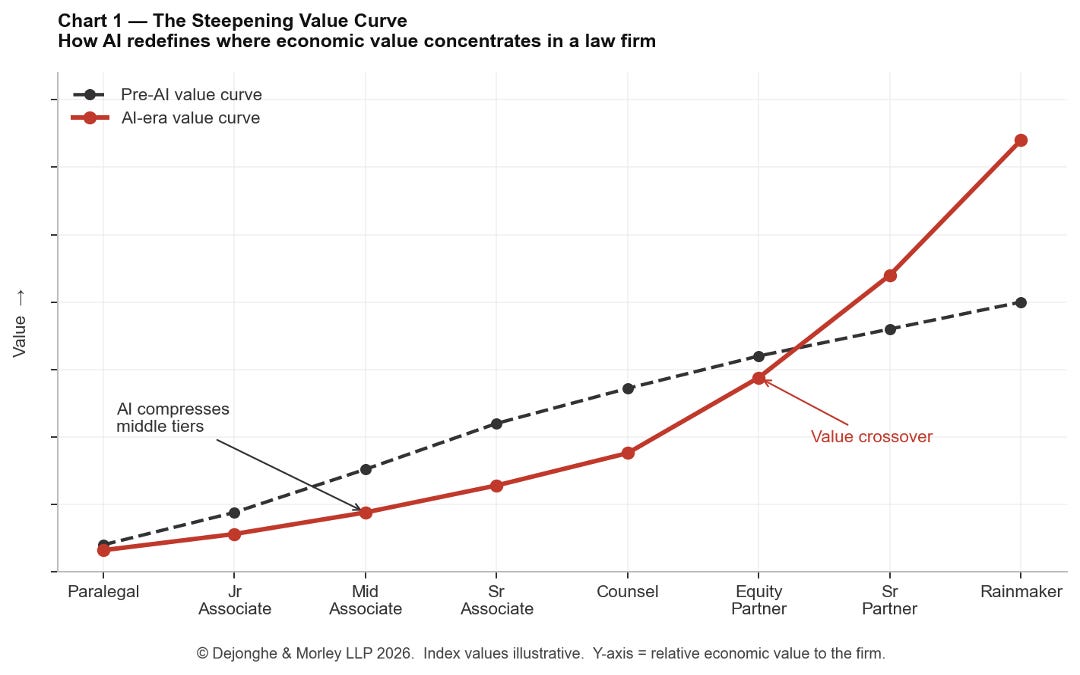
Feltman’s reported $80m is the visible version of this. Strip cost from the bottom of the pyramid, and the cash can be redeployed to fund the hire of a partner who can be truly transformative for the platform. Kirkland did not invent the dynamic. It is the same one that produces $100m-a-year hedge fund portfolio managers and the wage scales of elite professional sport. AI now brings it to law. Expect the price of top partners to continue rising and lateral velocity to accelerate.
A second pattern follows from the first. Kirkland has $10.5 billion in revenue and a balance sheet that can write the Feltman cheque without blinking. A gap is already opening — even between elite firms — between the capital-rich, who can outbid the market for top talent, and the capital-poor, who can only watch.
That gap is about to widen dramatically. When the first elite firms take external investment, they will create war chests no traditional partnership can match. They will add a balance sheet strategy to their talent strategy. The old model funds today’s partners out of today’s profits. The new model also has permanent capital to invest in tomorrow’s firm. The two are not in the same competition.
The steepening curve, however, is a transitional state, not a destination.
Rainmakers win Round One. As AI absorbs the work below them, their judgment and client relationships remain irreplaceable, and the value below them collapses into theirs. But the same technology that hollows out the work below the partner is, slowly and unevenly, learning to do parts of what the partner does. Companies like Mercor are already reported to be paying about $2m a day to some 30,000 experts to explain how they think — industrialising the transfer of expert judgement into the systems that will one day compete with them. With each iteration, the platform — the data, the systems, the proprietary know-how — compounds what it has learned.
In Round Two, value migrates sideways. Away from the individual lawyer, toward the platform that holds, organises and monetises the institutional knowledge. Rainmakers do not become worthless. They become a component of the platform rather than the platform itself.
This is the deeper reason capital wins. Capital-rich firms can fund the rainmakers in Round One and own the platform in Round Two. Capital-poor firms can do neither.
The familiar counter-narrative runs something like this: AI will hollow out the middle, the billable hour will collapse, in-house teams will reclaim routine work, junior pipelines will shrink. The partnership model survives, but smaller, cheaper and poorer.
Some of that will happen. None of it changes the central argument.
The world does not get simpler as the technology gets better. It gets harder to navigate. Complexity at the top of the value chain has historically grown faster than commoditisation at the bottom — and AI itself will create complexity of its own, as transactions involve more parties aware of more risks, and fresh questions arise about how AI has been used and who bears responsibility when it fails. The people clients trust to navigate that complexity are the people at the demanding end of the profession. They are the ones whose price is going up.
As for cutting the junior ranks, it offers short-term cost relief at the expense of long-term pipeline destruction. The senior lawyers of 2036 are today’s trainees. There is no platform without them.
The implications for ownership are profound.
AI will widen the inequality between labour and capital inside the legal profession, just as it’s starting to do in every other industry it has touched. Firms with capital can win the talent war today and rebuild the operation around the question every senior partner should be asking:
If we were starting this firm today, what would it look like? They are building structurally different platforms — long-term incentives that bind rainmakers to the institution, and proprietary systems that accumulate value year on year.
Firms without capital will gain efficiency. Drafting, research and review will get cheaper and faster. They will become better versions of the firms they already are. But the value will keep walking out the door with the partner.
As that gap becomes more visible, partners will start asking a different question. Not “what is my share of this year’s profits?”, but “what is my stake in the long-term value of this platform?”. Taking your share of this year’s profits and walking out empty-handed is a fair deal when the firm itself has no lasting value. When the platform is steadily growing in value, it isn’t.
The question is hard but not unanswerable. And the answers are not only available to firms with private capital behind them. The partners who confront the question now will help shape what comes next. The ones who wait will live with what others decide
No posts
Comments
Nothing yet. Say the first thing.
Sign in to join the conversation.