
This week, the UN Climate Change Conference (COP30) wraps up in Belém, Brazil, poised to adopt a new action plan on health equity and climate justice. COP30 comes just months after a historic ruling from the International Court of Justice proclaimed that all countries, regardless of whether they have signed on to the Paris Agreement, have a legal obligation to address the “existential and urgent” threat of climate change–and that the right to a healthy environment is foundational to other human rights.
The ICJ’s landmark opinion reflects the profound role of youth in driving action on climate change around the world. The movement to seek a ruling on countries’ climate responsibilities from the world’s highest court began with law students in the Pacific Islands–one of the most climate-vulnerable regions in the world–who grounded their claims in the principle of intergenerational equity. As the students made clear, although children and young people bear the least responsibility for climate change, they have the most to gain from climate action–and the most to lose from climate apathy. This helps explain why youth have been leading some of the boldest efforts to hold their governments accountable, from Montana to Colombia to Taiwan. Meanwhile, young people have been participating at COP30 in historic numbers–as delegates, as protesters, and as public voices.
At the same time, growing movements of older people across countries are organizing for climate justice–both for their own sake, recognizing the outsized impact of extreme weather on older adults, and for the sake of their children and grandchildren. Their efforts are making a difference: as just one example, in 2024, a group of Swiss women in their 70s secured the first climate victory in the European Court of Human Rights by arguing that their government’s inaction was discriminatory based on both age and gender, given older women’s greater health risks in extreme heat. Beyond activism, older people are passing down critical knowledge for adaptation and insights from engagement in past social movements.
In short, while some studies suggest small differences in climate views and action across age cohorts, the importance of protecting the planet for future generations is a widely shared value among younger and older people alike. Indeed, global studies have shown that love for future generations–wanting a better planet for one’s children and grandchildren, nieces and nephews, and their children to come–drives people to care about climate more than anything else does; protecting the future for the next generation was 12 times more effective than the potential for job creation in moving people to support government action on climate. Can enshrining this value in countries’ fundamental legal documents—their constitutions—move governments to act with more urgency?
Today, Equal Futures is releasing its first global policy brief, examining protections for the right to a healthy environment in constitutions worldwide. Our findings show that these provisions are becoming far more common over time: 76% of constitutions adopted from 2010-2024 protect the right to a healthy environment, compared to just 28% of those adopted before 1980. What’s more, these provisions are found in every region of the world.
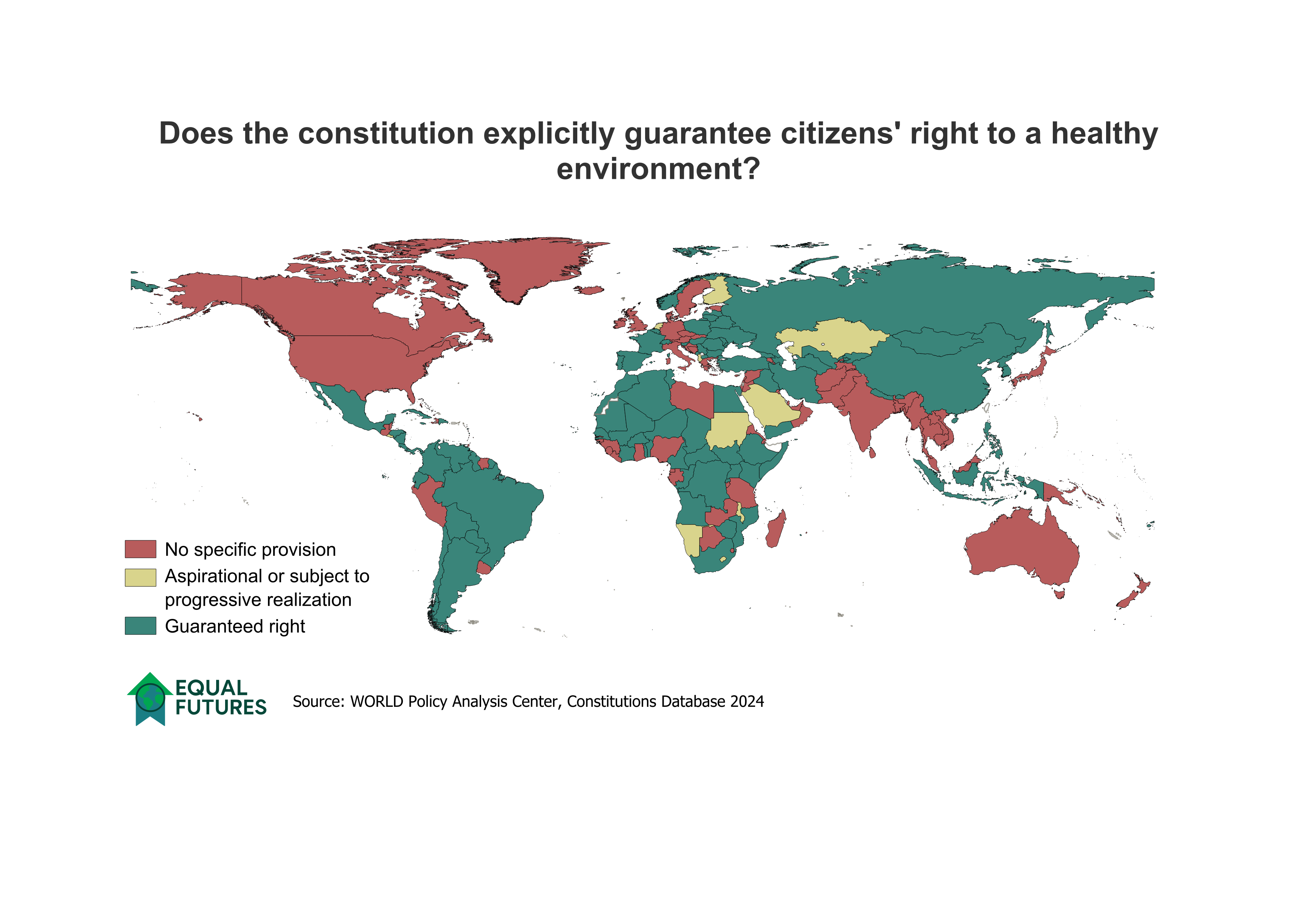
Moreover, dozens of countries’ healthy environment provisions–from Bhutan to Kenya to Uruguay–explicitly embed a commitment to future generations, while a similar number make clear that protecting the environment is everyone’s responsibility. In Portugal, for instance, the constitution specifies that “Everyone shall possess the right to a healthy and ecologically balanced human living environment and the duty to defend it,” and that the use of natural resources must be undertaken “with respect for the principle of inter-generational solidarity.”
These provisions are having impact. From Chile to South Africa to Papua New Guinea, constitutional rights to a healthy environment have helped prevent deforestation, protect endangered species, and address unhealthy air quality, to name just a few examples. In some cases, the concept of future generations has been paramount: a landmark ruling from the Supreme Court of the Philippines, which helped slow the destruction of the rainforest, found that children had standing to sue on behalf of both themselves and “generations yet unborn.” What’s more, momentum continues around these rights’ expansion. In the US, a movement to advance constitutional “green amendments” at the state level has active campaigns across the country.
The natural environment is our greatest shared resource–and protecting it for the sake of both the present and the future is fundamental to what we owe one another as human beings. Yet to put these values into practice and to advance concrete steps within countries, the ideals of the ICJ opinion, the new Action Plan, and the Paris Agreement itself need to be translated into national-level commitments. Constitutional rights can provide both a practical tool for accelerating state action and a powerful statement about our collective responsibility for the environment. Learn more here, and stay tuned for our factsheet putting US approaches in global context.
.
No posts
Comments
Nothing yet. Say the first thing.
Sign in to join the conversation.