
The links below are from earlier articles in this publication (Essays on Music), representing about 20% of what’s available. Take your time and come back for more! And please share, leave a comment, a like — in other words, let us know you were here! There are buttons below for all this. Also, feel free to support this work by becoming a paid subscriber if you aren’t already (it really helps in ways more than the financial).
After decades of performing and teaching, I heard a common question from one of the students towards the end of a series of classes. As I decided how to answer it (and not the first time for this student), it suddenly occurred to me that all my teaching and writing about music has been aimed at this type of question. My approach throughout, it seems to me now, has been to acquaint people with what it means to be a musician. Along the way, they learn technique and tunes to enjoy.
I admire and applaud those who seek to learn an instrument at any age — it is a stimulating challenge, for fun, sociability, good for the soul and for the brain. Adults in particular are to be appreciated, especially if starting from scratch, because all adults are really good at something — their work, reading, driving, cooking, traveling, computering, loads of everyday skills — so it is humbling to learn something they’re definitely not good at!
And it can be delicate to teach some of them, depending on the deal they make with themselves. One older gentleman told me he gave himself two years to get “good” at violin. (I told him none of us gets “good” at this, we just get better.) One adult asked me for a single half-hour lesson in order to get “all the basics” so he could use free YouTube channels to perfect everything himself! Many learners, especially those accomplished at professional careers, believe they know how to learn anything and just need to apply themselves enough to “succeed.” In the end, most just want to be able to play music for themselves and with others, and happily, this is within everyone’s reach.
But when I get that old question, it focuses me on the heart of the matter. The question is simply, “Can you give me the sheet music? I’ll be fine if only I can have that.” Since I usually do provide sheet music, this question only shows up when I’m teaching a tune by ear — i.e., when I’m teaching them to be a musician. Such a student is basically giving me notice that they would know exactly how to play the music, if they could only look at the notes. They’re saying that despite all the nice things I am coaching them through — such as providing audio by phrase, and getting them to experience note patterns within the context of beats and phrases — they don’t need any of that stuff because they know how to apply their brains and put in the work to read, sequence, and memorize how the notes go, and therefore be able play the tune.
This is a totally understandable request, and of course, reading music is an important and useful skill. But the fact is, reading is no more essential to playing music than reading English is to being able to speak and understand the language.
For music is indeed a language. And that’s what I teach. Being a musician is not about sounding or looking like one, but about being able to hear and speak the language. And let me be clear: I mean not just passively “hear” but actively listen. And speaking does not mean knowing musicology or music theory; those are descriptive disciplines that make sense only after you’ve been listening and speaking/playing the music.
When someone claims that they can bypass those troublesome ideas about patterns, beats, and phrases (and on the fiddle, the bowing that brings it all to life), and that they can simply memorize the notes, to me, it’s like saying to the director of a play, “Don’t worry about me playing my character, I can easily learn my lines. I just need to see and memorize all the letters and words in the right order. I don’t need to know what I’m saying.”
But of course we don’t learn the lines of a play that way. We learn the lines according to what they mean, phrase by phrase rather than word by word, and certainly never letter by letter. And the phrases are spoken in rhythm, which makes them both easier to remember and more powerful. There’s a reason most of Shakespeare’s plays were written in iambic pentameter. If in the heat of the moment during the performance of a play, we perchance forget a line, we improvise, because we know what we’re trying to say. In real conversations, we never hit a brick wall because we forget a word we memorized for the occasion. We make do, because we want to get an idea across.
Unfortunately, some learners of music do hit a wall when they memorize the notes of a tune instead of learning the music. If they happen to forget a note or two, or someone sneezes behind them and distracts them, they may well get flummoxed and freeze.
In all my music teaching, I coach people to learn the music by phrase, and then to place the phrases in order. The meaning of each phrase is built into how groups of notes coalesce into beats and how those beats form phrases. This structure can also be heard in the lyrics of any good song, which always match the phrases of the music. The best songs also match the natural pronunciation of the words to the rhythms of the beats. I like to keep in mind how Robert Burns, Scotland’s national bard and composer of lyrics for 323 mostly-famous songs, noted that he always had to have in mind the melody of the music before writing the words. Contrary to the impressions given by English professors, Burns was primarily a songwriter, and secondarily a poet. (The popular novelist Joyce Carol Oates once disparaged Bob Dylan for being a songwriter rather than a real writer. But then he won the Nobel Prize for Literature, which settled that question. And she hasn’t. You can read my opinion on this if you like).
Most musical phrases contain four beats, and are typically grouped in four phrases per musical section. The first phrase asks a question, the second phrase answers tentatively. Oftentimes, the first phrase returns to ask its question again, and the ending phrase provides a resolution to the question.
A good example of this pattern in both the lyrics and the corresponding musical phrases of a song can be found in “Where Have All the Flowers Gone?” by Joan Baez and Bob Dylan.
Text within this block will maintain its original spacing when published
     A1: “Where have all the flowers gone?”
     A2: “Long time passing.”
     A1: “Where have all the flowers gone?”
     End: “Long time ago.”
When you tap your foot to this song, you tap it four times for each phrase. Sometimes people sing it with syncopations, sometimes straight, but our feet will still tap four times per phrase. (In this song, you might notice that the A2 and End phrases start with an empty beat before the first word, with the second beat landing on “time”, and the final word taking up beats 3 & 4.)
Musicians hear music as phrases which play off each other, like the question/answer feeling. The music has something to say. It is greater than the sum of its notes.
I once heard a member of the Alvin Ailey dance company advise a young dancer to take not just dance classes but every kind of class they can while in school, because when they become a dancer, they will want to use their technique to actually say something. And to do that, of course, they have to have content, something to say.
The writer Elizabeth McCracken, in her new book about writing, The Long Game, expresses this point in many ways, one of them being: “No need to worry about voice. It’s the material that’s the real question, the thing you must look for and dream about.”
This is why it’s important for musicians to play music they love, from day one. Wanting to play the music provides the impetus for learning to play it, even if a tiny bit at a time. Waiting until the technique catches up before attempting a piece of music is a somewhat robotic approach, much like waiting until you can play a sequence of notes before learning the rhythm or the bowing. Timing is the heartbeat of music, like the armature of a clay sculpture. Waiting to learn the notes before applying timing is like building a clay person and then trying to insert the wire skeleton afterwards.
And the bottom line of all this is that learning the language of music, like learning any verbal language, is not an intellectual exercise. It requires openness to the feeling, the tone, the phrasing, the mood, the meaning. You need to have something to say, and then you’ll want to say it. Otherwise it will sound like a bunch of memorized notes. And that can get boring, even to yourself.
More importantly, and less well understood, the act of playing an instrument is not dependent on the brain (as if there were an “executive decision center” directing everything, which cognitive science has disproved), or the eyes that read the notes and markings on paper. The playing of a musical instrument is governed by the ears, who teach the muscle memory of the body to satisfy the ears, and the brain helps place phrases in the proper order, and helps recall the big picture for next time.
It’s important to note that the ears and muscle memory, which are actually in charge of our musicmaking, are constantly busy doing things for which we have no words, and therefore we have trouble thinking about and applying our brain power to these crucial activities, since we generally only think about things we can verbalize. Our brains and eyes prefer to focus on the stuff that’s easy to see and talk about — the notes.
When babies learn to speak, they start with the sounds before applying actual words. There is much mystery in how we hear and speak any language, and the language of music is no exception. Though I haven’t checked it out myself, it’s somehow no surprise to me that Duolingo, the language-learning app, has added music as one of its languages!
To explore more about music as a language, take a look at some of my earlier articles, in addition to the ones I’ve linked above —
Practicing effectively, according to cognitive scientists
The truth about learning styles
Finding the beat in music
Feeling the beat, like stepping on the gas
Why we should all write our own tunes, and how to write one
Learning the language of different fiddle styles
Musical expression can’t be learned as mere technique
Ornaments are natural to any language
Rhythm is tied to physical motions like crawling
Pickup notes lead us where we want to go
The power of sound and soundtracks
The pentatonic scale helps you listen and learn many types of music
Competence through learning an instrument
Think more fluently about reading written music.
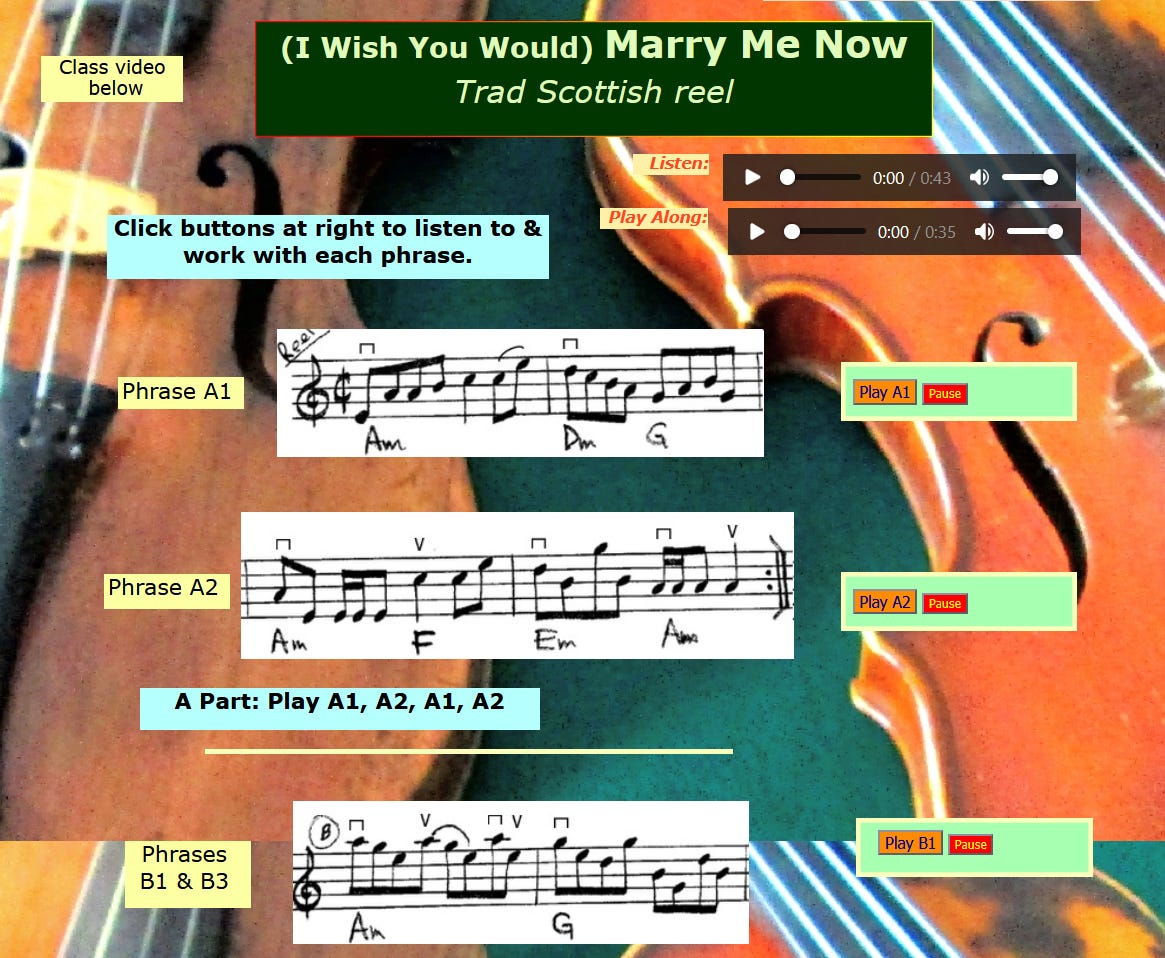
On my teaching site, at fiddle-online.com, I explore many of my teaching ideas, including boxing phrases and providing self-repeating audio for each. In a few instances, as shown below, I actually display only the individual phrases, along with the recipe of to how to put the tune together (which is how musicians think).
Comments
Nothing yet. Say the first thing.
Sign in to join the conversation.