
"Politics is more difficult than physics." - Albert Einstein
Before entering Germany’s national parliament and primary legislative body (the Bundestag) in 1998, former Chancellor Olaf Scholz was an attorney. He practiced labor law in Hamburg.
Former Canadian Prime Minister Justin Trudeau received Bachelor’s degrees in English literature and education. He dabbled in engineering classes at Montréal’s École Polytechnique, and others in environmental geography. Trudeau later taught French, humanities, and drama. And elementary school math.
Teaching is an important and fine calling, and good teachers are underpaid. But teaching primary and secondary school doesn’t prepare one for the role of political leader of a G7 nation making critical decisions involving complex engineering, scientific, and economic matters .
Engineering, energy, physics and economics were just not Justin Trudeau’s or Olaf Scholz’s thing. Unfortunately, 2022 was not a good time for Canada and Germany to be led by people with little expertise in those areas.
In the summer of 2022 Putin’s war in Ukraine had driven European oil and natural gas markets to painful levels for industry and the continent’s citizens. As a result, European political “leaders” spent the spring and summer scouring the earth, from Africa to Alberta, in search of relief.
Russia’s war in Ukraine poured kerosene on an already burning European energy market. Much of the damage was self-inflicted (e.g., Germany’s Energiewende). Between September 2021 and January 2023, the European Union and United Kingdom and Norway governments spent over €651 billion subsidizing fuel and energy “to shield consumers from the rising energy costs” they had largely created.
Putin intentionally reduced natural gas supplies. The EU fruitlessly sanctioned Russia and planned to phase out Russian oil and natural gas. Germany needed liquified natural gas (LNG), especially after finding no meaningful help in Africa or anywhere else.
The western Canadian province of Alberta is blessed with an abundance of oil and natural gas. So, in August 2022, Scholz and a contingent of German Charlaticians™ and business leaders went to Canada.
A 2025 reserve study conducted by McDaniel and Associates Consultants for the Alberta Energy Regulator concluded that Canada ranks 9th in the world in recoverable natural gas reserves. (U.S. Energy Information Administration and other sources rank Canada 14th – 16th.) And Alberta’s oil fields are so prolific Canada ranks 4th globally in proven oil reserves.
Trudeau had spent years simultaneously flogging and sucking money from Alberta’s oil and gas fields. As Chancellor, in the midst of an energy crisis, Scholz rebuffed efforts to stop or defer closure of the last German nuclear power plants his fellow German “leaders” had imposed a decade earlier. So, expecting that a former teacher and an attorney, leading governments that denominated virtually all policies in CO2 emissions and “climate change, might come away with any plan didn’t defy the laws of physics and economics was probably overly optimistic.
Trudeau was no help on the LNG front. But together, the two G7 members came up with a “better” idea, one that fit their mutual, CO2-centered raison d’être.
Their brainchild was announced in Stephenville, Newfoundland on August 23, 2022, by (then-) Canada’s Natural Resources Minister Jonathan Wilkinson and Germany’s Vice-Chancellor/Minister for Economic Affairs and Climate Action Robert Habeck:
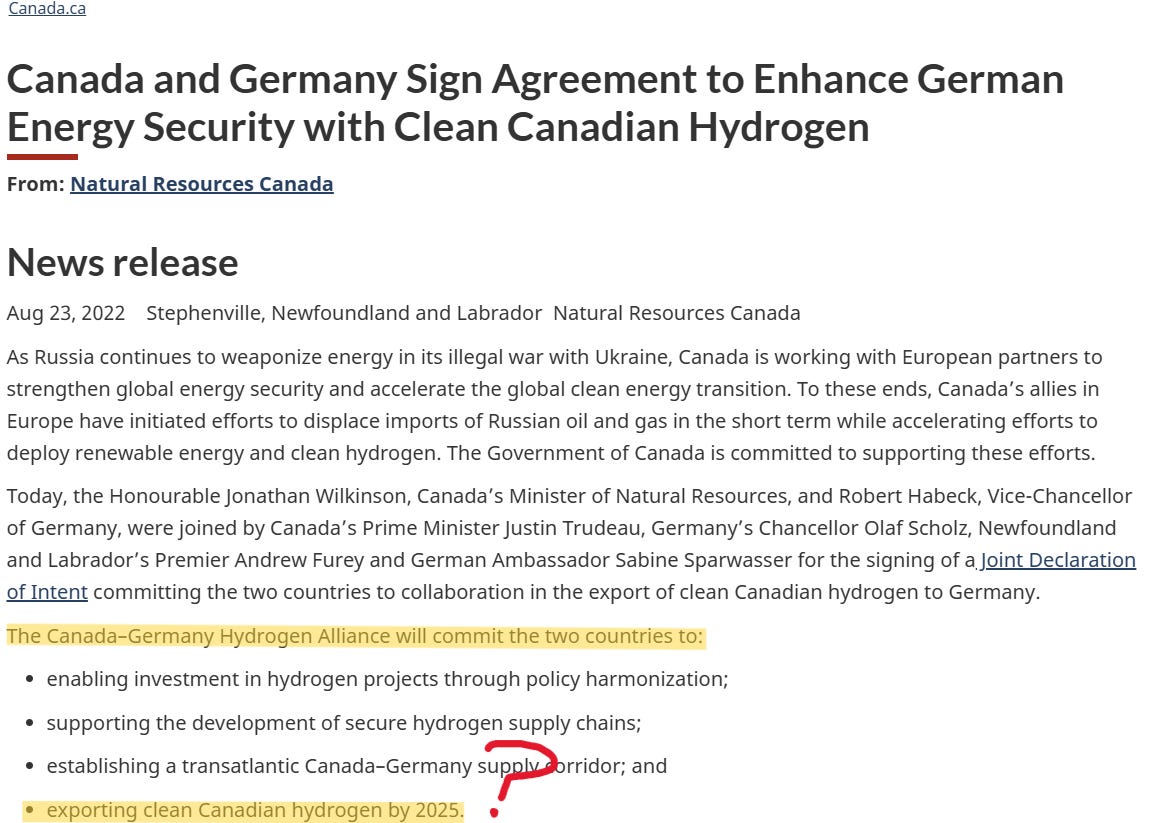
The plan for the Canada Germany Hydrogen Alliance (The Alliance) envisions a series of multibillion dollar facilities using hundreds (possibly thousands) of wind turbines to power electrolyzers used to split hydrogen from water. Air separation units isolate nitrogen from the air. Nitrogen and the non-fossil fuel derived hydrogen are combined, compressed, and fed to the same type of catalytic Haber–Bosch plants that have made ammonia for over 100 years. This “green” form of ammonia (NH3) would be shipped to Germany via tankers. There, it would either be “recracked” into hydrogen or used in its existing form.
The Alliance announcement was four years ago this month. It projected “commercial scale green hydrogen production beginning in late 2025.”
So, we were curious to check the status of the initiative. Where do the two highly touted, first-mover projects that emerged from the announcement stand? And what about other similar hydrogen Dutch tulip bulbs planted in the Canadian Maritime Provinces nearby since? Let’s head to the island of Newfoundland and to Nova Scotia to see how The Great Canada Germany Hydrogen Hopefest has fared.
We begin with the global love affair with the concept. All of the requisite technologies exist and are commercially produced. It sounds simple, elegant and compelling. A diagram depicting the process makes it look like a piece of cake:
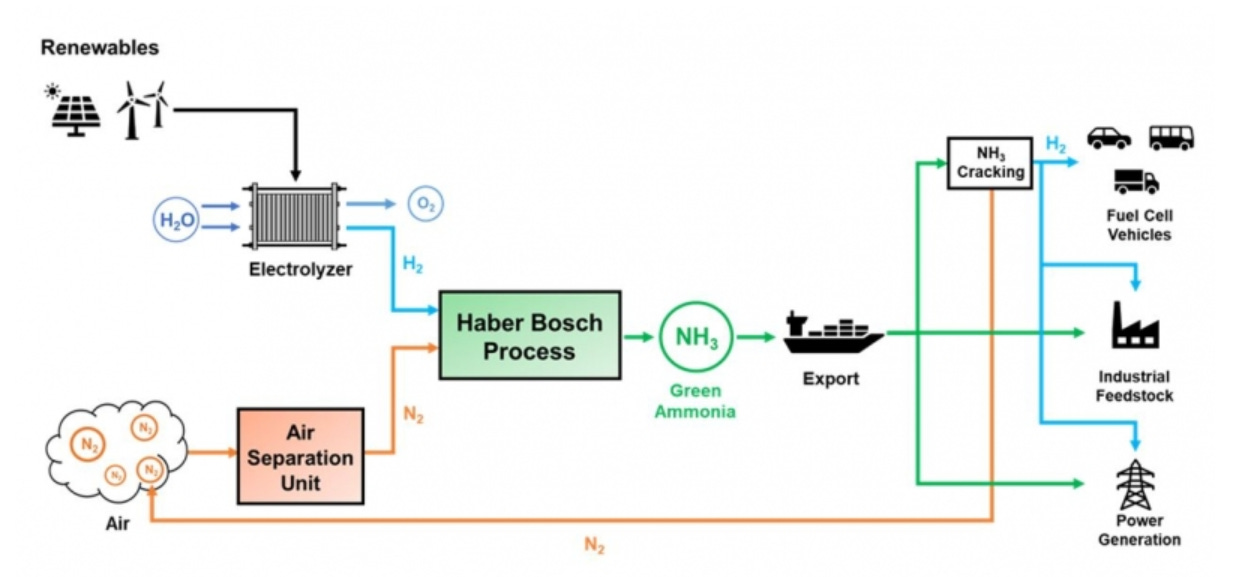
Touted as a compelling, “green solution” across a variety of sectors, ammonia can be burned in some combustion-based electricity generating plants or used in certain high heat industrial applications, and as an industrial feedstock. We’ll call it “an aspirational fuel” for vehicles and global marine shipping.
But in most Alliance schemes, it simply acts as a carbon-free carrier for the desired hydrogen molecules. Hydrogen is notoriously difficult and expensive to store and transport long distances. But ammonia is a global commodity, readily stored and transported by ships, with the basic infrastructure to support the “green” ammonia trade, until the “recracking” infrastructure that processes the ammonia back to hydrogen becomes widespread.
The EU, naturally, has an entire regulatory classification for “green hydrogen” and “e-ammonia” produced by this “renewable” powered electrolysis process: Renewable Fuels of Non-Biologic Origin (RFNBO, another desperately needed, catchy, five-letter climate acronym). And, surely, hundreds of pages of implementing regulations.
Fuels of biological origin produce CO2 when combusted. (Bad!) RFNBOs don’t (Good!). World’s most pressing problem solved!
If only life were that simple.
Globally, the wind/solar to electrolysis to hydrogen to ammonia project hype started to emerge in the years just before Covid-19(84). Early projects were announced in Australia (2019), Saudi Arabia (2020), Chile and Egypt (2021).
But as most of these project developers have discovered, even with government support, “if you build it, they will come!” is not a “sustainable” model for “green hydrogen” or “e-ammonia” (irony intended). Most have struggled to reach Final Investment Decision (FID) or obtain necessary financing.
Many are being delayed and, with the exception of the Saudi’s NEOM project and a scattering of others, few have actually started construction of the key infrastructure, other than some of the planned wind turbines and/or solar arrays. Environmental assessments, permitting and “social license” problems (the last ranging from NIMBYs to environmental to indigenous groups) continue to plague many.
But the biggest problem is that long-term offtake contracts for the hydrogen or ammonia being produced are not materializing. For most project developers, those firm contracts are the gating function for private sector financiers.
Governments, always excellent at picking losers, are trying to solve that problem. The EU’s auction mechanism, described near the end of this post, is intended to close the “green premium” gap between producers and industrial consumers Bill Gates noted in his notorious climate memo last fall. For the EU, subsidizing that gap is just another climate-related taxpayer-funded bonfire “necessary investment,” of course.
In our view, the projects with much more than a snowball’s chance in hell combine a credible offtake buyer under contract with existing ammonia production and port terminal facilities owned/controlled by the project developer. According to our research, you could lose a finger or two in a meat slicer and still be able to count the number of projects worldwide currently meeting those standards on that hand.
Meaningful physical progress on most projects is hard to find. Project cancellations, wildly out-of-scale capacity ambitions getting pared back dramatically (wind/solar and electrolyzer capacity, volumes of hydrogen and ammonia) and bankruptcies are more common.
In the middle of the head-on crash between aspiration and reality sits the Canada – Germany Hydrogen Hopefest. Four years after the announcement, things look very different than what was promised.
The first two significant project announcements tied to The Alliance were World Energy GH2’s (WEGH2) Stephenville project on the southwestern coast of the island of Newfoundland, and the EverWind Fuels Company (EverWind) Point Tupper project on the Strait of Canso northeast of Halifax, Nova Scotia.
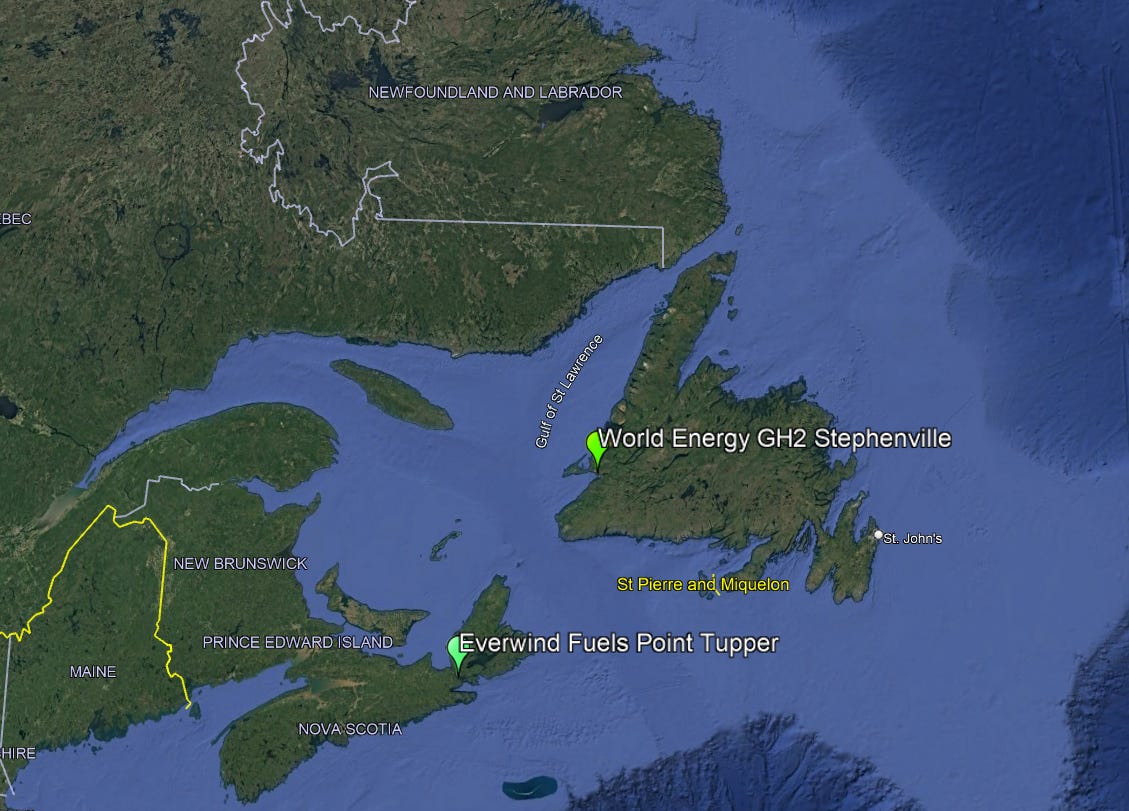
World Energy GH2 – Stephenville/ Port au Port, Newfoundland
Just over two months before The Alliance was announced at the Port of Stephenville, WEGH2 registered the required Environmental Assessment (EA) under Canadian regulations for “Project Nujio’qonik.” The translation for the Mi’kmaq name for St. George’s Bay is “where the sand blows.
The initial EA for the first phase envisioned 1 Gigawatt (Gw) of wind turbines (~164, reaching ~200 meters in height), powering a 0.5 Gw “green hydrogen” plant (the electrolyzers, air separation units and Haber-Bosch system) at the Port of Stephenville. Three 50 Megawatt (Mw) gas-fired turbine generators WEGH2 claimed would be “primarily fueled by hydrogen” (highly doubtful), and a 230 kV interconnection to the electric grid were also specified.
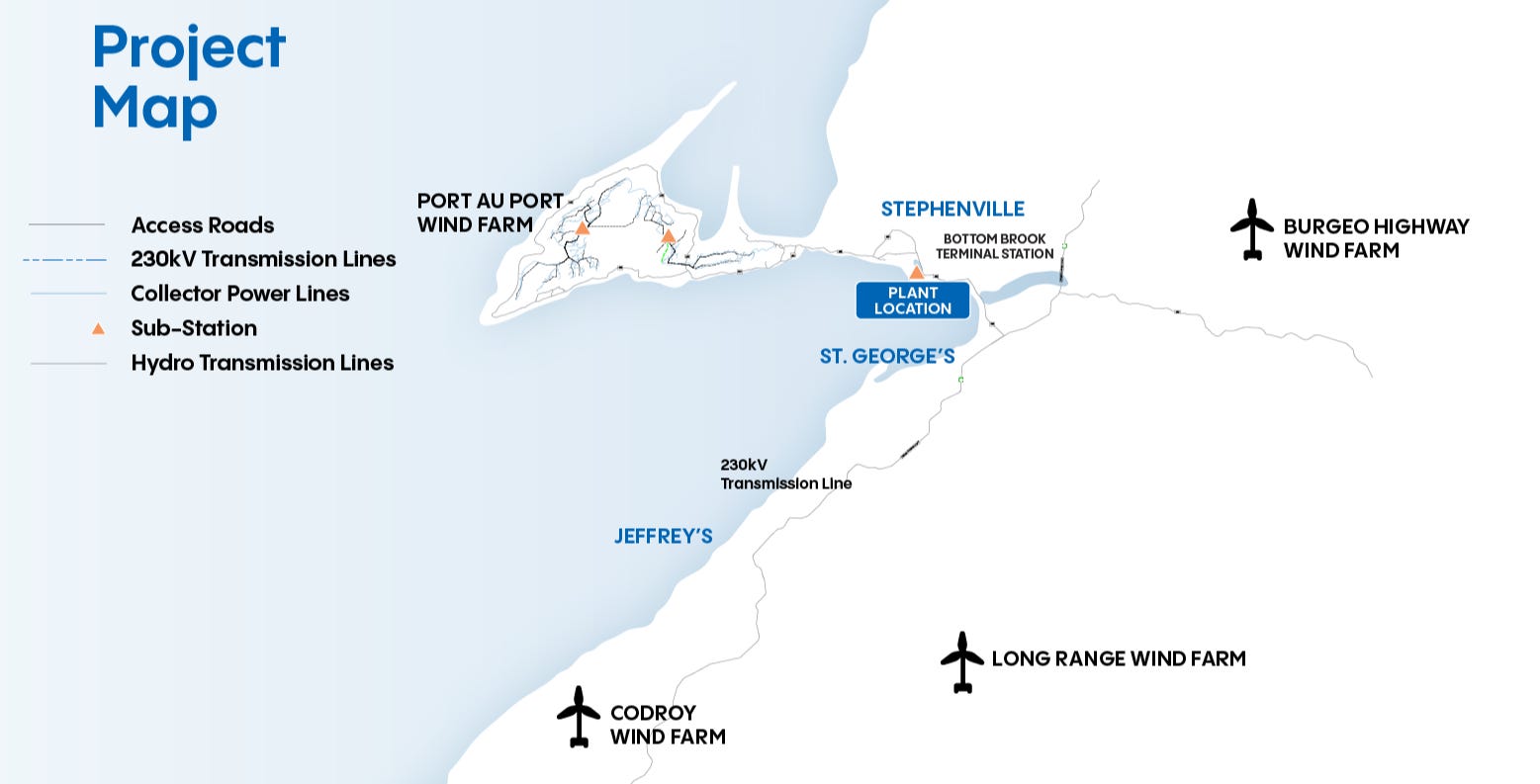
The wind turbines were to be scattered over 108,000 hectares (>250,000 acres) of Newfoundland and Labrador (NL) Crown Land. This required WEGH2 to submit and win Crown Land bids, after which it would first control the properties through provincial a land reservation/exclusive development rights agreement, eventually converting to long-term leases upon payment of all fees and meeting designated project milestones.
But that was just the start of WEGH2’s big ambitions. Planned later phases would bring the total wind power capacity to 3 Gw by expanding wind turbines to two additional sites and adding another Gw of “green hydrogen” production (twice the capacity of phase 1), bringing that capacity total to 1.5 Gw.
Later ambitions expanded wind generation further to 4 Gw. For the completed project, WEGH2 advertised goals of 280,000 metric tons (MT) per year of hydrogen (1.6 million MT of ammonia).
With offices in St. Johns on the island of Newfoundland, WEGH2 was created to be the ~$12 billion project’s local proponent. WEGH2’s ownership is split among three different entities, CFFI Ventures, Horizon Maritime, and World Energy, LLC. Wealthy Canadian maritime business owner John Risley owns controlling interests in CFFI Ventures and Horizon Maritime and a minority stake in World Energy, LLC.
Born in Halifax, Nova Scotia, Risley is former co-founder of Clearwater Seafoods and a successful Canadian maritime business owner. In the EA for the project, his CFFI Ventures is described as “an Atlantic Canadian based private investment firm with global investments... spanning a range of industries from renewable energy to extensive involvement in the ocean economy, banking, and a leading role in Canadian space exploration.”
Recognizing the sensitivity around indigenous land rights Canada has been struggling with for several years, as part of its “social license” WEGH2 has partnered with several indigenous groups in area communities, as well as a wind energy training and workforce development entity to create new jobs and economic opportunities. Despite the effort some residents formed a group called Environmental Transparency Committee to try and fight the project.
Money talks and WEGH2 used it in order to quell opposition in the rural communities, promising a $3 million+ “vibrancy fund” for the project area during the 3-year period of construction. Left unclear was the question of how that money would be distributed among unincorporated rural communities.
Questions of political homecooking emerged as the opposition organized in the fall of 2022. John Risley was at the center of it:
“..the project has made headlines not only because of its size, but also due to the close relationship between two of the project’s directors, John Risley and Brendan Paddick, and Newfoundland and Labrador Premier Andrew Furey.
Furey has previously called Paddick, a telecom exec, his “best friend.” The Liberal premier also holidayed at Risley’s fishing lodge less than a year before announcing an end to a long-standing moratorium on onshore wind development. (Furey has repeatedly rejected any suggestion of a conflict of interest, saying he has maintained an “ethical wall” and that all political decisions on Nujio’qonik — the name of the World Energy project — are the purview of other ministers.)
Three members of the Stephenville town council, including Tom Rose, and a civil servant, also flew home aboard John Risley’s private jet following a trade show in Germany in August.
But that opposition was not able to stop the project. By early 2023, WEGH2 seemed to be making significant progress.
In March 2023, WEGH2 submitted its Crown land bids for the 108,000 hectares needed for the project’s wind farms. In May, South Korean engineering and construction firm SK Ecoplant invested ~$50 million for a 20% stake in the project.
In June, WEGH2 acquired the Port of Stephenville. Critically, this gave the firm control of the brownfield land – a former Abitibi pulp and paper mill – for the planned hydrogen/ammonia plant and export terminal.
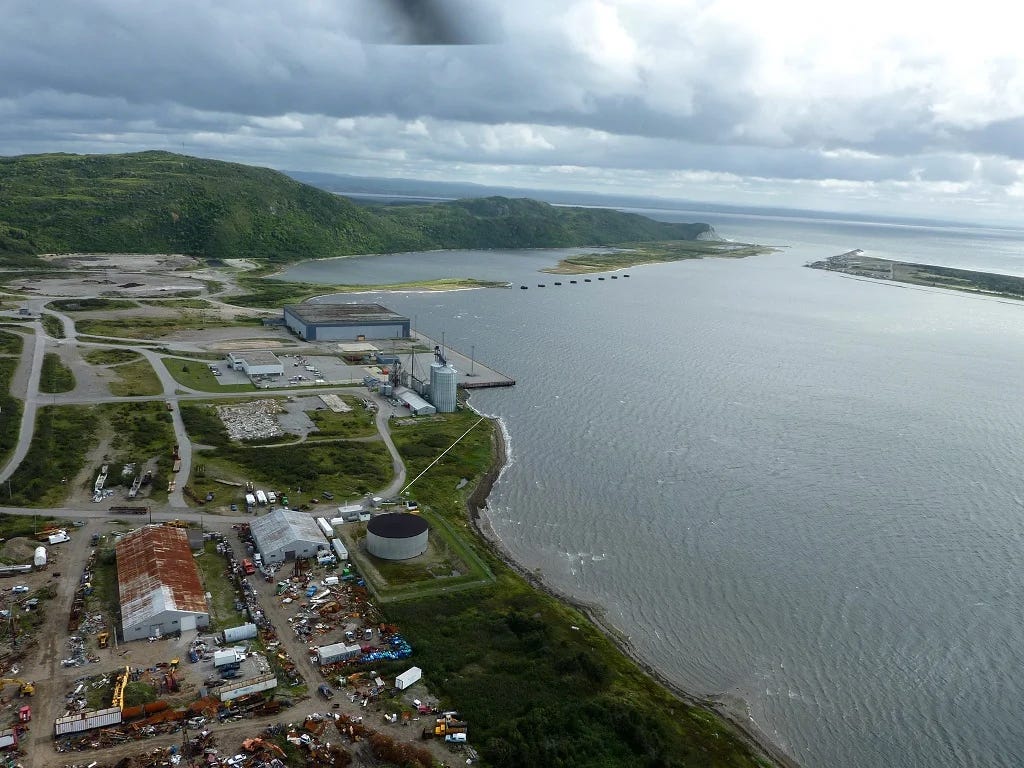
A major milestone occurred in August 2023 when the government of Newfoundland and Labrador approved WEGH2’s Crown Lands application for the 108,000 hectares of wind farms for Project Nujio’qonik. The same month the firm selected Topsoe to provide the Haber-Bosch ammonia loop for the project.
In February 2024, WEGH2 and the Government of Canada executed agreements for a $128 million (~US$95 million) credit facility from Export Development Canada to support the project. By mid-2024, WEGH2’s Project Nujio’qonik appeared to have the wind in its sails.
But around that time, the company began shifting the project’s framing. No longer limited to pure export hydrogen/ammonia, now Project Nujio’qonik was described as a broader “green energy campus,” capable of decarbonizing industry, supporting green fuels and green steel, and power data centers and other domestic loads from its planned 4 GW of wind turbines.
The “Newsroom” tab on WEGH2’s website contains an article dated May 9, 2024, briefly recounting the company sharing artists renderings of the hydrogen and ammonia plant with a Member of Parliament for St. John’s East and the Minister of Labour. Nothing has been posted under the tab since.
Despite its early hype materials implying the project would achieve first deliveries of hydrogen and ammonia in late 2025, by the end of 2024 the company was still not committing to specific construction much less production dates. All of this should have been a signal that WEGH2 was having trouble securing the necessary offtake agreements, something it surely would have been crowing about had they been executed.
An early 2025 CBC article confirmed the pivot. It also gave two critical clues that the project might be in trouble. First, the critical offtake agreements were not forthcoming:
“..in November, the company told The Canadian Press it couldn’t find a buyer and said it was shifting its focus to using wind energy to power a “renewable energy campus” in the short term.”
The second came when CBC asked provincial Energy Minister Andrew Parsons about WEGH2’s recent change of plans. The response came in the form of a letter, which stated:
“The department has not been formally advised of plans by World Energy GH2 to utilize the energy generated by its proposed wind turbines to power a data centre ..
.. “Any material changes in the project from what was proposed in the call for bids process would require review by the provincial government.”
Things did not improve for WEGH2 or Project Nujio’qonik throughout 2025. And they were about to get worse.
In early January this year, industry publications reported that the company had shelved its original project “after failing to secure buyers” for its hydrogen/ammonia and was “pivoting” to a “new wind-focused venture — Clean Grid Atlantic — to export power domestically.” John Risley explained the situation (emphasis in original):
“In comments to CBC, Risley acknowledged that with no viable export market and a lack of domestic industrial demand, clean hydrogen in Canada remains economically unfeasible in current market conditions. The company will instead focus on power transmission infrastructure to deliver clean electricity from its Stephenville wind development to other parts of eastern Canada.
The new website for World Energy GH2 reflects this pivot — rebranding itself primarily as a renewable energy developer, with hydrogen now positioned as a potential long-term application rather than a lead business model.
But the real shovel to the head occurred one month later. On February 19th, the provincial government gave WEGH2 nine days’ notice that its Crown land reservation would not be renewed and would expire at the end of the month.
And that was pretty much the end of WEGH2 and its vision of “green hydrogen” production at Project Nujio’qonik. One week after receiving the notice, WEGH2 filed for creditor protection under the Companies’ Creditors Arrangement Act (CCAA, the federal insolvency restructuring law for bankrupt large corporations).
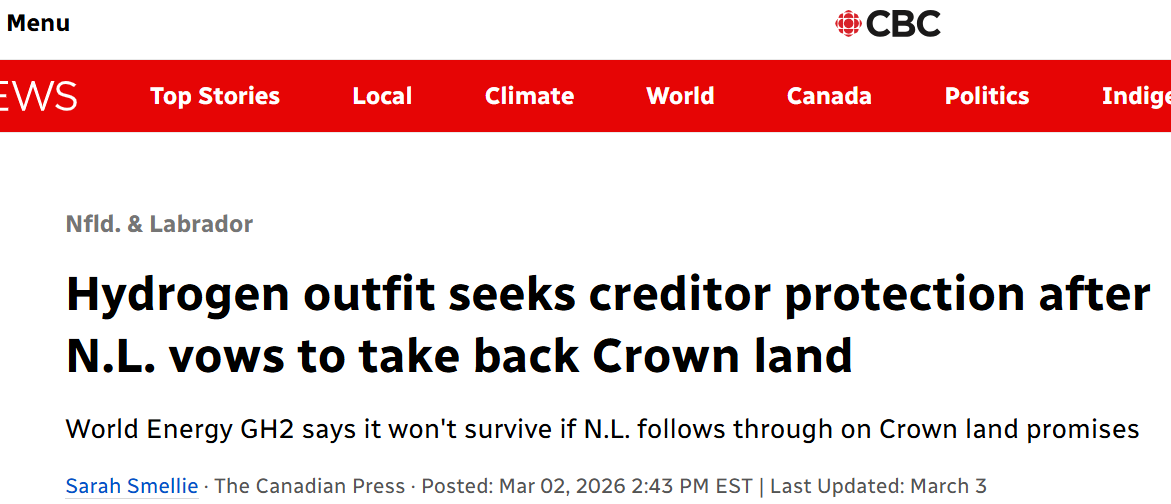
The filing shows that WEGH2 owed the Newfoundland and Labrador provincial government over $10.5 million in unpaid Crown Land reservation fees. The fees to reserve the land were ~$390,000 per month, billed quarterly. It owes Export Development Canada another $50 million (all figures Canadian dollars).
John Risley must have been warned just before the province notified WEGH2 that its Crown Lands reservation was terminated. Two days before receiving that notice, CFFI Ventures sought bankruptcy protection under the Nova Scotia Companies Act.
As a result of ongoing disputes with, and pressure from, large creditors over the initial reorganization plan, the CFFI Ventures proceeding was transferred to federal jurisdiction, where it appears to be proceeding as a liquidation. Whether WEGH2’s Crown Lands reservation of 108,000 hectares associated with Project Nujio’qonik is an asset on WEGH2’s books remains a key legal battleground in both the bankruptcy cases.
Suffice to say, despite the hopes and best laid plans of “The Alliance,” Germany won’t be getting any “green” anything from WEGH2 and Project Nujio’qonik any time soon.
EverWind Fuels – Point Tupper, Nova Scotia
EverWind acquired the Point Tupper terminal from NuStar Energy for $60 million in April 2022, around four months before the big Alliance announcement (at WEGH2’s now failed Newfoundland project). Construction was slated for late 2023.
EverWind announced plans to produce a small amount of green hydrogen in 2025 (sound familiar?). Full phase one operations were scheduled for 2028, with production of approximately 200,000 tons of “green ammonia” each year, using newly built wind farms powering electrolyzers and a Haber-Bosch plant, just as WEGH2 had planned.
A second phase would add approximately 800,000 tons more annual capacity. Total capital investment was projected at more than $6 billion.
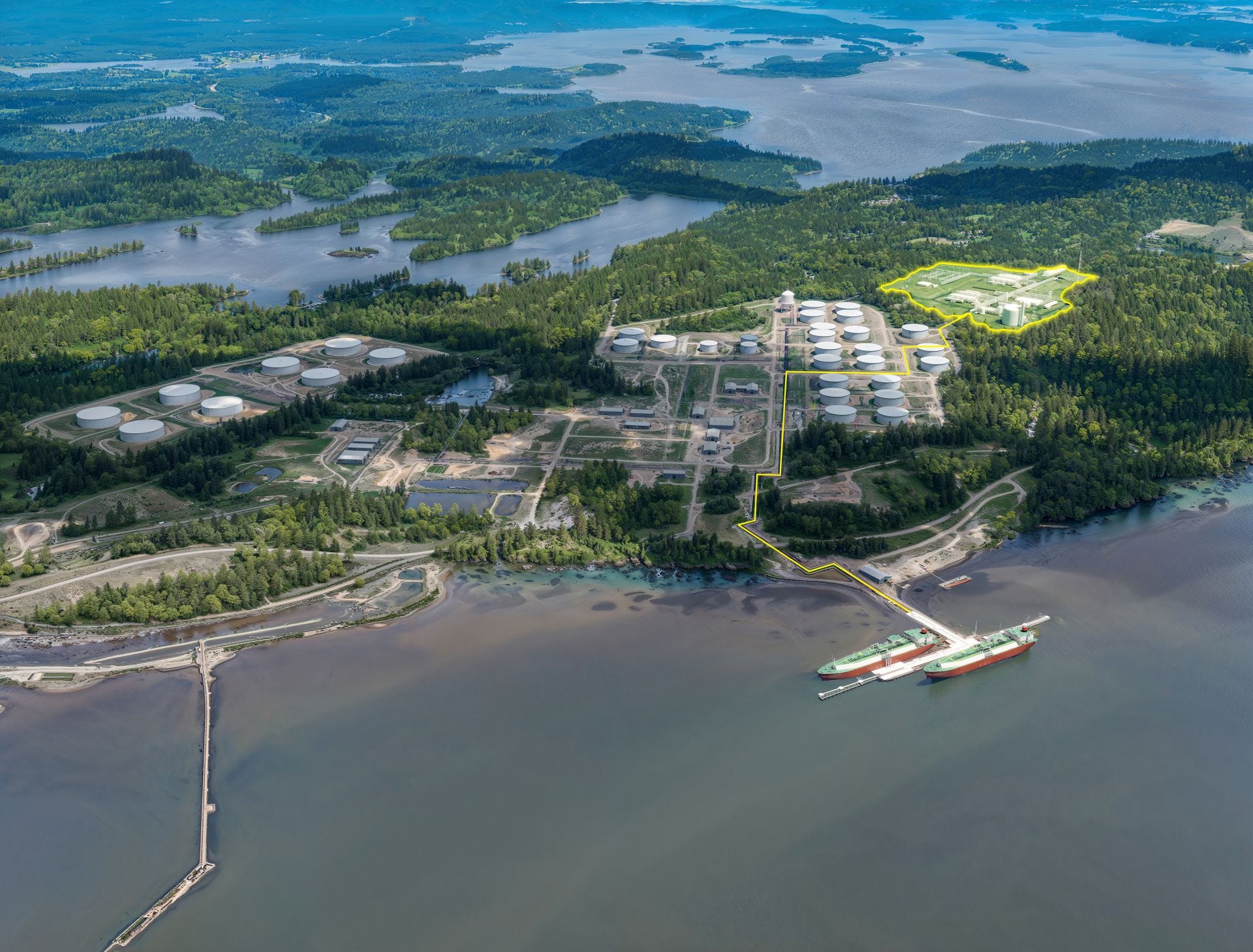
The project has achieved numerous milestones similar to WEGG2’s failed project in Newfoundland. EverWind acquired the former NuStar terminal, which was crucial. The project has completed the requisite Environmental Assessment process. Its Crown Lands reservation appears to be intact, suggesting EverWind is paying the required fees. Front-End Engineering Design is said to be complete.
EverWind has indigenous partnerships in place, with Cape Breton’s Membertou First Nation leading a consortium that owns 51% of the project’s wind portfolio. And in March, it secured $240 million in “structured financing” from New York-based investment manager Nuveen Infrastructure Credit.
But technical, permitting and financing difficulties have pushed the schedule back about three years. EverWind’s website now states construction is targeted to begin in 2027. If relevant history is any guide, the same problem WEGH2 faced with offtake agreements in Newfoundland suggests EverWind’s new schedule may even be optimistic.
On the same fateful day in August of 2022 when the Canada Germany Hydrogen Hopefest was proclaimed, Everwind announced Memoranda of Understanding (MOU) with two German multinational utilities, each contemplating 500,000 tons of “green ammonia” purchases annually. One was E.ON and the other with Uniper.
In an irony we could not make up, Uniper was spun out of E.ON in 2017 and sold to Finnish utility Fortum in 2018, only to be bailed out by the German government in July 2022 in a €15 billion rescue deal that nationalized part of the company. Why, you might ask? Because it ran out of cash trying to buy natural gas on the spot market in the very situation that sent Olaf Scholz to Canada in the first place.
But those MOUs were non-binding, nothing more than contemplating future negotiations for purchase contracts. And last week, E.ON announced that it was abandoning the project. EverWind has provided no update on the status of any offtake contract negotiations with Uniper.
EverWind had another similar, but even bigger project on the Burin Peninsula of Newfoundland, less than 200 miles as the crow flies from WEGH2’s failed project at Stephenville. There EverWind had ambitions of as much as 10 Gw wind generation and 1.75 Gw of solar generation. The company claimed the $16 billion investment would be one of the largest in Newfoundland history.
But in August 2025, the province reduced the broader wind-energy reserve area and extended it only until February 28, 2026. And in the same February 19, 2026 announcement that swept away WEGH2’s Crown Land reservation for unpaid fees (3.5% of land value, paid quarterly), EverWind lost its own reservation for its Burin Peninsula project.
Such is the state of The Alliance as of this writing. One of the marquis projects that captured the “green hydrogen” world’s imagination went bust before putting the first piece of steel in the ground. The other is supposedly alive but without the offtake agreements that are clearly the gating function.
Of course, German and European leaders who have their taxpayer’s wallets hearts in “green hydrogen” won’t give up the dream easily. And it looks like Canada won’t either.
The answer is the “H2Global joint Canada-Germany H2Global auction” concept, first announced in March 2024 in the form of (what else?!) a Memorandum of Understanding. In January of this year, the European Commission (who else?!) gave the H2Global auction a (citizen-funded) boost (emphasis added):
“On January 15, 2026 the European Commission (“Commission”) approved the €400 million H2Global joint Canada-Germany H2Global auction concept under State aid rules. The Commission’s decision authorizes Germany to contribute €200 million towards the scheme, which will be matched by Canada, to support Canadian production of renewable hydrogen and its derivatives, known as renewable fuels of non‑biological origin (“RFNBOs”).”
The Bilateral Window will follow H2Global’s double-sided auction approach, with Hint.Co (the government-backed intermediary) acting as market-maker, bridging the cost difference between buy-price and sell-price for the imported RFNBO. However, unlike the other H2Global tenders previously launched, the Bilateral Window will run simultaneous auctions on the producer-side and the customer-side.
Hint.Co will auction ten-year Hydrogen Purchase Agreements (HPAs) and Hydrogen Sales Agreements (HSAs) under separate auctions but on parallel timelines. Winning bids on each side will then be matched, so that producer and customer have a contractual relationship.
We’re certain Hint.Co is acting as intermediary and market maker pro bono, out of the goodness of their hearts. And color us skeptical that the volumes of “green” hydrogen or ammonia that the H2Global Auction scheme could possibly unlock with only €400 million to bridge the gap between buyers and sellers will have any material impact on Europe’s or Canada’s lofty decarbonization goals.
We generously assumed a US$500/ton “green premium” for ammonia produced by wind/solar/electrolysis (the International Renewable Energy Agency’s 2022 estimate mid-point was ~$810/ton), not including tank storage, port handling, or transatlantic shipping costs. The “landed” green premium would surely be higher than our $500/ton.
Using today’s exchange rates, the €400 million Canada and Germany recently committed to the European H2Global auction equates to ~$462 million in U.S. dollars. At a “green premium” difference of $500/ton, that $462 million would subsidize the purchase of less than 1 million tons of “green ammonia,” a figure equal to ~0.5% of the nearly 200 million tons of ammonia used globally last year. Add in transatlantic shipping costs and call us skeptical that the Canada Germany auction subsidy can even purchase that much.
All of this hydrogen bombing was avoidable, because it was predictable. In only our third post on Substack, we panned the facts that Trudeau “could not make the business case” for Canadian LNG, that none of the hundreds of wind turbines, electrolyzers, or the Haber-Bosch plants that render ammonia existed, and that Germany didn’t even have sufficient infrastructure to receive and process the “green” ammonia to be produced and shipped. But others whose work we admire provided specific details as to why the entire charade was a road to nowhere before, and after, The Alliance was announced.
Doomberg’s June 2022 post Immaculate Combustion took apart the idea of turning hydrogen into ammonia and then cracking it in a reactor to reconvert to hydrogen to use in a fuel cell to produce electricity to power a tractor, additionally noting that in order for the process (emphasis added):
“..to enable a reduction in carbon emissions, there would need to be a virtually limitless supply of economically viable hydrogen produced from renewable sources (or nuclear power). If we had such so-called “green hydrogen” available to make ammonia, the last thing we would do is convert it back to hydrogen and run tractors using fuel cells. Instead, we would focus on systematically replacing the ammonia we currently make from fossil fuels and use to grow food, which is an enormous task that would take decades.”
And Doomberg’s post Chicken’s Razor in October of that year about the recently announced Alliance succinctly pointed out the absurdity of the scheme in no uncertain terms (emphasis in original):
With no realistic ability to ship hydrogen directly anytime soon,
aspiring griftersgreen hydrogen proponents intend to transform hydrogen to ammonia and ship that, a concept we’ve had fun ridiculing in a prior piece. While the notion of using carbon-free energy to produce hydrogen to produce ammonia is indeed seductive – and one we wholeheartedly endorse in the right setting – making ammonia using hydrogen derived from wind energy in Newfoundland, where no Haber-Bosch plants exist, for ultimate use in Germany, is insane.
Doomberg’s better alternative for Germany was elegantly simple:
“If the goal is to land “carbon-free” ammonia in Germany, simply turn back on the retired nuclear power plants and dedicate them to the production of ammonia!”
And Doom would not be alone in making the suggestion.
In June 2024, around the time WEGH2’s fortunes were changing, Chris Keefer and Canadians for Nuclear Energy (C4NE) produced a 38-page report titled “The Canada-Germany Hydrogen Alliance: Throwing Caution to the Wind.” C4NE’s report details the major problems with The Alliance concept. Regarding energy losses in the production of hydrogen and ammonia (emphasis added):
“With current technology, electrolysis + the Haber-Bosch process to make ammonia is at most about 66% efficient before loading the product onto a tanker ship. Then, re-converting it to hydrogen using ammonia decomposition, or “cracking,” requires extra fuel inputs and creates further inefficiencies that drive the energy losses throughout the process to over 50%. In all, more than half of the energy that would be used to bring Canadian hydrogen to German shores would be lost before it could be used.”
Regarding the wisdom of importing ammonia from Canada versus producing hydrogen domestically in Germany:
“Compared to domestically produced German hydrogen that avoids the conversion to ammonia and back, the low efficiency of exported Canadian hydrogen multiplies its carbon intensity, ecological impact, end-user price, and subsidy cost for each unit delivered. This constitutes a major competitive disadvantage.”
In terms of the economic absurdity of the proposition (emphasis in original):
“Close to 100% of current global hydrogen production occurs on-site where it is needed. And of this on-site production, the higher cost of electricity-powered electrolysis compared to Steam Methane Reformation of fossil fuels has held electrolysis at a mere 0.1% global market share. The combination of electrolysis and inefficient international hydrogen exports is therefore, on economic grounds alone, an extremely dubious proposition.”
The report provides details how the lifecycle CO2 emissions are far higher than the front-end onshore Canadian carbon emissions counted, how the projects have significant ecological impacts, that much of Canada’s subsidies will leak to foreign companies (electrolyzer and wind turbine manufacturers, etc.), and many other consequences that Canadian and German politicians were all too happy to ignore.
The C4NE report takes direct aim at Germany’s ignorant decision to close its last nuclear power plants. Like Doomberg had suggested nearly two years earlier, C4NE suggested that if “green hydrogen” is their aim, those plants need to be the source, not the Canadian wind-electrolysis-hydrogen-ammonia scam (emphasis ours):
“The fully-completed Nujio’qonik project (with around 1.8 GW of electrolysers) will cost an estimated CAD 16 billion and occupy over 1,000 square kilometres. At the expected 50% overall utilization of its electrolysers and roughly half of its inputted energy irretrievable from the delivered hydrogen, the project will deliver around 4 TWh of hydrogen per year. This is about 1/15th of what Germany could produce from its half-dozen nuclear plants while requiring little more than the capital cost of new electrolysers. At a capital cost of USD 1,100–1,800 per kilowatt for PEM electrolysis, the cost for electrolysers to make use of the full output of the otherwise unused, recently shuttered German nuclear fleet would range between 9 and 15 billion USD.”
It is fair to argue that Keefer and C4NE are unapologetic advocates for nuclear power as the preferred electricity generation technology for decarbonization and would rather see Canada invest in domestic nuclear power. That said, their report puts numbers to the scale of the stupidity of The Alliance in terms of Canada’s interests:
“Using the figures from Nujio’qonik, for Canada to match the hypothetical H2 production capacity of electrolysers powered by already-built German nuclear plants would require astronomical expenditure”, including:
$240 billion (Canadian) in capital investment for wind turbines, electrolysers, and ammonia conversion facilities
60,000 Mw of new wind capacity (equal to Germany’s entire installed wind fleet)
3,000 Mw of new gas-fired generators
2,000 Mw of additional balancing power from the grid, the equivalent of three large CANDU nuclear units
15,000 square kilometers of land (2X the area of Greater Toronto)
· 30,000 MW of electrolysers (3X what would be needed if using restarted German nuclear plants coupled w/sufficient ammonia conversion capacity)
Over 200 annual round trips across the Atlantic by large gas carrier ships (powered by refined oil, not “RFNBO”)
Space does not allow us to give proper justice to the CFNE report, but we applaud Chris Keefer and the organization for an outstanding, sober, detailed analysis that Canada’s leaders chose to ignore. We highly encourage readers interested in more details to read the full report (linked here).
We close by noting that some quantity of “green” hydrogen derived from wind and/or solar powered electrolysis is surely going to reach the market long before, say, electricity from fusion reactors. But most of it will be used domestically where it is produced, it will be costly, there won’t be very much of it relative to global hydrogen consumption by industry (as C4NE’s report notes, ~94 million tons) and, as such, it won’t be the holy grail for decarbonizing heavy industry any time soon.
If Germany wants hydrogen from electrolysis, let it restart its nuclear plants and use them to power a domestic hydrogen industry. And as C4NE makes the case, if Canada wants a domestic “green hydrogen” industry, the case for the nation’s own CANDU reactors gets even stronger.
Germany, on the other hand, like the rest of Europe will try everything that won’t work first, and as long as it promises a reduction in CO2 emissions, the cost, environmental consequences, land use, and whether it will actually work or not are mere afterthoughts.
For now, Hydrogen is Bombing in the Canada – Germany Hydrogen Alliance.
“Like” this post or be sent to babysit the Port of Stephenville for CFFI and WEGH2’s creditors this winter.
Leave us a comment. We read them all and reply to most. Refills the tank here.
Subscribe to environMENTAL for free below. Please consider a voluntary paid subscription to support our work.
Share this post. Helps us grow. We’re grateful for the assist!
No posts
Comments
Nothing yet. Say the first thing.
Sign in to join the conversation.