
“There is no instance of a nation benefiting from prolonged warfare.” – Sun Tzu
On podcast appearances since Russia’s invasion of Ukraine, Doomberg has routinely made the comment that “one of the reasons you don’t go to war is because you might lose.” The statement itself is blind to whichever side you happen to support in any conflict. The consequences of losing are never good.
Technically speaking, a nation need not even lose a war to suffer society-straining political or economic consequences - or both. Think America, at home and in southeast Asia, in early the 1970s.
The theocratic regime running the Islamic Republic of Iran cannot defeat the overwhelming firepower, capacity, technology and sheer force of the U.S. military on any battlefield or at sea. But it may not need to do so.
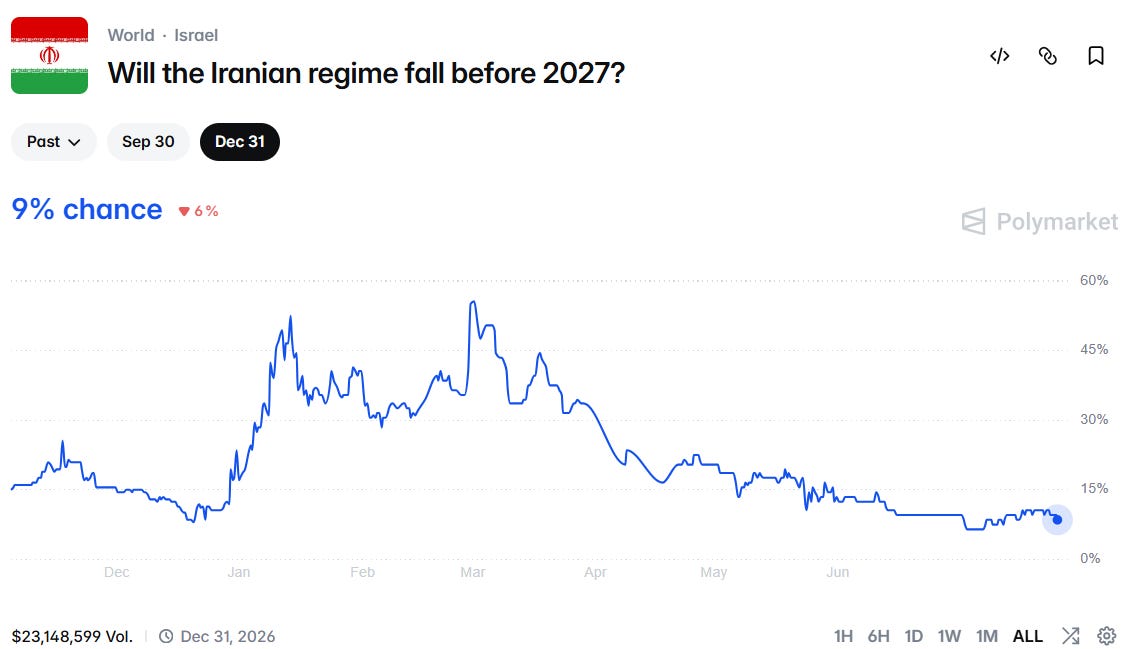
The regime may merely need to extract enough of a toll on the U.S. economically, and Trump politically, to get the latter to soften his demands and survive with its skin. Prediction markets, with all their flaws, seem to reflect that reality.
Open-source data from the Russian war in Ukraine made it clear that cheap drones had changed modern warfare in a profound way well before Trump’s “excursion” in Iran. Meting out its ballistic missiles, and using ~$30,000 Shahed drones powered by two-stroke air-cooled small aircraft gas engines (that Iran copied from a simple German design) generating a mere 50 horsepower and weighing less than a bag of play sand have kept tens of billions of dollars’ worth of the world’s most sophisticated and powerful naval battlefleet out of the Persian Gulf and even several hundred miles offshore in the Arabian Sea out of an abundance of caution to date.
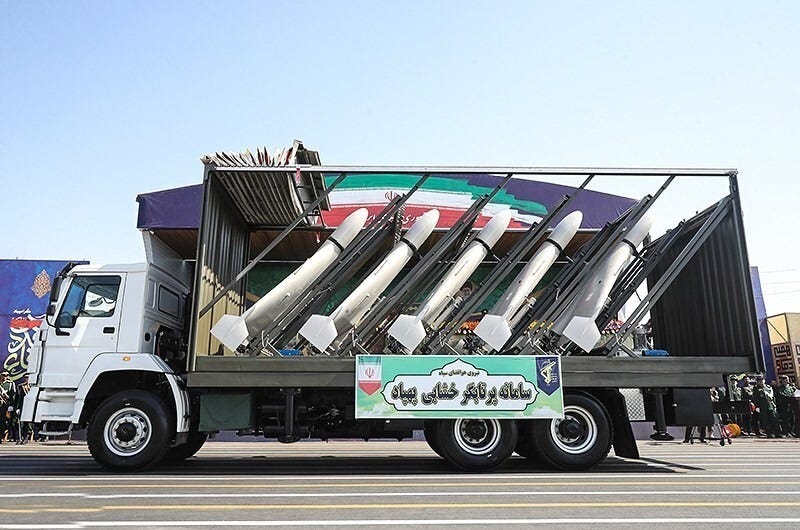
The Iranian regime is a despotic, fundamentalist theocracy crushing its citizens’ freedoms, the Middle East’s undisputed lead terrorism sponsor, and a legitimate nuclear threat. But it has strategically leveraged its assets against an opponent with a military advantage it can never overcome in a surprising manner that has defied Trump’s objectives (whatever they actually are) for five months.
Diplomatic negotiations during the ceasefire failed in April. Nine days after the parties walked away from the negotiating table, Trump extended the fragile ceasefire “indefinitely.”
But in late June, Iran began attacking vessels in the Strait of Hormuz, and in early July, the Islamic Revolutionary Guard Corps (IRGC) struck three more. By July 8th, Trump had seen enough and announced that the beatings would continue until Iranian diplomatic morale improved, then it was bombs away with the two sides reigniting an escalating series of tit for tat strikes.
The U.S military pounded Iranian missile sites, air defenses and coastal facilities. This week, with Saudi Air Forces, U.S. Central Command confirmed it bombed Iran-aligned terrorist logistics targets in eastern Iraq, stating the targets were associated with more than 30 attempted drone attacks on U.S. and Saudi forces and oil infrastructure in the last few days.
Iran does not seem fazed. It continues to launch missile and drone attacks, targeting U.S. military assets in Kuwait, Bahrain, Jordan, Qatar, and Oman.
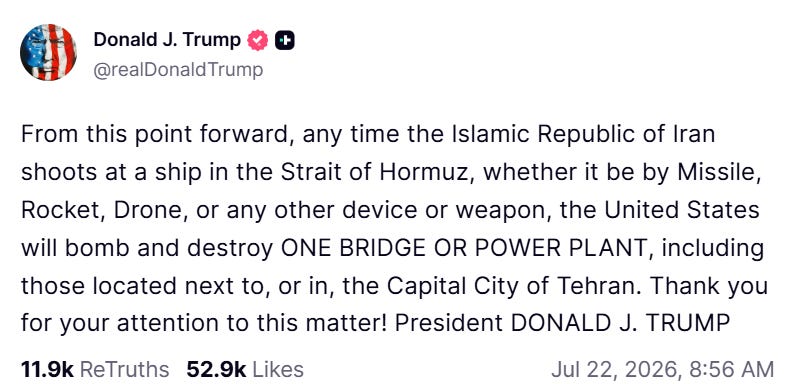
On July 22nd, Trump used his Truth Social outlet to threaten Iranian infrastructure.
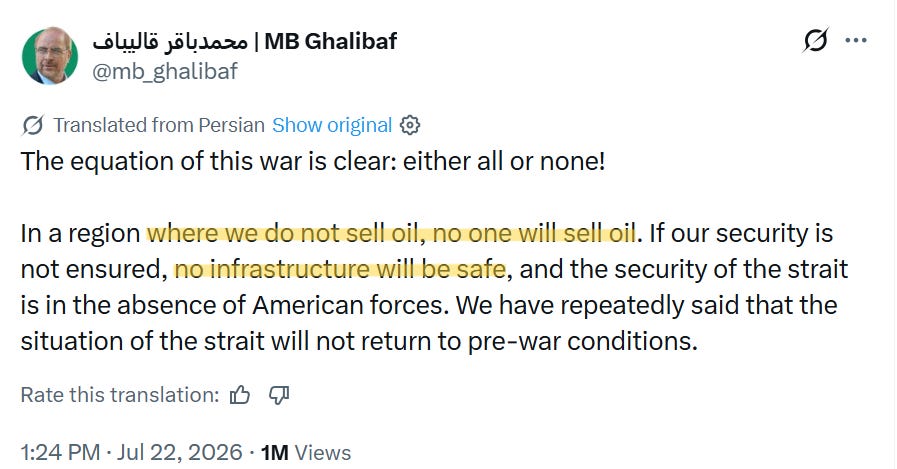
Iran responded in kind. Iranian Parliament Speaker Mohammad Bagher Ghalibaf specifically threatened neighboring Gulf states’ oil and infrastructure on X:
Iran’s Foreign Minister Abbas Aragachi reiterated the threats on X. In response to Trump’s threat, he went all biblical and he, too included a not-so-indirect threat against Iran’s neighbors in the region:
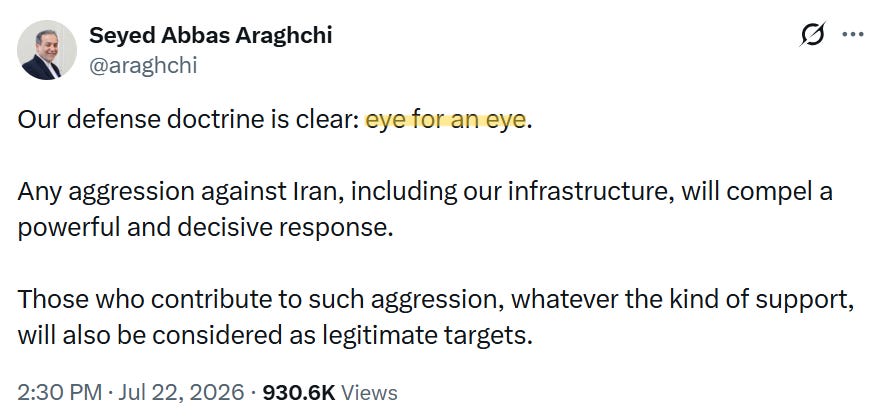
Attacking civilian infrastructure that makes no effective contribution to an opponent’s military actions is a violation of international law. But in the second decade of the twenty-first century, Russia, Ukraine, Iran, President Trump and much of the rest of the world are blowing by that quaint concept in the left lane out in the Wild West, while whatever “international law” enforcement still exists is either at the nearest truck stop eating donuts or on the side of the road out of gas.
In the midst of all this, on July 20th, the Yemen-based group Ansar Allah, known in the West as the Houthis, entered the conflict, announcing a blockade of maritime traffic to and from the Gulf of Aden to Saudi Arabia’s Red Sea coast via the Bab el-Mandeb Strait, something we warned about four weeks into the conflict. In the ensuing days, they claimed attacks on a Saudi oil tanker and Saudi oil facilities in Yanbu and Jizan.
Any disruption to oil cargos transiting the Bab el-Mandeb strait becomes a costly new problem for Saudi Arabia and those dependent on its oil. But as the Houthi’s actions and vessel tracking in the ensuing days quickly confirmed, their blockade - if they can even enforce it - doesn’t apply to everyone. One important buyer has “other arrangements.”
How does a disruption to the Bab el-Mandeb strait impact Saudi crude oil, and who gets hurt the most? Which country’s Very Large Crude Carriers (VLCCs) have been granted safe passage through the Bab el-Mandeb? What else did that geopolitical power signal this week, and how do all of these developments fit into our working mental model from April about what could have possibly driven Trump to pursue a war in Iran?
We begin with the Houthi disruption to the Bab al-Mandeb strait. The narrow waterway connects the southern Red Sea to the Gulf of Aden and the Arabian Sea beyond.
Within about a month after the munitions started flying back in February, the Saudis had rerouted millions of barrels per day (bpd) of oil flows to the East West pipeline they constructed decades ago as a contingency plan in the event of a Strait of Hormuz disruption. Running ~750 miles from the Eastern Province oilfields around Abqaiq to the Saudi Arabia’s Red Sea port of Yanbu, the pipeline’s capacity was quickly maxed out to move ~5 million additional bpd for export through the Bab el-Mandeb strait once it was clear the Strait of Hormuz closure would not be temporary.
Prior to the Iran war, the East West pipeline was moving ~2.5 million bpd. Some of that oil is routed to Yanbu area refineries for domestic consumption. But significant volumes were destined for European markets via the Mediterranean to the north by transiting through the Suez Canal.
If the Houthis can effectively close the Bab el-Mandeb, the Suez Canal is the only other realistic option for Saudi oil loaded at Yanbu to transit exit the Red Sea in order to reach international markets. That would seem simple enough but for one problem.
The Suez Canal comfortably accommodates “Suezmax” crude oil vessels designed to draw no more than 65 feet when fully loaded, each carrying ~800,000 – 1,000,000 barrels of oil. Suezmax vessels are thus used to carry the bulk of Saudi oil shipments headed north from its Red Sea port at Yanbu to European buyers.
Most of the current generation of VLCCs are much larger, with more draft than the Suez Canal’s ~66-foot depth limit. VLCCs can carry 1.75-2 million barrels of crude and aside from their greater navigational depth requirements, their larger beams (width) exacerbate the problem in the narrow canal.
The difference has real world implications once the Houthi’s started firing at ships and into Saudi Arabia. The consequences in terms of time and money are non-trivial to the nations importing that Saudi oil.
Fully loaded VLCC’s normally have to engage in a cumbersome, time-consuming and costly exercise to lighten their loads and pass through the Suez Canal into the Mediterranean in order to reach ports of call anywhere in the world, offloading as much as 30% of their cargos at Ain Sukhna on the Egyptian Red Sea coast, at the southern terminal of the SUMED (Suez to Mediterranean) pipeline and storage tank system. That oil then gets piped to the northern SUMED terminal west of Alexandria on the Egypt’s Mediterranean coast, where it is reloaded via offshore pipeline back on the VLCCs.
In addition, the question of whether the limited market of commercial insurers willing to issue coverage for VLCCs and their cargoes will shy away from Red Sea passages given the Houthi’s ability to strike vessels some distance from northwest Yemen is an open one. For now, risk premiums have skyrocketed:
“On Thursday, the sources said, indicative war risk premiums for voyages through the southern Red Sea rose to over 1% of the value of a ship from around 0.75% on Tuesday and 0.3% last week before the Houthi announcement, according to the sources, who declined to be identified due to the sensitivity of the matter.
Rates for some shipping companies calling at Saudi ports and also Saudi-linked ships were quoted as high as 3% for voyages from southern Saudi ports in the Red Sea such as Jizan and Al Shuqaiq, which would take them closer to Yemeni territory and for transits through the Bab el-Mandeb gateway further south that leads into the Gulf of Aden..”
The distances from Houthi launch sites to the Saudi port at Yanbu, the SUMED southern terminal at Ain Sukhna, and even Suez canal’s northern terminus at Port Said, Egypt are all we understood by Lloyds of London and the commercial insurance market for crude oil carriers. All are within range of Houthi missiles or drones, some of which have easily traveled over 1,300 miles. In July 2024, a Houthi Samad-3 drone followed an indirect route and is believed to have traveled ~2,000 miles before striking Tel Aviv, killing one person and injuring about a dozen more.
Around 70% of Saudi oil exports are destined for Asia. A Saudi cargo leaving Yanbu passing through the Bab el-Mandeb normally reaches South Korea, for example, in about 24 days. After transiting through the Suez Canal into the Mediterranean, the route around Africa adds about 30 more days.
No matter where in Asia that cargo is headed, the reroute adds 3,000 – 6,000 nautical miles and weeks of additional travel, doubling or more the voyage for some Asian destinations. The additional cost of fuel to haul those cargos and the added daily vessel charter fees add to the cost of each barrel.
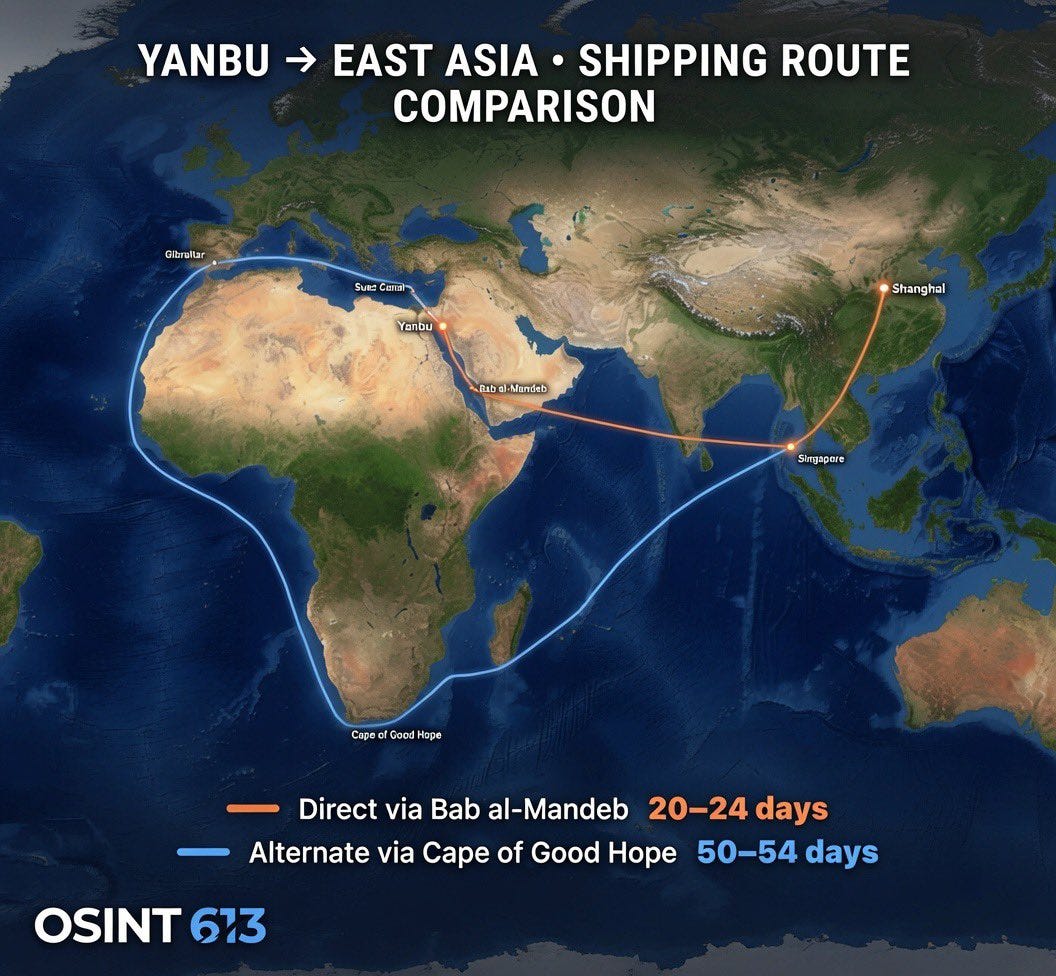
Higher frictional costs for the offload/reload scheme to get through the Suez Canal, higher war-risk insurance costs for VLCC owners, and add up to 30 days or more for delivery to Asian destinations plus all the additional costs of charters days and fuel burned. These are the practical realities once the Houthis joined the conflict and began threatening the Bab el-Mandeb strait.
Somebody has to pay for all that frictional cost. A reasonable estimate is ~$2 - $5/barrel.
The Saudis’ can discount their oil to offset the cost. But there’s not a damn thing they, or their Asian buyers, can do about the additional time if VLCC’s are forced to use the Suez Canal. That matters for nations with uncomfortably narrow crude oil inventories.
Houthi attacks in the Bab el-Mandeb strait have had substantial impacts on the flow of Saudi crude in recent years. As we wrote in Decades in Days (March):
Starting in the fall of 2023, Houthi attacks threatened and rerouted significant volumes of global shipping traffic through Bab El-Mandeb. Prior to October 2023, ~9mmbpd of crude oil and refined products (~9% of global seaborne) and nearly 10 million cubic meters of LNG (about 8% of global LNG trade) transited the Strait each day. Since the attacks, LNG volumes have been practically reduced to zero, and crude oil shipments down to around 4-5mmbpd.
In 2025, the Trump administration bombed the Houthis in northwest Yemen for seven weeks before negotiating a ceasefire agreement in May. Given their paymaster’s interests, the Houthi’s effectively declared force majeure on that agreement last week, changing the oil import calculus across Asia.
American allies South Korea and Japan will feel the impact. Saudi oil makes up ~35% - 40% of their crude oil imports.
What about China?
According to the Statistical Review of World Energy, in 2025 China produced 4.3 million bpd of crude oil but consumed around 17.3 million bpd. The ~13 million bpd difference was imported. (Other reports show that 2025 shortfall at ~11.4 million bpd.)
By our calculations, ~3.5 million bpd of those crude imports came from Saudi Arabia and Iran. This means a good working estimate is that Saudi and Iranian crude makes up ~25-30% of Chinese imports.
China was reported to have ~1.3 billion barrels of oil in storage when Trump commenced the Iran war. Engine switching, electrification, and other measures may limit consumption in the short term. And its giant strategic oil reserves buffer China even if it were to completely lose and be unable to replace ~3 million bpd of imports from Saudi Arabia and Iran for six months.
But just as all of these realities were emerging in the wake of the Houthi’s opening a new front in the Iran war, something rather telling happened.
Last Friday, reports began to emerge that the Houthis were allowing some ships to pass through the Bab el-Mandeb strait. And, while we suspect most of our readers will only need one, we’ll give you three guesses whose ships those were (emphasis added):
The Houthi militia in Yemen appears to be allowing some ships to pass through the Bab al-Mandab strait at the mouth of the Red Sea, despite its blockade of shipping to Saudi Arabia, experts said on Thursday.
A Chinese oil tanker, Cosco Shipping’s VLCC Xin Long Yang, has been granted permission to pass through the waterway, according to the trade publication Lloyd’s List.
It said Chinese tankers returning from the Saudi port of Yanbu in the Red Sea may be able to negotiate passage with the Iranian-backed Houthis on a case-by-case basis.
China isn’t likely to confront the U.S. Navy in the Persian Gulf or Arabian Sea to protect its Middle Eastern oil supply. But it demonstrated this week that it won’t quietly sit on the sidelines, either.
Tuesday, Reuters reported that its “sources” had determined (emphasis added):
“China has held direct talks with Yemen’s Houthi movement to enable its tankers to sail through the southern Red sea without being attacked after the Iran-aligned militia pledged to prevent access to Saudi ports, six sources with knowledge of the matter have said..
..Beijing asked the Houthis directly to promise safe passage for its tankers, according to the sources, who included a senior Iranian official.
China was among the first countries to contact the Houthis directly about transits through the Bab el-Mandeb, the strait at the southern end of the Red Sea with Yemen on its eastern bank, said the sources, who declined to be identified due to the sensitivity of the matter..
At the other end of the spectrum was the VLCC New Champion, operated by Hong Kong-based Associated Maritime. It had no such safe passage. Discretion being the better part of valor under the circumstances, according to Kpler and other industry sources it exited the Gulf of Aden and headed back into the open waters of the Arabian Gulf after having been scheduled to call at Yanbu to load Saudi oil.
That was not the only instance in which China’s President Xi appeared to take a new posture with regard to the war in Iran this week. The other development leaves us wondering whether China sees Trump and the U.S. as weakened by the conflict.
Trump has warned China and Russia not to supply (or resupply) Iran with arms. Last Friday, when asked directly about the matter by a Fox News reporter, Trump suggested he had spoken with Xi and Putin, and both said they would not “partake.” He further stated that he did not think they would want to “disappoint” him.
China and Russia have provided Iran with intelligence, satellite data, and precision target acquisition since the war began. Caspian Sea ports make it easy for Russia to do resupply Iran without any Russian or Chinese ships ever entering the Persian Gulf.
In early May the New York Times reported that Russia was resupplying Iran with drone components via the Caspian. This is likely the reason Israel hit Iranian naval facilities and a port facility at Bandar Anzali that supports Capsian Sea trade with Russia in March.
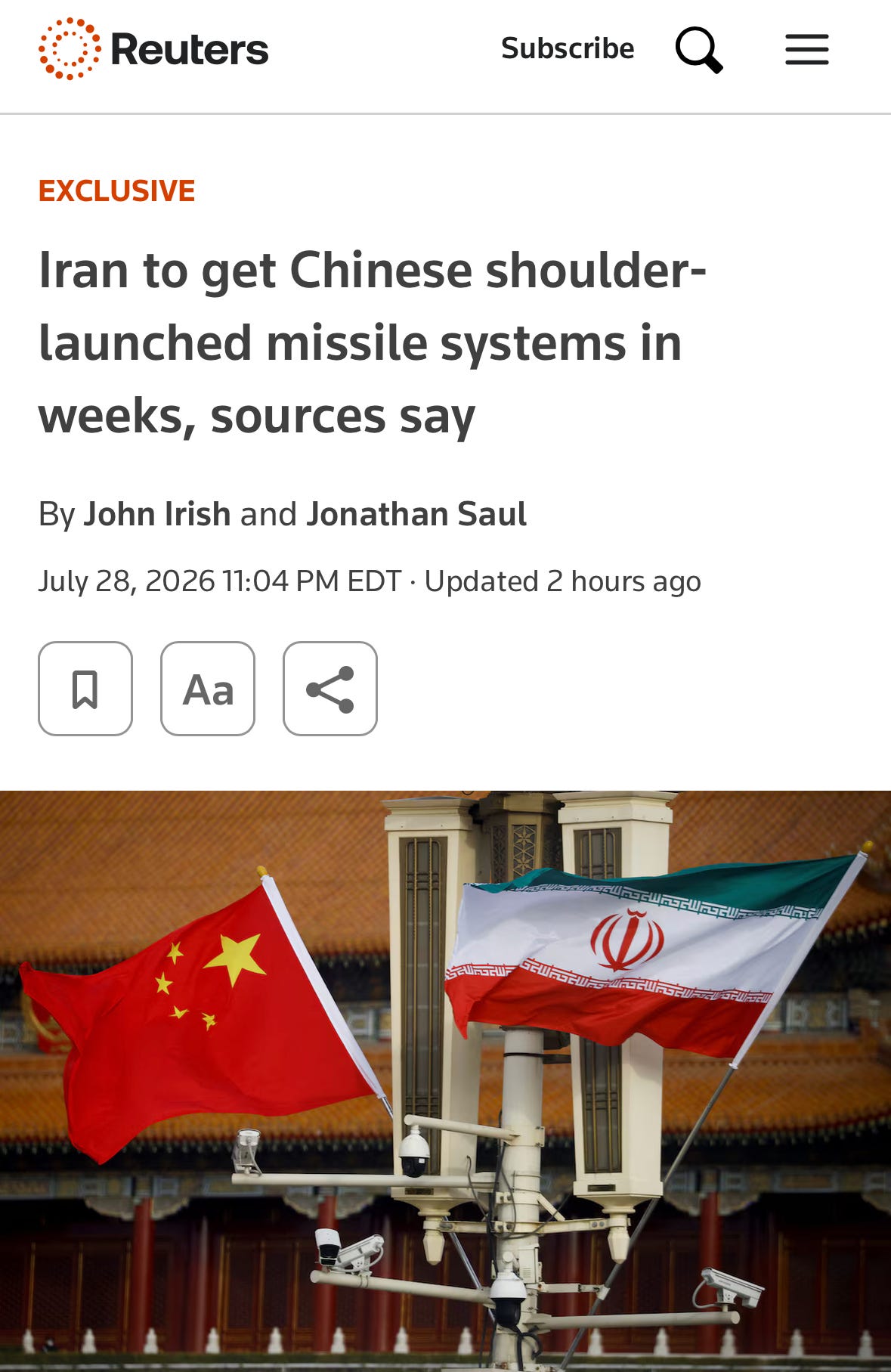
Despite his public assurances less than a week ago, on Wednesday this week, citing “sources familiar with the matter who spoke anonymously because of the sensitivity of the sale,” Reuters reported that China is preparing to send hundreds of shoulder-launched missile systems to Iran.
We close by returning to a question that framed our working model to try and explain why a President in Trump’s situation would risk a protracted military operation in Iran if America’s immediate interests were not directly threatened. In The Art of the Blockade (April), we wrote:
In Beijing, we expect that Trump will attempt to leverage (read: threaten) access to China’s energy supplies, whether or not the U.S. blockade of the Strait of Hormuz is still in place, or the tenuous ceasefire fails and the bombs and drones begin destroying more Gulf state oil and gas infrastructure. We will not be surprised if Trump threatens interdiction of shadow fleet tankers carrying sanctioned oil in, or even closure of, the Strait of Malacca.
What will he try to achieve in return? A sweetheart tariff deal for China (by comparison to Europe and other “allies”) in return for guarantees not to place license restrictions, export controls, or play other games to constrain the supply of any of the low-cost, critical inputs to the U.S. economy that China controls.
According to the official releases by both governments, Trump did not attempt to leverage China’s hydrocarbon energy supply in his May meeting with Xi in Beijing. But we have still yet to see any convincing evidence that the mental model is wrong.
If Trump’s real objective for the war in Iran is to leverage China’s oil and natural gas import dependency to secure an unimpeded supply of critical resources for U.S. industry, technology, the American economy and military defense, then the Houthi’s threatening Red Sea maritime oil trade but allowing Saudi oil destined for China through the Bab al-Mandeb strait does not bode well. Nor do suggestions about Chinese missile sales to Iran, if Reuters’ reporting is correct.
Iran will not defeat the mighty U.S. military. But in order to achieve an outcome that it - and many across the world - will perceive as a victory, it does not need to do so.
Using drones and ballistic missiles, Iran’s strategy seems to be Hold On for Dear Life to keep global energy prices high and the U.S. bogged down until the U.S. midterm elections. Houthis, their proxies in Yemen, are a useful tool in that game.
After directly negotiation with the Houthis for safe passage of Saudi oil on their VLCCs, we are led to wonder: just as China foresaw some event and filled its strategic oil reserves with ~1.3 billion barrels in 2025, what do the latest developments suggest Xi sees coming and may be positioning China to preempt or leverage for itself?
Iran is HODLing, betting Trump will TACO when the economic and political price gets high enough and, weakened as they are likely to be, their emboldened behavior is a test of Trump’s political resolve. Xi may sense Trump is in trouble in Iran and, if so, use it to China’s advantage.
Iran HODLing, the Houthis helping, and now the X(i) factor. With less than 100 days until the midterm elections and the U.S. average gasoline price presently $4.10/gallon, August is going to be interesting.
“Like” this post or be put in the cargo hold!
Leave us a comment. We read all and reply to most. Refuels the tank here.
environMENTAL is a reader-supported publication, free to all. Please consider supporting us with a voluntary paid subscription.
Share this post. Helps us grow. We appreciate the assist.
No posts
Comments
Nothing yet. Say the first thing.
Sign in to join the conversation.