
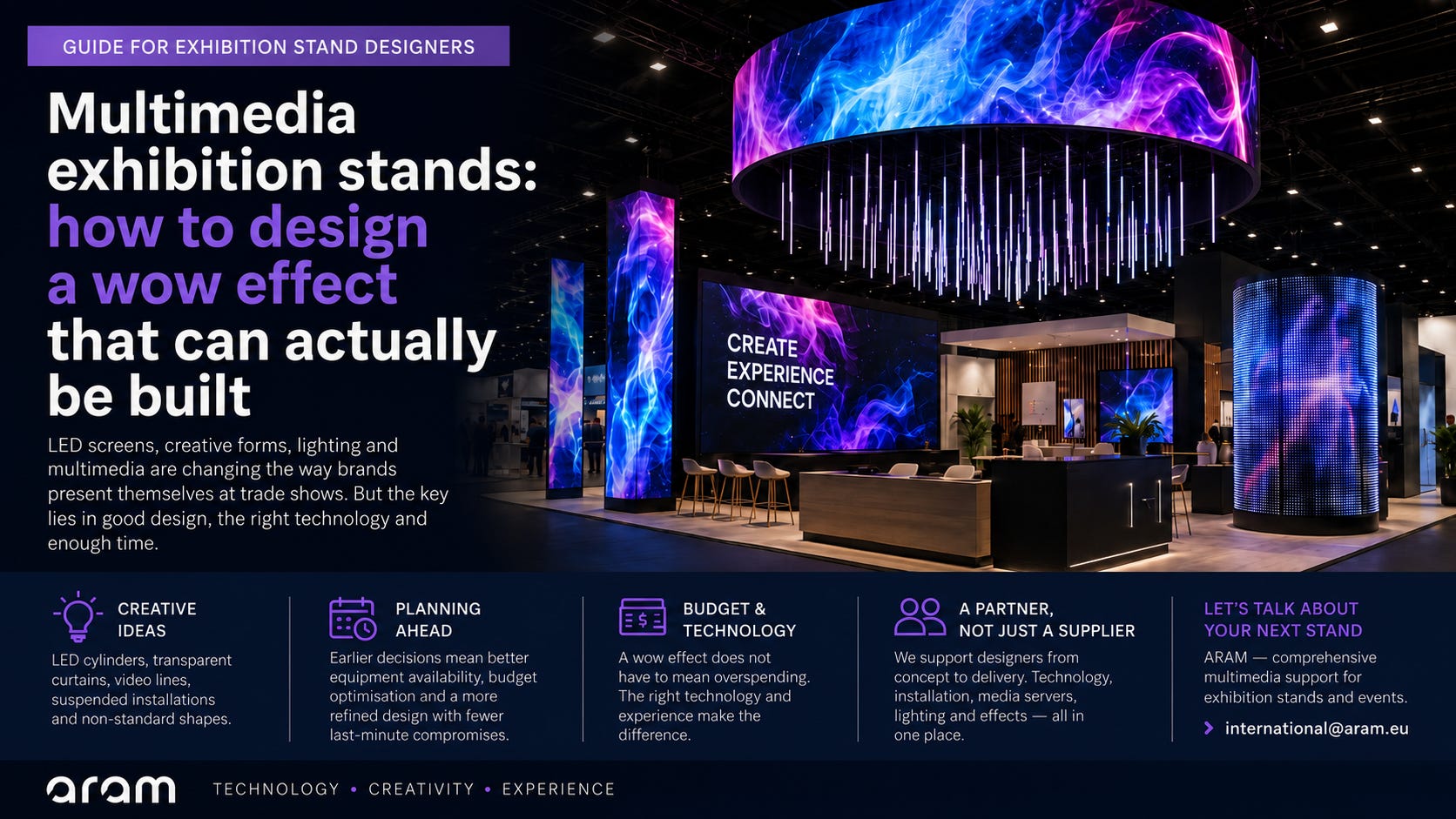
Exhibition stand design is changing fast.
For many brands, a trade show booth is no longer just a place to show products, meet clients and hand out brochures. It is beoming a live brand experience: part architecture, part content, part technology and part stage design.
That is why more companies are looking for multimedia exhibition stands, LED screens for trade show booths, transparent LED displays, creative lighting, interactive content and technical prodction partners who can help turn a strong visual idea into a real, working installation
For exhibition stand designers, this creates a very interesting opportunity.
You can now design spaces that move, react, glow, change and tell a story. But there is one condition: the technology has to be planned early enough, and it has to be designed in a way that can actually be built on-site, within the available time, budget and venue rules.
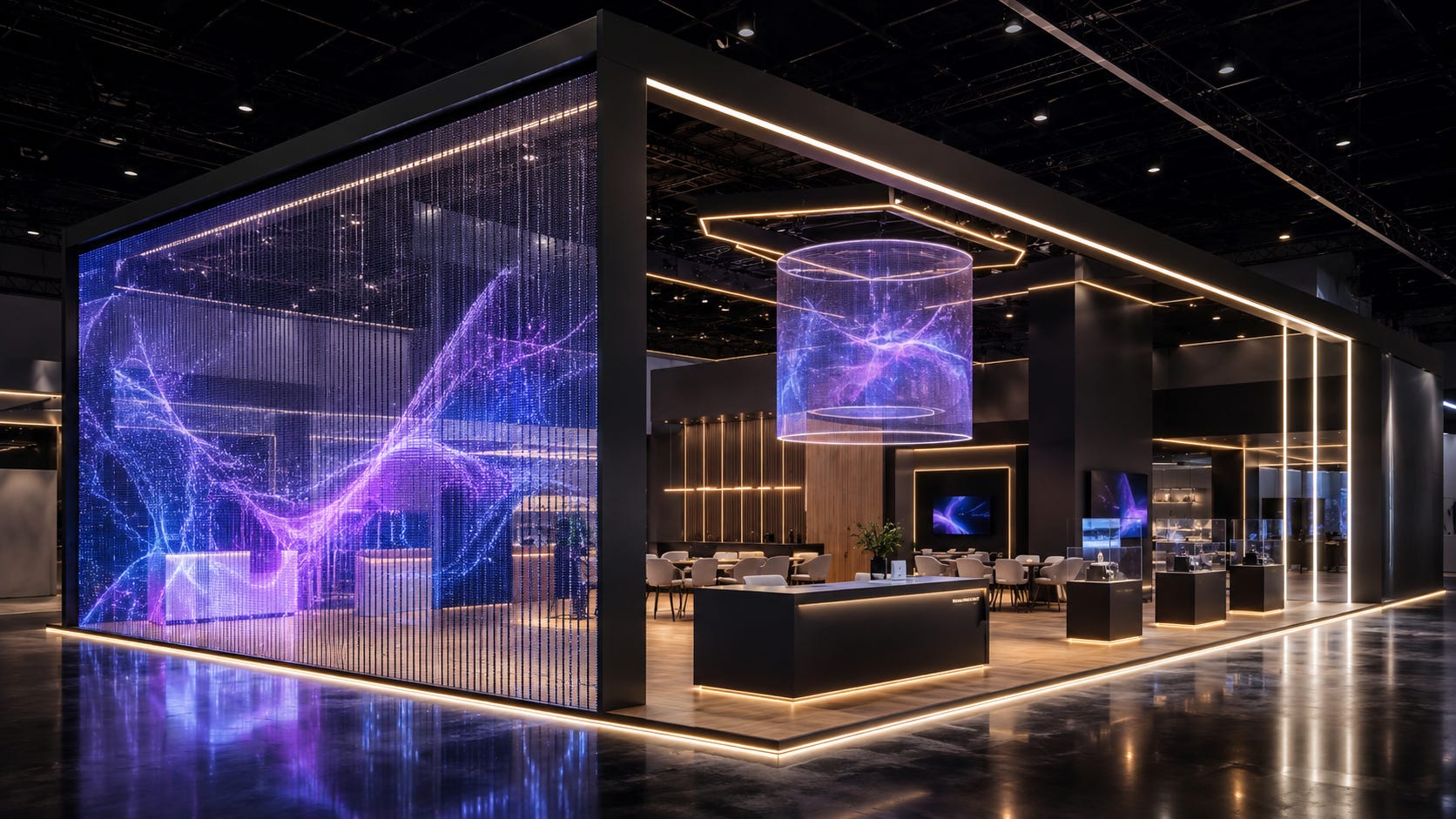
Trade shows are visually crowded. Every brand is trying to be noticed. Every stand competes for attention from visitors who are already overloaded with messages, screens, graphics and noise.
This is why static design is often not enough anymore.
Printed walls, product counters and classic branding still matter, but they are increasingly supported by custom exhibition stands with LED screens and audiovisual technology. Motion content, LED walls, transparent LED curtains, lighting effects, media servers and interactive elements can help a brand stand out in a busy exhibition hall.
A multimedia stand can do several things at once:
It can attract visitors from a distance.
It can explain a product faster than printed graphics.
It can create a stronger emotional impression.
It can make the booth more visible in photos and videos.
It can help the sales team start conversations.
And, maybe most importantly, it can turn a trade show presence into something that feels more like an experience than a display.
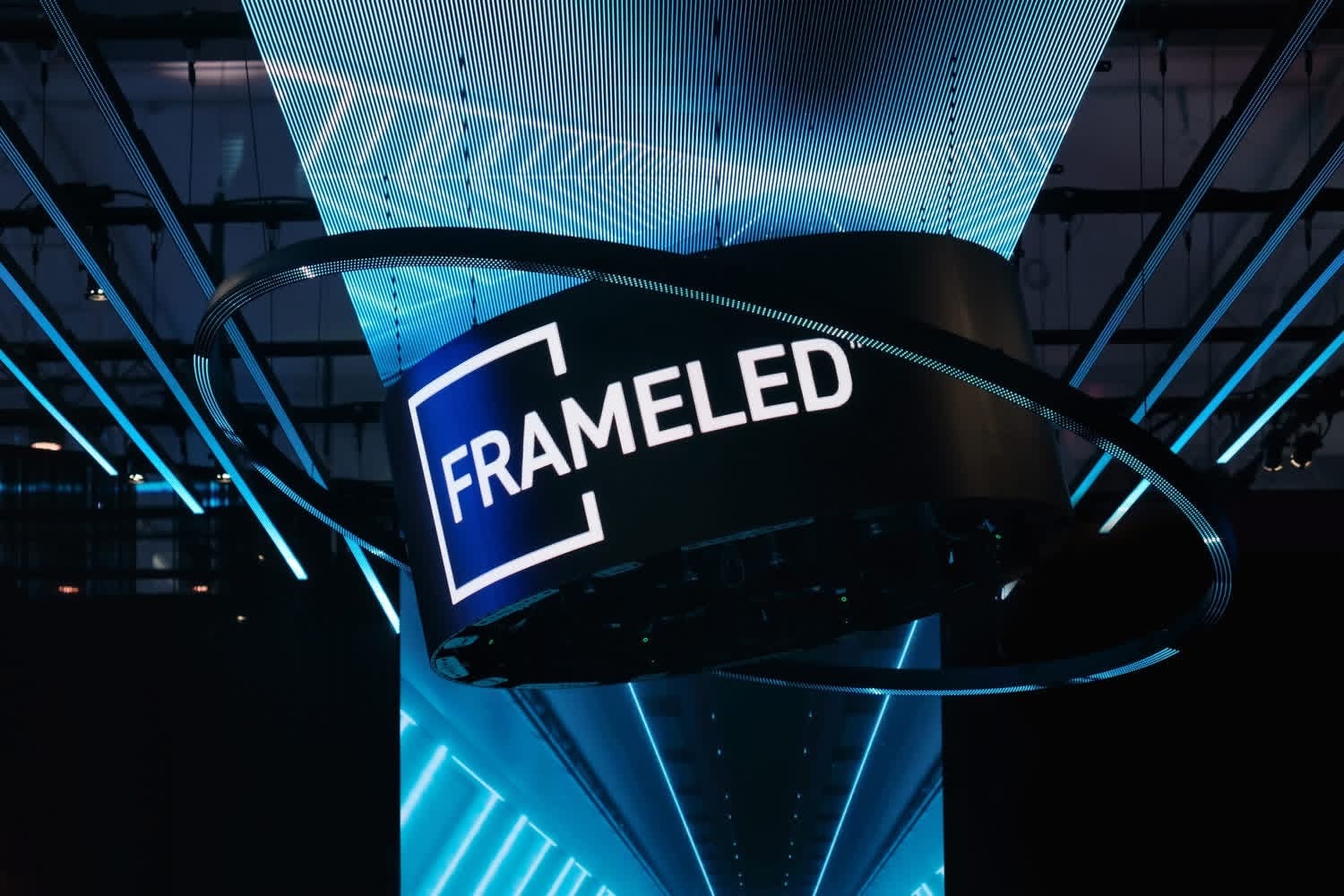
When people hear “LED screen”, they often imagine a flat rectangular wall at the back of the stand. That is still one of the most common solutions, but it is only one option.
Modern exhibition stands can use many different types of multimedia technology:
LED walls integrated into stand architecture,
curved LED screens and LED cylinders,
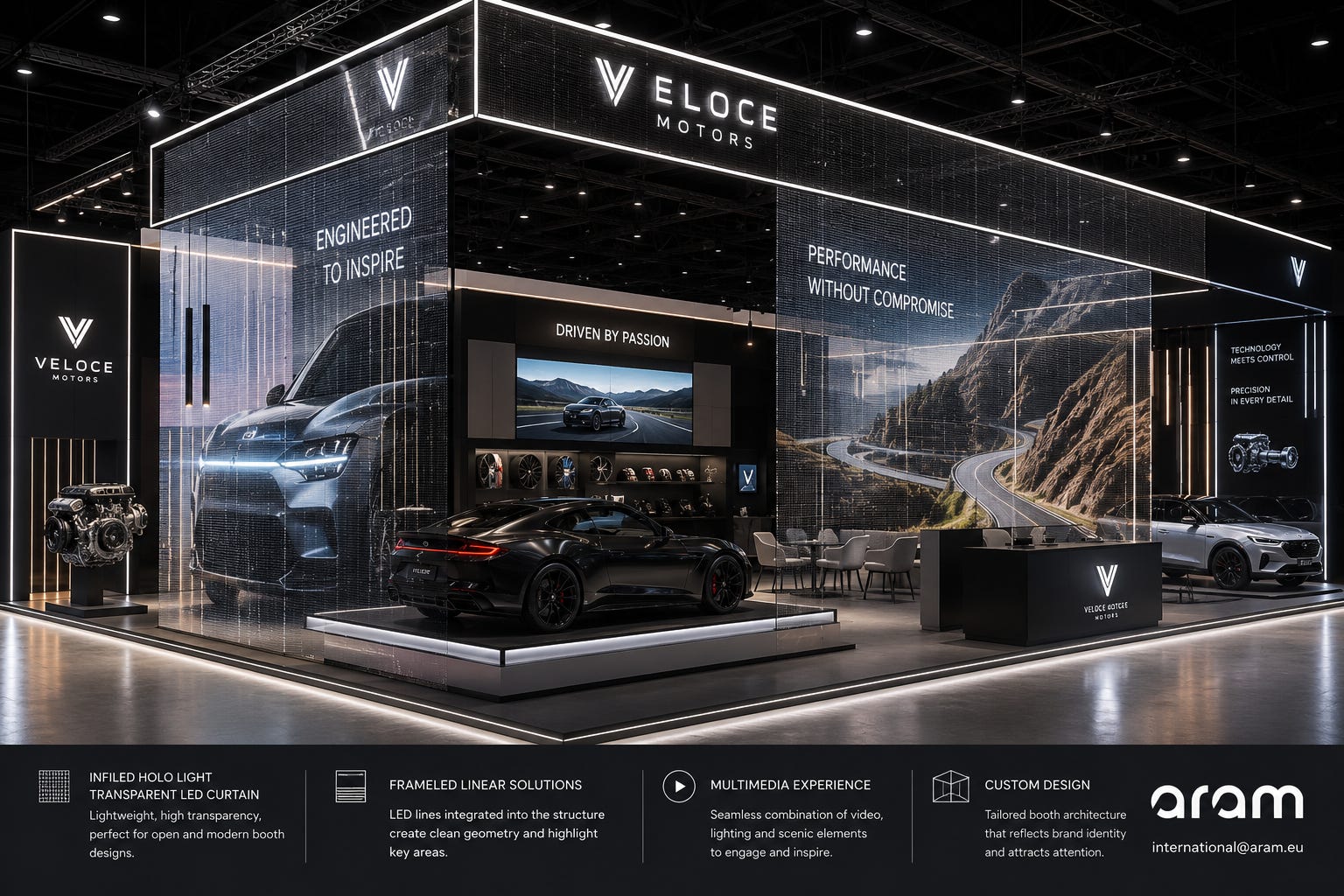
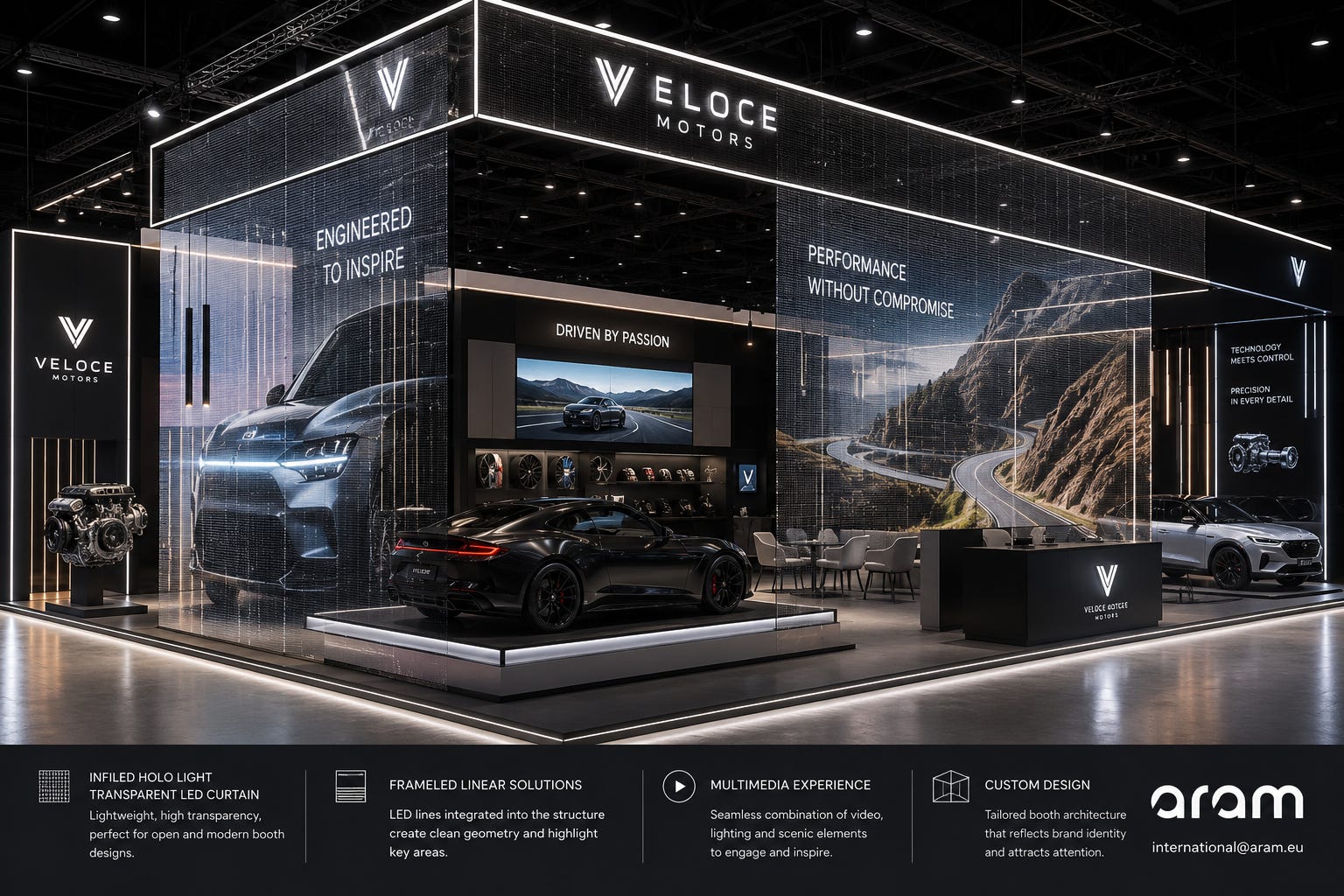
transparent LED curtains,
suspended LED elements above the booth,
LED strips and video lines built into scenic structures,
product displays with synchronized video content,
media server-controlled screens,
interactive screens and sensor-based installations,
lighting effects integrated with video,
small mobile LED screens for flexible use,
multimedia ceilings or overhead brand markers.
The most interesting designs usually do not treat technology as a separate object. They treat it as part of the space.
A screen does not have to be “a screen”. It can become a wall, a column, a portal, a ceiling, a product halo, a transparent layer or a moving visual background.
This is also why designers who work with AI-generated concepts should be careful. A beautiful render can be a great creative starting point, but it still needs technical translation. This is exactly the challenge described in how to move from AI-generated event concepts to real technical production: the image is not the project yet. The project begins when the idea is checked against equipment, structure, budget, logistics and time.
One of the biggest mistakes in exhibition projects is treating multimedia as something that can be added at the end.
In practice, that usually creates problems.
If the LED screen is added after the stand architecture is finished, it may not fit properly. If the content format is decided too late, it may not match the screen. If rigging is not considered early, suspended elements may become impossible. If the power and signal paths are not desined in advance, installation becomes stressful and expensive
That is why multimedia planning should start during the concept phase.
A designer does not need to know every technical detail at the beginning. But it helps to involve a technical production partner early enough to answer a few important questions:
What kind of LED technology will work best here?
Can this shape be built safely?
How heavy is the structure?
Can it be suspended?
How much power is needed?
What content format should be prepared?
How long will installation take?
What is available for the chosen dates?
Where can the budget be optimized without killing the idea?
Early technical consultation does not reduce creativity. It protects it.
It helps make sure that the final stand still looks close to the concept — and does not become a series of compromises made two days before installation.
Many companies already know months in advance that they will participate in a trade show. But the final stand concept, budget and technology decisions are often approved very late.
From the outside, this may seem harmless. After all, the event is still a few weeks away.
But in technical production, late decisions usually reduce options.
The right LED screens may already be booked. Transparent curtains may not be available. Specialist crews may have other projects. Rental prices may rise because equipment has to be sourced from other suppliers. The design may need to be simplified because there is no time for testing or optimization.
This is why last-minute approval does not always save money. Very often, it does the opposite.
It limits availability.
It increases stress.
It reduces time for content preparation.
It makes technical coordination harder.
And it can force the project team to accept whatever equipment is still available, instead of choosing the best solution for the design.
A useful comparison is airline tickets. If you book early, you have choice. If you book late, you take what is left.
The same logic applies to LED screens, media servers, rigging, lighting, control systems and technical crews.
This is one of the reasons why technical production is different from simple equipment rental. A successful multimedia stand is not only about having equipment. It is about planning, integration, installation, content, safety, people and timing.
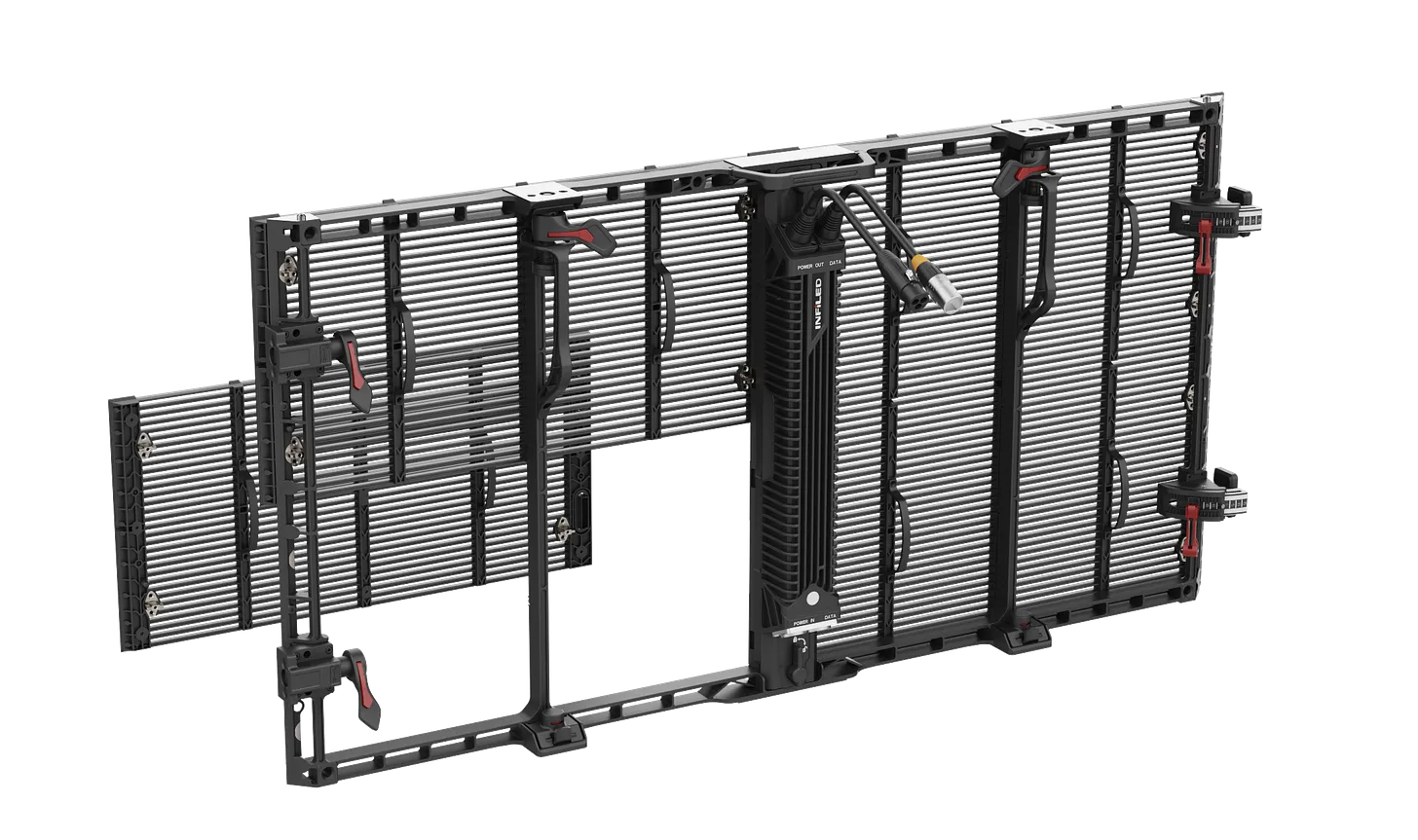
Transparent LED is one of the most useful tools for modern exhibition stand design.
Unlike a classic LED wall, a transparent LED curtain does not completely close the space. It can create a visual layer while still allowing light, depth and visibility through the stand.
This makes it especially interesting for:
brand entrances,
product zones,
semi-transparent walls,
suspended multimedia elements,
large overhead visual markers,
open booth designs,
premium product launches,
immersive brand spaces.
ARAM offers transparent LED curtains for large-scale productions and creative scenic installations, including a very large stock of INFiLED HoloLight transparent LED technology available for major projects in Poland and across Europe.
For trade shows, this type of technology can be used to create motion without making the stand feel heavy. It can also help a booth become visible from a long distance while keeping the architecture open and elegant.
But transparent LED is only one part of the toolbox.
Designers can also use LED display solutions for events and installations such as curved screens, modular LED walls, LED lines, video strips and smaller display systems integrated into furniture, scenic elements or product displays.
For projects where flexibility and speed matter, mobile LED screens for events, trade shows and multimedia installations can also be a practical solution. They can support presentations, brand films, product launches, sponsor content or dynamic messaging without requiring a fully custom LED structure.
A screen without content is just hardware.
This is one of the most overlooked parts of multimedia stand design. The technology may be impressive, but the actual visitor experience depends heavily on the content.
Good content for trade show LED screens should be designed for the booth, not simply copied from a corporate presentation.
It should consider:
viewing distance,
screen shape,
loop duration,
brand hierarchy,
product messaging,
visitor movement,
camera visibility,
legibility in a bright hall,
how the content works with lighting and space.
A cylinder needs different content than a flat screen. A transparent LED curtain needs different visual treatment than a solid LED wall. A narrow LED strip should not be treated like a normal video screen.
This is why designers, content creators and technical teams should work together. The earlier the screen format is known, the better the content can be prepared.
And when content, screen shape, lighting and architecture are designed together, the result feels intentional rather than accidental.

If you are an exhibition stand designer, agency, brand manager or marketing director looking for multimedia technology for trade shows, ARAM can support the project from concept to delivery.
ARAM works with live events, trade shows, corporate productions, immersive spaces, esports, TV, concerts and brand experiences. The company provides technical production, LED screens, media servers, lighting, control systems, installation teams and integration between different technologies.
For exhibition projects, ARAM can help with:
selecting the right LED technology,
checking whether a visual concept can be built,
designing multimedia solutions around the stand architecture,
planning media servers and signal flow,
integrating lighting with video content,
providing transparent LED curtains,
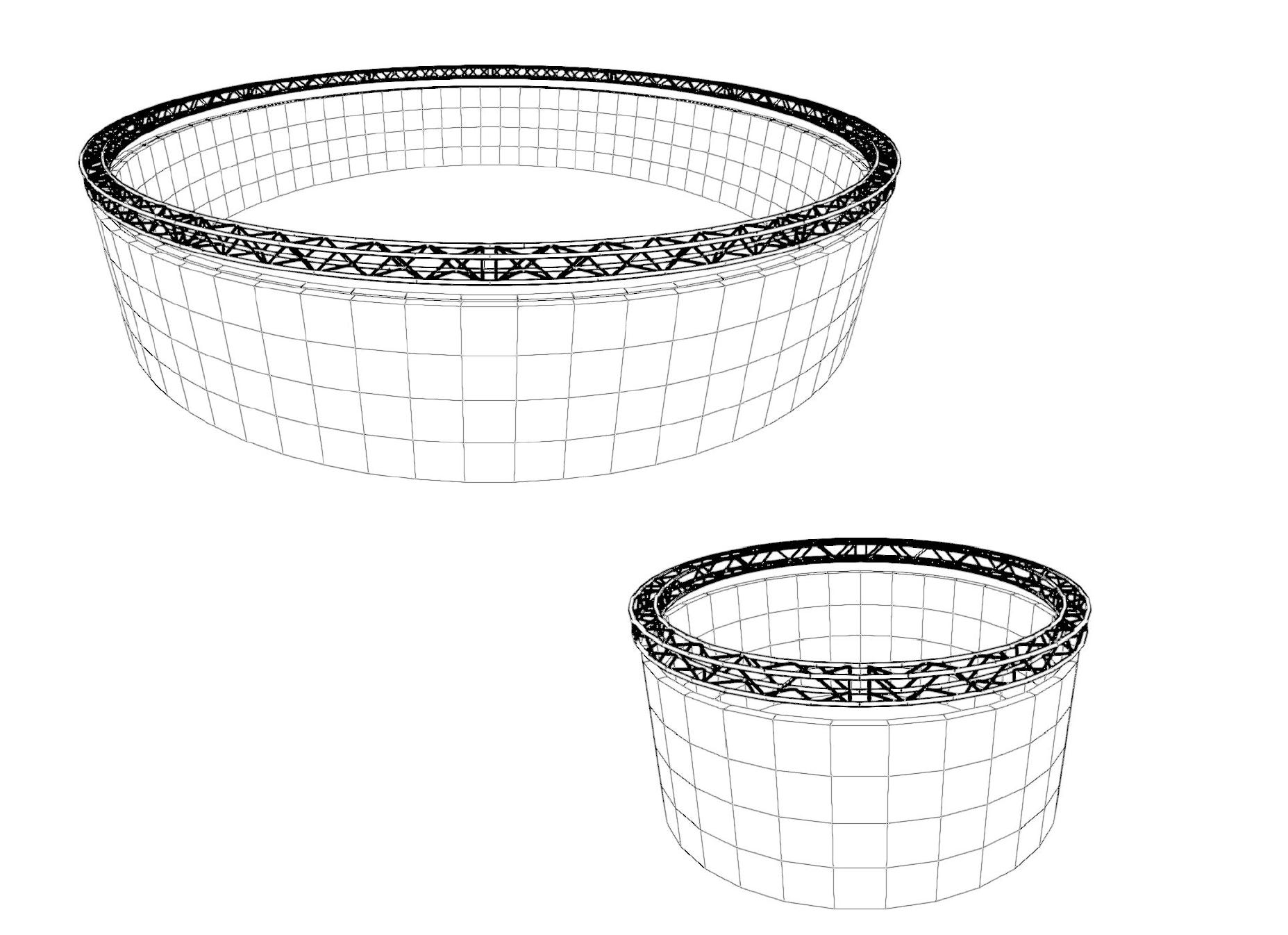
building LED cylinders and non-standard display forms,
supplying mobile LED screens,
supporting installation and operation on-site,
optimizing the idea to fit the budget and timeline.
The value is not only in supplying equipment. The value is in connecting creative design with production reality.
If you are looking for a technical production partner for live events, exhibitions, corporate events and large-scale multimedia projects, it is worth starting the conversation before the concept is completely locked. This gives everyone more room to choose the right technology, find better solutions and avoid last-minute compromises.
If your company already knows it will attend a major trade show, start earlier than you think you need to.
Even if the final booth design is not ready, early conversations can help define what is realistic, what should be reserved, what can be optimized and what budget range makes sense.
Late decisions can still be delivered, but they often come with fewer options.
Early decisions create more space for better design, better availability, better content, better pricing and fewer emergency solutions.
For marketing teams, this is not only a production issue. It is a business issue.
A trade show stand is often one of the most visible brand investments of the year. It deserves enough time to be planned properly.
If you are designing a stand and want to use multimedia, LED, lighting or interactive technology, bring the technical partner into the process early.
You do not need to have the full technical specification ready.
A sketch, render, mood board or concept is enough to start the discussion.
The right partner can help answer a simple but important question:
What is the smartest way to build this effect?
Sometimes the answer is a large LED wall.
Sometimes it is a transparent curtain.
Sometimes it is a cylinder.
Sometimes it is a few well-placed LED lines.
Sometimes it is lighting, not video, that creates the strongest result.
And sometimes the best solution is a smaller but better-designed multimedia idea that fits the budget and still makes the stand memorable.
The future of exhibition stand design is not about putting screens everywhere.
It is about using multimedia intelligently
A good multimedia exhibition stand should be visible, but not chaotic. Technological, but not overloaded. Impressive, but still realistic to build. Creative, but also planned with power, rigging, content, budget and installation time in mind.
That is where the strongest projects happen: between creative ambition and technical experience.
If you are designing a trade show booth and looking for LED screens, transparent LED curtains, creative multimedia forms, lighting integration or technical production support, let’s talk early.
We can help check what is possible, what is available, what can be optimized and how to turn the idea into a stand that looks good not only in a render, but also on the exhibition floor.
Comments
Nothing yet. Say the first thing.
Sign in to join the conversation.