
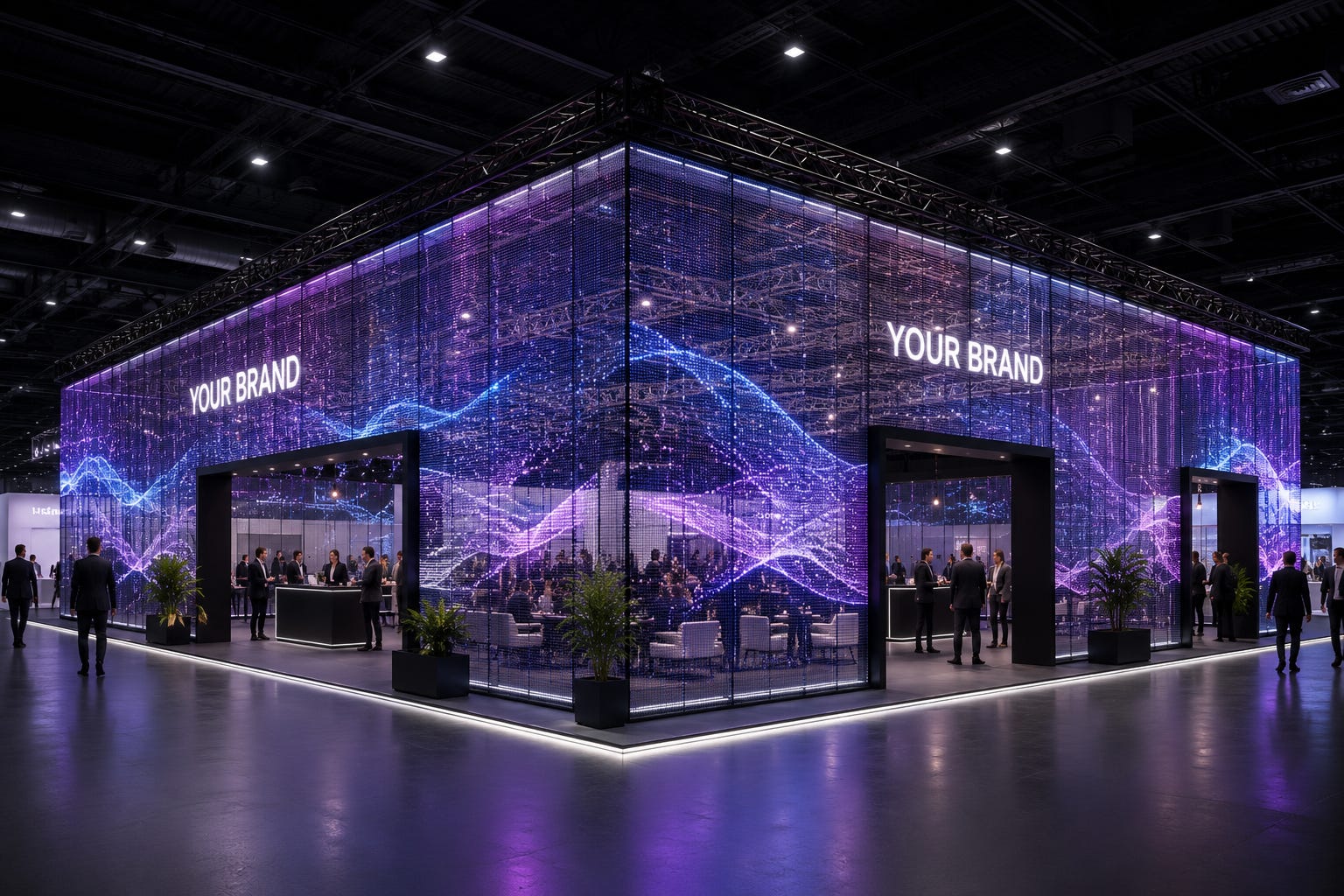
How transparent LED architecture is giving exhibition stand builders, design studios and event agencies a new way to create spectacular trade show experiences.
If you’re an exhibition stand builder, design studio, event agency, brand experience team or simply looking for a fresh approach to multimedia exhibition stand design, this concept was created with you in mind.
It isn’t a finished booth that has to be copied.
Instead, it’s a production-ready technical concept showing how a lightweight transparent LED system can become part of almost any exhibition stand—whether as an external multimedia façade, an architectural feature, a brand activation zone or a complete LED envelope surrounding the booth.
Our goal isn’t to present one specific design.
It’s to demonstrate what becomes possible when exhibition architecture and multimedia technology are developed together from the very beginning.
One of the biggest misconceptions about large multimedia exhibition stands is that every project has to start from a blank sheet of paper.
Fortunately, that’s no longer the case.
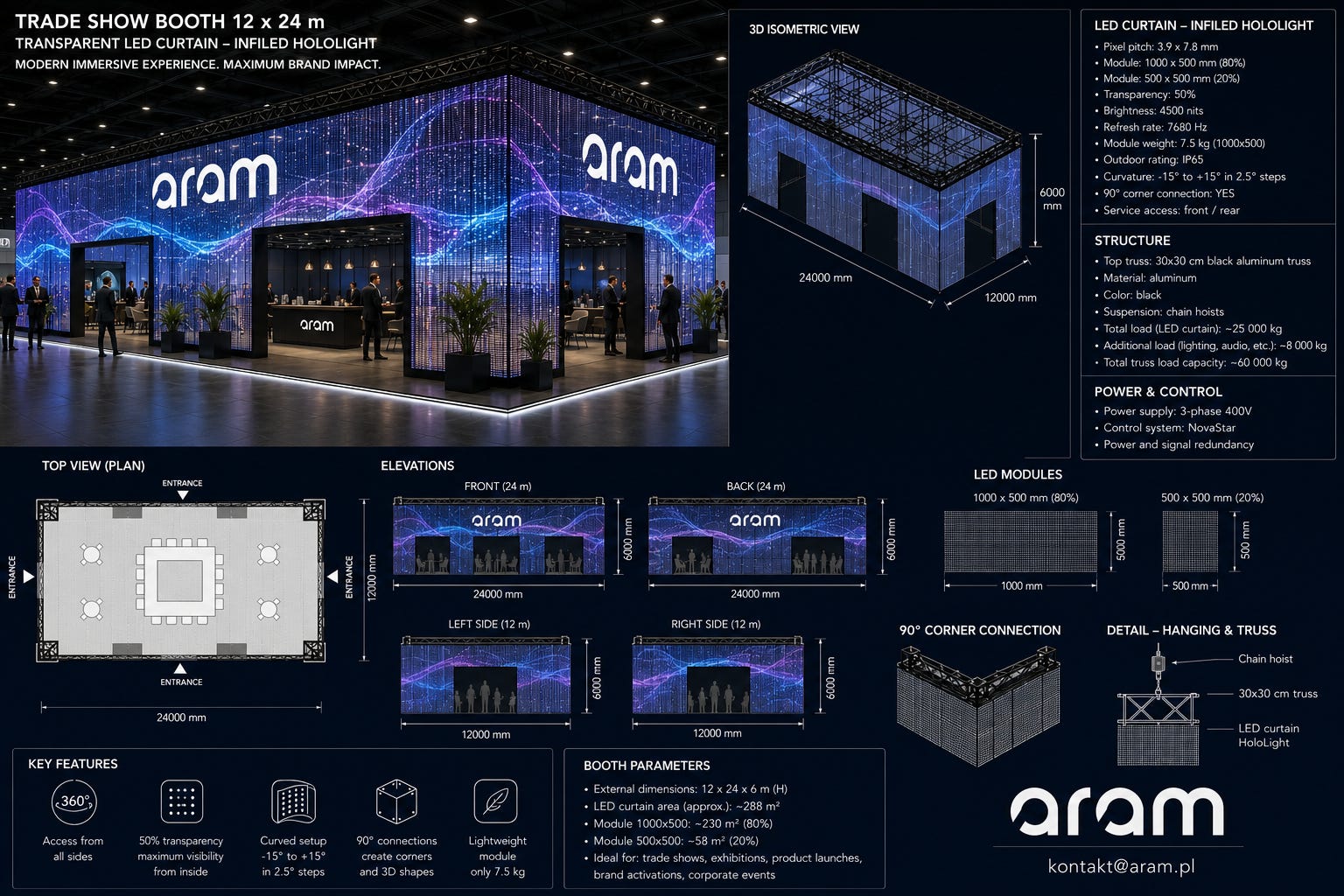
The concept shown here measures 10 × 16 metres, but the same technical principles can be used for almost any exhibition space.
For example:
6 × 6 m
8 × 12 m
10 × 16 m
12 × 24 m
20 × 30 m
or completely custom dimensions.
Instead of redesigning everything every time, the system simply scales to the available space.
That makes advanced multimedia exhibition architecture much more achievable—and often far more affordable—than many exhibitors expect.
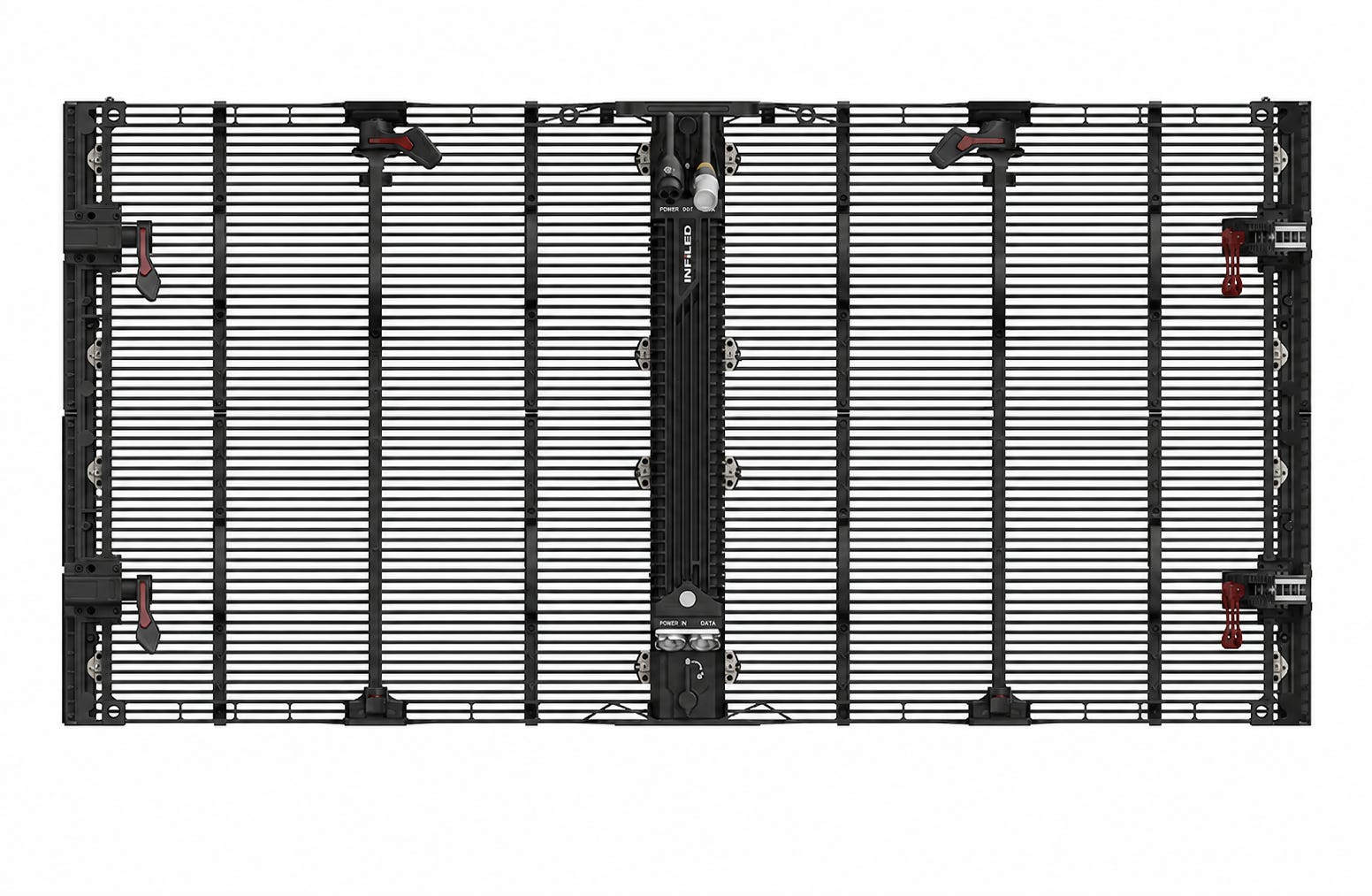
Imagine replacing printed graphics and solid exhibition walls with a lightweight architectural skin made from 50% transparent LED.
Visitors immediately notice the content.
But they also see what’s happening inside.
Products remain visible.
Lighting becomes part of the experience.
People become part of the architecture.
Rather than creating another enclosed booth, transparent LED creates a structure that feels open, modern and inviting while attracting attention from across the exhibition hall.
This is one of the reasons why custom exhibition stands and booth designs for modern brand experiences are increasingly incorporating multimedia architecture instead of treating LED as a separate element.
The beauty of the system lies in its simplicity.
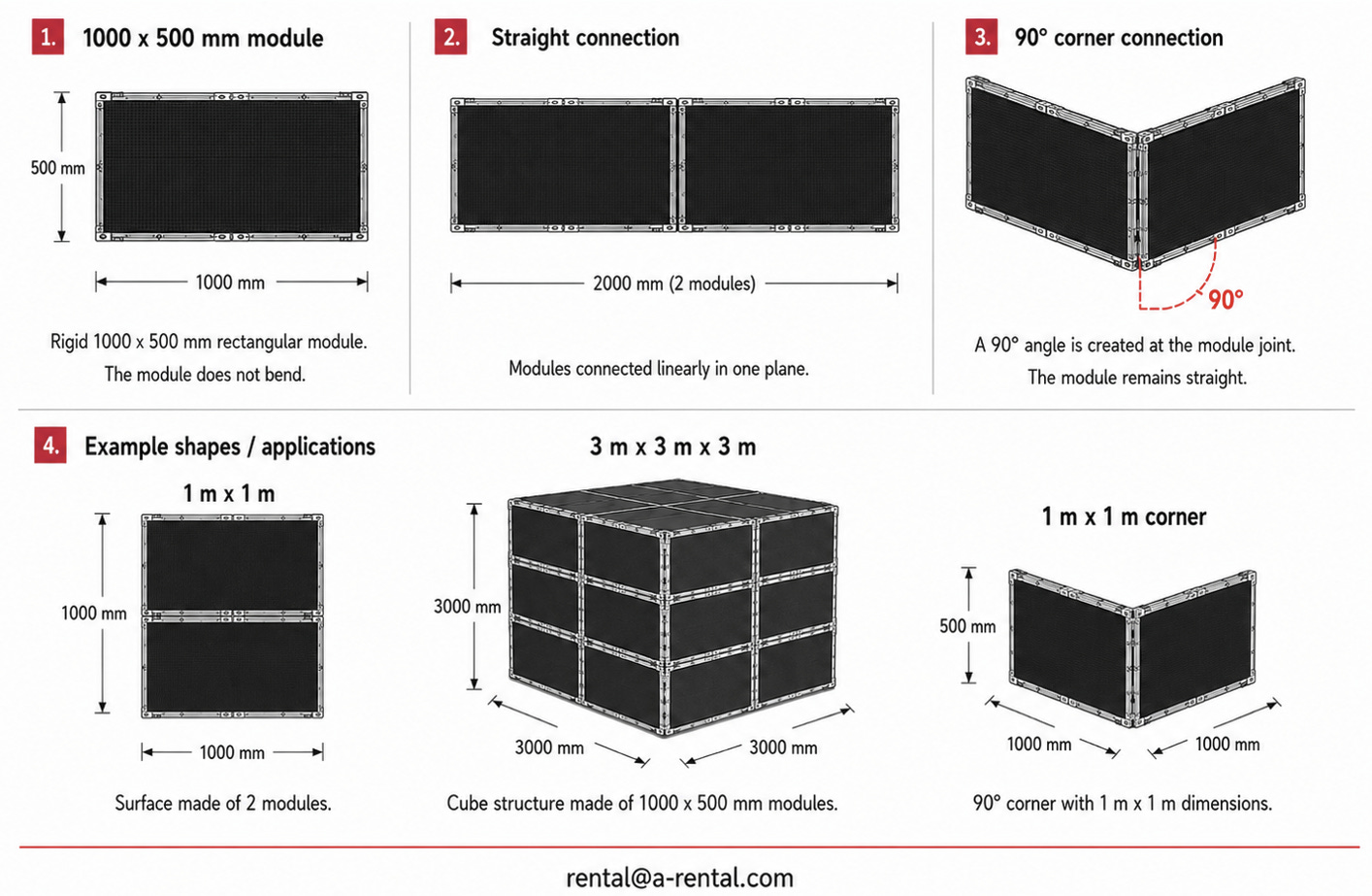
Everything is built using just two standard module sizes:
1000 × 500 mm
500 × 500 mm
These modules make it possible to create almost unlimited layouts.
Need a taller façade?
Simply add more rows.
Need wider entrances?
Move the modules.
Need meeting rooms inside?
Adjust the perimeter.
Need a different visitor flow?
Reconfigure the openings.
Because the entire system is modular, the same components can create completely different exhibition stands.
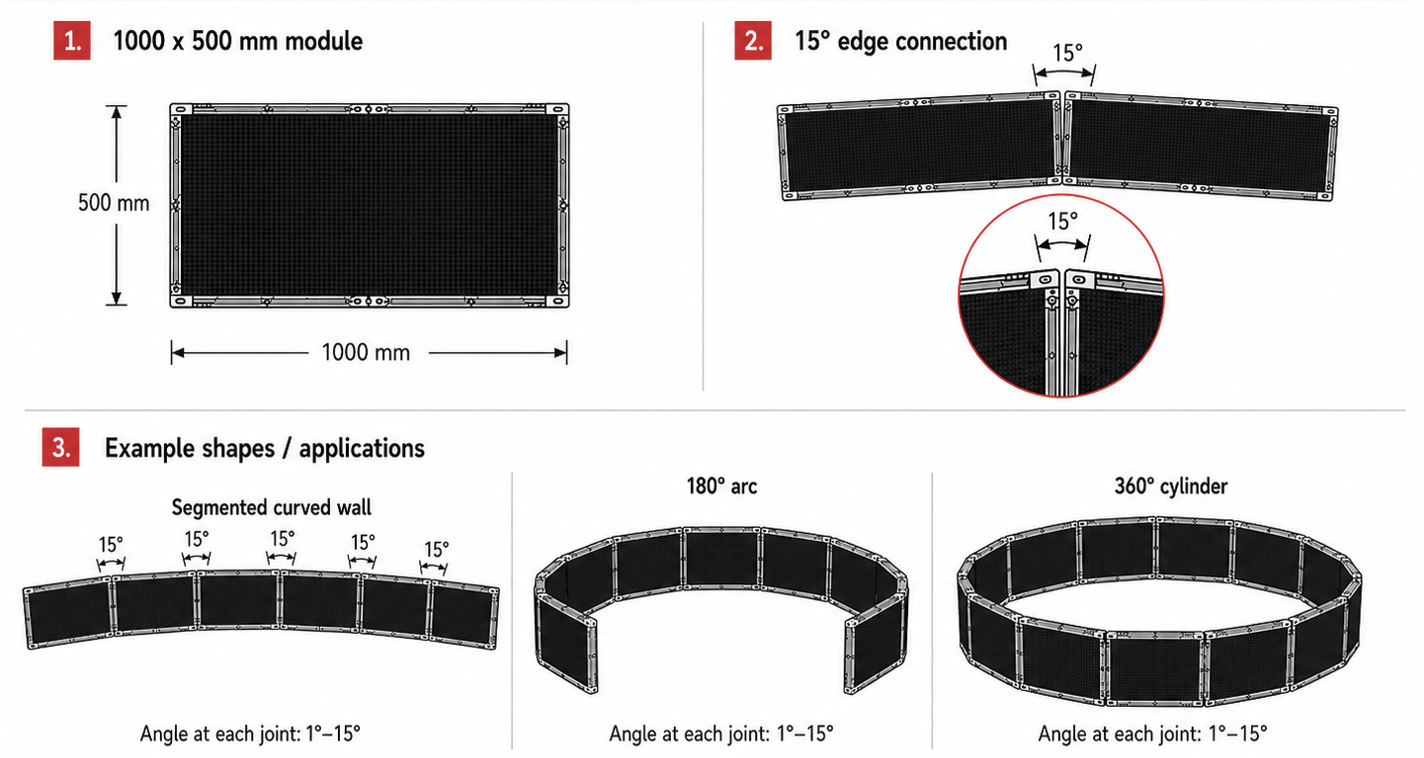
Perhaps the biggest advantage of transparent LED - It’s the freedom.
The system supports:
curved walls
cylinders
wave-shaped façades
tunnels
360° installations
rounded corners
90° connections
custom architectural structures
At that point, LED stops being a display.
It becomes an architectural material.
Instead of asking:
“Where should we place the LED wall?”
You begin asking:
“What kind of experience should visitors walk through?”
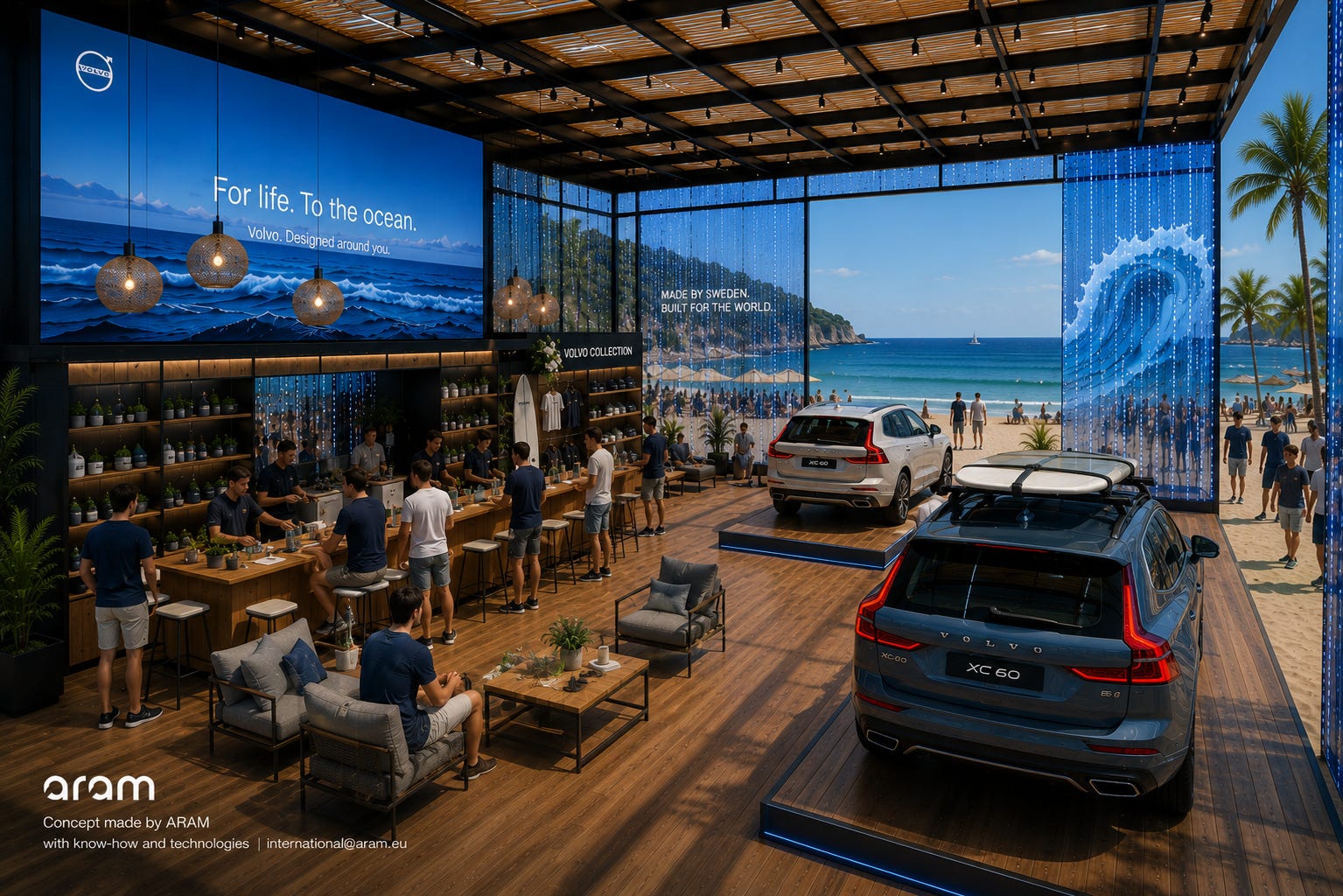
Every exhibition project is different.
Some brands want open spaces.
Others need controlled entrances.
Some require meeting areas.
Others focus on product demonstrations.
Because the façade is modular, entrances can be:
repositioned
widened
narrowed
multiplied
temporarily closed
The technology adapts to the exhibition design—not the other way around.
Transparent LED doesn’t replace every display technology.
It complements them.
One of the most effective approaches is combining:
transparent LED façades
fine-pitch LED walls
LCD displays
interactive touchscreens
projection mapping
immersive lighting
synchronized multimedia content
Each technology performs a different task.
Together they create a much richer visitor experience.
This layered approach is becoming increasingly common in multimedia exhibition stands and LED technology for trade show design, where architecture, storytelling and technology are designed as one integrated experience.
Besides its visual impact, the technology offers several practical advantages.
The system features:
approximately 50% transparency
refresh rates exceeding 7,000 Hz
lightweight construction
modular dimensions
front and rear service access
curved connections
90-degree corner connections
One specification deserves special attention. The refresh rate.
Today every exhibition visitor carries a professional-quality camera in their pocket.
Thousands of photos and videos are captured every day during major trade shows.
A refresh rate above 7,000 Hz dramatically reduces visible flicker, ensuring your stand looks just as impressive on smartphones, social media and broadcast cameras as it does in person.
AI has transformed the way we generate ideas.
That’s fantastic.
But between an AI render and a finished exhibition stand lies an entire engineering process.
Structural calculations.
Rigging.
Load analysis.
Cable management.
Access for installation crews.
Maintenance planning.
Logistics.
Venue limitations.
Content integration.
Visitor circulation.
These are the invisible elements that determine whether a spectacular concept becomes a successful exhibition—or remains just another beautiful rendering.
That’s why we deliberately included technical references alongside the visualization.
Not to make it more complicated.
But to show that every inspiring concept needs equally strong technical thinking behind it.
This is exactly where creative event production, multimedia installations and technical design for live experiences begin.
This is an example—not a limitation
The project shown here isn’t a catalogue product.
It’s an example.
The height can change.
The width can change.
The entrances can change.
The internal layout can change.
The multimedia content can change.
Even the overall shape can become completely different.
The underlying technology remains exactly the same.
That’s what makes modular transparent LED architecture so powerful for exhibition design.
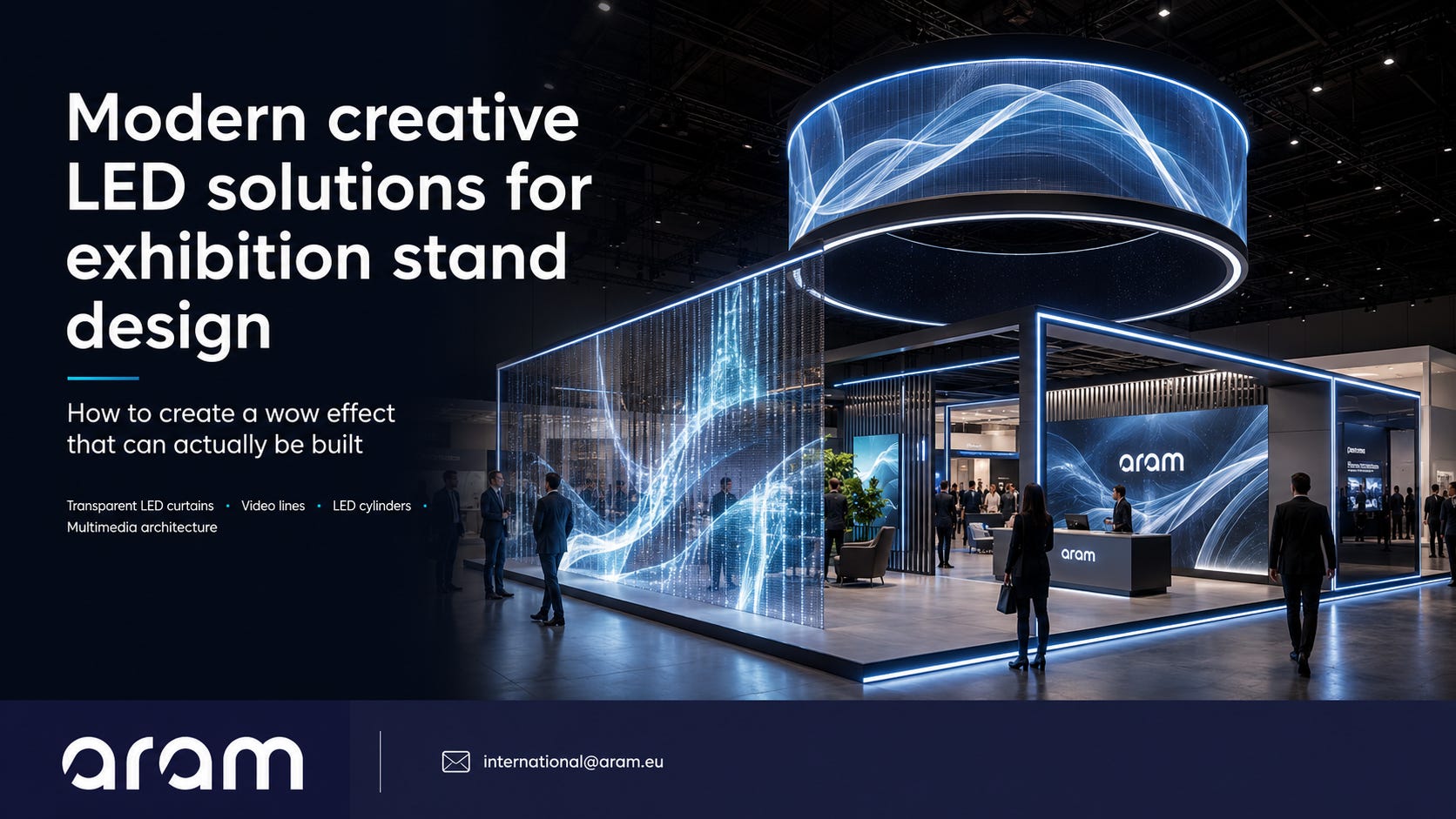
It may be architecture that becomes the screen itself.
Further reading
If you’re exploring creative exhibition stand design, multimedia trade show booths, transparent LED architecture or technical production for exhibitions and live events, these articles may also be useful:
Multimedia exhibition stands and how LED technology is changing exhibition design
Custom exhibition stands and booth designs for modern brand experiences
Creative event production, technical design and multimedia installations
Large-scale transparent LED technologies for events, exhibitions and immersive brand experiences
Whether you’re an exhibition stand builder, creative agency, technical production company or brand preparing your next trade show, we’d be happy to help transform your concept into a fully engineered, production-ready multimedia solution.
Also read:
Comments
Nothing yet. Say the first thing.
Sign in to join the conversation.