
(Welcome to the Entertainment Strategy Guy, a newsletter on the entertainment industry and business strategy. I write a weekly Streaming Ratings Report and a bi-weekly strategy column, along with occasional deep dives into other topics, like today’s article. Please subscribe.)
You probably remember egg prices spiking a few years ago. This led to a lot of debate between the pro-market/pro-competition/antitrust/Neo-Brandesian crowd and the center/center-right/center-left/abundance/libertarian crowd over the cause, whether it was the avian flu outbreak or whether industry consolidation led to price fixing, using avian flu as a convenient cover. Basel Musharbash wrote a whole investigation at BIG looking at it.
Well, two years later, we have our answer: it was price fixing.
The Justice Department found proof, via emails, of price fixing. Indeed, just the threat of an investigation brought prices down two years ago:
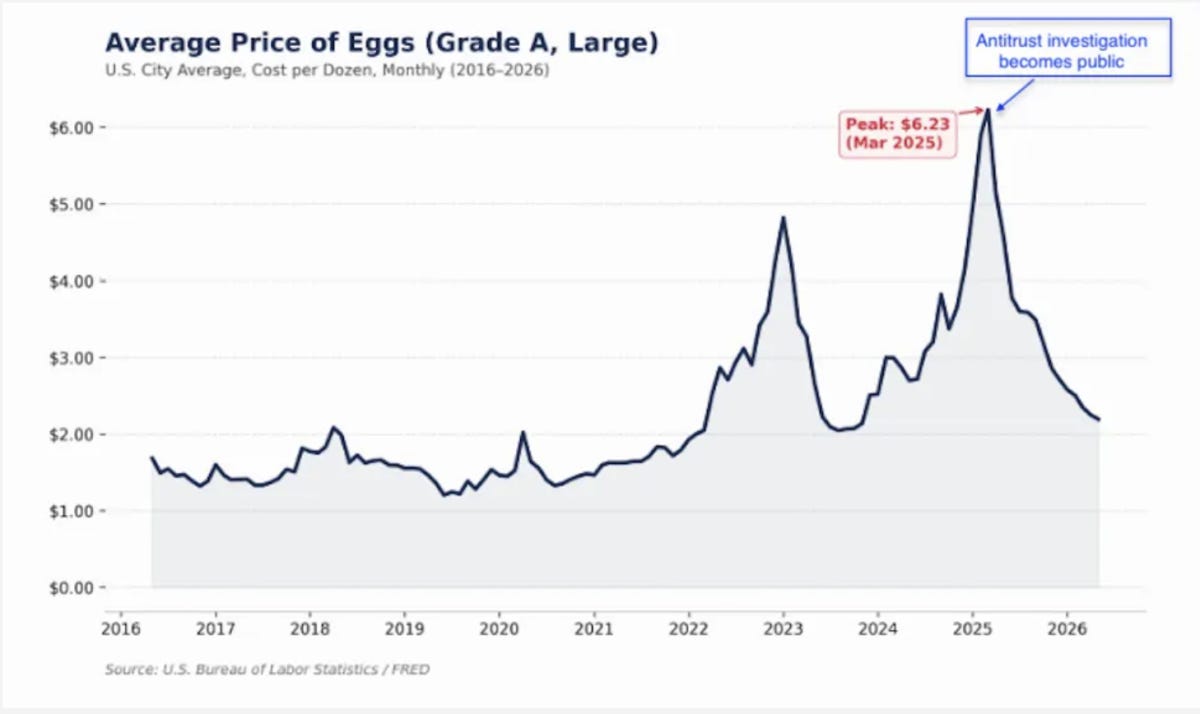
I bring this up because at least half a dozen of my favorite political writers and pundits, who were skeptical about price fixing at the time, haven’t written any mea culpas on this issue. It’s really dispiriting and makes it much, much harder to trust their work on other issues. If you take a hard stand on an issue, then you get it wrong, you need to explain how and why you got it wrong. Or update your priors. This is how epistemological bubbles are formed!
All of which is to say, it’s time for another installment of “What I Got Right, What I Got Wrong”. Last issue, I mostly focused on the “wrong” side of the equation, so today’s is a bit more balanced, but with one big mea culpa (though I still stand by my original concerns).
Let’s dive right in!
In my analysis of the viewership of UFC Freedom 250, I wrote...
“Paramount has also released datecdotes bragging about their subscriber numbers. Earlier this year, they claimed that the first UFC fight on Paramount+ brought in 1 million subscribers.”
Well, that datecdote did not come from a PR rep, but from great reporting from James Faris at Business Insider. The actual quote was this:
“Paramount’s flagship streaming service generated about a million new subscribers on the day of its first-ever UFC event, Paramount product chief Dane Glasgow told employees in a town hall on Tuesday morning, three staffers who attended the meeting told Business Insider.“
This wasn’t the biggest goof in the world; even Faris emphasized to me that this is more a “clarification” than a correction. Still, it sounds like, internally, the folks at Paramount were very happy about this result—and I’m guessing they were happy with this news getting out—even though the gains didn’t last through the quarter, dropping to 700K adds.
I’m very skeptical about MrBeast’s burgeoning media “empire” and, in particular, its $5 billion valuation, as I wrote earlier this year and last year. Sure enough, according to Business Insider, regarding its “booming” consumer products division:
“US sales volume grew 13% year-over-year in 2025, following a 33% leap the previous year, according to a presentation deck dated May 2026....A February 2025 investor deck viewed by Business Insider showed Feastables’ net revenue more than doubled in 2024 from 2023, to $215 million, and was forecast to grow 74% in 2025, to $375 million.” [Emphasis mine.]
If you told investors that you projected 74% growth but delivered 13%,1 that’s not ideal.
But it’s not just MrBeast. Logan Paul and KSI’s Prime had sales drop in half for their energy drinks.
It’s one thing to build a successful entertainment company and an entirely different thing to succeed in the heavily-consolidated-but-also-very-competitive consumer packaged goods space! CPGs are dominated by a few firms with very wide moats compared to YouTube, which has few barriers to entry. These businesses require different skill sets and have completely different business environments.
Almost as soon as I published my article about the NBA’s finances, casting skepticism on NBA expansion, I saw this Front Office Sports headline:

One group “claims to have already raised $8 billion” for the Vegas expansion team. I mean, wow. That’s just $2 billion less than what the Los Angeles Lakers were valued at when they were sold just last year. And they’re arguably the most popular team in the NBA. (Side note: the new owner is now under an investigation for fraud in how he went about financing the Lakers and the Dodgers purchases.)
So much for the “dried up” language I used in that article. (This is why I usually stick to my “Entertainment Nuance Guy” tone in articles...) I went off old information—from April, when I read/heard about the NBA downplaying expansion efforts—instead of doing a quick double-check for new news. That said...if you read the article, the market for Seattle is “slow”, with just one reported bidder. So I wasn’t entirely off.
This goof has annoyed me since I first published it, mainly because it undercut that article’s real point, which I stand by:
NBA franchises are really overvalued right now.
Now, I get why NBA teams are overvalued. When it comes to owning sports teams, it’s basically never wrong to assume that some rich person somewhere will care more about owning a team (or just being part of a group since they’re so expensive) than the actual financials. There are only so many teams to own, and opportunities to buy in preferred markets don’t come along very often. This explains why the teams sell for such high multiples (usually above a 10 to 12.5 revenue multiple, which is very high). You only need one person to overpay!
Beyond the ultra-wealthy luxury good explanation, I worry NBA teams are becoming speculative assets. More and more private equity investors are buying into NBA teams. But the value, in owning a team, comes from selling it later, not any meaningful relationship to revenue or profit growth.
In other words, the newer NBA owners are increasingly expecting someone later to buy their inflated asset. That’s not sound economics; that’s the “greater fool” theory at work.2
At some point, actually making money has to matter. Especially since revenue growth is now below the growth of the stock market. (And this matters because the NBA doesn’t have easy levers to pull to drastically lower their costs—half of their revenue has to go to players and then you actually have to run a team, including coaching, training, travel, media expenses, and more—or raise revenues aside from one-off expansions in America and overseas.)
I just don’t see how investors make their money back buying NBA teams, except for selling at a higher price later on down the line. But if revenue/profit growth continues to slow, at some point, someone will be left holding the bag.
Related to the above, I wanted to cite two quick pieces of evidence for one of my other theories: that the NBA and MLB are about as popular as each other, but the NBA gets much, much better media coverage. One YouGov survey has that fans prefer basketball to baseball by 52% to 48%, which I’m guessing is within the margin of error for that poll. That’s virtually even, meaning they’re about the same popularity.
Over on NBC, a recent Red Sox-Yankees game averaged 4 million viewers, higher than Sunday Night Basketball’s average of 3.4 million on the same network. A Yankees-Dodgers game averaged 3.9 million two weeks ago. Not every game averages this much, but it shows you that baseball isn’t far off from basketball, depending on the matchup.
Altogether, the NBA is just slightly more popular than baseball, but NBC is paying MLB a fraction of what they pay the NBA, a point I’ve made before.
I’ve long been skeptical about many of Hollywood’s buzziest startups/smaller indie studios. It’s not that they don’t make great movies—films like Anora and Everything Everywhere All at Once are amazing—or that they’re not (rightfully) pushing the majors to make better films, but...they get a ton of hype, and that hype often doesn’t live up to the reality or difficulty in scaling up.
Starting with MUBI, well, The Wall Street Journal wrote a feature on MUBI’s struggles last April, best summarized by the subheader “After Sequoia valued Mubi at $1 billion, a left-wing revolt sent the indie film company into a tailspin”. MUBI lost $7.3 million on $200 million in revenue in Q4 2025, but reportedly hit a record 1.7 million subscribers at the end of Q1.
As for Neon, Department M purchased a “significant stake” in the company earlier this year. How much is that “stake” worth? According to Deadline, “No financial figures for the Neon-Department M deal were disclosed.” So...that’s not great! If it was a big valuation, we’d hear about.
Also, I found this curious: “Both Neon and Department M already have separate partnerships with Qatar. The Qatar Film Committee has a slate deal in place with the former, and a biopic production pact with the latter.” Color me skeptical about much Middle Eastern investment dollars. See: LIV Golf.
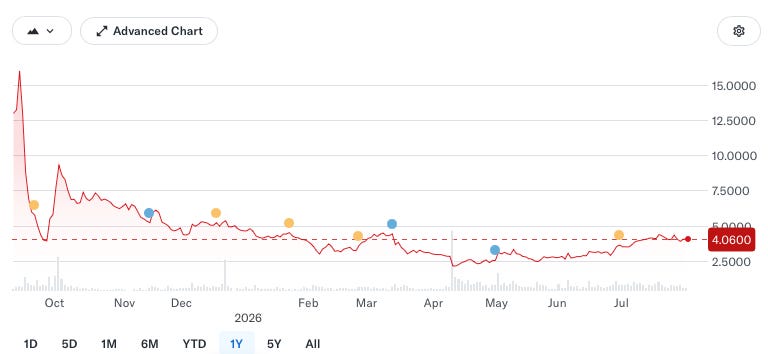
Finally, as for Angel (formerly Angel Studios), their stock very, very slightly popped last month after Young Washington ($20 million budget) which made $45 million in the US, but their stock is still way down from its opening.
RIGHT: The WGA should focus on antitrust concerns! I’ve been on this for years. Post-WGA/AMTPT deal in 2023, I wrote an article for the Ankler calling on the WGA to focus and organize against industry consolidation. Sure enough, the WGA filed a lawsuit against the Paramount-WBD merger, and people are organizing around this issue now. I wish this energy had coalesced earlier (specifically to lobby Washington much earlier), but better late than never!
WRONG: Actually, the chip shortage might be due to market manipulation. In my last “Long Reads for the Long Summer” article, I shared an article about how LLMs are causing memory chip prices to spike, which will make all electronics more expensive. Well, turns out, three RAM manufacturers control 90% of the market, and now a private lawsuit accuses them of price-fixing. So yeah.
WRONG/UPDATE: The Odyssey will hold! Two weeks ago, I wrote, “As of this moment, we haven’t had a super-blockbuster, though The Odyssey, Spider-Man: Brand New Day and Avengers: Doomsday could all cross the $500 million mark. (At this point, The Odyssey would need a very strong hold to get there.)” Well, it’s safe to say it’s going to have that hold! It only dropped 30% in weekend two and IMAX screenings are sold out all month. Spider-Man: Brand New Day is also off to a great start.
RIGHT: People are rushing to get shows out yearly. I’ve long been bullish on yearly, weekly-released shows, and Leslie Goldberg at The Ankler wrote about how many people in town are now listening.
WRONG: Mark Carney reverses Canada’s stance on homegrown production. After writing about Canada installing domestic production quotas, Canada has backed off.
WRONG: I don’t trust Spider-Man: Brand New Day’s online “views”. When I originally wrote about the latest Spider-Man film’s record-breaking trailer, I thought this was just YouTube views, but after watching this Corridor Crew video and doing more research, well, it’s all social views of the trailer globally. Really? That stat includes TikTok, Reels and YouTube Shorts views. Basically, I don’t trust it anymore. (This film will probably set record, but I trust the pre-sales data more.)
RIGHT: Celebrity Production companies are still struggling. I’ve written about this for years, but the company that I didn’t track was Kevin Hart’s HartBeat, which was valued at $650 million but is struggling now and might just end soon, especially after Kevin Hart pulled his endorsement deals. And Bad Robot is moving to NYC.
CORRECTION: SpongeBob is a “second run” title. In my 2025 recap article, I had SpongeBob SquarePantslabelled as a “library” title, when it is still a “second run” show, with new episodes still coming out on Nickelodeon.
CORRECTION: In my last “What I Got Right, What I Got Wrong” update, I offered a correction from Doug Creutz and misspelled TD Cowen. Thanks, Grammarly!
Though he could have increased prices to make up for the gap, he couldn’t have increased them that much.
There’s a theory, which I think that Daryl Morey created and Bill Simmons popularized, that, to be successful building your team, you only need a handful of bad GMs in the league to take advantage of. To be clear, Daryl Morey’s theory was also for signing bad contracts, that you could always get out of bad contracts. Basically, there’s always someone who will make a bad trade. It’s not the same exact thing, but similar enough to the Greater Fool Theory that I really like it.
Comments
Nothing yet. Say the first thing.
Sign in to join the conversation.