
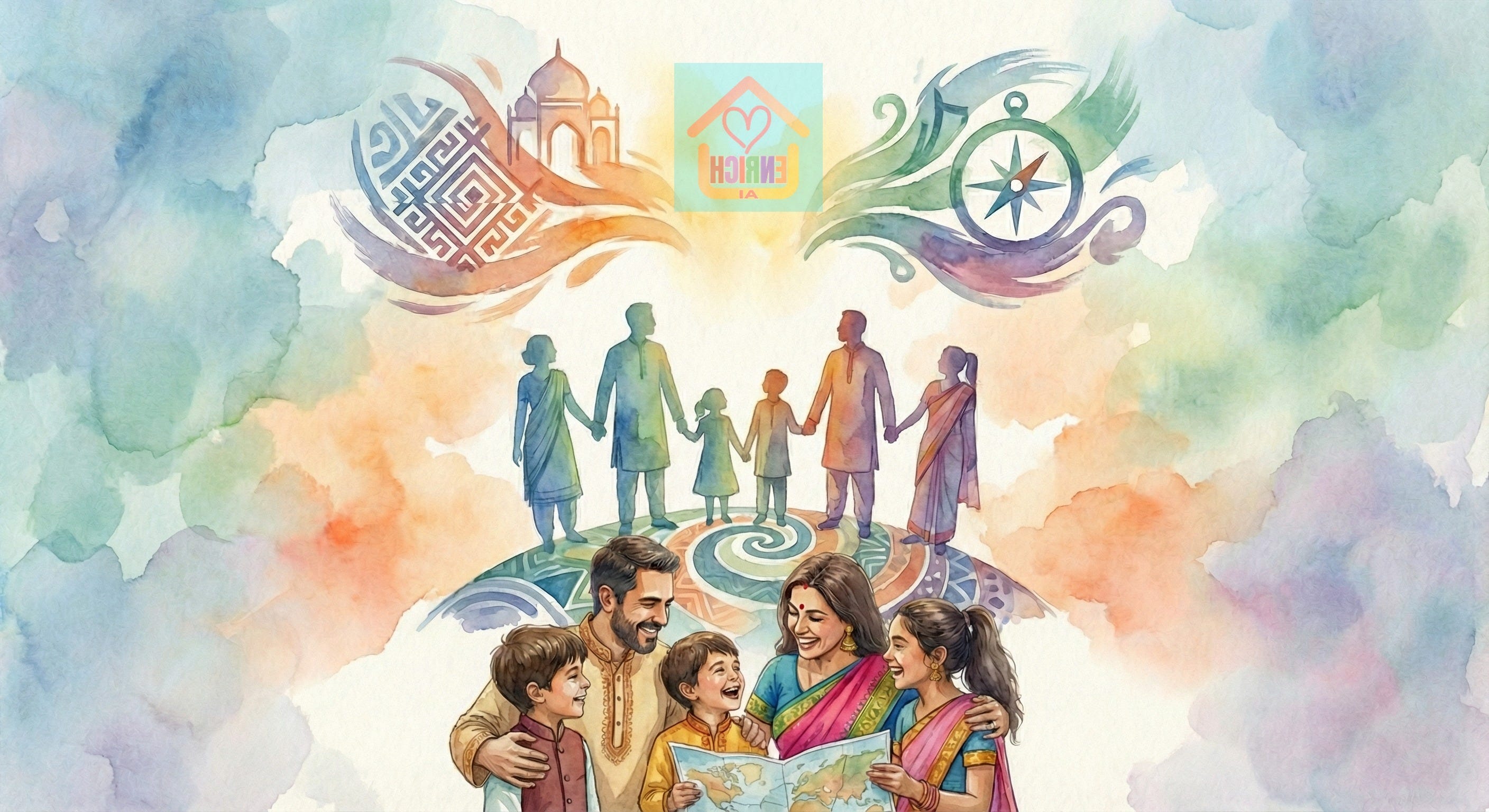
You watch your child grow, and somewhere along the way, they stop being simply “yours.” They develop preferences you didn’t teach them. They question beliefs you thought were settled. They want things you never wanted, reject things you cherished, and seem determined to become someone entirely their own.
For some parents, this feels natural, even exciting. For others, it feels like loss, betrayal, or failure. The difference often isn’t about how much you love your child. It’s about what individuation means in your cultural context, and whether you were raised to see separation as healthy development or dangerous disconnection.
This article is for every parent trying to understand not just their child’s journey toward selfhood, but also their own conflicted feelings about it. Because before we can support our children’s individuation, we need to understand what it is, why it matters, and how our own cultural inheritance shapes our response to it.
Individuation is the lifelong process through which a person develops a distinct identity separate from their family of origin, their culture, and the collective expectations around them. It’s how we become psychologically autonomous individuals with our own thoughts, feelings, values, and sense of self.
The term comes from Carl Jung, who described individuation as the central process of human development: becoming who you actually are, rather than who others expect you to be or who you think you should be. Later psychoanalysts, particularly Margaret Mahler and Peter Blos, mapped how this process unfolds from infancy through adolescence.
Individuation is not the same as separation or independence. This distinction is crucial. You can be deeply connected to your family while still being individuated. You can honor your culture while still thinking for yourself. Individuation is about developing an internal sense of self that allows you to choose your connections and commitments authentically, rather than living them out of obligation, fear, or unconscious programming.
In healthy individuation:
You can distinguish your feelings from others’ feelings
You can hold opinions that differ from your family without feeling like you’re betraying them
You can make choices based on your own values, even when others disapprove
You can maintain close relationships without losing yourself in them
You develop the capacity to self-soothe and regulate your emotions
You claim responsibility for your own life rather than blaming others or waiting for rescue
Individuation doesn’t mean you stop caring what others think. It means their opinions inform you without controlling you. It doesn’t mean you never need anyone. It means you choose your dependencies consciously rather than remaining trapped in childhood patterns.
Understanding when and how individuation happens helps parents recognize what’s normal development versus what might need support.
Infancy and Early Childhood (Birth to 3 years): The First Individuation
Margaret Mahler described the first individuation process in early childhood. Initially, infants experience themselves as merged with their primary caregiver, usually the mother. There’s no clear boundary between “me” and “not me.”
Between 6 months and 3 years, children gradually realize they’re separate beings. This is why toddlers become so fascinated with the word “no” and the phrase “me do it.” They’re not being difficult; they’re discovering autonomy. They walk away from you and then run back for reassurance. They practice being separate while staying connected.
Early to Middle Childhood (3 to 11 years): Consolidation
During these years, children consolidate their sense of being separate people. They develop preferences, friendships outside the family, and begin to form opinions. But they still primarily organize their identity around family values and parental approval. Their job is to learn and absorb the culture, values, and skills their family provides.
Adolescence (12 to early 20s): The Second Individuation
Adolescence brings what Peter Blos called the “second individuation.” This is when children must psychologically separate from parents to develop their own identity. They question everything you’ve taught them. They experiment with different values, beliefs, styles, and groups. They need to reject aspects of you to discover what’s authentically them versus what they absorbed without choosing.
This is often the most painful stage for parents because the separation feels personal. But it’s developmentally necessary. Teenagers who aren’t allowed to individuate either become rigidly obedient (and later struggle with depression and anxiety) or rebel so completely that they lose the foundation you built.
Early Adulthood and Beyond (20s onward): Ongoing Integration
Individuation doesn’t end at 25. Throughout adulthood, we continue differentiating ourselves from collective expectations while integrating parts of ourselves we’d rejected. Many people in their 30s and 40s return to family values they’d dismissed as teenagers, but now they’re choosing those values consciously rather than living them by default.
To make this concrete, here are examples of individuation at different ages:
A 2-year-old refuses to wear the outfit you picked and insists on mismatched clothes. This isn’t defiance; it’s the earliest form of “I have preferences that are mine.”
A 7-year-old announces they don’t like a food that’s central to family meals, or they want to quit an activity that’s important to you. They’re discovering their own tastes and interests.
A 14-year-old questions your religious beliefs, challenges your political views, or rejects family traditions. They’re trying on different identities to see what fits.
A 19-year-old chooses a college major or career path you don’t understand or approve of. They’re claiming authority over their own life direction.
A 28-year-old makes parenting choices different from how they were raised. They’re integrating their values with their experience to create their own approach.
A 45-year-old sets boundaries with aging parents about visits, phone calls, or unsolicited advice. They’re maintaining connection while honoring their own needs.
All of these are healthy individuation. And all of them can feel threatening, especially if you were raised in a culture where these assertions of self are seen as disrespectful or dangerous.
Here’s where culture becomes essential to understanding individuation. Not all cultures value or recognize individuation the same way. In fact, Western psychological theories about individuation reflect a specifically Western, individualistic worldview that doesn’t translate universally.
Individualistic Cultures (primarily Western: United States, Canada, Northern Europe, Australia)
These cultures emphasize:
Personal autonomy and self-determination
Individual rights over collective obligations
Self-expression and uniqueness as positive values
The goal of raising independent, self-sufficient adults
Success measured by individual achievement
Identity as something you create and choose
In individualistic cultures, individuation is seen as the goal of healthy development. Children are expected to “leave the nest,” form their own families, and make decisions without excessive parental input. Parents who remain too involved are seen as enmeshed or controlling.
Collectivist Cultures (primarily non-Western: many Asian, Caribbean, African, Latin American, Middle Eastern, and Indigenous cultures)
These cultures emphasize:
Interdependence and relational harmony
Family and community obligations over individual desires
Conformity and fitting in as positive values
The goal of raising connected, dutiful family members
Success measured by family honor and collective wellbeing
Identity as inherited and role-based
In collectivist cultures, excessive individuation is seen as selfishness, family betrayal, or psychological immaturity. Children are expected to remain deeply connected to family, consider family input in major decisions, and prioritize collective wellbeing. Parents who remain deeply involved are seen as loving and responsible.
Neither model is right or wrong. They’re different solutions to the human challenge of balancing autonomy and belonging.
The problem arises when parents raised in one model are raising children in a culture organized around the other model. Or when psychological theories developed in individualistic cultures are applied to families from collectivist backgrounds without translation.
If you immigrated from a collectivist culture and are raising children in an individualistic one, you’re facing one of parenting’s most painful challenges. Your children are individuating not just from you as parents, but into a culture that may contradict your deepest values about family, respect, and identity.
What this looks like:
Your teenage daughter wants privacy in a way you never had or wanted. She closes her bedroom door, guards her phone, and stops sharing details of her life. In your culture, this secrecy feels like rejection or deception. In hers, it’s normal teenage individuation.
Your son wants to choose his own career path instead of the profession you’ve sacrificed for him to pursue. In your framework, he’s ungrateful and selfish. In his case, he’s being authentic and self-determined.
Your adult child wants to move across the country for a job, leaving you without nearby family support. You experience this as abandonment. They experience it as an opportunity and as a form of independence.
Your child marries someone from a different culture or religion without asking your blessing first. You feel disrespected and excluded. They feel they’re making their own adult choice.
The pain is real on both sides. You’re not wrong to feel hurt. Your children aren’t “bad” to want autonomy. You’re living in the gap between two different cultural models of what it means to be a person, a family, and a healthy adult.
Before you can support your child’s individuation, it helps to understand your own. Most parents raising children in a culture different from their origin have complex individuation stories themselves.
Reflect on these questions:
Were you allowed to individuate in your family of origin? Did your parents accept your differences, or did deviation feel dangerous? Were you praised for obedience or for independent thinking? How much choice did you have in major life decisions?
How did you individuate, if you did? Did you rebel? Comply outwardly while hiding your true self? Leave your culture entirely? Find a way to integrate tradition with autonomy?
What did individuation cost you? Did choosing your own path mean losing family relationships? Creating distance from your culture? Carrying guilt or shame? These losses inform how you respond to your child’s individuation.
What individuation gifted you? Even if it was painful, what did you gain by becoming your own person? A stronger marriage? Career fulfillment? Authenticity? Peace with yourself?
What do you wish your parents had understood? When you pushed for autonomy or made choices they didn’t like, what did you need them to know or feel or do?
These reflections aren’t about blaming your parents or rejecting your culture. They’re about understanding how your past shapes your present reactions. Often, parents who weren’t allowed to individuate healthily either become rigid with their own children (recreating what they experienced) or permissive to an extreme (rebelling against what they experienced). Neither extreme serves your child well.
The goal is integration: honoring what your culture taught you about connection and respect while making space for your child to develop authentic autonomy.
Let’s look at how various cultures approach individuation, so you can understand where you’re coming from and what your child is navigating.
East Asian Cultures (Chinese, Japanese, Korean, Vietnamese traditions)
Traditional approach: The self is fundamentally relational and interdependent. Filial piety requires lifelong duty to parents. Individual desires are secondary to family harmony and honor. Success brings honor to the family; failure brings shame.
Individuation challenge: Children raised in Western contexts may see filial piety as controlling rather than loving. They want to honor parents while also making independent choices. Parents may experience normal Western individuation as a devastating form of rejection.
South Asian Cultures (Indian, Pakistani, Bangladeshi, Sri Lankan traditions)
Traditional approach: Family structure is hierarchical with clear roles and duties. Marriage, career, and major decisions involve family input and approval. The extended family operates as a unit, with individual needs subordinate to collective wellbeing.
Individuation challenge: Children want to choose their own partners, careers, and life paths without being seen as disrespectful or ungrateful. Parents struggle to understand why children don’t want their guidance and involvement.
Latin American and Caribbean Cultures (Mexican, Puerto Rican, Dominican, Colombian, and Cuban traditions)
Traditional approach: Familismo emphasizes strong family loyalty, close intergenerational bonds, and prioritizing family needs. Respect requires deference to elders and authority figures. Family celebrations and gatherings are central to identity.
Individuation challenge: Children raised in the U.S. may want more independence and privacy than traditional familismo allows. Setting boundaries can be seen as rejecting family rather than self-care. Geographic mobility for work or education can feel like abandonment.
Middle Eastern and North African Cultures (Arab, Persian, Turkish, North African traditions)
Traditional approach: Identity is deeply tied to family honor and reputation. Gender roles are more defined. Community opinion matters significantly. Family involvement in major life decisions is expected and seen as support, not intrusion.
Individuation challenge: Children, especially daughters, wanting autonomy around education, career, marriage, and lifestyle can create intense family conflict. Parents may fear the loss of their children's cultural and religious identity.
African and African Diaspora Cultures
Traditional approach: Ubuntu philosophy emphasizes “I am because we are.” Extended family and community networks are central to child-rearing and support. Collective survival and racial solidarity are prioritized. Elders hold wisdom and authority.
Individuation challenge: African American parents balancing individualistic American values with collectivist African heritage face unique tensions. Add the necessity of teaching children to navigate racism, and individuation becomes even more complex.
Indigenous Cultures
Traditional approach: Connection to land, ancestors, and tribal community are central to identity. Wisdom is passed through stories, ceremony, and intergenerational relationships. Individual identity is inseparable from tribal belonging.
Individuation challenge: Children educated in Western systems may internalize individualistic values that conflict with tribal identity. Parents navigate how to pass on traditional ways while preparing children for Western success.
If your child is growing up between cultures, their individuation is exponentially more complex. These “third culture kids” must integrate multiple, sometimes contradictory, cultural values into a coherent identity.
They’re asking:
Which culture’s values do I adopt around family, career, relationships, gender roles?
Can I honor my heritage while also being fully American (or Canadian, or British)?
What do I do when my parents’ culture and my peer culture give opposite messages?
How do I belong to both worlds without betraying either?
Who am I when I’m not quite one thing or the other?
This is “layered individuation.” They’re not just separating from you. They’re building an integrated identity from multiple cultural sources. This is beautiful, creative work, but it’s also exhausting and lonely.
What these children need from you:
Permission to be both/and. “You can honor our culture and be fully American. You don’t have to choose.” This relieves the pressure of binary thinking.
Validation of the complexity. “I know it’s hard to figure out who you are when you’re living between two cultures. That takes a lot of emotional work.” This acknowledgment helps them feel seen.
Your own cultural story. Share how you navigated (or didn’t navigate) cultural tensions in your own life. Let them see your humanity and struggles.
Space to experiment. They may embrace your culture deeply for a while, then reject it, then return to it differently. This isn’t instability; it’s integration work.
Affirmation that they’re not betraying you. When they adopt values or practices from the dominant culture, reassure them they’re not losing their heritage or rejecting you. They’re expanding, not replacing.
So how do you support your child’s individuation when everything in your cultural upbringing tells you it’s wrong, dangerous, or disrespectful? Here’s a framework:
1. Distinguish between core safety and cultural preference
Some boundaries are about safety: not using substances, avoiding dangerous situations, and maintaining basic respect in communication. These are non-negotiable.
Other boundaries are about cultural preference: how much privacy is appropriate, how much family input they need in decisions, what career is suitable. These can be negotiated.
Getting clear on this distinction helps you hold firm where you need to while creating flexibility where you can. Ask yourself: “Is this about my child’s actual safety and wellbeing, or is this about my cultural comfort?”
2. Name the cultural difference explicitly
Don’t let the tension remain invisible. You can say things like:
“In my culture, children live at home until marriage. In American culture, children move out at 18. I know you’re feeling pressure from both sides. Let’s talk about what makes sense for you.”
“I was raised to believe that questioning parents is disrespectful. You’re being raised in a culture that values independent thinking. Can you help me understand your perspective while I share mine?”
This transparency reduces your child's guilt and helps them understand that your reactions aren’t personal rejection but a cultural difference.
3. Focus on values beneath the behaviors
Often, the surface disagreement is about a behavior, but the deeper issue is about values.
You want them to visit every Sunday, the value beneath: family connection and honoring relationships.
They want to limit visits to once a month. The value beneath: autonomy and managing competing demands.
Both values are legitimate. Can you find a solution that honors both? Maybe a weekly phone call plus monthly visits? Maybe less frequent but longer, more intentional time together?
When you get beneath the behavior to the value, you often find common ground.
4. Grieve what you’re losing
It’s okay to feel sad about the differences between how you were parented and how your child wants to relate to you. It’s OK to miss certain aspects of your culture that your children don’t embrace. This grief is real and deserves space.
What’s not okay is making your child responsible for managing that grief or changing to spare you pain. Find other adults, a therapist, or a parents’ support group where you can process these losses. Let your child see that you’re sad sometimes, but make it clear it’s not their job to fix it.
5. Remember: connection can deepen through individuation
This is counterintuitive if you were raised to see individuation as disconnection, but it’s true. When your child knows you’ll love them even when they differ from you, when they can be honest about who they are without fear of rejection, the relationship actually becomes more intimate and authentic.
Many adult children who were allowed to individuate report feeling closer to their parents than those who remained enmeshed or compliant. The relationship transforms from duty to choice, from obligation to genuine affection.
Sometimes what looks like normal individuation is actually a child struggling with mental health issues, trauma responses, or identity crises that need professional intervention. Seek help if you notice:
Severe depression, anxiety, or emotional dysregulation that persists beyond normal teenage moodiness
Self-harm behaviors, eating disorders, or substance abuse
Complete withdrawal from family relationships with no attempt at repair
Suicidal thoughts or expressions of wanting to die
Identity confusion that causes significant distress, rather than normal exploration
Inability to function at school, work, or in peer relationships
Cultural factors matter here too. In some cultures, seeking mental health support feels like airing family shame publicly. But getting help for your child isn’t betrayal; it’s wisdom. A culturally responsive therapist can help your child navigate individuation while honoring your cultural values.
As you support your child’s individuation, you need tools to manage your own emotional responses. Here are practices that help:
Notice your triggers. What specific behaviors trigger panic, rage, or deep sadness? Usually, these connect to your own individuation wounds or cultural values. Understanding your triggers helps you respond consciously instead of reactively.
Separate your identity from your child’s choices. Your child’s career, your partner's choice, or your lifestyle doesn’t define your worth as a parent. They’re becoming themselves, not rejecting you.
Find community with other immigrant parents. Talking with parents navigating similar tensions normalizes your experience and provides perspective. You’re not alone in this struggle.
Maintain your own cultural connections. If you’re grieving your child’s distance from your culture, deepen your own connection to it. Attend cultural events, maintain language, and cook traditional foods. Your identity doesn’t depend on whether your child fully embraces it.
Practice self-compassion. Parenting between cultures is extraordinarily difficult. You’re going to make mistakes, feel confused, and sometimes respond in ways you regret. That’s human. Treating yourself with kindness models self-compassion for your child.
Consider your own therapy. Working with a culturally responsive therapist can help you process the complex emotions of raising children in a culture different from your origin. It’s not weakness; it’s wisdom.
As you navigate these challenges, structured tools can help both you and your teenager process the complexities of identity development across cultures.
The Mental Health Workbook and Journal for Teenagers provides guided exercises specifically designed to help adolescents explore their developing identity, build self-esteem, and navigate the internal questions that arise during individuation. The workbook format allows teenagers to engage in private self-reflection, which can be especially valuable when family dynamics feel tense around questions of identity.
For teenagers navigating multiple cultural identities, having a private space to explore questions like “What do I believe versus what was I taught to believe?” or “How do I honor my heritage while becoming my own person?” can accelerate healthy individuation. The structured prompts provide scaffolding for complex identity work that might otherwise remain confusing or unprocessed.
If you’re a parent reading this, caught between honoring your cultural heritage and supporting your child’s development in a different cultural context, I want you to know: you’re building a bridge. It’s exhausting, lonely work, and often nobody fully understands what you’re navigating.
Your parents may judge you for being too lenient. Your child may judge you for being too strict. The dominant culture may judge both your culture and your parenting. And you’re in the middle, trying to do right by everyone while often feeling like you’re failing all sides.
But here’s what you’re actually doing: You’re integrating wisdom from two cultures. You’re teaching your child that identity isn’t either/or, that they can honor heritage while choosing their path, that connection and autonomy aren’t opposites.
This is sacred work, even when it hurts, especially when it hurts.
Your child’s individuation isn’t a rejection of you. It’s the fruit of your labor. You gave them roots deep enough to feel secure, and now they’re growing branches in directions you might not have imagined. That’s not failure. That’s success at the deepest level.
The relationship you’re building now, through this painful differentiation, is the relationship that will sustain you both for the rest of your lives. Not a relationship based on obligation or control, but one based on genuine love, mutual respect, and the profound gift of being truly known.
That’s worth every moment of discomfort. That’s worth the bridge you’re building, stone by stone, between worlds.
About the Author
Sherry Jerimie, LCSW-R, is a Licensed Psychoanalytic Psychotherapist and Certified Psychoanalyst with almost three decades of experience supporting individuals, couples, and families through cultural transitions and identity development. As an immigrant herself and the founder of ENRICH Global, she brings both lived experience and clinical expertise to understanding the complexities of raising children across cultures. Her ENRICH framework (Ethnicity, Nationality, Race, Identity, Culture, Heritage) provides culturally responsive approaches to mental health and family dynamics.
Important Disclaimer
This article is for educational and informational purposes only and does not constitute medical, psychological, or mental health advice. The content should not replace professional therapeutic guidance or treatment. If you or your teenager is experiencing a mental health crisis, self-harm, suicidal thoughts, or severe emotional distress, please seek immediate professional help by contacting a mental health professional, calling the 988 Suicide and Crisis Lifeline, or visiting your nearest emergency room. Cultural considerations in parenting are complex and individual; what’s described here may not apply to your specific circumstances. Please consult with a culturally responsive mental health professional for personalized guidance.
No posts
Comments
Nothing yet. Say the first thing.
Sign in to join the conversation.