
The shift has already happened. The best teams have moved on. But most engineering organisations are still mid-transition — running a 2026 stack with a 2020 operating model.
For 30 years we operated on the same loop:
Plan → Code → Test → Deploy
ADLC — the Agent Development Life Cycle.
Humans specify. Agents implement. Systems verify.
The entire development loop has been rewritten:
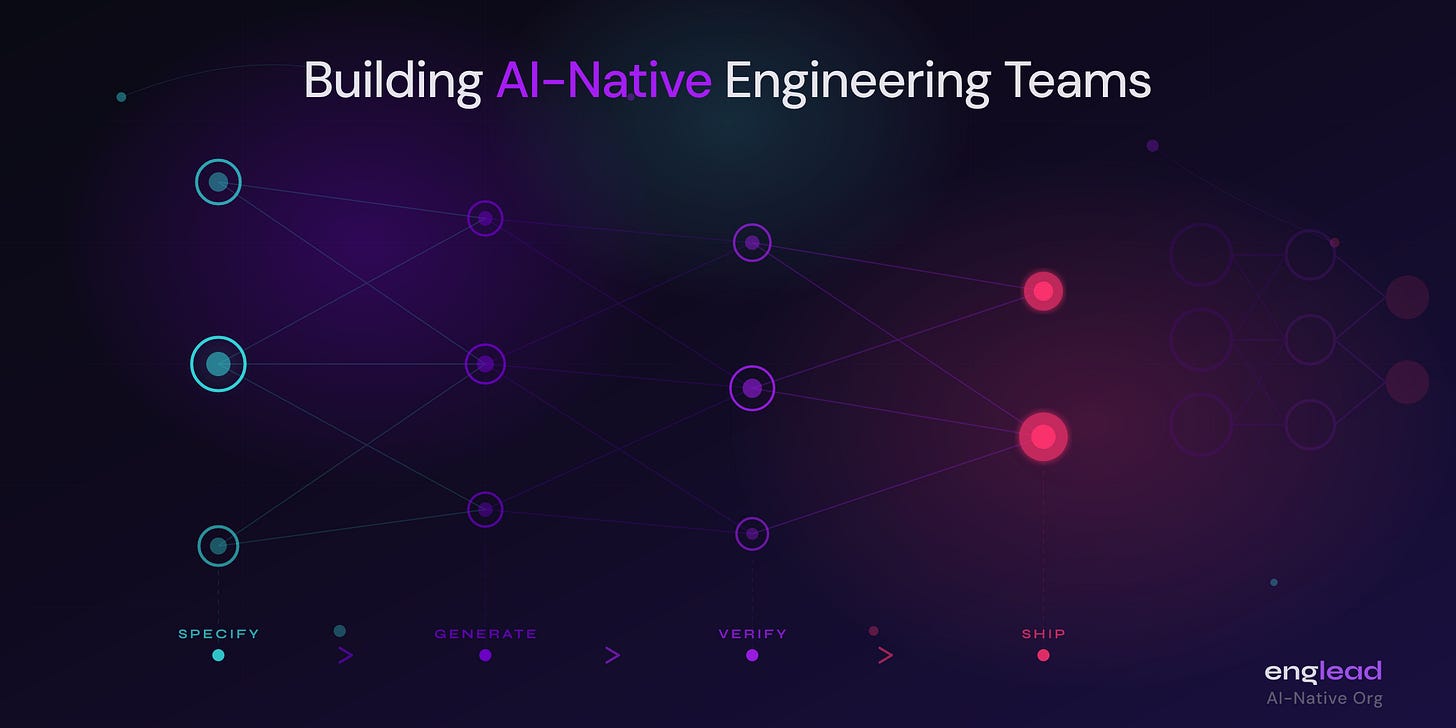
🚀 Specify → Generate → Verify → Ship
Let me break down what this actually looks like.
Forget 8-10 person teams with a fixed tech lead.
AI-native teams run lean:
🔹 3-4 engineers per pod (Sora shipped in 28 days with 4 people)
🔹 A “Producer” role to coordinate agent workflows
🔹 Rotating leadership — no permanent tech leads
🔹 Domain-driven, organised around customer problems — not components
No daily standups. No sprint planning. Only alignment meetings.
The meetings you don’t have are as important as the ones you do.
Microsoft’s data on AI-native engineering flow shows where time actually goes:
📊 22% co-planning with AI
📊 35% building by prompt
📊 38% reviewing and refining
📊 5% manual coding
Read that again. Five percent manual coding.
The bottleneck has shifted from implementation to specification and verification.
“Coding is increasingly the fastest part of the process.”
This means your highest-leverage activity is no longer writing code — it’s writing specs.
Product Canvas. Tech Spec. AGENTS.md. CLAUDE.md.
These documents are your new codebase.
The old model assumed humans write code.
The ADLC assumes:
1️⃣ Humans write detailed specifications
2️⃣ Agents generate implementation
3️⃣ Automated systems verify (TDD, static analysis, security scanning)
4️⃣ Humans review for architecture, intent, and edge cases
5️⃣ Systems ship with confidence
Share AI-native Engineering Leader
The core principle: Delegate-Review-Own
- Delegate mechanical, well-specified work to agents
- Review quality, alignment, and architectural consistency
- Own strategy, novel problems, and system-level decisions
This isn’t about replacing engineers. It’s about redirecting their judgment to where it compounds.
Here’s what executives actually care about:
❌ Stop measuring:
Lines of code
Story points completed
Number of PRs merged
✅ Start measuring:
Cycle time — idea to production
Shipped capabilities — features customers use
Quality metrics — incidents, rollback rate, security findings
Customer outcomes** — adoption, retention, satisfaction
A 4-person AI-native team shipping a product in 28 days delivers more business value than a 15-person team shipping the same thing in 4 months.
The ROI isn’t headcount reduction. It’s velocity-to-value.
What kills AI-native teams:
🚫 Skipping TDD (tests ARE your specification language)
🚫 No AGENTS.md (agents without guardrails produce chaos)
🚫 Running multiple agents without task isolation
🚫 Measuring output instead of outcomes
🚫 Adopting with anxiety instead of intention
The best engineering leaders in 2026 won’t be the ones who adopted AI the fastest.
They’ll be the ones who adopted it the most thoughtfully.
The ADLC isn’t a buzzword. It’s the operating model for every engineering team that wants to stay competitive.
The question isn’t whether your team will make this shift.
It’s whether you’ll lead it — or be dragged into it.
What’s working (or not working) in your team’s AI-native transition? 👇
No posts
Comments
Nothing yet. Say the first thing.
Sign in to join the conversation.