
University instructors throughout the United States are struggling with upcoming requirements to make all web materials compliant with enhanced standards under the Americans with Disabilities Act.1 Many institutions are sending out announcements and setting deadlines to convey that these updates must be completed. Many instructors report feeling unprepared and overwhelmed, not because they don’t care about their students, but because the framing of these expectations as fundamentally about compliance with legal standards undermines internal motivation. Furthermore, the required updates to materials remain outside the scope of campus units where instructors typically direct their questions or request for support, such as disability centers. More well-known inclusive teaching frameworks, such as Universal Design for Learning, also fall short of fully addressing this particular challenge (although improving digital accessibility will likely support achieving some of UDL’s aims).
As academic developers and instructors ourselves, like the instructors we work with, we are not excited by compliance, and often compliance messaging loses the underlying “why.” Particularly in environments where many excellent teachers approach their work intuitively, looking at students’ faces, engaging in discussions, and responding to success on work, a frame around compliance challenges our underlying motivation toward student thriving. Our colleague, Brooke Shafar, recently wrote about the ableist resistance she has experienced when supporting digital accessibility updates, noting that even instructors who would otherwise advocate for student success may still treat accessibility as an add-on, separate from that goal. How can we reframe these efforts to center student learning, access, and instructor agency rather than legal compliance, to better attune these expectations with our personal goals and values as educators while navigating limited resources? We suggest instructors conduct a risk assessment and develop a mitigation plan, which allows us to proactively acknowledge the real uncertainties that arise in the course of instructional decision-making. This is a form of risk management, the activity of identifying, evaluating, and mitigating risk. This process can inform complex and complicated decisions, where there is no correct answer and/or time and resources don’t allow us to make simple and straightforward decisions.
Many readers probably bristle at the notion of risk management and its roots in a neoliberal corporate structure that many of us enter academia to avoid. In fact, two of the three authors here (Dan and Lindsay), both responded with skepticism when Andy approached us to discuss the possibilities of writing about risk management 18 months ago. After having just finished working on a project about students and staff with disabilities being excluded from emerging conversations about AI, we feared that explicitly identifying teaching “risks” might lead to justifications for denying access. For example, perhaps instructors would simply remove inaccessible materials, rather than taking steps to make them accessible. Andy persuaded us that if we understood risk as uncertainty, something we deal with every day in our teaching, risk management is actually about how we connect our values and limited resources to navigating uncertainty with intention and meaning.
The Americans with Disabilities Act (1990, 2008) and its precursor, The Rehabilitation Act of 1973, addressed a significant social problem in the United States: there were no blanket guarantees of equal opportunity in educational, social, and economic spaces for people with disabilities. In practice, nearly all accessibility work on university campuses stems from these two laws aimed at creating equal opportunity via two primary mechanisms: 1) the reasonable accommodation and 2) the intentional design (or retrofit) of accessible physical and digital space. Here, we address the latter and the mandates that follow. When it comes to physical space, adherence to guidelines is generally visible, concrete, and clearly owned. Someone is responsible for ramps, push buttons to open doors, braille signage, accessible parking spaces, and bathroom stalls. Their absence is obvious, and determining how to fix them is relatively straightforward, even if performing those fixes is sometimes costly.
Digital access, as defined by the new regulations, is more complex, messy, and difficult to discern, and is often not really owned by… anyone. IT departments are in charge of making sure campus websites comply with federal standards. Those who support online course design, whether as instructional designers, instructors, teaching center staff, accessibility specialists, or others, ensure learning environments are compliant with digital accessibility standards, but they may not engage with maintenance and updates to those classes. At many institutions, those in these types of roles also tend to act as de facto campus-wide experts on this issue, providing training, workshops, and leading troubleshooting accessibility challenges. When viewed through this game of “hot potato” ownership and responsibility, many abdicate not only responsibility, but also the meaning and student benefits derived from providing accessible materials and resources. In fact, the risk of legal repercussions for dropping this particular ball has even driven some universities to remove digital resources rather than update them. A compliance-centric approach leads to a situation with little reward and a lot of risk in (non-)compliance.
An intentional process applying risk management concepts to guide instructional decision-making can help us focus on risks to student learning outcomes, access, and the instructor.2 While many instructors may be reluctant to apply terms like “risk management” to their work, conversations often reveal that they understand teaching as an inherently risky endeavor—that is, a process filled with uncertainty that can affect the teaching and learning experience. Every time an instructor weighs the pros and cons of changing a teaching strategy or assessment where the resulting outcome is largely uncertain, they manage risk.
Using Instructional Risk Assessment, a process that we have adapted from the International Organization for Standardization Standard 31000 (figure 1), adds intentionality and a structured means of identifying and weighing what is truly at stake in any complex instructional decision. Considering potential risks to learning outcomes, access, and the instructor helps us move from asking what is legally permissible (or required) to what best serves students and instructors. Further, if instructors discover that their institution lacks resources to support creating accessible materials, a risk analysis process can help articulate and communicate those gaps to leaders and decision-makers. This process helps instructors reframe risks, prioritizing which to mitigate, and determining how to communicate those decisions based on their own expert judgment rather than external pressure alone.
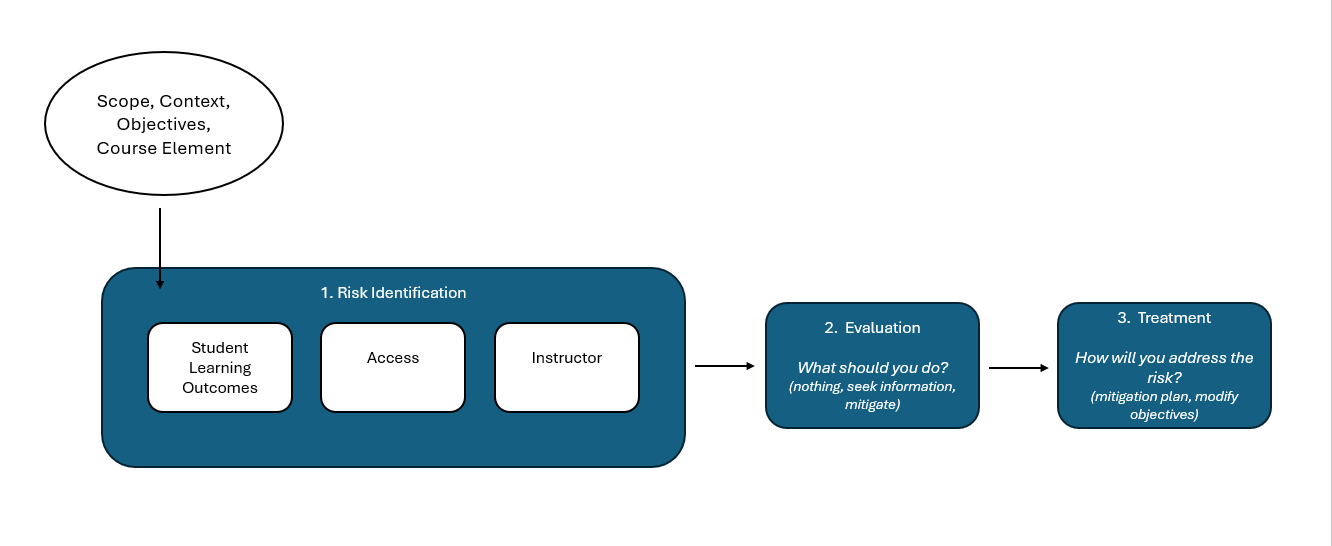
By using this framing, risks become not primarily about us as individual instructors who are fearful of lawsuits, but about the core premise of the ADA: without accessible materials, our students will not have full access to our classes. Knowing that over 20% of students identify as having a disability, the likelihood that we will have students in our classes who face challenges accessing materials is, in fact, high. The impact of inaccessible materials can be devastating. In the past, the impact of inaccessible materials may not have always been apparent because these students have quickly dropped our classes, relied on other avenues to learn material, or accepted that they will struggle and end up taking a class multiple times in an effort to pass. Too frequently, we see compliance framed as an all-or-nothing proposition, which we might experience as a threat to our agency as teachers. But, in fact, risk management helps us make direct connections to the students impacted by our decisions and reclaim teaching agency.
Conducting a risk assessment and developing a mitigation plan allows us to acknowledge the real uncertainties that arise in the course of instructional decision-making, moving us from reactive compliance to proactive action. The reality is that we may not be able to complete all of the revisions necessary to make our teaching materials 100% compliant by the (now-extended) deadline. Some barriers, such as inaccessible journal articles or educational software tools, cannot be reasonably addressed by individual instructors. Distinguishing between risks instructors can mitigate versus those that require institutional support, resources, or advocacy is one potential productive outcome of this process. However, this process can also support identifying risks within our control and plan how to address them before they pose more serious problems. Having a clear mitigation plan can help determine which risks to address first, allocate time and identify or request resources accordingly, and prevent potentially time-consuming troubleshooting. When risk analysis and mitigation planning are built into this decision-making process, instructors can approach accessibility intentionally, instead of as an afterthought or a crisis.
We encourage instructors to get started by applying the risk analysis and mitigation planning process (example in Table 1 below). Analyze the various elements of a class (recorded lectures, readings, quizzes and assessments, slides, etc.) and reflect what risks to student success and accessibility are posed by not creating accessible versions of these materials. Then prioritize the work based on how compelling these risks are and the effort needed to address them. We find it helpful to examine risk categories that emphasize the human stakes in teaching and learning decisions: risks to student learning outcomes, access, and the instructor. Student learning outcomes are statements of the goals that every instructional decision works towards. Access is necessary to ensure that instructional decisions support the success of all students. Recognizing risks to the instructor acknowledges that teaching decisions must align with our own values, capacities, and contexts to be feasible and sustainable.
When it comes to continuing to use course materials that are not accessible, risks may include, but are not necessarily limited to, the following:
Risks to Student Learning Outcomes: Students unable to access course materials would experience barriers in their learning experience, which may affect learning outcomes.
Risks to Access: Students may not be able to, or know how to, access course materials, determine what content they are missing, or, in the case of inaccessible assignments, understand expectations or how to demonstrate learning. Students may have to disclose disabilities, ask for alternative formats of course materials, and otherwise wait and/or rely on others to complete additional steps before they can access materials.
Risks to the Instructor: The instructor may experience decreased student trust, need to enact practices or policies that misalign with their teaching philosophy, and spend time and effort on remediating challenges or complaints related to inaccessible materials.
When considering addressing risks, start by determining what you can address and what requires additional resources and support. For risks that you can manage, determine what resources you have at hand. Numerous institutions now have PDF remediation tools available, or your campus library may be able to create accessible digital class reading lists. You may also find that significant work has already been done within your discipline, such as the efforts to generate accessible PDFs from LaTeX files. If this process reveals a risk that cannot be managed individually, such as an inaccessible required textbook, use the documentation you have generated to escalate requests to leaders. Finally take action, with the knowledge that every step you take contributes to current and future student success.
There is no divorcing teaching from risk. Teaching is risky business, and digital accessibility is just one example of a teaching challenge that could be navigated using risk analysis. As this example illustrates, meeting minimum legal standards is rarely enough to meet our own goals as instructors who hope to create accessible learning experiences for our students. Discussions about compliance, which are so often focused on deadlines and punitive warnings, have distracted us from recognizing potentially higher-impact risks. Facing and planning for those risks provides us with a way to reprioritize creating the types of teaching and learning experiences we value.
NOTE: Substack does not make the presentation of tabular information easily doable. We have shared the information from a table below as text, but we recommend accessing the Google document here.
Task: Auto-Generated Captions for Videos
Resources/Support: High quality campus-supported caption tool
Time: Very little
Recommendations and notes: Use built-in tools (Zoom, Kaltura) that already run in the background
Task: Audio descriptions
Resources/Support: Few available right now
Time: May need to re-record older videos, can incorporate in real time for future recordings
Recommendations and notes: Descriptions do not need to be excessively specific, consider what would be useful for learners and make processes explicit
Task: Accessible PDFs
Resources/Support: Remediation materials
Using the Adobe Accessibility Checker
WebAIM PDF Accessibility Checker
Library services
Time: Little to moderate
Recommendations and notes: Focus on common issues that are simple to fix, such as header levels. When you can, work from source materials—this might mean rescanning non-OCR’d text.
Task: Add alt text to images in slides and documents
Resources/Support: Generative AI tools available when needed
Time: Little to moderate depending on existing materials, minimal when creating new materials
Recommendations and notes: Consider removing non-critical decorative images and designs
Task: Color contrast
Resources/Support: WebAIM checker
Time: Can have an initial learning curve, but once learned and if using templates becomes more straightforward
Recommendations and notes: Consider using already established and validated templates created by your institution
Task: PowerPoint Text Reading Order
Resources/Support: Internal PowerPoint Accessibility checker.
Resources from professionals like Jennifer Pusateri’s Intentional Slide Design
Time: The accessibility checker guides you through the process for older materials
Recommendations and notes: Consider this an opportunity to be more strategic in slide design
Task: LMS Accessibility Checkers
Resources/Support: Campus-wide Instructional Designers or online LMS support guides can guide you through how to use these tools
Time: Easy to use and generally provides guidance on fixing issues
Recommendations and notes: Consider using built-in templates for LMS pages (many institutions develop these
Task: Syllabus templates
Resources/Support: CTLs might have a university-wide syllabus template like University of Delaware’s template
Time: Medium
Recommendations and notes: If it does not exist encourage your CTL or faculty development team to create templates set up to promote accessibility.
On April 20, 2026, the Department of Justice extended the deadline for public entities’ compliance with Title II changes until April 2027 or 2028.
These categories were adapted from Gresty et. al., 2013, who categorized teaching risks as intrinsic, extrinsic, and learning.
No posts
Comments
Nothing yet. Say the first thing.
Sign in to join the conversation.