
What are the most expensive and affordable ways to power new data centers?
That’s the question your Energy Bad Boys set out to find in this week’s article—and we created an incredibly useful dashboard for all of our paid subscribers that allows you to work with the numbers yourselves.
By now, everyone knows that data centers use massive quantities of electricity and require 24/7 power. As a result, the resources used to power them must provide a constant energy source. With this in mind, the answer to what should power them may seem obvious to some of you (including us), but that hasn’t stopped a wide array of solutions from being presented, including the idea of using 100 percent wind, solar, and battery storage.
Our new dashboard puts that to the test.
It allows users to choose different data center loads and resource mixes across the 7 main regional transmission operators (RTOs) in the United States and compare them to the cost of using fuel-based generators like natural gas, nuclear, and coal with carbon capture. It also highlights the amount of capacity needed to maintain 24/7 reliability and the amount of land it would require.
In a separate tab, you can change the clean-energy levels and explore the differences in costs between WSB and nuclear.
This week’s article highlights some of the results from this project, and makes clear that a 100 percent renewable-powered data center is nothing but a fantasy.

Before we get into the data, we wanted to explain the methods behind the numbers.
The resource mixes are cost-optimized for 100 percent reliability based on the hourly generation profile shapes for wind and solar from EIA's Hourly Grid Monitor and cost data from EIA’s assumptions to the Annual Energy Outlook (AEO). The only exception is the capital cost of natural gas, which we increased to a range of $2,200 to $3,000 per kilowatt (kW) to reflect surging turbine prices and regional construction costs.
For dispatchable resources, we used a 90 percent capacity accreditation, and the dashboard allows you to set different reserve margin levels. Fuel costs for each resource were based on data from the EIA and are region-specific for each of the RTOs. They range from $3.03/MMBtu in ERCOT to $6.04/MMBtu in ISO-NE for natural gas, $1.60/MMBtu in SPP to $3.80/MMBtu in ISO-NE for coal, and $.80/MMBtu for nuclear.
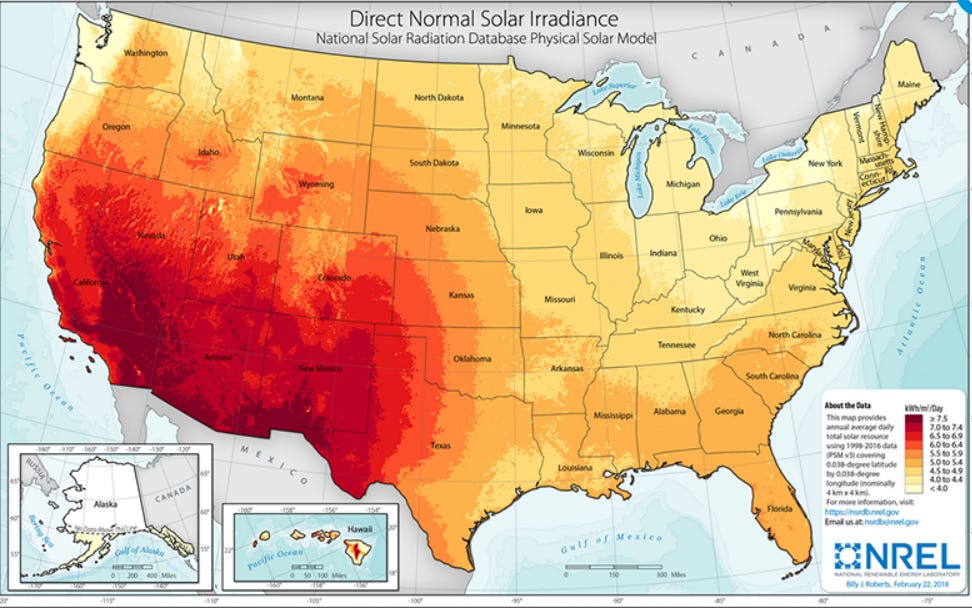
Finally, EIA lacks data for certain regions. For example, despite solar power being present in NYISO, the hourly grid monitor does not populate any data for hourly solar generation in the RTO. As such, we used ISO-NE solar data because it is the most similar to the region.
Furthermore, CAISO has a long-standing moratorium on new nuclear and effectively bans new coal plants, so EIA cost assumptions do not contain any values for these resources. We still wanted to include something for comparison, so we used an average cost multiplier based on other resources in the region compared to EIA’s general assumptions to estimate the cost of both technologies.
Now let’s dig into the data.
This should be the least shocking finding of this entire post. And yet, we made this dashboard partly because so many people have been making the case that a balanced wind, solar, and battery-operated grid is the lowest-cost system for data centers and the grid at large—including the Big Tech owners building data centers.
Our analysis has determined… this is false.

For example, the region with the lowest-cost renewable resource mix was ERCOT, where a solar, wind, and battery storage system needed to power a data center 24/7 would cost $307 per megawatt-hour (MWh)—which is 5 times more expensive than natural gas, 2.5 times more expensive than nuclear, and 2.3 times more expensive than CCS coal.
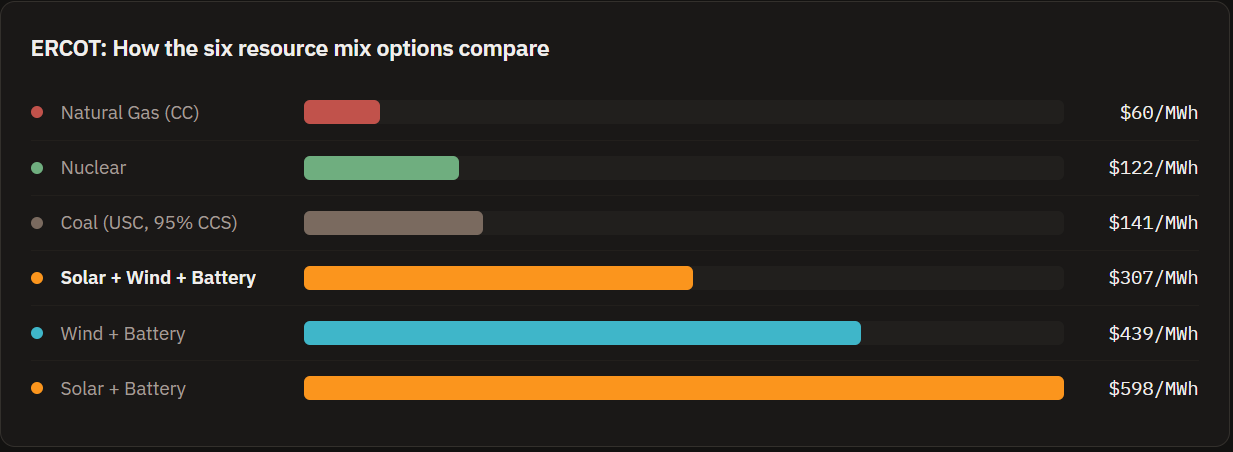
This differs from the numbers in our previous article, The Baseload Solar Beatdown, because adding wind, rather than solely relying on solar and batteries, helps cut down on the overbuild costs.
Other regions are even worse.
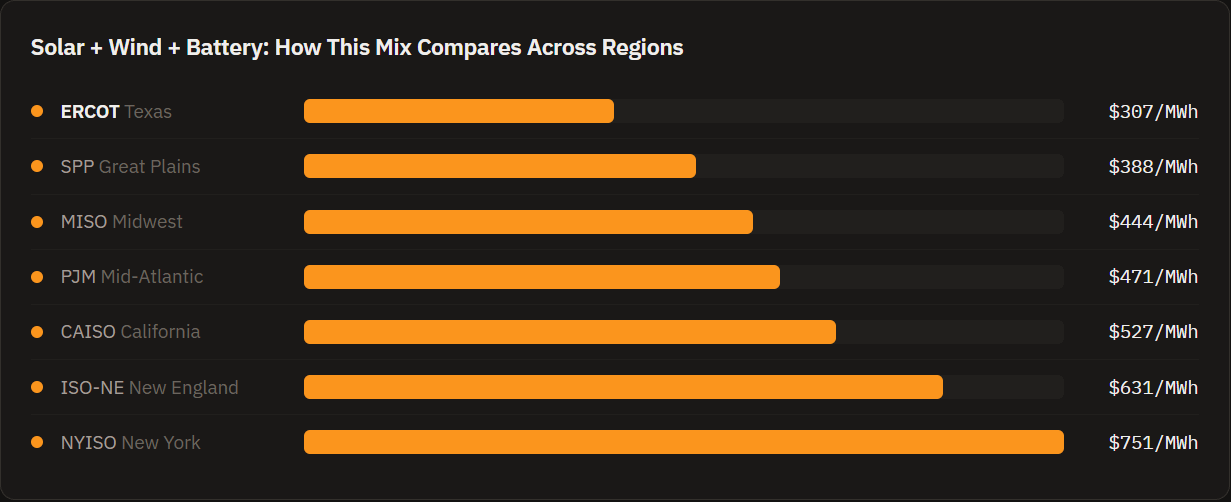
While the fuel-based resources stay relatively consistent regardless of region, the price for a solar, wind, and battery storage grid ranges from $307/MWh in ERCOT to $631/MWh in ISONE and $751/MWh in NYISO—where wind and solar resources are somehow worse than most of New England.
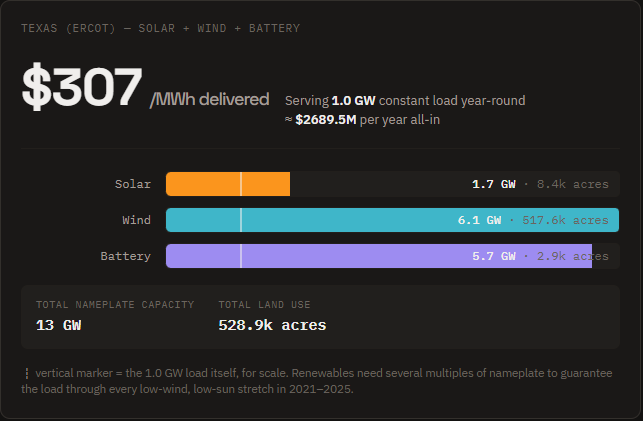
The dashboard also lets you choose the size of the data center in megawatts (MW) you want to power and how much electricity generation capacity is needed at different load requirements and resource mixes.
For example, to power 1,000 MW of data center demand with a wind, solar, battery storage mix, ERCOT would need 13,000 MW of capacity—1,700 MW of solar, 6,100 MW of wind, and 5,700 MW of storage—requiring nearly 529,000 acres of land. This is the lowest requirement among all the RTOs.
NYISO, on the opposite side of the spectrum, would need a total of 27,000 MW of capacity—4,100 MW of solar, 10,000 MW of wind, and 13,000 MW of battery storage—and require over 883,000 acres of land.
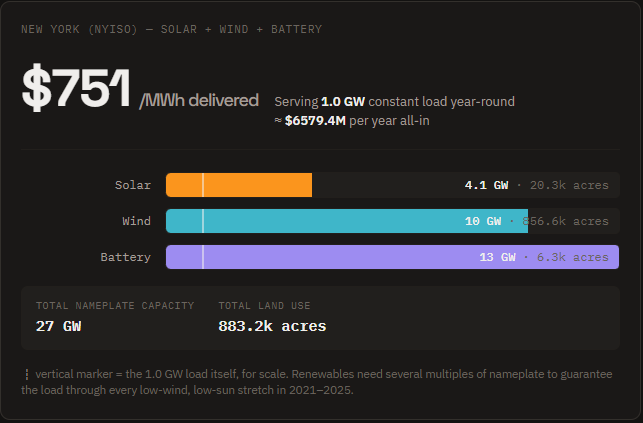
This is far more generation capacity than the 1,300 MW needed for natural gas, coal, and nuclear generators, which would require 140-1,100 acres of land. In other words, wind, solar, and battery storage would require 480-1800 times more land than thermal generators.
For higher data center loads, the requirements outlined above would increase significantly. At 5,000 MW using solar, wind, and battery storage, for example, ERCOT would need 67 GW and take up over 2.6 million acres of land, while NYISO would need 134 GW and over 4.4 million acres of land. Thermal generators, on the other hand, would need just 6,400 MW of capacity and 700-5,300 acres of land.
Here’s another finding that shouldn’t shock anyone.
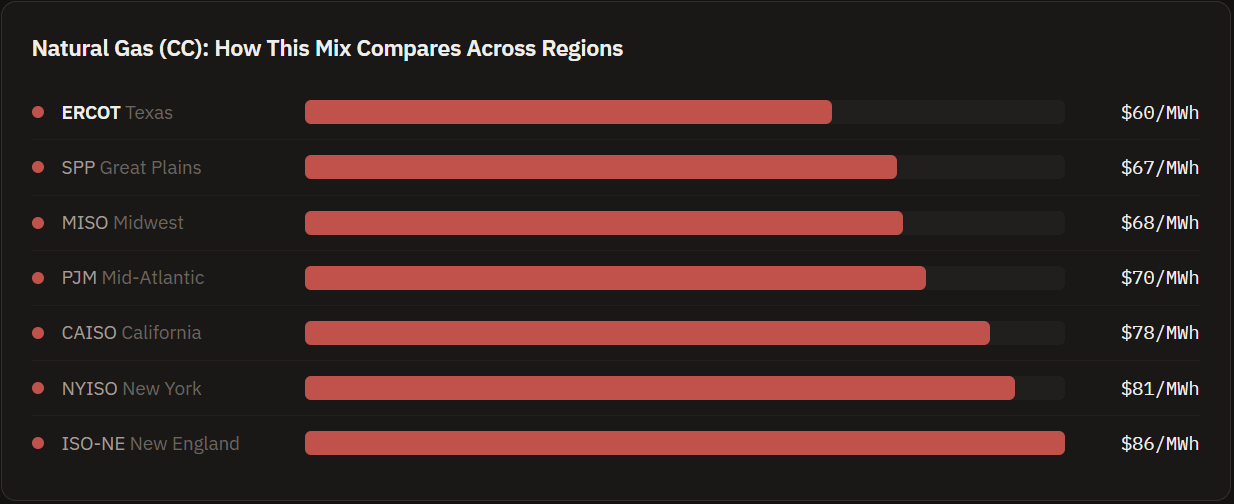
If you want the most affordable solution to powering data centers, natural gas is the clear winner. Even at the elevated capital cost of new combined-cycle natural gas facilities, the cost ranges from $60-86/MWh, making it the lowest-cost resource to power data center load in every single RTO.
Nuclear and coal are the next clear choices. Even though they range from $122-$187/MWh, which is anywhere from 1.4 times to 3 times the cost of new natural gas, they still firmly beat out solar, wind, and battery storage mixes, which range from $300-$1,400/MWh depending on the resource mix.
This is one of the more interesting things to explore in the dataset: at what point are renewables plus gas more expensive than nuclear plus gas for powering data centers?
As you can see below, nuclear and natural gas are less expensive than wind, solar, and storage in PJM, NYISO, ISONE, and CAISO even at a 50 percent clean energy requirement, the lowest penetration the dashboard allows.
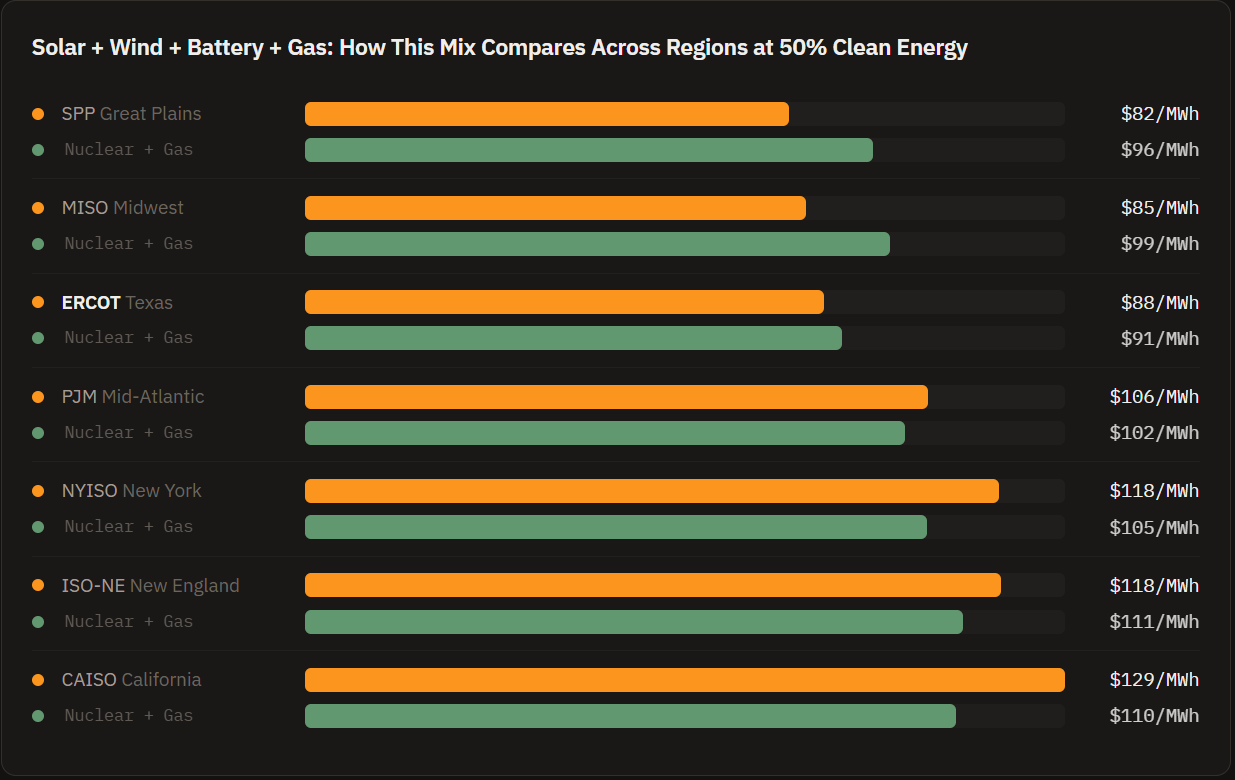
By the time the solar, wind, and battery storage levels reach 85 percent, this resource mix is more expensive than nuclear plus gas in every single RTO.
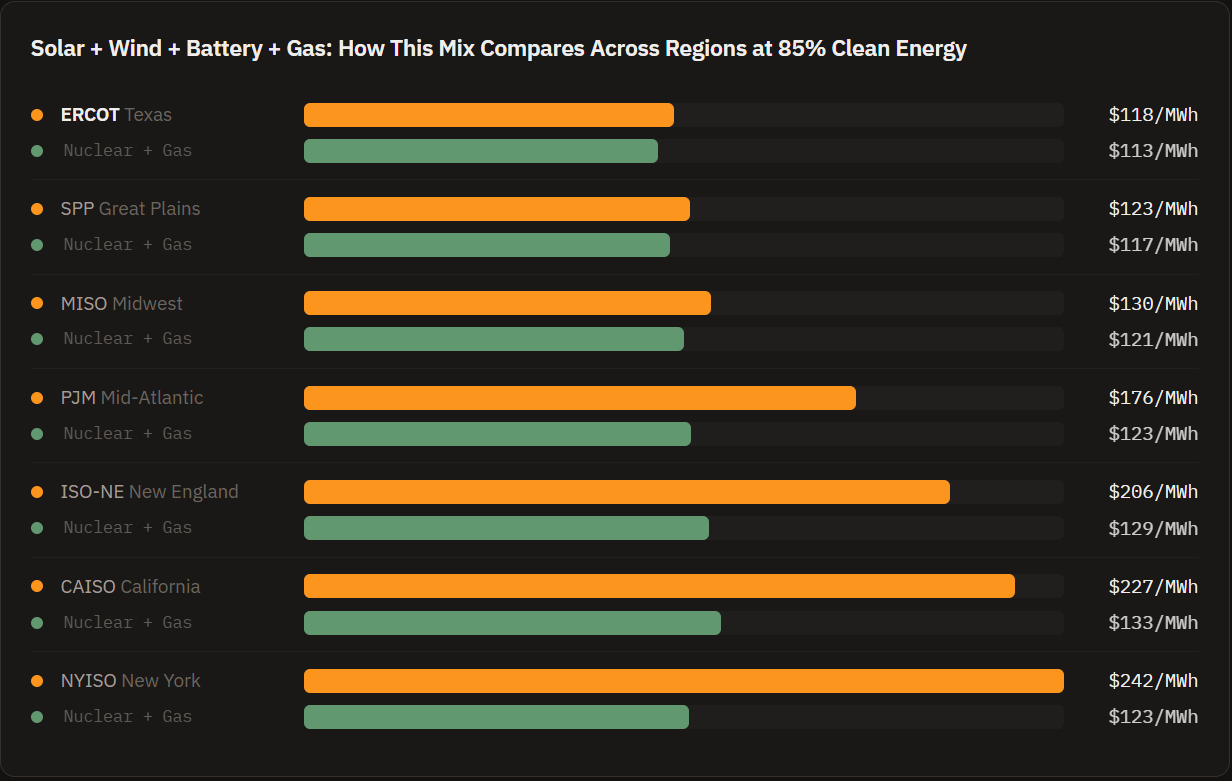
In NYISO, the cost of WSB is already nearly double the cost of nuclear plus gas at 85 percent, and it only gets more expensive as you approach 100 percent. This simply affirms that while solar, wind, and batteries are an incredibly expensive way of powering the grid in every region in the country, there are some regions where it makes even less sense than others—especially in NYISO and ISO-NE. There is simply no reason any of the states in these RTOs should have renewable energy mandates—and yet all 7 have enacted one.
When we originally wrote our Baseload Solar Beatdown article, we focused on ERCOT because it was one of the better solar resource areas in the country. Our analysis was a counter to an Ember report, which claimed that “baseload solar”—or solar firmed by battery storage—could compete with fuel-based generators in the United States to power 24/7 load profiles.
Just to recap: our research found that Ember’s analysis relied on cost assumptions in foreign markets that were only able to achieve such low costs for solar and battery storage due to heavy and unsustainable government subsidization—circumstances that don’t exist anywhere else in the world.
When we corrected the numbers for US-specific cost assumptions in ERCOT, the numbers were roughly 5 times larger than what Ember suggested.
We have now updated our numbers for our data center analysis, because it’s essentially the same concept—how much does it cost to supply a constant load?
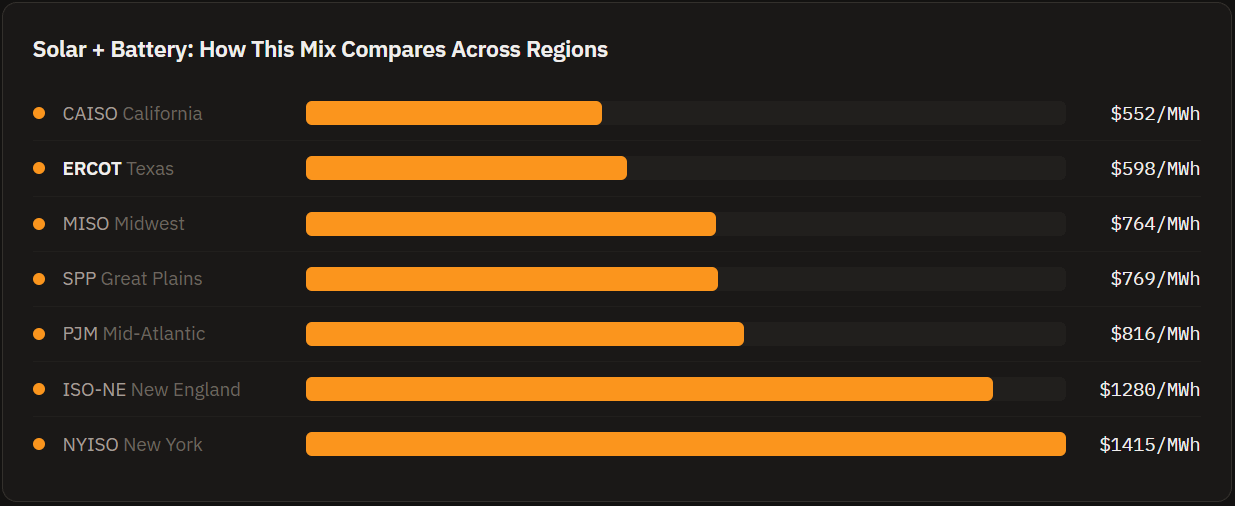
The results haven’t really changed. Baseload solar in ERCOT was $600 per MWh in our previous article, and it has dropped to a whopping $598 today. And this is one of the better regions for baseload solar in the country, with only CAISO showing better numbers at $552/MWh.
The other regions are far worse, as you can see below. ISONE and NYISO, for example, reach $1,280/MWh and $1,415/MWh, respectively.
Let this be the final nail in the coffin for “baseload solar.”
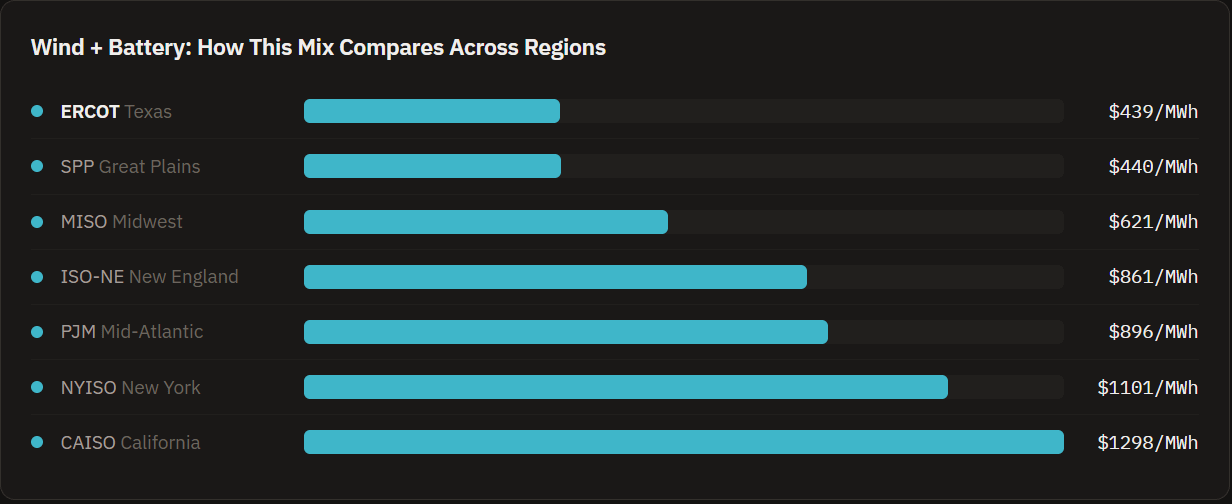
While baseload wind fares somewhat better, it isn’t that much better. It ranges from $439/MWh in ERCOT to $1,298/MWh in CAISO.
We’ve made the claim many times before that if you want to fully decarbonize the grid, using wind, solar, and battery storage is the least intelligent way to do so. And while new nuclear is not the most affordable energy source by any means, it is clearly the lowest-cost solution for decarbonization.
The same is true for powering data centers.
The unfortunate truth is that had energy policy not been focused on retiring reliable generators for the last couple of decades, U.S. electric grids would have more than enough capacity to facilitate substantial demand growth.
As we noted in Watt, Me Worry?, after decades of closing reliable power plants like coal and nuclear, and attempts to slow-roll new natural gas, the US electric grid now has less reliable capacity than it did 20 years ago.
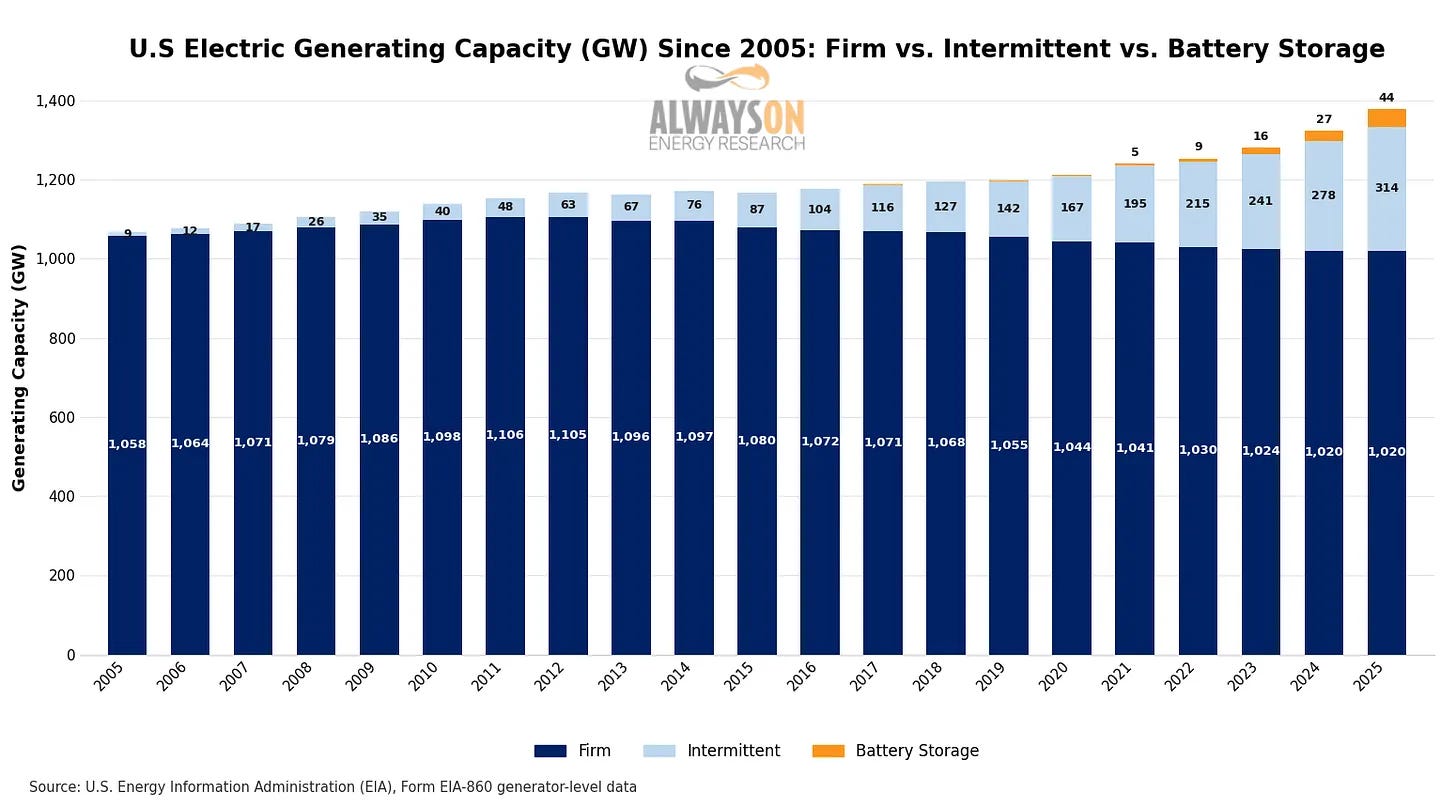
Bad energy policies—not data centers—dug the supply-constrained hole we now find ourselves trying to claw out of, and only good policies will remedy the situation.
For others who haven’t come to terms with the destructive climate policies responsible for eroding the nation’s reliable grid, the answer is more of the same: wind, solar, and batteries.
But this mentality is exactly what has led to the mess we’re in today. Wind, solar, and batteries are already struggling to meet the needs of today’s grid. The idea that they are also the cheapest way to power the enormous, round-the-clock loads coming from data centers isn’t a serious solution.
It’s a fantasy.
We hope this tool can help bring common-sense solutions back into the data center discussion. If not, then it’s off to never-never land for the grid.

Energy Musings - August 20, 2026 by Allen Brooks
Can the Truth Convince People to Like Data Centers? by Cremieux
Comments
Nothing yet. Say the first thing.
Sign in to join the conversation.