
There is a massive pushback against data center growth in the United States. Our friend Robert Bryce’s data center rejection database now tracks over 300 bans across the country as of this writing. Furthermore, these bans now transcend local and county bans to affect data center development across entire states, including New York and Texas.
Personally, we love AI because it has enabled us to improve our data analysis and create products like our graphs and interactive dashboards that advance our mission to bring reliable and affordable energy back to the forefront of energy policy. We’ve also routinely noted that data centers are not the reason electricity prices have been rising in recent years—they’re simply exposing the weaknesses of the system after decades of bad policy decisions.
However, we also understand the frustration and distrust of Big Tech that has arisen, in no small part, because these companies advocated for (and still do) the very green energy policies that have made electricity so expensive and excess power so sparse.
In other words, data centers may not be responsible for rising electricity prices and dwindling reserve margins, but Big Tech certainly deserves its fair share of the blame.
And now their green chickens (but not Doomberg) are coming home to roost.
For many years—decades even—the companies building data centers have been endorsing, lobbying for, and establishing corporate goals for wind and solar energy at the expense of reliable generators like coal and natural gas.
In fact, our friend Travis Fisher notes they even (erroneously) boasted about powering their data centers with 100 percent renewable energy as far back as the mid-2000s, and Amazon, Apple, Google, and Microsoft supported the strict requirements of President Obama’s Clean Power Plan in federal court filings.
This advocacy has backfired in a big way, as these initiatives are the exact reason we’re now having trouble powering data centers and why electricity prices have skyrocketed in recent years—which, ironically, is now being blamed on data centers themselves.
It’s not lost on us that electricity prices began to increase years before data centers started putting upward pressure on load growth. And it’s also true that large load users have historically been a net positive for affordability because they spread the fixed costs of operating the electric grid over more megawatt-hours (MWhs) of electricity (that is, if the grid is run properly, which it hasn’t been for some time).
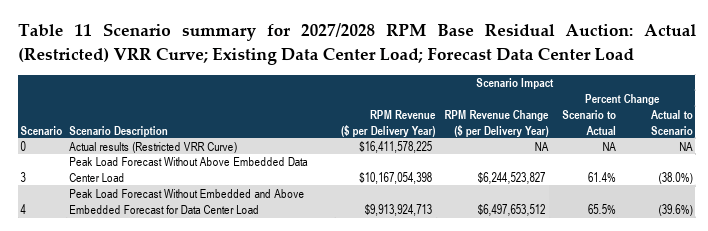
But even though data centers are not responsible for recent price hikes, outside of PJM, where the market monitor estimates they were responsible for 39.6 percent of total capacity-auction costs, the policies pushed by their Big Tech owners certainly are.
For a perfect example of this, let’s start by looking back to Virginia—the state with the most data centers in the country—during Dominion Energy’s 2018 Integrated Resource Plan (IRP).
The Big Tech companies building data centers didn’t merely sit idly as states and the federal government pursued energy policies that reduced reliability and increased prices—they actively participated in advancing these policies.
During Dominion Energy’s 2018 IRP proceedings, for example, data center companies in Virginia personally advocated for more renewables, fewer fossil fuel facilities, and fewer pipelines. In other words, they argued against their own interests—especially considering that these facilities are powered primarily by natural gas, coal, and nuclear generators to this day (which we highlight further below).
For example, several data centers filed a letter during the proceedings stating the following:
We are writing to encourage the Virginia State Corporation Commission and Dominion Energy ("Dominion") to consider the data center community's commitments and innovations in renewable and clean energy technologies when evaluating Dominion's proposed 2018 Integrated Resource Plan (IRP).
They continued:
…we are increasingly looking to power our data centers with renewable energy. Data center companies and their customers recognize the value of renewable energy in helping to control energy costs and achieve price predictability as well as driving toward our ambitious sustainability and greenhouse gas reduction targets. Renewable energy is the most cost-effective resource—a fact reflected in Dominion's own IRP—and we recognize that it is therefore in our best interest to power our operations with renewable resources like wind and solar… Many of our companies have made public commitments to reduce our greenhouse gas footprint and invest in clean energy—in some instances, to procure 100 percent renewable energy for all of our operations. We intend to successfully fulfill our commitments to renewable energy, and access to cost-competitive renewable energy is a significant factor in deciding whether to locate or expand new data centers within the Commonwealth.
In another letter filed by the likes of Microsoft, Apple, AWS, LinkedIn, and others, they promoted the same arguments to prevent natural gas pipelines and power plants from being built, stating that "'solar plus storage' projects are beating out the price of new gas plants, and data centers are already proving the effectiveness of storage in our 24/7 operations."
We’ve debunked the idea that wind and solar are the cheapest energy sources on numerous occasions, so we’ll simply note here just how little these companies understood about how expensive—and unreliable—powering their facilities with 100 percent renewable energy would be.
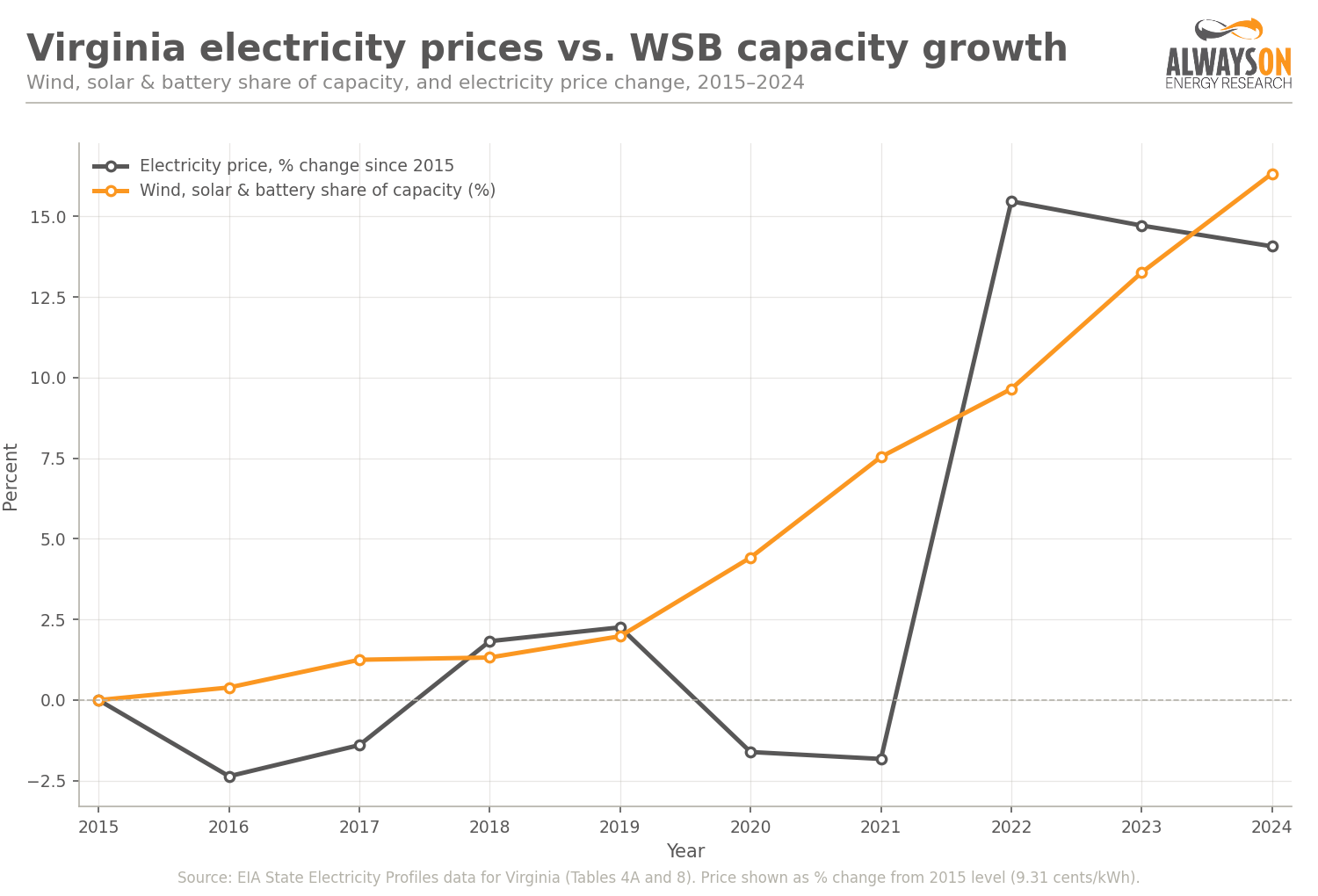
Since this filing, Virginia rates have already been skyrocketing in recent years, as the cost of achieving the state’s clean energy mandates has been growing.
Additionally, PJM—the RTO for Virginia—has now come up short in capacity auctions two years in a row.
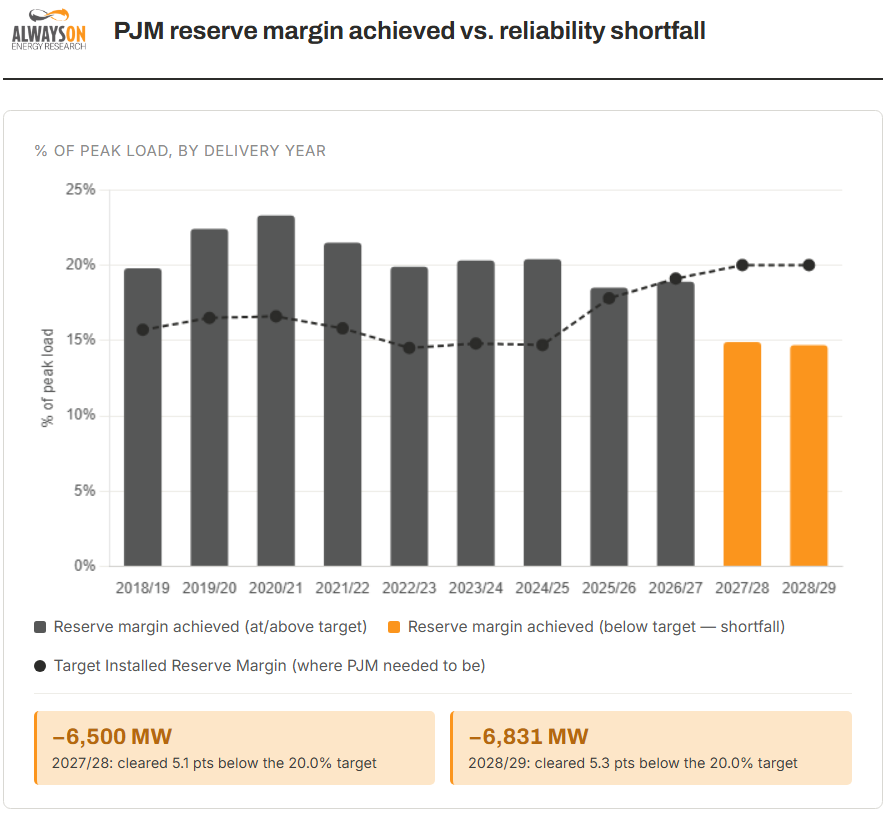
These facts fly directly in the face of arguments made by Big Tech that pursuing a renewable grid would maintain reliability and affordability.
Interestingly, the Data Center Coalition in Virginia hasn’t learned from this, as it has continued to submit filings supporting additional renewable additions in the state in Dominion’s latest request for rate increases in 2025.
The Clean Power Plan was finalized by the Environmental Protection Agency (EPA) in 2015, and set state-by-state emissions limits for existing power plants. Even though the rule was stayed by the Supreme Court, it influenced utility resource plans nationwide and created the risk of future greenhouse gas regulations on power plants. The result was that utilities opted to prematurely shutter their coal plants as they pursued costly measures to reduce CO2 emissions.
Big Tech companies like Apple, Microsoft, and Google filed an amicus brief in support of the plan.
In the brief, they noted that their commitment to renewable energy “reflects their firsthand experience that developing and using renewable electricity generation is affordable, reliable, and consistent with sound business practices. Renewable energy is less subject to price volatility than non-renewable energy; provides greater long-term cost certainty to its purchasers; and, in many parts of the United States, is available at prices comparable to or better than the current prices for other electricity options.”
Once again, these companies vastly underestimated the damage of pursuing a renewable-heavy electricity grid.
Worst of all, their own operations do not support their conclusions. A recent study found data centers are overwhelmingly powered by reliable generators like coal, natural gas, and nuclear. They merely purchase renewable energy credits as a means of offsetting the emissions produced to power these facilities—which may make for nice “sustainability reports” for billion-dollar corporations, but it doesn’t help keep the lights on for small businesses and the American public.
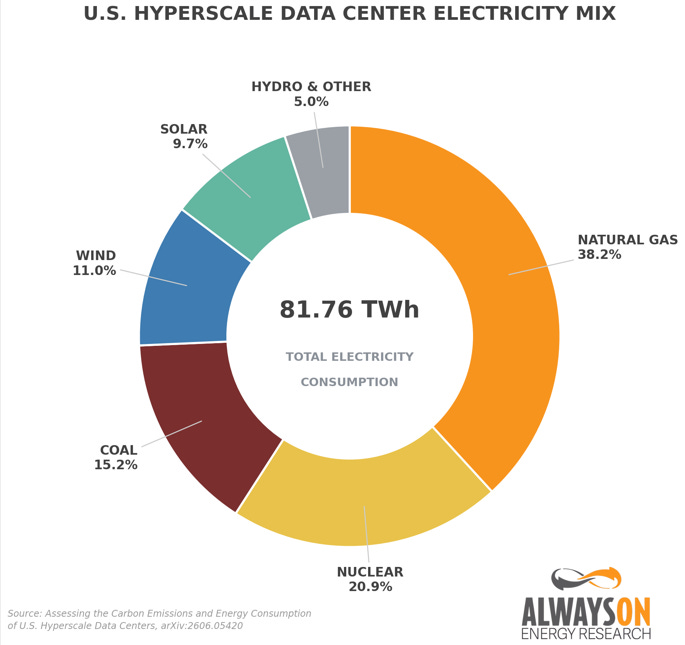
Unfortunately for other energy consumers who can’t simply build their own facilities, this kind of advocacy from Big Tech has made the grid less reliable, more fragile, and more expensive.
Big Tech companies also routinely lobby Congress to keep subsidies for wind and solar in place, which have been some of the most damaging policies for electricity markets across the country
For example, during the fight to end subsidies for wind and solar technologies last year, the Data Center Coalition lobbied Republican senators and wrote a letter to Senate majority leader John Thune to keep the subsidies in place, fearing a disruption in their business investments.
This is especially interesting given their comments from 7 years prior, when they argued solar plus batteries were already cost-competitive with natural gas facilities. If they were, what’s the need for continued subsidies?
These are the same subsidies that have been distorting energy markets across the country, resulting in the closure of reliable power facilities that could’ve been used to power data centers.
As we’ve noted previously, firm capacity in the country is at pre-2005 levels. We’ve updated the graph below to show where we stand currently, and also separated battery storage and used EIA 860 data this time, so the numbers have changed slightly—but you’ll notice that firm capacity is far behind where it needs to be to take on projected new load growth stemming primarily from data centers. Even when adding battery storage to the firm figures, it’s still only on par with 2006.
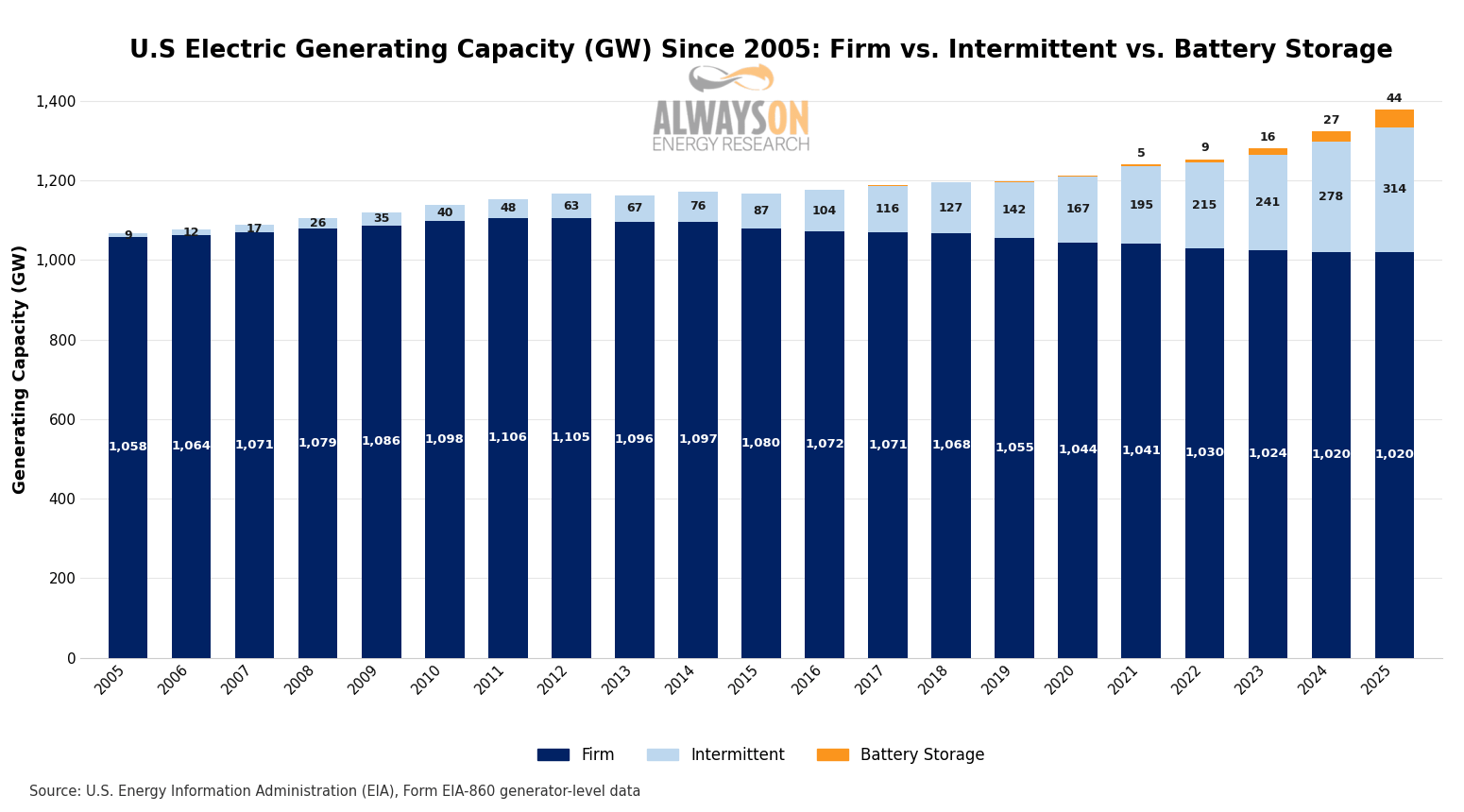
Again, while data centers are not the cause of recent price hikes, needing to play catch-up from the years of dismantling this reliable system will almost certainly exacerbate the upward pressure on prices (unless solutions like Consumer Regulated Electricity are implemented)—and you can absolutely thank Big Tech for playing a role in this.
Not to mention, Big Tech companies and their founders gave billions of dollars to climate organizations, clean-energy advocacy, renewable procurement, carbon-removal projects, and technologies intended to accelerate the transition away from fossil fuels. Jeff Bezos alone committed $10 billion to the Bezos Earth Fund, while Amazon and Microsoft created multibillion- and billion-dollar climate-investment funds of their own.
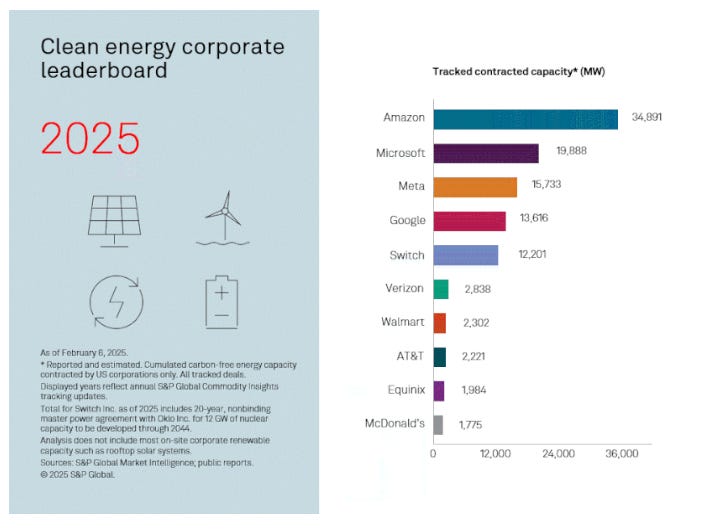
Furthermore, hyperscale companies have been by far the largest facilitators of wind, solar, and storage projects for corporate commitments.
According to S&P Global, tech companies accounted for 84 gigawatts of wind, solar, and storage capacity on the grid. For context, the entire U.S. grid had 353.8 GW of these resources, meaning Big Tech accounted for nearly 24 percent of U.S. projects.
Wind, solar, and battery projects are also facing fierce backlash in rural communities throughout the country. As documented by Robert’s long-running Renewable Rejection Database, there are over 1,310 recorded rejections of these energy projects worldwide since 2003.
Leading the charge against these projects are community groups that often network via Facebook and other online platforms. In many cases, the strategies used by the anti-data center movement are built upon the anti-wind and solar movement that came before it.
This is relevant because locals have understood that the wind and solar projects built for Big Tech were not being used to power their own electricity needs. In essence, many rural communities feel Big Tech’s wind and solar buildout was the first imposition into their lives, and they do not appreciate the second.
Even those who have backed away from initiatives like RE100 (i.e. Meta) continue to commit to matching data center electricity usage—which it is powering with natural gas—with 100 percent clean energy.
While it’s difficult to pull out of a bad narrative once it’s been ingrained, data centers and the Big Tech companies building them still have time to win back the public—we simply hope they realize the damage they did to their own business models and America in general, and that they need to change course.
Big Tech needs to end this “Good for me, not for thee” mentality when it comes to energy sources on our system. They should be promoting the same energy sources that are powering their data centers for the rest of the country—as in coal, natural gas, and nuclear. It’s not just data centers that need reliable and affordable electricity. This is a reality for everyone.
We understand that articles like this may not win us many friends among the tech sector, but We Didn’t Start the Fire, we are merely trying to diagnose its origins.
Comments
Nothing yet. Say the first thing.
Sign in to join the conversation.