
“Nokia, our platform is burning.”
In February 2011, Nokia CEO Stephen Elop attempted a moment of radical transparency. His memo to employees acknowledged what many inside the company already knew: the iPhone and Android had turned Nokia’s dominant market position into an existential crisis almost overnight. The memo spread globally, becoming one of the most famous corporate communications in business history.
Yet for all its honesty about the external threat, the burning platform memo couldn’t address Nokia’s deeper problem. The company had cultivated a culture of fear that stifled the innovation it desperately needed. Engineers and managers, afraid to report problems or challenge decisions, had allowed critical issues to fester. When the technological shock arrived, Nokia lacked both the capability and the culture to respond. Within five years, the company that once commanded nearly 50% of global mobile sales had faded into relative obscurity.
Today’s senior executives face a similar moment. Generative AI is reshaping entire industries with the same abruptness that smartphones disrupted mobile computing. But unlike Nokia’s leaders, today’s executives have the advantage of seeing what happens when companies fail to balance transparency about disruption with the empathy needed to preserve the innovation capacity that changes demands.
The signals arriving at the executive level are in direct conflict. Productivity pilots show AI-human teams elevating both throughput and worker experience. CEOs at firms like Shopify and Fiverr are moving to “AI-first” mandates. Yet the same technological capabilities driving these gains are generating widespread anxiety across the white-collar workforce.
This anxiety is not unfounded. Early-career workers in AI-exposed occupations have seen a 13% relative employment decline after widespread GenAI adoption. The gap between what AI can handle and human expertise continues to narrow: frontier models can now complete complex, economically valuable tasks at near-expert quality, and performance improves with each new generation of models. Reports of AI-linked layoffs, combined with warnings like Anthropic CEO Dario Amodei’s forecast of a “white-collar bloodbath,” are amplifying fear and uncertainty across knowledge workers.
Yet even as AI capability and adoption accelerate, most organizations have left their people to navigate the transition without clear direction. Pew’s September 2025 survey finds 21% of U.S. workers now use AI for at least part of their job—up from 16% last year. But Gallup’s polling reports that while 44% of employees say their organization is integrating AI, only 22% have seen a clear plan and just 30% report any guidelines for use.
This communication vacuum creates a leadership problem: in an environment defined by fast-moving technology and widespread uncertainty, senior teams must be capable of communicating clearly about disruption without losing their people’s confidence. The challenge goes beyond whether to simply be transparent or empathic—it’s how to be both.
When negative outcomes feel likely, people judge leaders less by the outcomes themselves and more by the process: whether decisions follow clear rules, treat people respectfully, and offer credible explanations. This finding from decades of research points to the dual imperative leaders now face. They must tell the truth about disruption while treating people with dignity—operating on what we can think of as a transparency-empathy frontier.
On one axis sits transparency: directness about what AI will change, likely winners and losers, and a clear strategy to navigate genuine uncertainties. Being candid signals competence and keeps trust anchored in reality. Yet controlled experiments show that leaders who vocalize doubt are judged to be less effective, less warm, and less competent—followers become less likely to heed their advice or reward them. The cost of professing uncertainty is real, underscoring the importance of leaders truly understanding the technology they’re deploying.
On the other axis sits empathy: preserving dignity and meaning amid change, validating anxiety, and designing processes that reduce fear. This goes beyond words. It means targeting automation where workers actually want it, involving teams in collaborative design, and investing in reskilling. Evidence from public retraining programs shows workers transitioning from AI-exposed roles can achieve meaningful wage gains with the right support. While retraining demands resources, leaders must weigh those costs against the alternatives: external hiring, lost tacit knowledge, and the cultural damage of layoffs.
Balancing these imperatives is delicate work. Unvarnished candor risks rattling people; soft-pedaling erodes trust. Silence or inaction—the most tempting responses—endanger the business. Some employees are already resisting or quietly undermining AI rollouts when communication falters. The practical goal isn’t perfection on both axes; it’s staying on the frontier, balancing the trade-offs rather than drifting into a zone where you’ve sacrificed both honesty and humanity.
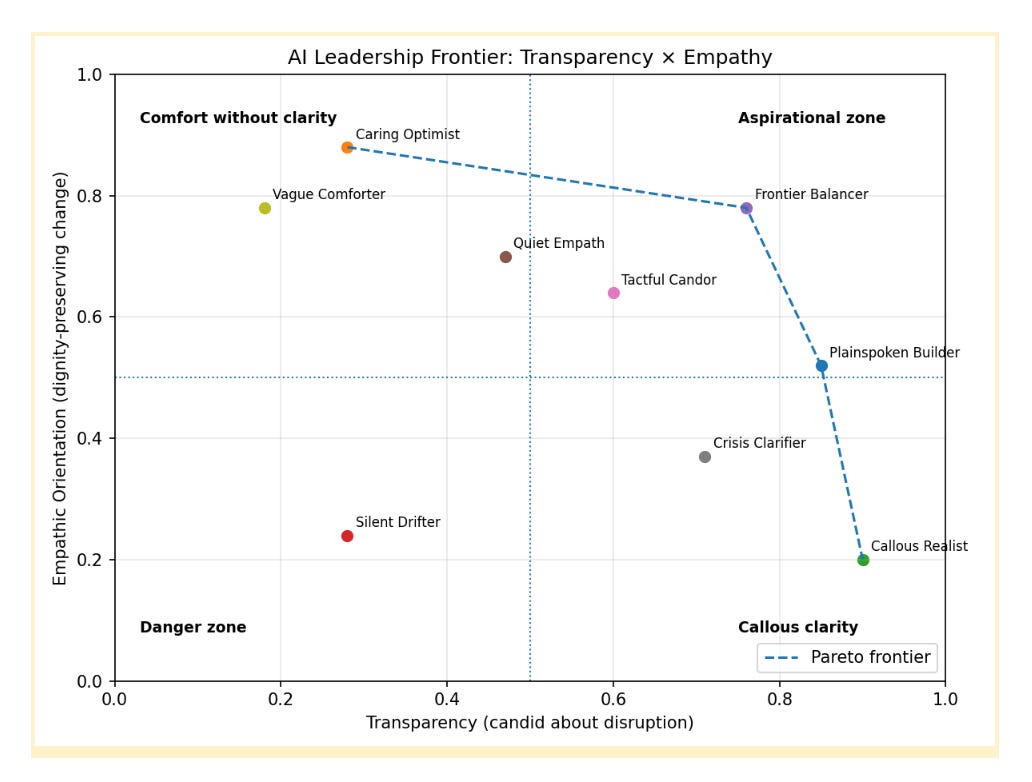
The ways organizations fail this test follow predictable patterns. The most common mistake is treating AI as a bolt-on rather than a transformation. Like electrifying factories a century ago, generative AI isn’t a plug-and-play add-on—it demands redesigning workflows, rethinking roles, and adapting organizational strategy. Yet many companies approach adoption as if they can simply layer AI tools onto existing processes and declare victory.
This is a critical moment for innovation, which makes cultural neglect especially dangerous. Nokia’s culture of fear when confronted with the emergence of the smartphone offers a cautionary tale: when employees are afraid to report problems or challenge decisions during technological upheaval, the organization loses the very innovation capacity it needs most. Breakthrough product work relies on trust, experimentation, and the tacit knowledge employees carry. Yet fear instills risk aversion. Likewise, when organizations force rigid, top-down AI tools onto teams without consultation, they drive shadow usage instead. Writer’s December 2024 survey found employees frequently pay out of pocket for alternative AI tools when employer options fall short—a clear signal that sanctioned solutions aren’t meeting the bar and governance is fracturing.
Aggressive headcount reductions inflict similar cultural damage. Glassdoor’s analysis of employer reviews spanning 2021–2025 shows post-layoff leadership and culture ratings stay depressed for years. Survivors are 40% more likely to start new job applications—especially key talent. This slash-and-automate approach saps capability, damages the employer brand, and undermines competitiveness in the talent market at the very moment innovation capacity matters most.
A credible vision for navigating AI disruption starts with understanding the technology itself. Leaders can’t chart a path if they don’t grasp how the underlying models work and where they’re headed. Nokia’s leadership lacked understanding of the smartphone transition, contributing to their failure to adapt. Today’s executives face a similar imperative: fluency in AI isn’t optional for those planning to deploy it at scale. At Endeavour Partners, and through MIT and London Business School, Michael Davies works with executives precisely to build this fluency—helping leaders understand not just current capabilities, but the trajectory of the technologies they’ll be betting their organizations on, and how to align the technology and business strategy.
Technical understanding enables the transparency axis of the frontier. But staying on the frontier also means keeping people at the center—and this goes well beyond communication strategy. The main bottleneck to successful AI adoption isn’t the technology—it’s people. Words of reassurance must be matched by actions. How you strategize around your workforce matters as much as what you say to them: which roles you redesign versus eliminate, where you invest in reskilling, how you involve teams in adoption decisions. Organizations that fail to build their strategy around their people will find even the best technical efforts falter.
Don’t let perfect kill good. You will face trade-offs between transparency and empathy, between moving quickly and preserving culture. The leader’s job is to aim for the best of both worlds while understanding perfection is out of reach. Understand the technology, design your approach, steer your organization, and adjust as you learn—but most importantly, take action.
No posts
Comments
Nothing yet. Say the first thing.
Sign in to join the conversation.