
In a recent interview, Y Combinator’s Garry Tan described an AI startup founder who took a job as a remote medical biller—on Zoom—simply to learn the work well enough to automate the worst parts of it. This “undercover” ethnography revealed a landscape of tedious, repetitive tasks, the sort of process friction that frontline staff know intimately but leaders rarely see. But the founder wasn't trying to implement AI solutions for the company they joined; rather, they were conducting firsthand user research to identify a compelling business opportunity.
More than a clever startup tactic, Tan's anecdote points to an important lesson for incumbent leaders. While that founder was discovering a clear business opportunity, they were also surfacing a fundamental disconnect in the way companies are approaching AI. There exists a category of tasks where AI is already capable, workers actively want automation, and yet investment lags. These are “Green Light” opportunities—the curiously neglected low-hanging fruit of AI adoption—and they represent the most reliable path to generating financial returns while building a workforce that sees AI as a partner rather than a threat.
A recent study by a team of Stanford researchers provides the first large-scale empirical map of the automation landscape. The researchers surveyed over 1,500 workers and 52 AI experts to map out the landscape of AI automation, comparing what is technically feasible with what workers actually want. In the process, the study unveiled a swath of tasks that are ripe for automation, with both high AI capability and strong worker desire.
These are the Green Light opportunities.
The researchers introduced a "Human Agency Scale" (HAS), which defines desired levels of human involvement in tasks from H1 (full AI automation) to H5 (continuous human involvement). Combining worker assessments of tasks on this scale with expert assessments of AI capability, the researchers proposed a four-zone framework to categorize tasks based on AI capability and worker desire:
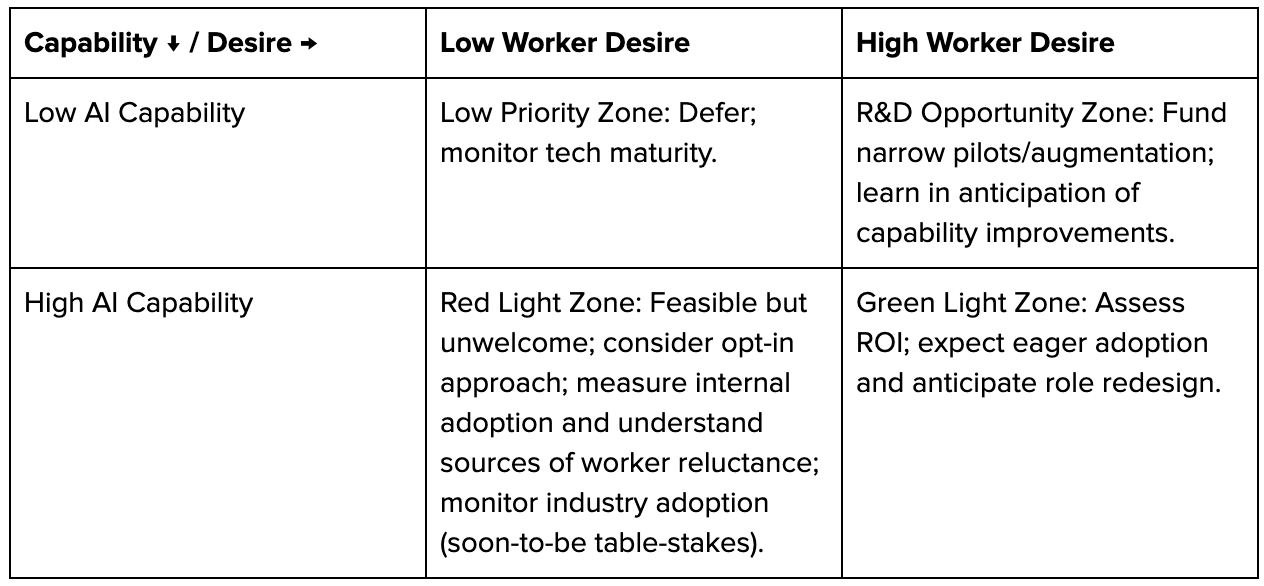
The data shows clear patterns: when workers want automation, their primary motivation is "freeing up time for high-value work" (about 70% of pro-automation responses). Yet despite this clear demand signal, Green Light opportunities remain systematically underfunded while capital flows toward automation projects for which workers show little eagerness.
Green Light projects are not only easier to adopt; they are also better aligned with how automation reshapes work. Yet a puzzle emerges when we examine actual investment patterns. The Stanford team found a striking disconnect between where the market is investing and where the Green Light opportunities lie: 41% of Y Combinator companies are focused on the "Low Priority" and "Red Light" zones, where worker desire for automation is low. This suggests a significant misallocation of resources and a missed opportunity to create value for both businesses and workers.
Yet the economic rationalist might object: if Green Light work were truly attractive, market efficiency would dictate that funding would already flow to these high-ROI use cases.
So, why does this underinvestment persist?
To be sure, some valid concerns do complicate some Green Light initiatives: integration complexity, compliance requirements, and change-management hurdles may make "capability" ratings look deceptively deployment-ready.
These challenges notwithstanding, however, there is real signal being missed. Key decision makers are vulnerable to information asymmetries where frontline workers understand task inefficiencies that executives and investors overlook. The McNamara fallacy compounds these problems: investment chases measurable gains like immediate payroll reductions while trust-driven productivity and retention benefits remain invisible in ROI models. This bias toward readily quantifiable short-term savings obscures the diffuse, long-lasting benefits of worker-aligned automation, including organizational climate improvements, talent retention, reputation effects that matter in competitive labor markets. Perhaps most critically in this pivotal moment, worker-aligned automation steers your organization toward an innovation-friendly culture that will prove essential as AI rapidly transforms entire industries.
The signs of disruption are already visible.
In customer service—one of the most AI‑applicable domains—BLS projects employment for customer service representatives to decline by about 5% from 2024 to 2034. Computer programmer jobs too, are on the decline. However, headcount reductions are not an inevitable outcome of automation, and may even be inadvisable if the affected roles can instead expand into new areas for which demand exists.
While individual businesses have limited control over the macro forces driving automation, they can influence outcomes through their choices about both how to automate, and how to redeploy human talent. Some organizations push hard on headcount reductions and backtrack after quality drops; others invest in reskilling (e.g., redeploying staff to higher‑touch advisory work) and may even see both service quality and employee engagement rise in the process. The difference is whether the roadmap aligns with what workers and customers actually want.
AI capabilities do not stand still; what reads as R&D today may be Green Light material in six months. In response, leaders need to establish ongoing processes for surfacing and prioritizing automation opportunities: actively solicit input from employees to understand their pain points, leverage their expertise, and identify tasks that are ripe for automation. As AI capabilities continue to improve, this process of "Green Light triage" should be an ongoing, iterative process; not a one-time exercise.
Effective Green Light triage begins with qualifying where AI belongs at all. Ethical, regulatory, or safety constraints, among other factors, may dictate human involvement even when automation is both possible and desired. Moreover, a portfolio perspective acknowledges that not every investment should target the Green Light zone: R&D investments in future capabilities and strategic moves in Red Light territories may be necessary. But organizations should be aware of their current underinvestment in Green Light opportunities and the indirect (yet significant) benefits that prioritizing worker-desired automation can deliver.
When prioritizing within the Green Light zone, avoid the trap of chasing only obvious efficiency gains. While immediate ROI from high-frequency workflows provides clear returns, these table stakes automations will quickly become industry standard. The real opportunities lie in identifying workflows where near-zero costs unlock entirely new and valuable applications. Universal transcription and note-taking, for example, enable new capabilities such as searchable knowledge bases and document generation pipelines that were previously too expensive to justify but now amplify your employees' capabilities. This requires vision to see beyond current workflows to future possibilities, making it both non-obvious and defensible in ways that narrow operational efficiency efforts are not.
Much of what can be automated will be—either by you or by someone else.
Organizations that fail to act on Green Light opportunities risk losing them to competitors that do. Startup founders are already "going undercover" to identify automation opportunities that incumbents overlook. These entrepreneurs recognize that frontline workers often have the clearest view of process inefficiencies and the strongest motivation to see them resolved.
The most successful organizations will be those that establish formal channels for surfacing Green Light opportunities and capture worker insights: regular surveys about workflow friction and automation preferences, innovation tournaments where employees propose AI solutions, and partnerships with AI vendors focused on worker‑identified pain points.
At Endeavour Partners, we've found that these approaches are most effective when guided by clear ethical frameworks, a central theme in Michael Davies' teaching on AI adoption at both LBS at MIT. Done well, these systematic processes deliver productivity and build trust, freeing people for higher‑value work and enabling future automation efforts.
The medical billing founder from Tan's story represents more than entrepreneurial ingenuity—they demonstrate the competitive advantage available to organizations that truly understand their workers' experiences. When done well, the Green Light zone reframes automation as collaboration with workers, not replacement of them. Aligning automation agendas with the people doing the work preserves the social license as capability races ahead. Sustainable advantage follows when doing right by teams becomes synonymous with deploying AI where it sticks.
No posts
Comments
Nothing yet. Say the first thing.
Sign in to join the conversation.