
…But the great man is he who in the midst of the crowd keeps with perfect sweetness the independence of solitude. (Emerson, Self-Reliance, P.92)
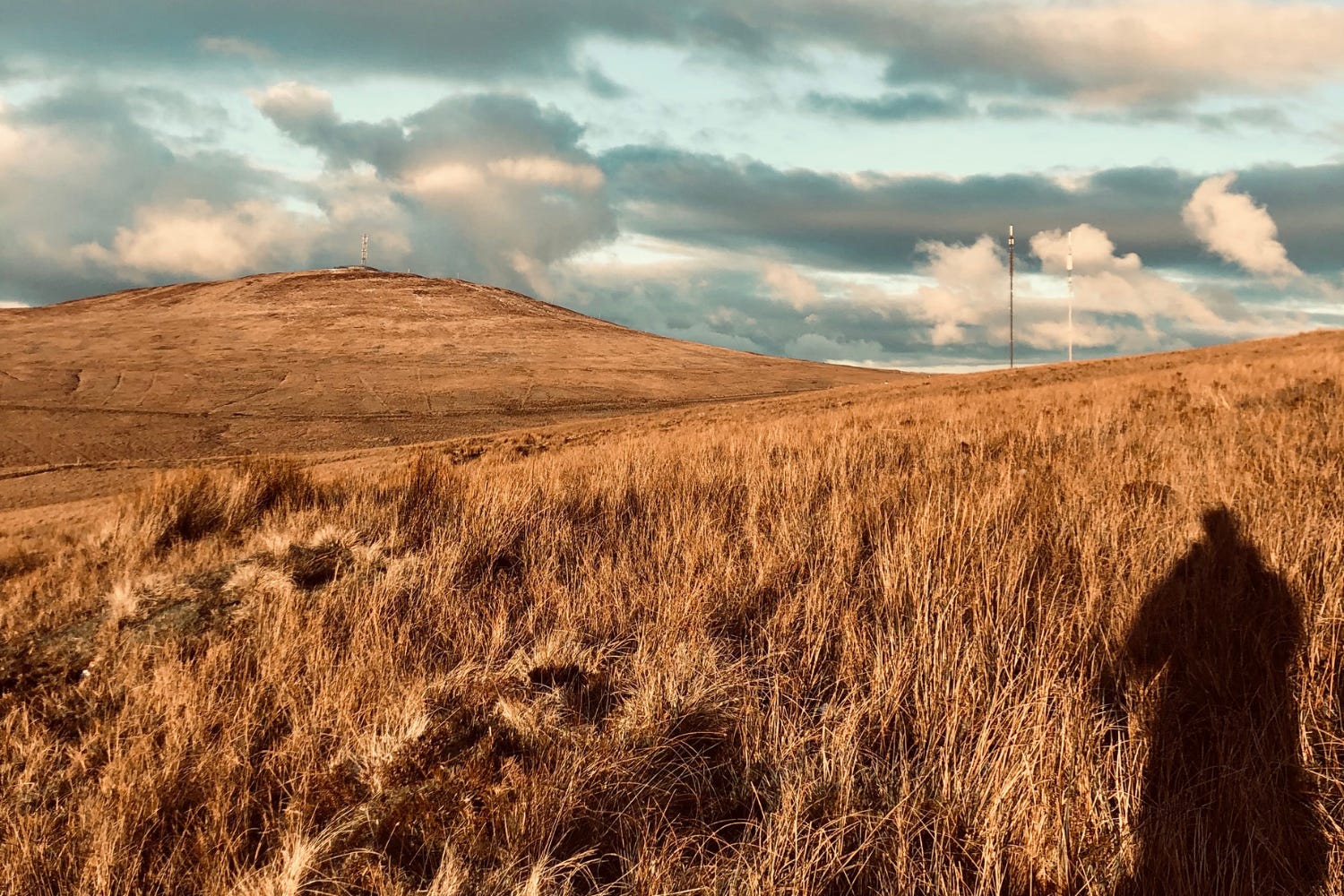
From my previous post, I took action on the letter to myself, on disconnecting from the pulls of modern life. On Sunday I set out to walk a trail about an hour from home, to a mountain range surrounded by forest. I went in the late afternoon and stayed into the evening, giving myself about four unhurried hours. I often take time for these small, half-day retreats, free from screens and any sense of schedule. What follows are the reflections I wrote the next morning, while the impressions of that beautiful afternoon were still fresh.
I step out of the car and into the embrace of the forest for the rest of the day, with my phone left behind in the cup holder. The first thing I notice is the lack of people around at this time of year, now summer has passed. So even the main public trails offer themselves to me. The second thing being the soft hush of oak and birch leaves underfoot, fox-brown and butter-yellow, with the whisper of an icy breeze through the still-dense canopy. I’m not far from home; but out here there is little to no signal, no schedule, only my own walking rhythm and the dirt path winding ahead.
We often try to escape and manage stress by plunging into screens and social media. Today I’ve chosen a different route, a return to the real world, the natural world, in search of something more enduring. I’m craving that sense of fulfilment, a natural embodiment of being with my own thoughts and the rugged form of the landscape around me.
At this point I take a pause, as there’s an opening from the thick forest behind me. I often wonder what these hills have witnessed being formed around 450 million years ago. I’ve purposely waited for early evening. Sunlight falls in dapples through the high branches, and the air is rich with the scent of damp moss and wood. As I walk, I think of the philosophers and poets of days gone, enjoying their time away from home, and how joyfully they wrote of long walks in the countryside and the simple pleasures of nature.
With each step now, the noise of modern life recedes from my mind. In its place comes the present moment. In this quiet, I start to notice the subtle tension I’ve been carrying in my shoulders and within the recess of mind. Bit by bit, it eases. There’s no one to impress here, no barrage of news to react to.
Trees of different varieties stand silently, as they have for decades or centuries, indifferent to worldly worries that consume us humans. I follow an even narrower trail that ribbons through ferns and gnarled roots. I need only a light pack, with the essentials for a trek like this, but the uphill climb soon puts my legs to work and my brow beads with sweat.
Discomfort arrives in small doses, a bramble scratching my calf, an icy autumn breeze raising goosebumps on my neck when clouds cover the falling sun. This mild strain and the occasional ache are not enemies to a good life; they are my instructors.
I came to the forest partly for this—to train myself away from the easy chair of convenience. Modern life coddles us with climate-controlled cars and instant entertainment on demand, but here I must confront whatever is, whether a sudden gust of cold or the mud that slicks the path. I choose to see these adventures as opportunities to fortify my will.
After about an hour of walking well off the main trail, I reach a small clearing where everything opens up again. Fallen oak is common now, due to past storms. I set down my pack and sit on an old trunk to rest. A few rays of sun break through the clouds, illuminating particles of dust and pollen dancing in the air.
The tree must have fallen in January past; in its decay it nourishes new moss and tiny mushrooms, representing a whole microcosm of life sprouting from death. I’m struck by a gentle realisation, everything is cyclic, and everything here has its season. What rises will one day fall. What falls, given time, feeds new life. All of it reminds me of the transitory nature of things.
Watching the dust motes swirl and the angel rays float through the canopy, I remember that my own life is just as fleeting in the grand scheme of things. This thought doesn’t frighten me as it once might have; instead, it brings a clear sense of urgency mingled with equanimity. If my days are limited, I should make each matter to me, and align them with some form of virtue. Character and goodness; I think to myself, these will be my legacy, far more than any material achievement or having my name etched in the history books.
From my bag I pull a small notebook (the only item of “technology” I’ve allowed myself) and a pen from a recent hotel stay. I jot down a few lines about what I’ve felt so far, trying to capture the serenity seeping into me. Immersion in nature is actually recalibrating my senses. I feel a quiet joy welling up, it almost brings me to tears.
As I widen my attention to include the rustle of the leaves and the dance of insects, it feels as if I’ve narrowed the gap between me and the world. I’ve gained something back.
I remember a line I read once: that we should keep a constant dialogue with nature, whether that be walking under the trees, observing the wildlife, and generally seeking out the wild on a regular basis. Now I know those words to be true. Sitting on that old oak, I feel completely restored. My worries have shrunk, my heartbeat is steady. Most importantly, my mind is fixed on the present moment.
The petty concerns that loom so large in normal life fade into perspective here. In the grand silence of this mountain forest, they seem like distant radio static, easily tuned out.
Disconnection from modern comforts has sharpened my appreciation for basic things; the first that come to mind are; food when hungry, need for connection with real people, and shelter when night falls.
The Stoics would approve, I think. They knew that luxury and excess can numb the soul, while simplicity and a bit of reasonable hardship can awaken it.
Night begins to draw in after a few hours in the depths of this forest. Silence deepens as I make my way back; even the birds are still now. I feel connected to all of it. Under the vast dome of the incoming night sky, I sense the same cosmos the philosophers spoke of when they urged us to live in harmony with Nature. Up here there’s no light pollution, nor presence of human interference, so both the green nature around us and our own true nature as rational beings feels evidently clear to me. The stars give off no electronic, man-made signals, and yet I feel more in touch with reality, and importantly with myself.
A sudden rustling in the undergrowth draws my attention. The hairs on my arms rise. It’s striking how alive the forest becomes at night and how the darkness can conjure old biological instincts. The sound comes again: a crack of twigs with the swoosh of leaves. Perhaps a herd of deer, I think, or a field mouse going about its nightly rounds.
With that it occurs to me how little of this world I can control and influence. A city-dweller might panic at that thought, but here and now with experience, I find it oddly liberating. I cannot command the creatures of the woods, nor the night or the wind that has appeared from nowhere. So I choose not to let fear overrun me. I refuse to be frightened by phantoms of my imagination.
In this forest today, I have found the Virtues I believe in. Courage in braving the unknown alone, temperance in aiming to live with less, wisdom in listening to nature’s teachings, and even a sense of justice (albeit indirectly at the time, in treating the natural world with respect and realising my duty to be a better human when I return to others). The night sky above seems to affirm my thoughts with its vast, unjudging presence.
I feel lighter than I have in ages, as though I’ve left more than footprints here, and no matter how noisy life becomes, I will remember this quiet path and know that I can return to that inner retreat whenever I need to.
Returning to where I set off, I say thank you, to all of this. I came here seeking disconnection, but I am leaving reconnected. There’s a serene resolve blooming inside me. The true test of this experience begins now, as I return to the world of roads and buildings, of other people and nightly duties. I go with a renewed sense of purpose.
In disconnecting from shallow distractions, I have reconnected with the deepest parts of myself. This, I realise as I emerge from the tree line, is the real goal of my practice: to live in accordance with nature and in accordance with one’s true self. As I take the final step out of the forest and head back to my car, I smile, inhale the crisp air. I carry the notes and wisdom forward with me. My temporary retreat is over, but the journey to live the good life begins anew.
I try to carry experiences like this into the week in small, practical ways, and you can too, a walk without headphones but with good company; keeping your phone and laptop out of sight each evening or morning; windows open to let in cold air and birdsong. I keep a notebook on the table and add three lines each night, what I noticed, what I learned, what I can leave behind. I eat when I’m hungry, stop when I’m full, and choose the simpler option where I can. None of this is complex, none of it new, but it keeps the path open so that when the next challenge comes, I’m already half-way back to the trees.
I was reading Emerson’s Nature and this truncated poem from George Herbert stuck with me, as Plato remarks, poetry comes closer to vital truth than history.
I modernised the language of the poem to match my simple writing style.
Human beings are built in symmetry—
our bodies balanced part to part,
and also matched to the wider world;
any one piece could call the farthest thing its kin.
The head and foot are secretly allied,
and both are kin to moons and tides.
Nothing exists so distant or so strange
that we haven’t grasped it and kept it near.
Our eyes pull down the highest star.
We carry the whole world in miniature.
Plants cure our bodies because they
recognise something of themselves in us.
For our sake the winds blow,
the earth holds still, the heavens turn, water runs.
Everything we see aims at our good—
either for our delight or our use.
The world is a pantry of food,
or a cabinet of pleasures.
The stars put us to bed;
night draws the curtain the sun will later lift.
Music and light crown our waking heads.
All things treat our flesh kindly
by how they come to be;
our minds receive them by their meaning and design.
Each thing performs a duty for us.
Water joined into seas carries us.
Water separated into rivers gives us homes.
Below it gives us drink; above it gives us food.
Both clean us. If one thing is that beautiful,
what of the whole?
More servants attend us
than we ever notice. On every road
we crush what helps us.
Sickness merely reminds us who we are.
What a fierce love! A single human is one world,
with another world watching over.
Until next time,
Memento mori,
Enda (The Irish Stoic)
P.S; My friend from Norway soundtracked my drive home, very on brand and theme for an exploration like this.
Something I’d recommend reading about this week: New information has come to light about Stoicism’s founder, and seems very on brand from the accounts we hear of him.
Comments
Nothing yet. Say the first thing.
Sign in to join the conversation.