
After the seven returned from Ireland, after they buried the head of Bran at the White Mount in London, after the singing of the birds of Rhiannon had ended their eighty years of forgetting, only then did the grief come.
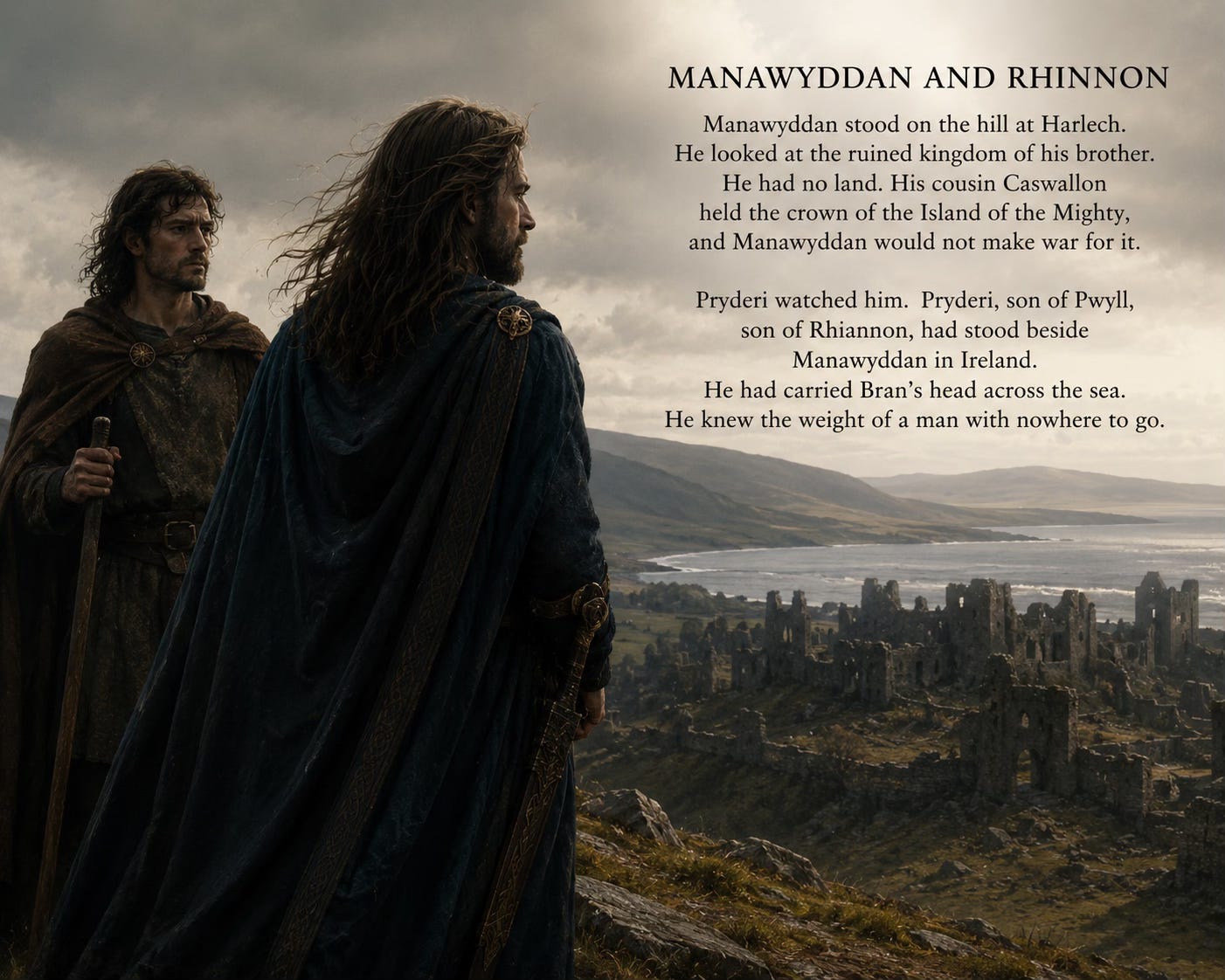
Manawyddan stood on the hill at Harlech. He looked at the ruined kingdom of his brother. He had no land. His cousin Caswallon held the crown of the Island of the Mighty, and Manawyddan would not make war for it.
Pryderi watched him. Pryderi, son of Pwyll, son of Rhiannon, had stood beside Manawyddan in Ireland. He had carried Bran’s head across the sea. He knew the weight of a man with nowhere to go.
“Come to Dyfed,” Pryderi said. “My mother is widowed. You are a king’s son with no kingdom. She is wise. You are wise. The land is good.”
Manawyddan considered this. A wife. A home. Seven cantrefs of soft country. He had buried too many brothers to refuse a kindness.
“I will meet her,” he said.
Rhiannon was older now. She had outlived Pwyll. She had outlived the slander that put her at the gate of the court for seven years, made to carry guests on her back like a beast. She had outlived her son’s stealing and her son’s returning. She laughed easily, which surprised him.
They sat together one evening. He told her of Branwen. Of the starling. Of the cauldron of rebirth where dead men rose without speech. Of his brother’s head, which had spoken to them for fourscore years on the island of Gwales.
Rhiannon listened. She did not weep prettily or look away.
“You have been somewhere terrible,” she said.
“Yes.”
“And now you want somewhere ordinary.”
“Yes.”
She poured him wine. “Ordinary is harder than it sounds. But we can try.”
They were married before the autumn. Pryderi was glad. Cigfa, Pryderi’s wife, was glad. The four of them rode the borders of Dyfed together and feasted and were, for a brief season, content.
This was the mistake. Contentment in the Mabinogion is always the moment before the mist.
They sat on the mound of Arberth. It was the mound where Pwyll had first seen Rhiannon riding her pale horse, the mound where strange things happened to those who sat upon it.
A peal of thunder. Then mist, thick as wool, white as bone.
When it lifted, Dyfed was empty.
No cattle. No sheep. No smoke from any hearth. No dog barking. No child crying. The halls stood, the houses stood, but no living thing remained except the four of them.
They searched for two years. They ate what they could hunt. They lived in the empty hall at Arberth like ghosts in their own kingdom.
Then Manawyddan said, “We cannot live like this. Let us go to England, and find a trade.”
Here the story becomes strange in a quieter way. Four nobles, a queen who once carried courtiers on her back, a prince who had ruled Dyfed, all of them learning to make saddles in Hereford.
Manawyddan had clever hands. His saddles were better than any in the town. The saddlers of Hereford grew jealous. They plotted murder. The four moved on to another town and made shields. The shieldmakers grew jealous. They moved on and made shoes. The shoemakers grew jealous.
There is a joke buried here, and it is not subtle. Wherever excellence appears, mediocrity sharpens its knife. The Mabinogion knew this nine hundred years ago.
“Let us go back to Dyfed,” Pryderi said.
So they went back. To the empty country. To the silent halls.
They hunted to live. One day a shining white boar broke from the bracken. The dogs gave chase. The boar led them to a tall fortress that had not been there yesterday.
“I do not remember this caer,” said Pryderi.
“Nor I,” said Manawyddan. “And what is not remembered should not be entered.”
But the dogs had gone in. Pryderi loved his dogs. He went after them.
He did not come out.
Rhiannon waited. Then she went in.
She did not come out either.
Manawyddan and Cigfa stood alone in the world.
Cigfa wept. She thought Manawyddan, now without her husband to restrain him, might treat her badly. He saw the fear and felt the old grief rise.
“I swear to you,” he said, “on the friendship I bore your husband, you are as a sister to me. While I live, no harm comes to you through me.”
She believed him. She had reason to. In the whole bloody cycle of the Mabinogion, Manawyddan is the man who refuses to lift a sword when patience will do.
They went to England again. They made shoes again. They came home again. And Manawyddan planted three fields of wheat.
The wheat grew. It ripened. The night before he meant to harvest the first field, he came at dawn and found every ear stripped. Only the bare stalks stood.
The next field, the same.
He sat up on the third night with his sword across his knees.
At midnight came a great host of mice. Thousands of them, swarming up the stalks, biting through and carrying the ears away. He caught one. It was fatter and slower than the rest. He put it in his glove.
“What have you there?” asked Cigfa when he came home.
“A thief,” he said. “I mean to hang it.”
“My lord,” said Cigfa, “a mouse? You are a king’s son. It is beneath your dignity.”
“Beneath my dignity or not, hang it I will.”
He built a tiny gallows on the mound of Arberth.
This is the part of the story I love best. A grown man, a prince of the Island of the Mighty, the last of the sons of Llyr, building a gallows the size of his hand to execute a mouse. And the world holding its breath.
For now the strangers came.
First a scholar, ragged-robed. “Lord, what are you doing?”
“Hanging a thief.”
“Take a pound from me and let it go.”
“I will not.”
The scholar went on his way.
Then a priest, on a fine horse. He had not seen a priest in Dyfed for seven years.
“Lord, that is beneath you.”
“Take three pounds, lord, and let it go.”
“I will not.”
Then a bishop, with a great retinue. Where had a bishop come from in this empty land?
“Name your price, lord, and let the creature go.”
Manawyddan looked at him. He had waited a long time for this conversation.
“I want Pryderi and Rhiannon returned to me. I want the enchantment lifted from Dyfed. I want to know who you are and what this mouse is to you.”
The bishop’s face changed.
He was Llwyd, son of Cil Coed. The mouse was his wife. The host of mice were the men of his court, transformed for the raid. The enchantment of Dyfed had been his vengeance, all of it, every empty hearth and silent field, for an old wrong done to his friend Gwawl by Pwyll, Rhiannon’s first husband, before Pryderi was born.
The grudge had waited a generation. It had crossed the death of Pwyll. It had used a starving country as its weapon.
Manawyddan listened. He did not rage. He did not threaten beyond what he had already done.
“Free them,” he said. “Lift the enchantment. Swear there will be no further vengeance. Then you have your wife.”
Llwyd swore. Pryderi and Rhiannon walked out of the mist. The cattle returned. The smoke rose again from a hundred hearths. Dyfed was a kingdom again.
And Manawyddan opened his glove and let the small thing go.
Consider what this story is doing. It begins with a man who has lost everything: brother, kingdom, the whole shining company of the second branch dead in Ireland. It ends with a man who saves a country with a mouse and a small wooden gallows and the absolute refusal to be hurried.
Patience is the moral, if you want one. Patience and a clear eye for what a thing is actually worth. Three strangers offer Manawyddan money. He wants none of it. He wants his people back. He waits until the right buyer arrives.
There is something to reflect on here. We live among Llwyds. We live among old grievances dressed in the robes of scholars and bishops. The world will offer us pounds and pounds to drop our small grip on what matters. The trick is knowing the price, and refusing the lesser one.
Manawyddan never drew his sword in Dyfed. He won the war with a glove.
Be the man with the glove.
Alan /|\
Thanks for reading Emrys Y Dewin! This post is public so feel free to share it.
No posts
Comments
Nothing yet. Say the first thing.
Sign in to join the conversation.