
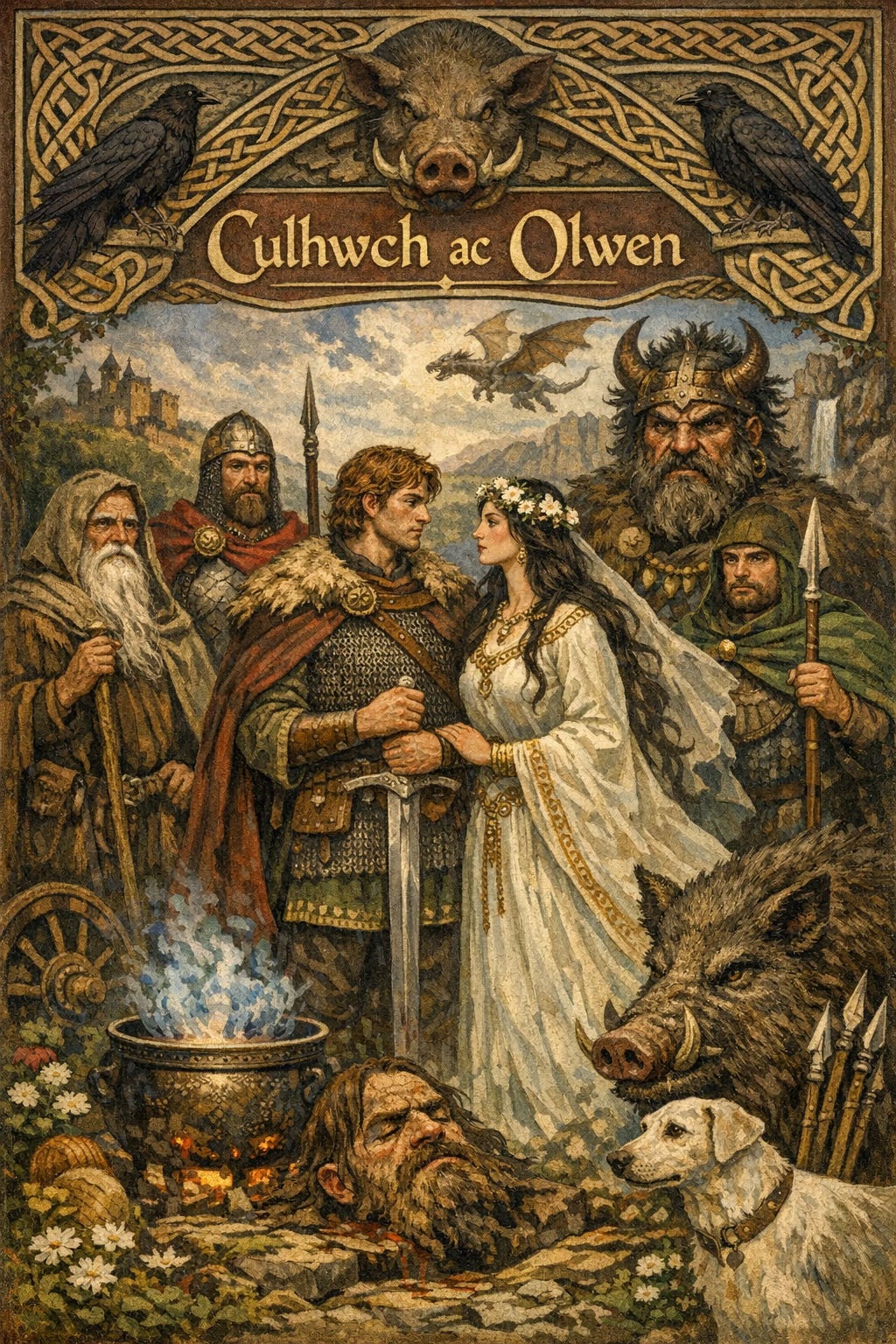
Hear me now, for this is a tale of blood and blossoms, of impossible tasks and the love that makes madmen of us all.
There was once a chieftain, Cilydd son of Celyddon Wledig, and his wife Goleuddydd — whose name means bright day— and bright she was, warm as midsummer, until the day she went wandering in her madness through the wild places, and her time came upon her far from any hearth. She gave birth, so they say, in a pigsty, among the bristled beasts and the deep straw, and she died in the giving. The boy they named Culhwch — for culch means a pigsty — and thus was the heir of a lord named for the squeal and the snout.
Let no man say the Cymry have no humour.
His father grieved, as fathers do. Then he stopped grieving, as fathers also do, and he took another wife.
Now here is where the trouble begins.
The new wife — a queen, shrewd and watchful as a crow — had a daughter of her own. She looked upon young Culhwch and saw in him a fine match for her girl. The boy refused, politely. Then less politely. The stepmother, her pride raw as a wound, fixed him with a gaze that had iron in it.
“Then I lay a destiny upon you,” she said, and her voice was the sound of a door closing in a cold house. “You shall never press your lips against a woman’s until you win Olwen, daughter of Ysbaddaden Pencawr — Ysbaddaden the Chief Giant.”
The boy had never heard of Olwen. But now he wanted her so ferociously that he could not breathe for the wanting, and he flushed red from his collarbone to his hairline, and his father said: “Why do you look so pale, boy?”
And Culhwch said: “My stepmother has placed a destiny upon me, and I am going to the court of my cousin Arthur.”
There is a gatekeeper at Arthur’s hall whose name is Glewlwyd Mighty-Grip, and if you have all day to stand in the cold, he will tell you about his adventures. He has been to India and Africa, Europe and the Enchanted Isles and the shivering corners of the world, and he will tell you each one, in order, with digressions.
Culhwch arrived on a horse that was grey as the sea-mist, with a purple-and-gold saddle, with two greyhounds sporting collars of red gold, with a hunting horn and a battle-axe and a gold-hilted sword. He arrived, in short, in the manner of a young man who has taken a great deal of trouble over his appearance because somewhere inside him he is terrified.
Glewlwyd looked at him through the gate and said, in effect: You cannot come in. The feast has begun.
Culhwch said: Let me in or I will shame your lord with three shouts that will be heard from here to the top of the world.
There was a pause.
He was let in.
Arthur saw him and knew him for kin by the bone of his face. He granted Culhwch any boon he wished, save only his ship, his sword, his lance, his knife, his mantle, the cauldron of Tyrnog, and Guinevere — you see how Arthur’s mind works, what he values, what he instinctively protects.
Culhwch asked for Olwen.
He asked for her, and in the asking of it he summoned up so many warriors to help him that the bard reciting their names could fill an evening and still not finish. Here is a small taste: Cai the tall, who could hold his breath for nine days underwater; Bedwyr the one-handed, whose lance drew three streams of blood at every thrust; Menw son of Teirgwaedd, who could make any man invisible in a wood; Gwalchmei the nephew; Gwrhyr the Interpreter of Tongues, who could speak to every beast and every bird; Clust son of Clustfeinad, who could hear an ant arise at dawn fifty miles away.
These are Arthur’s men. They are magnificent and they are peculiar, and there is not a court in the world like it.
They found Ysbaddaden Pencawr’s fortress after asking, as you do, the oldest creatures they could find. First the Blackbird of Cilgwri, who had worn a smith’s anvil to nothing with the wiping of her beak each evening. Then the Stag of Rhedynfre, old beyond counting, with trees growing on its antlers. Then the Owl of Cwm Cawlwyd, and the Eagle of Gwernabwy, and at last the Salmon of Llyn Llyw — oldest of all, who alone knew the way.
This is not merely good storytelling. This is the oldest kind of geography: the world measured in lifetimes of birds.
In the fortress, amid the bones and the shadows, they found Olwen herself.
She came and they saw why a young man had crossed the country for her. White was her skin, whiter than the sea-foam. Red were her cheeks, redder than the reddest fox. Yellow was her hair, yellow as the broom in flower. And where she walked, four white trefoils sprang up behind her feet — that is why they call her Olwen, which means white track.
She sat with Culhwch and he spoke his heart to her plainly. She said: I like you well. But my father is what he is. Go to him, agree to whatever he asks — and whatever he asks, make Arthur’s men do it. That is the only way.
A sensible woman, Olwen.
The giant’s eyelids were so heavy that they needed forked staves to prop them up. His men lifted them, one by one, so that he could see his visitors. This is the image of a man crushed by fate, weighed down by a doom he cannot escape: for there was a prophecy upon Ysbaddaden that he would live only until his daughter married, and here was the bridegroom at the door.
He could not say yes. He could not bring himself to it. And so he named tasks — anoetheu, impossible things — stalling, bargaining with time, setting up obstacles so vast and so ridiculous that surely, surely, the boy would give up and go home.
He was wrong. He did not account for Arthur.
The tasks, at their greatest, amounted to this: Culhwch must get the comb and the shears from between the ears of the great boar Twrch Trwyth — once a king, now a ravening beast by God’s punishment — so that Ysbaddaden’s monstrous hair might be dressed for the wedding. And the blood of the Black Witch, daughter of the White Witch of the uplands of Hell. And the leash of Cors Cant Ewin the hundred-clawed. And the hound Drudwyn, who alone could hunt the Twrch Trwyth. And a dozen other things, each tied to the last like links in an iron chain. Each one impossible without the one before.
Ysbaddaden was thorough. You have to give him that.
Hear me carefully here, because this is the heart of it.
The Twrch Trwyth had been a king of Ireland, and whatever sins he committed were between him and God, but God turned him into a boar, a monstrous boar, a boar with seven young boars at his heels, a boar that laid waste to a fifth part of Ireland before crossing the sea to Wales. He was not a thing to be bargained with. He was not a thing to be reasoned with. He was rage made flesh and bristle.
Arthur gathered the warriors of the island of Britain. He gathered the warriors of Brittany and of France and of all the lands he could reach by messenger and legend. They drove the Twrch Trwyth north and south, through the mountains of Wales, through rivers, through marshes, losing men always, losing hounds of great fame, losing warriors whose names the bard knows and whose deaths he mourns.
Cai was killed in one version of this story, and in another he was merely shamed, and maybe there is no difference, for a proud man.
They drove the Twrch Trwyth into the Severn estuary, into the water, and Arthur himself plunged in after him, and his warrior Mabon son of Modron — that Mabon, the one they had to free from an ancient prison, who had been taken from his mother when he was three nights old and held in Gloucester stone until Arthur’s men found him and broke him free — that Mabon rode in the water beside the great boar and seized the shears from between his ears. And another took the comb. And the Twrch Trwyth ran out into the sea and was never seen again.
Where did he go? Into whatever place old and terrible things go when the story is done with them.
God forgive me, this part is swift.
Arthur went himself to the cave of the Black Witch in the uplands of Hell — which is somewhere in the north of things, bleak and cold — and she flew at his two servants and broke them. And his champion Gwyn went in and was thrown out. And Gwythyr went in and was thrown out. And Arthur, who was a king and not a man to crouch outside a cave for long, strode in himself and struck the witch with his knife Carnwennan and cut her in two.
He is Arthur. There are some things only Arthur does.
They took her blood in a vial. They took it to Ysbaddaden.
They brought it all. The comb and the shears. The blood. The leash and the hound and the huntsman. Everything Ysbaddaden had named, one by one, impossible thing by impossible thing, done.
They sat the giant down and combed and shaved him. They combed away his matted and ancient hair. They shaved his enormous face down to the bone, and his two ears came off in the shaving, and one of the warriors — Goreu, Arthur’s own man — stood behind him and took his head.
Because the prophecy had come to pass. The daughter was married. The father’s time was done.
And Culhwch took Olwen. And the white trefoils bloomed where she walked. And they were happy, as people are happy at the end of the kind of story that has cost them something real.
What is this tale, in the end?
It is a tale about desire that will not be told no. About the strange economy of the impossible, where love is the currency and the tasks are merely the price of it. About a world where the oldest creatures hold the deepest knowledge, and the salmon knows the way when the eagle cannot. About Arthur not as a king in a castle but as something older and stranger — a force that can be called upon, a solver of anoetheu, a man who goes into caves himself when his warriors fail.
It is the oldest story we have in Welsh. It is wild and funny and violent and strange, and it has a boy in it named after a pigsty who walked into the greatest court in the world and asked, with a straight face, for the moon.
And got her.
The fire is low now. You know where the wood is.
Alan /|\
Thanks for reading Emrys Y Dewin! This post is public so feel free to share it.
No posts
Comments
Nothing yet. Say the first thing.
Sign in to join the conversation.