
I have a running document I use for my art practice, a color-coded to do list in week-long chunks that extends at least a month and up to 6 months into the future:
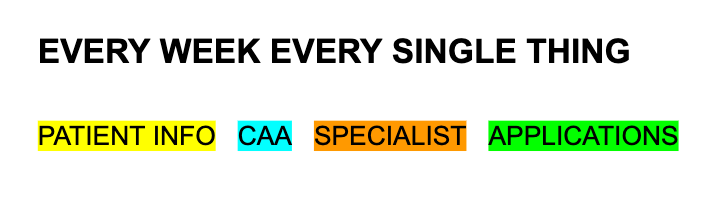
This list butts up against my idea of what making art is supposed to feel like. The projects I make live for a long time in my brain and in my computer—as research, proposals, lists, floor plans, schedules—before existing in the world. Some of this is the inevitable logistical cost of involving collaborators and participants in the work. But I worry the rigidity of constant planning infiltrates parts of the process where it’s not needed.
Sometimes I wish I made the kind of art that demands full attention of all your senses from the very beginning, making it impossible to do anything else with your body or brain while you work. Or the opposite end of the spectrum, the kind of work so entirely visual that you can make it while listening to an audiobook. My imagined dancer experiences perfect happiness when the endorphin rush of exercise mixes with the pride of making something. My unencumbered painter intuits color choices in their big-windowed studio while simultaneously getting further than I have in The Brothers Karamazov. These two never dread their craft.
I know I’m flattening and projecting when I romanticize the way other artists work. I think of my friends Maia Chao and Netta Sadovsky, who ran a workshop last year called DOMA: Dread of Making Art.1 The workshop wasn’t medium-specific because there’s plenty to dread about being any kind of artist. But idealizing other processes helps me realize what I’m missing in my own. I want a shorter planning period before I start trying things out (but I don’t want to feel underprepared), and I want more room for discovery (but with a promise from some god that what I’ll discover is Good Art).
The nature of Patient Info encourages flexibility. It always feels like a gift to have source material to respond to rather than starting from nothing. For this show, the material was the gallery itself.
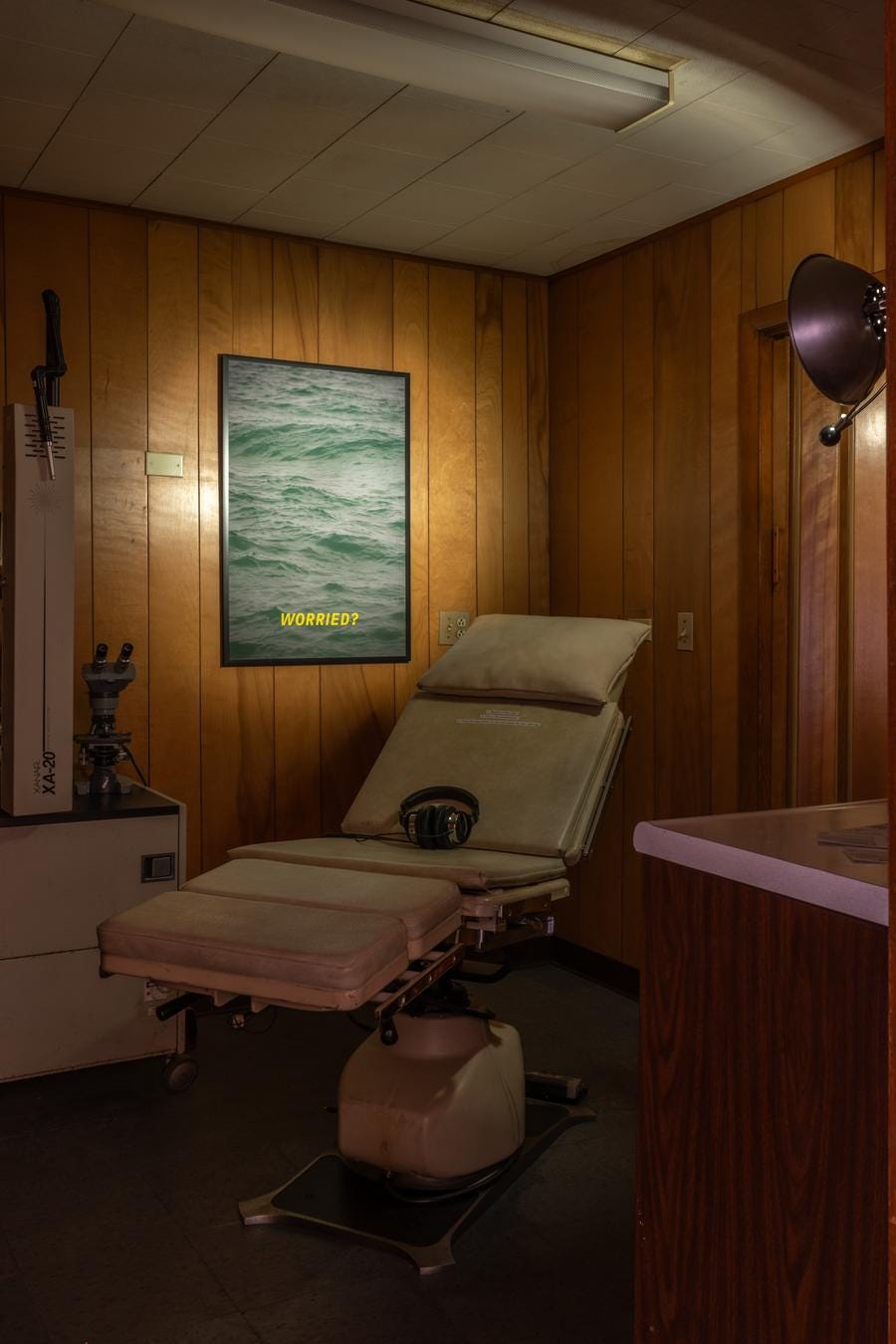
Patient Info is unruly. There’s a lot to look at—pamphlets, framed degrees, medical devices, stacks of boxes—so there was no guarantee that my attempts at directing viewers’ attention would work. There are relationships between objects that predate artist intervention, and new relationships that emerge between the space and its shows. The fact that it doesn’t make perfect sense as a gallery opens it up as a site for experimentation.
The space is divided into three main areas: a waiting room/reception desk, an examination room, and a back area that has been gutted to create a more conventional white cube. I decided to turn that final space into more office. This means that the real thing (the office when it was functional) gave way to both the preservation of the thing (the real equipment recontextualized as an art space), and now the facsimile of the thing (another office fully invented as art).2
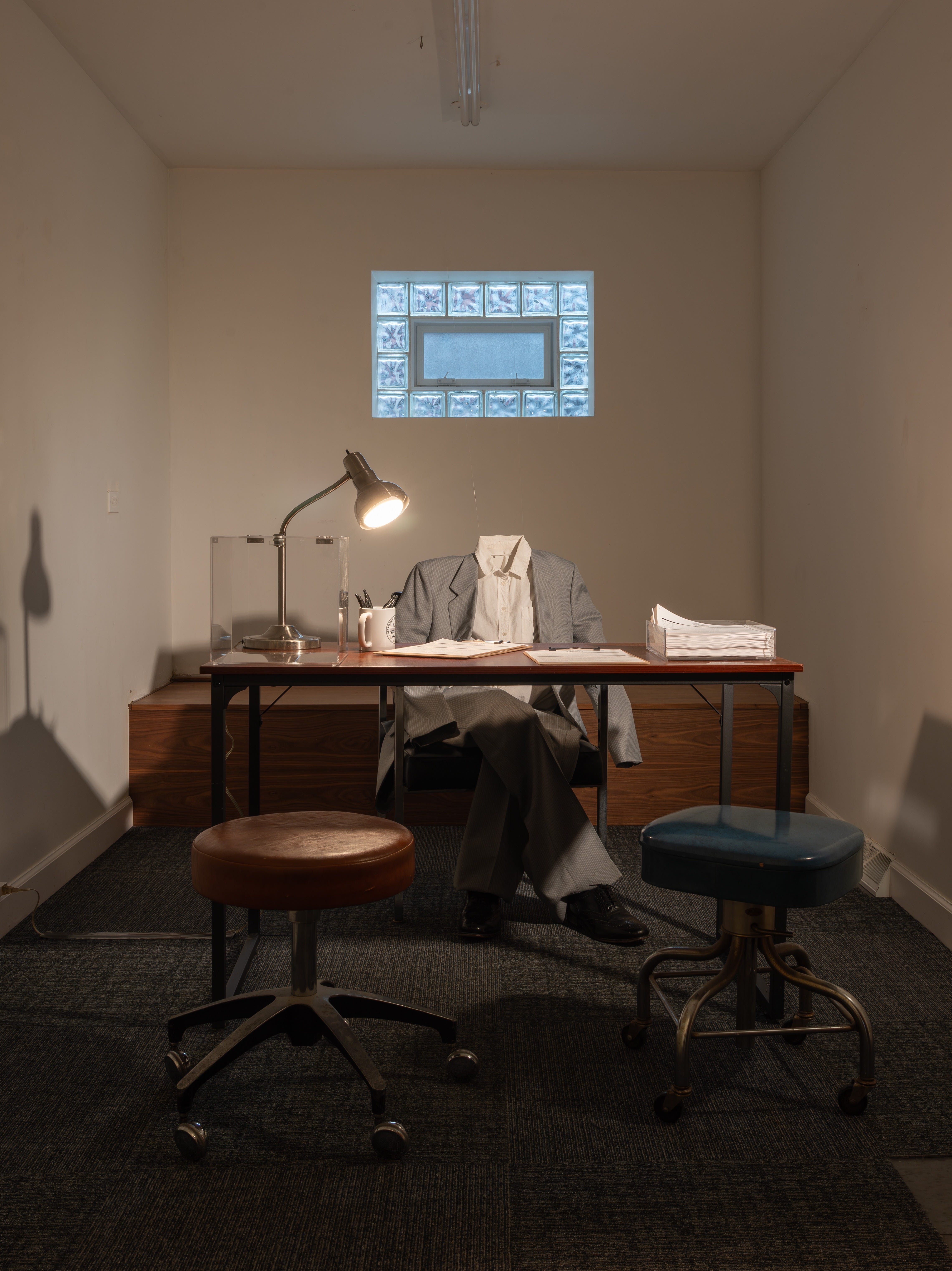
There’s something inherently adaptable about live art, since even the most practiced performer can’t perfectly replicate something night after night. It’s one of the things I like most about putting people in my work—they will inevitably surprise me and interrupt my meticulous planning. Extending the performance metaphor, I wanted this back area to feel something like a stage with all the elements of one:
Set - Carpeting, a desk, and rolling stools borrowed from other parts of the gallery.
Lighting - Strong directional stage-like light from lamps.
Character - A faceless businessperson to oversee the administration of a new survey.
Action - Participants asking each other questions.3
Audience - A place to stand outside the bright lights and observe.
These last two, though structured, invite mess and unpredictability.
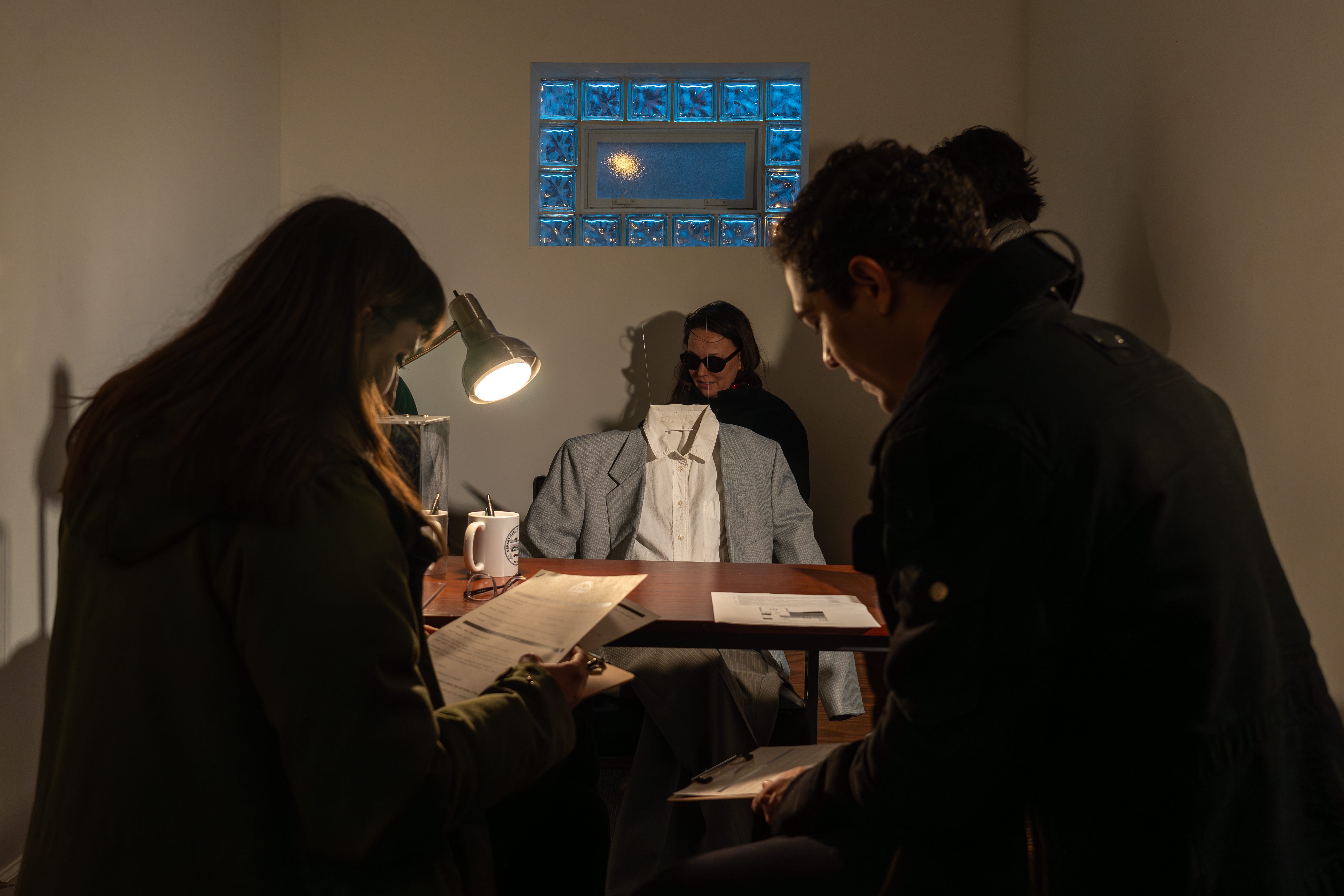
At the opening, I prompted people to sign up for filmed research sessions the following weekend. I only had a vague idea of what those sessions might entail. As the shoot got closer and I realized I still didn’t have the kind of extensive plan I’m used to, I started to panic. It felt ridiculous to use resources (money, equipment, other people’s time and my own) on something that was still just a sketch.
This shifted after a conversation with artist Elaine Byrne. I met Elaine several years ago when she was a visiting lecturer at my grad program, and have since learned a lot from her about staying nimble throughout a research-based practice. As I was developing prompts for the filmed research sessions, she encouraged me to vary my approach. By guiding participants through more than one kind of activity, I would give myself options to figure out what the piece was in the edit.
In the name of writing about process, here are the three beats I landed on for each 45-minute session:
Beat 1: The participant enters and sits in the waiting room. From offscreen, I ask them ten questions about their projections of the future.
Beat 2: We move to the examination room. I introduce them to the Harvard Sentences and ask them to repeat some of the sentences aloud. (From my script: “The Harvard Sentences are a series of 720 phonetically balanced sentences developed in the 1960s to test voice over and audio systems. The sounds in these sentences represent specific phonemes at the same frequency they appear in English. The Department of Eschatology is invested in understanding shifts in language over time. As such, we have selected 75 of these sentences from the past to envision the future. I will now ask you to recite some of these sentences. Please repeat after me.”)
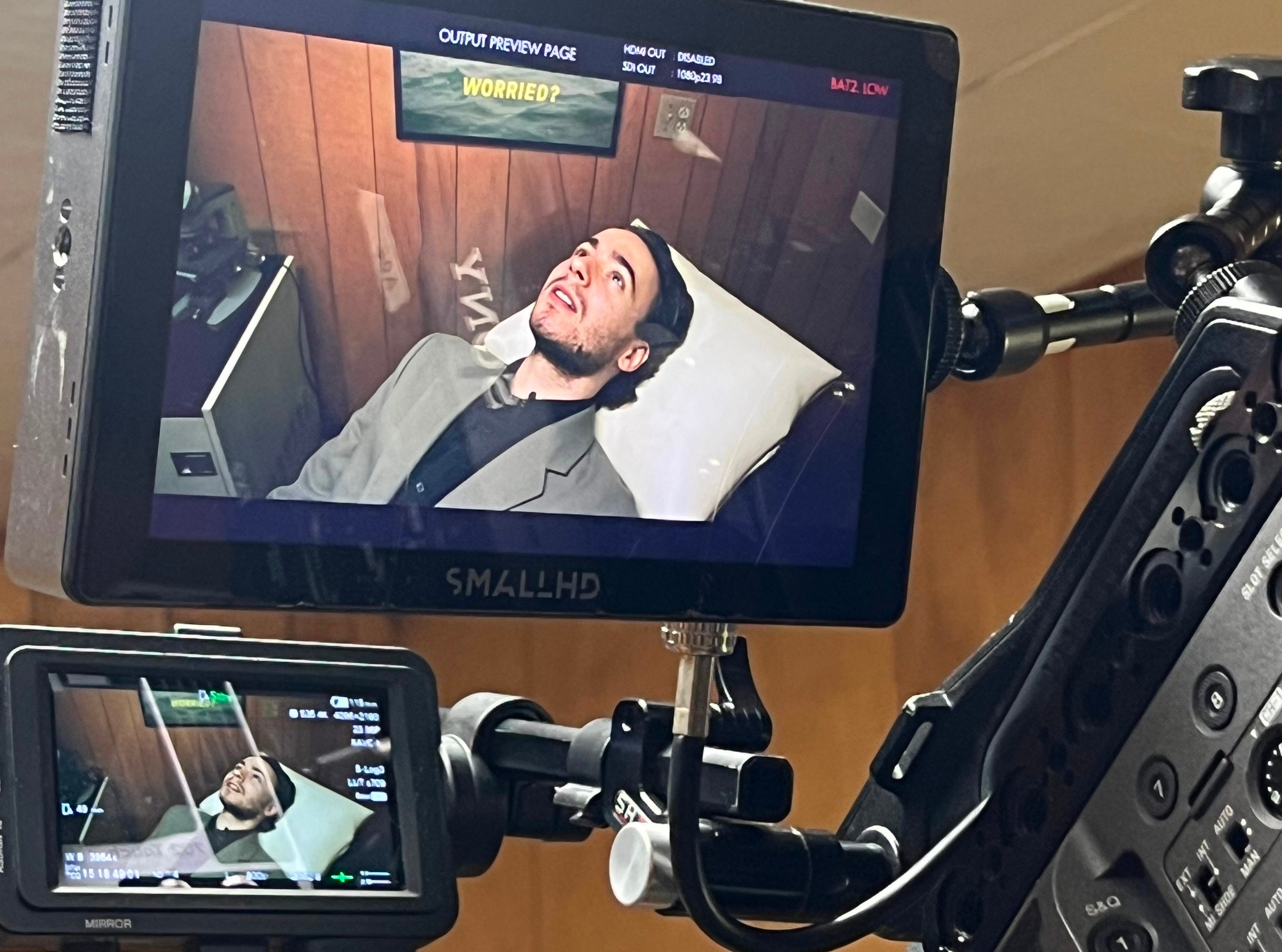
Beat 3: We go to the reception desk, where I present them with three envelopes labeled “PRE-CRISIS,” “CRISIS,” and “POST-CRISIS.” Each envelope contains around 25 of the sentences. The participant is prompted to choose an envelope, draw ten sentences from it, and arrange any number of those ten sentences into an order that forms a narrative. When they finish, I ask them to explain the scene, society, or context they’ve created.4
I hoped participants’ encounters with the sentences would position them as part-curator, part-inventor, letting them tap into the sense of possibility I found in working with a charged space like Patient Info rather than an expanse of white walls. I wanted them to enact the spontaneity and free association I’m craving in my own process. I got lucky with the people involved. The eleven participants were open to trying everything I threw at them. The cinematographer I worked with, Jason Chiu, was both extremely prepared and eager to discover things as we went.
I’ll leave you with one of my favorite narratives from the research sessions, a story by Hal Baum, made of sentences from the CRISIS envelope. First, Hal’s sentences in order:
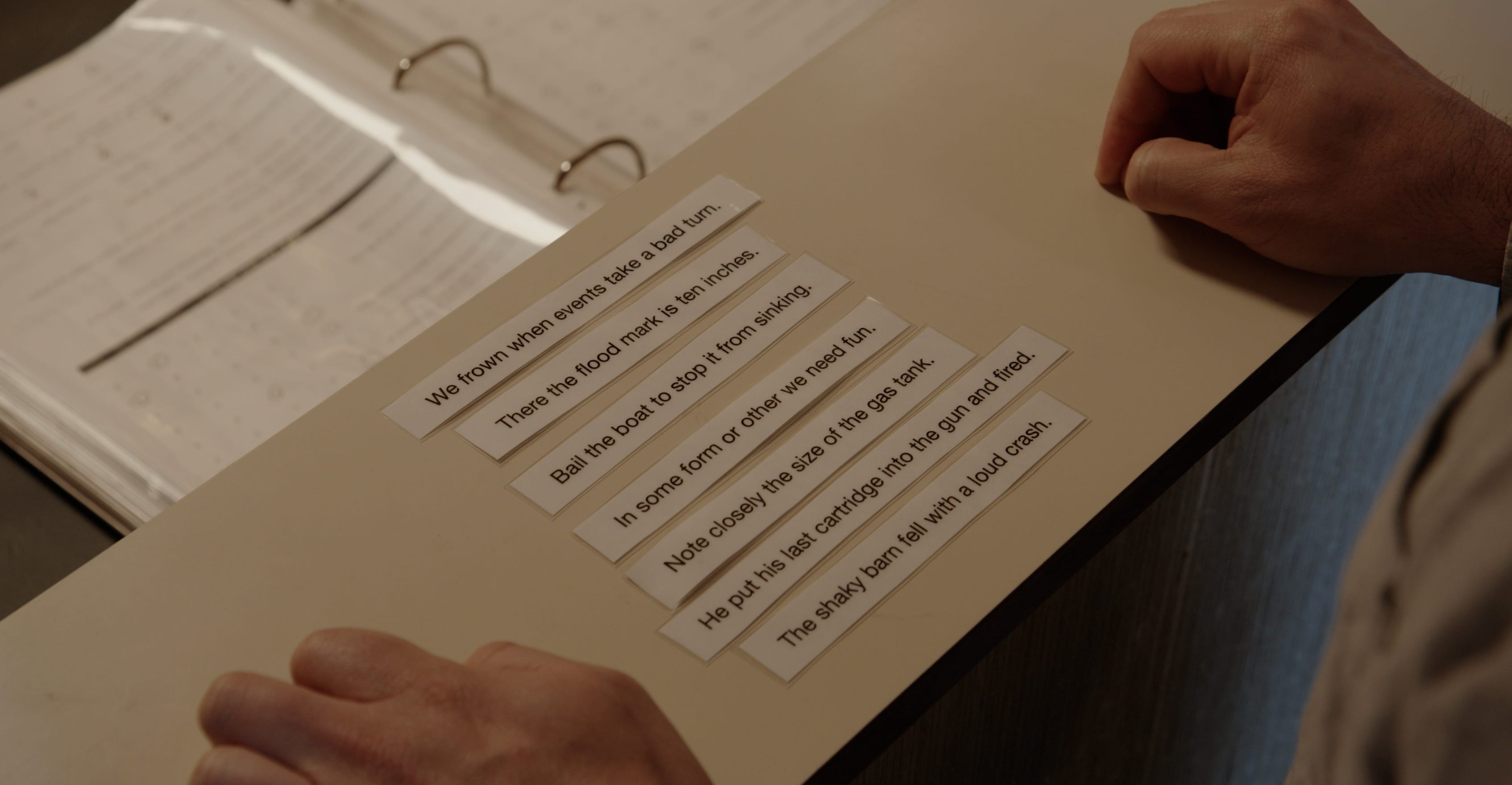
Here’s how Hal told the story:
There’s a family that lives on a farm or in some rural area, and there’s been a catastrophic weather event and the water levels are rising to the point of no return. And so they hop their whole family into a boat and float off into the distance. But as they’re floating off, the father of the family is trying to keep everybody’s spirits high, and so he loads his last cartridge into his gun and blows up the family barn for fun. It’s kind of a like “it’s over,” but also like, “check this shit out, kids.”
I ask how the kids react.
They love it. They’re like, “hell yeah.” Maybe they hated that barn for whatever reason. Maybe they’ve been trying to fix that barn—I’m imagining, like, dustbowl, 1920s—they’ve been trying to fix this barn for their entire lives, and it’s never worked. And the farm has never been profitable, and now this weather event is happening, everything’s gone to shit. It’s all over. And one last big fuck you to this world that didn’t work for them is blowing up this barn that they’ve never been able to fix up.
Using this tool that took a good deal of planning to make, Hal accessed a more spontaneous form of creation. If I can develop systems that get other people to that place, maybe I can use them to get there myself.
Do you live in Seattle? Do you know someone who does? I’ve been working with my friend Matthew Deane Parker to prepare the next iteration of the show, which opens next Thursday, May 7 at Specialist Gallery in Seattle. Until then, all my tasks are highlighted in orange.
I’d love to see you there.
From their workshop description: “Am I making enough? Will I ever be done working? Is it any good? How will I fund it? Where will I put all this stuff after? Is what I have to say worth saying? Is anyone paying attention? Am I making the best use of my time? Does the world need this? What’s the point in times like these?” You can read more about DOMA here.
Like how a taxidermied animal and a clay sculpture of an animal represent the essence of the living animal in different ways?
This most recent survey asks a pair of people to evaluate each other’s preparedness. More on that later.
Some of my favorite sentences and their corresponding envelopes: “Men think and plan and sometimes act” (PRE), “Bail the boat to stop it from sinking” (CRISIS), “The map had an X that meant nothing” (POST).
No posts
Comments
Nothing yet. Say the first thing.
Sign in to join the conversation.