
Dear Readers,
I was in The Wall Street Journal’s Free Expression section on Monday, with a short meditation on the magic of mingling in person and the ideas of Maurice Merleau-Ponty. Please read it. You can also see it on Substack here. If you haven’t checked out Free Expression yet, you definitely should.
The following essay was originally intended for another publication, but it ended up being better to publish it myself. It’s not the kind of thing I would have written on my own, but here you go. Happy and Blessed Holy Week to all those who celebrate.
“Whatever you do, don’t make any big changes right now,” he said. I had climbed to the top of a hill and was sitting under a water tower in Fulton County, New York, talking to my new 12 Step sponsor on the phone. “Don’t move anywhere. Don’t quit your job. Just start the Steps.” I then told him that I was days away from moving to Washington, D.C. and my bags were already packed. I had been living at my second cousin’s house for three months trying to decide what to do. I knew that I needed recovery.
“Ok,” he sighed, the first of many laments on my behalf. He didn’t know then that he would be called upon to have the patience of Job while he dug me out of the primordial pit of addictive behavior over the next two years. In 12 Step wisdom, what I was doing might be seen by some as the dreaded “geographic cure:” the idea that moving somewhere and starting over is a false solution to our afflictions. Not only was I warned about moving, I was also counseled to not commence any romantic relationships for at least a year, which is a common piece of advice.
Many of these things can be daunting to someone embarking on recovery. But I had been gifted with what addicts call “G.O.D.” — the “gift of desperation.” And I did, in fact, find the willingness to go to any lengths to find a new life.
The place I am originally from is a hamlet called Meco in a larger town called Gloversville. It is very rural and conservative. My great-grandmother worked as a seamstress in the glove factories, and baked pies for a local hotel. My great-grandfather worked in a leather tannery. Our family had migrated to that area in the 19th century because land was being offered for homesteading at the foot of the Adirondack mountains. They were tough people, and people of deep faith.
I suppose it is odd to move to the power center of the world the same week you are taking Step One, i.e., admitting your utter powerlessness over your dependency. But something about it made sense. I remember watching over the snowy view of Pennsylvania on the plane to D.C. from Albany while listening to Jason Aldean’s “Flyover States.”
Just a bunch of square cornfields and wheat farms
Man, it all looks the same
Miles and miles of back roads and highways
Connecting little towns with funny names
Who'd want to live down there in the middle of nowhere?
Aldean sings that things change once you drive “through Indiana,” meet “the men who plowed that earth,” once you catch “a harvest moon in Kansas,” or see “the plains of Oklahoma” and “take a ride across the badlands.”
You'll think heaven's doors have opened
You'll understand why God made
Those flyover states.
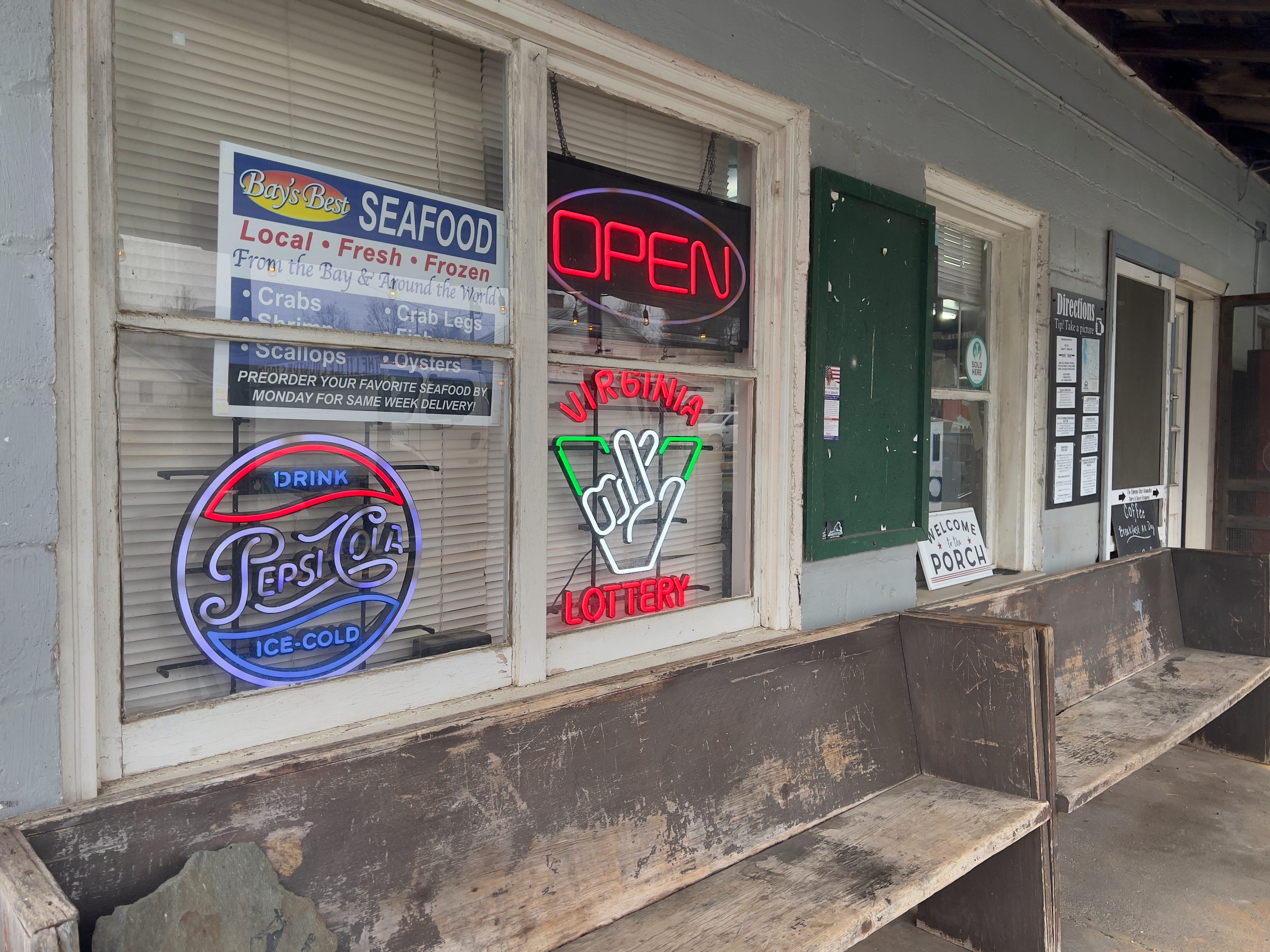
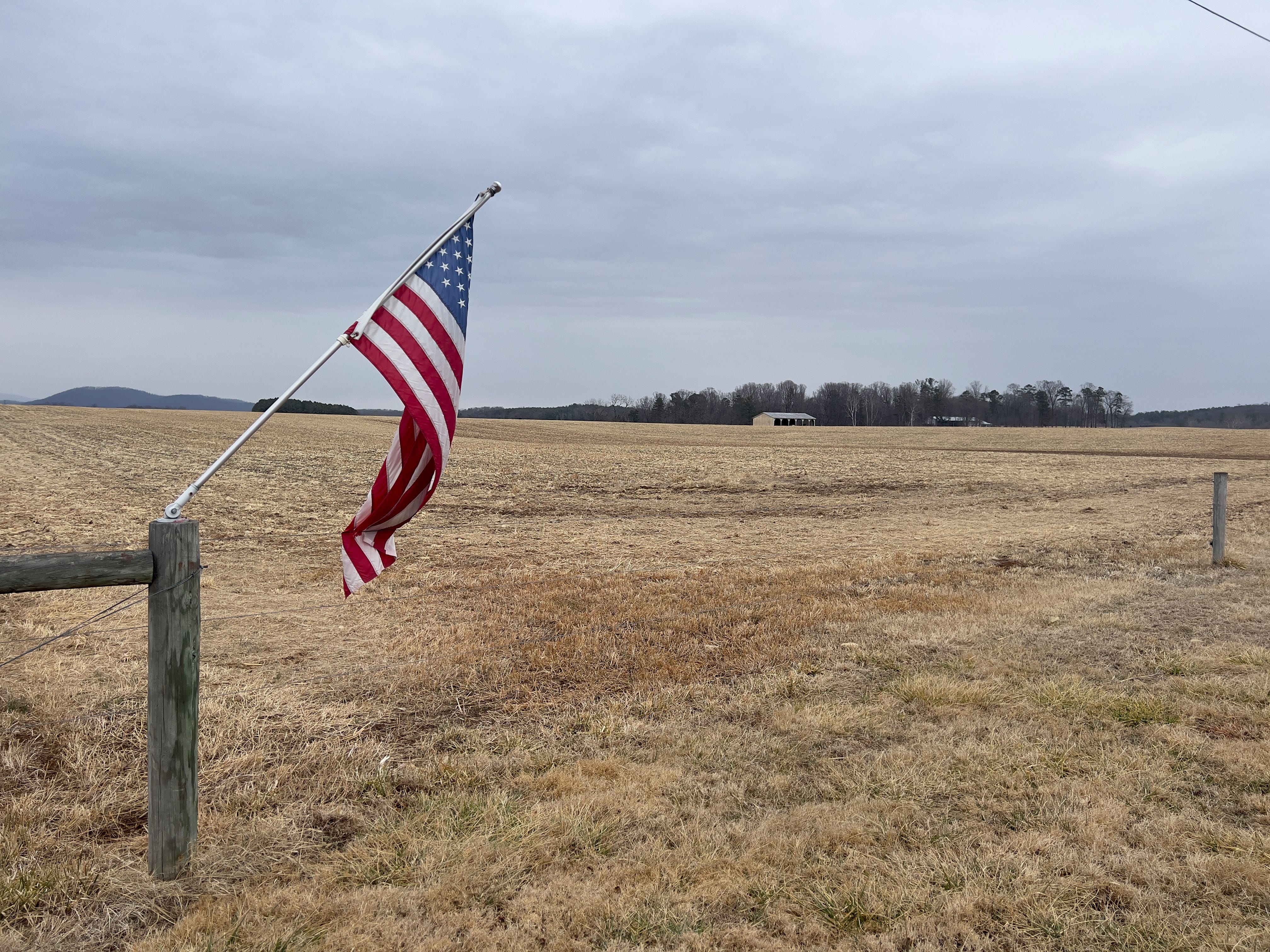
Most of my time in DC has involved efforts to “stay country or die tryin’,” in the words of Blake Shelton. I drive whenever I can to Rappahannock or Madison County, Virginia, because something about it reminds me of home. I think mountain foothill culture is pretty much the same anywhere.
I got to Washington four years ago with a suitcase, no real plan, 2000 bucks, a vague sense of calling, and the memory of a Hampton Inn I had stayed at once in the past. When I ran out of money for the hotel, I moved uptown to a hostel that still gives me shudders when I walk past it. In the first room I stayed in, an old lady sat in the lower bunk all day long eating entire roast chickens in bed. After I changed floors my roommates were three other young women. One of them was clearly mentally ill but funny as hell, and a great interlocutor. She had been living there a while. Another was a tourist who painted her face every day in the style of Euphoria characters and brought back souvenirs from the Mall. The third was a rather well-heeled girl with perfect highlights who probably didn’t belong in the hostel. I had torturous conversations on the phone in the stairwell with my parents who weren’t sure what I was doing there. I went to think tank discussions for the free food and back in the hostel at night, I talked and told stories with the girls until we screamed with laughter and fell asleep delirious in our bunks. I was thirty something, a near-derelict, and starting over. At the time it felt like a nightmare. I see it now as a blessing.
People in recovery are supposed to maintain “anonymity at the level of press, radio, and films,” so I don’t talk about which program I’m in. Maybe some day I will. The only reason I know about 12 Step is because of another woman who spoke about it on her podcast. Along with church, it is far more effective than anything else I’ve ever tried, including therapy, medication, and reading self-help books alone.
Whenever people talked about the “spiritual awakening” you are supposed to have by the end of the Steps, I mostly nodded and ignored it. I already believed in Jesus. I didn’t need that. I just wanted to know how to fix my problems. The part I balked at the most was the Amends — the 9th Step where you contact people you’ve wronged (even if they’ve wronged you, too), and admit your part, and apologize.
In the recovery group I joined, no one treated me like a mental patient. No one told me even after two hours of talking that “our time was up.” No one pressured me to ingest things I didn’t want to ingest, and no one looked down on me. We were equals. It is a mutual aid society. We are all walking on a path alongside a ditch, always in danger of falling in, but some of us are farther along the path than others. We keep each other out of that ditch.
In the end it was the Amends that caused my spiritual awakening. I walked around for about a month afterward in a rosy haze. I had a feeling of complete peace. I suddenly perceived that “the God of my understanding,” as we say in the rooms, is a benevolent God, and can be trusted. I decided I needed to be baptized.
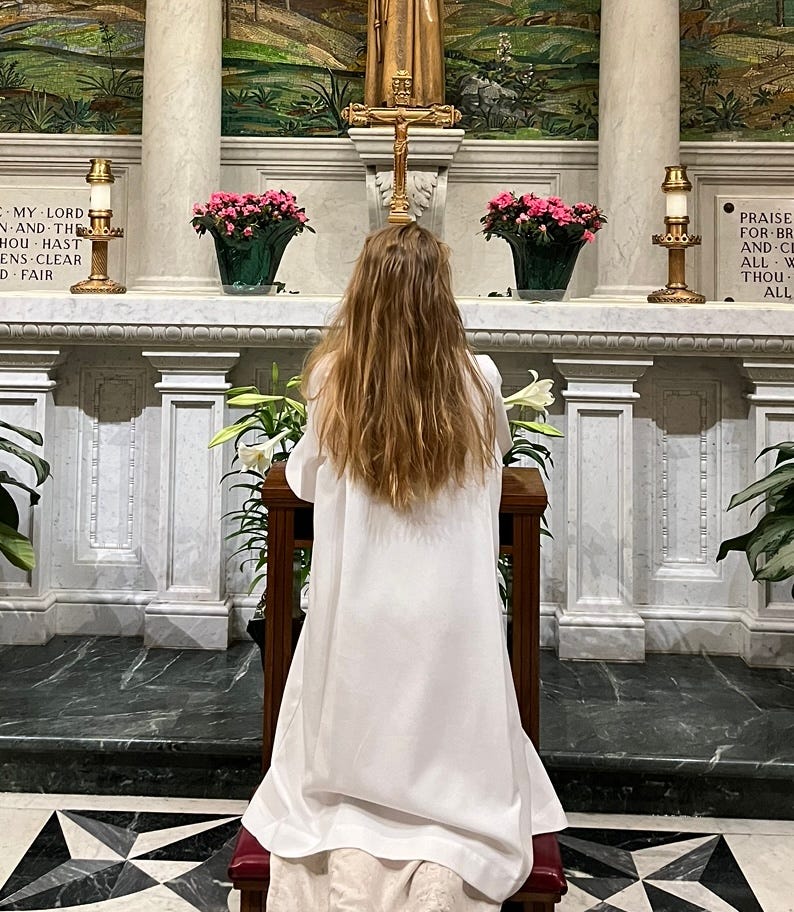
My baptism though, like working the Steps, was not easy. It was more like a traumatic birth than an orderly ritual. As soon as I stepped out of the pool, my whole body shaking from nerves, I slipped and fell on the marble floor leading to the sacristy. I spent the rest of the Easter Vigil, including confirmation and my first Eucharist, not knowing if I had seriously hurt myself. But nothing would have stopped me in that moment from going forward.
I spent the next morning at urgent care and after being cleared went right back to church. I wanted to be in the place I felt safest. In the Book of Revelation, someone asks its author, John:
Who are these wearing white robes, and where did they come from?
And then answers his own question:
These are the ones who have survived the time of great distress.
About seven years ago, while working as a peer at a mental health respite house in Manhattan, I came across a woman in the hallway wearing a sweatshirt with a picture of a motorcycle heading toward a cross in the sunset. She was a tough, butch chick, about 50 years old, and had PTSD from being a 9/11 responder. “What’s that shirt?” I asked.
“Christian Motorcyclists Association,” she answered. “Instead of kickin’ people’s asses, we pray for ‘em.”
It’s people like that who made me believe I could be a person of faith and live in this world, that I didn’t have to erase everything about myself because I had found God. Still, things wouldn’t be the same as they had been before.
“The land to which God has brought you is not like the land,” Thomas Merton wrote, “from which you came out.” He was writing about his conversion and to other people who might be starting to take their faith seriously. “You can no longer live here as you lived there. Your old life and your former ways,” he explained, “are crucified now.”
I think what I hated about myself before recovery was that I was so dependent. The more I tried to eradicate my dependence, the more dependent I became. I thought there was something bad about needing people, about needing to be soothed or comforted, about needing anything. I hadn’t been baptized as a child because a close family member hadn’t wanted it. “She doesn’t need that,” they said.
But I did need it, and I needed other people, too. I hate the word “community,” but I needed a place I could go where I could see the same faces over and over again and more or less put up with each other. I needed physical assurances of God’s love. I needed to be of service to others. I no longer look at dependence as something that should, or can, be eradicated. I see it as the human condition.
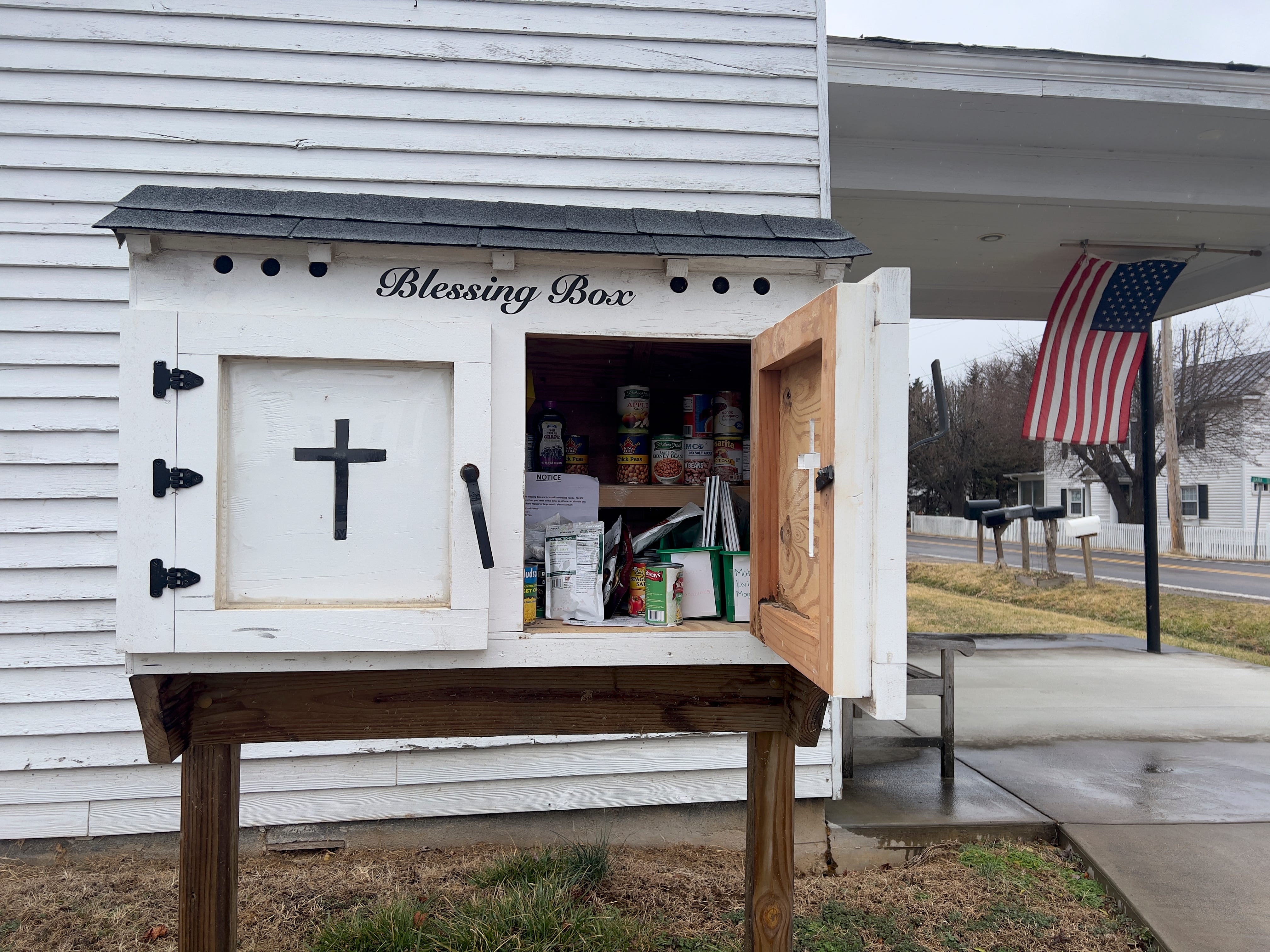
“Many of us struggle with having to ask for help,” it says in a book called Living Clean, a piece of recovery literature authored by members of Narcotics Anonymous. “Each of us has abilities that are valuable and limitations that are regrettable.” It’s similar to what someone from my local club said to me after I texted him thanks for walking me to my doorstep when I was sick. “Of course. We have all been in that place of need and will be again.”
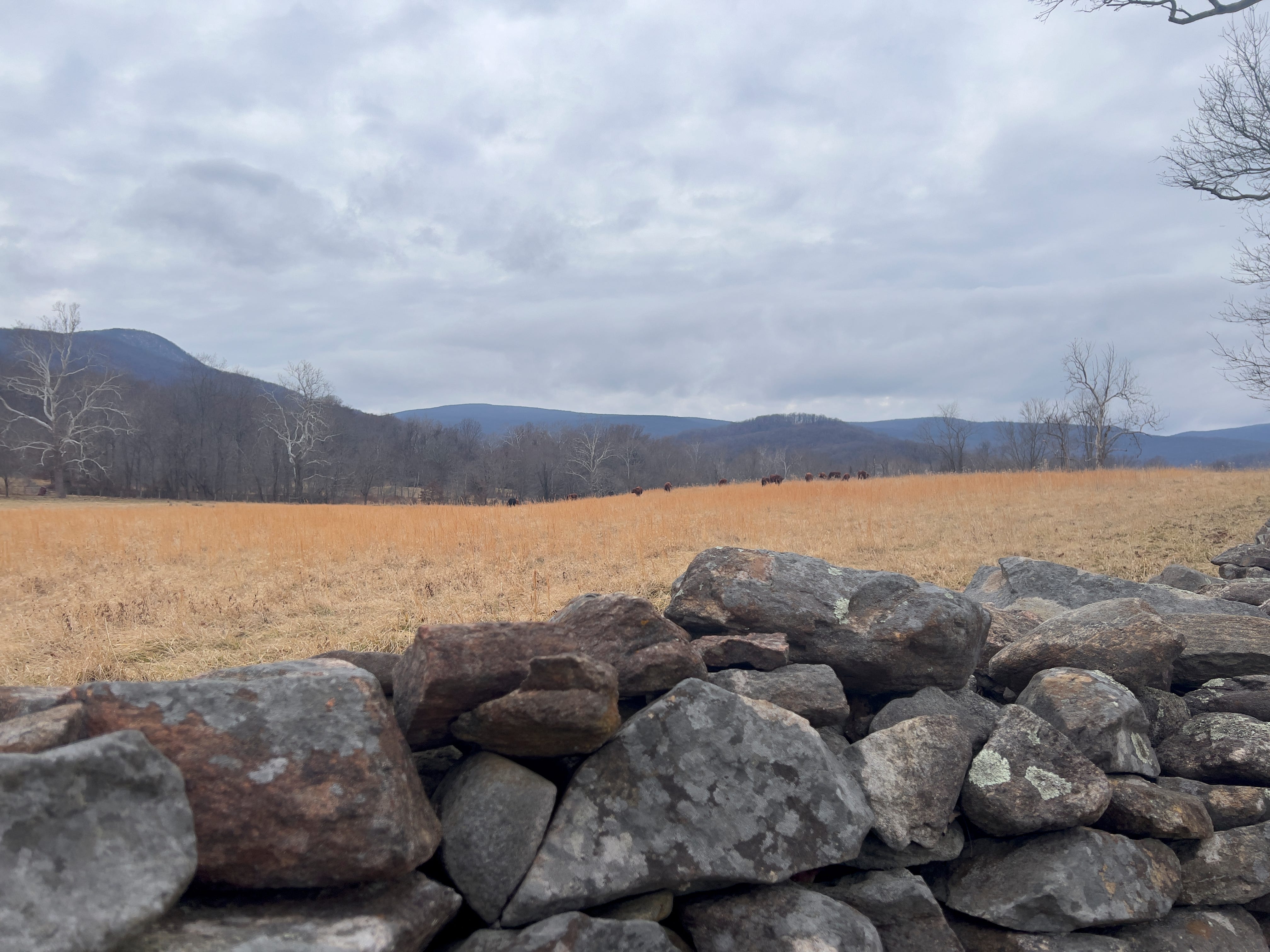
Virginia is a beautiful state, in many ways like New York State. Sometimes when I drive far enough into the country I feel like I enter what the philosopher Charles Taylor calls the “interspace” — the realm in which you start to feel the cosmic order of the universe, like some vestigial knowing your ancestors had and which still lives within you. When I think of New York State, I often have memories of dark pines and imposing hills, but Virginia feels lighter somehow. It’s probably because my vision, which had been so blocked by despair, has started to clear.
I don’t always feel in touch with the vision of God I had when working the Steps. I still have a couple big problems. Some days I’m just getting through and life is monotonous. But I turn back to that memory, like a bookmark saving a favorite paragraph, because I know it is true. I am ok today because of other people who had been at rock bottom and offered their time to me in solidarity. I am stable in a way I never was before because I go to a church every week and receive the Body of someone who offers Himself to me, and to anyone else who comes to Him. I am free because I live in a country, no matter how damaged or broken, that still gives me a way to worship where I want to.
Comments
Nothing yet. Say the first thing.
Sign in to join the conversation.