
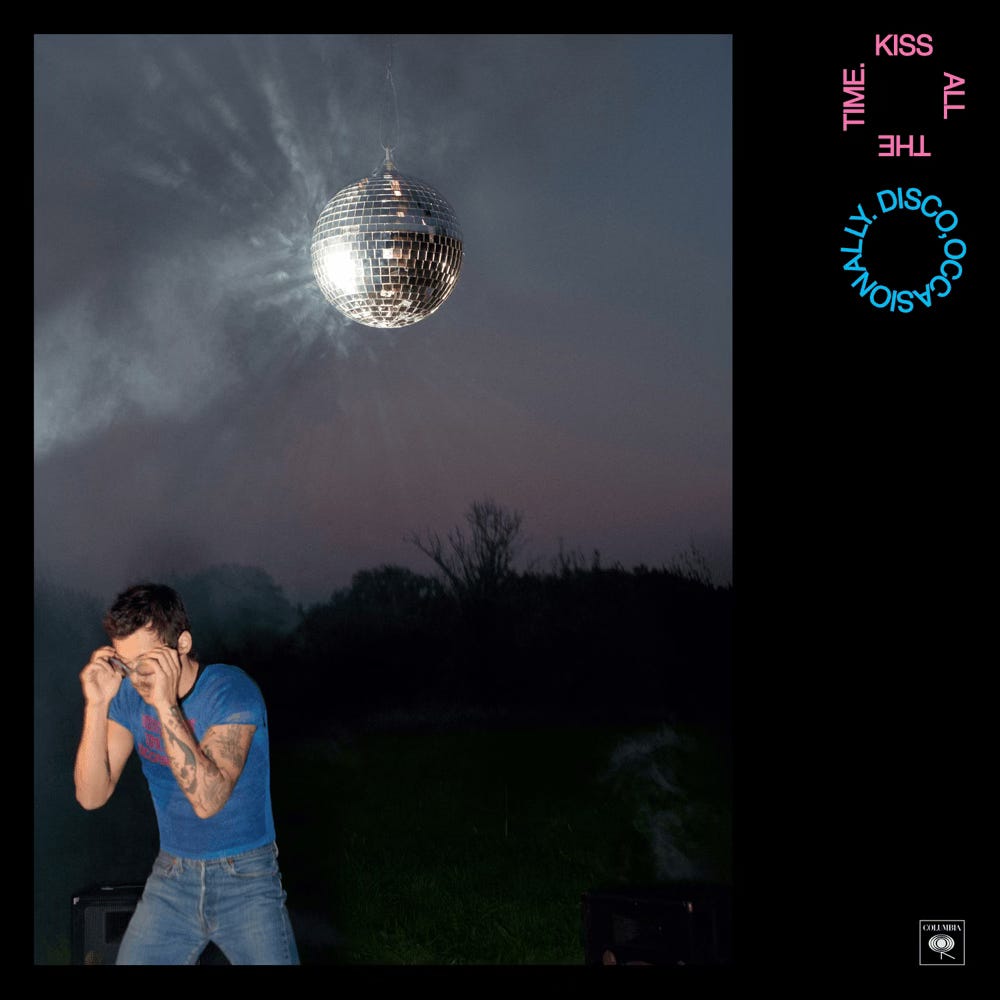
Kiss All the Time, Disco Occasionally—Harry Styles
Released March 6, 2025
I didn’t have much of a reaction to this new Harry Styles music. Even after listening to the first single “Aperture” for the first time in January, I thought “well, that’s a song.” I didn’t want to make any judgements without having heard the whole album, but even after I did hear the full thing, only one song really caught my attention. I am hardly an early stage adopter of anything and I often need time to digest new music, hence the entire genesis of this project. But this album in particular I really needed to sit with, let it in to my daily life, and allow my thoughts and feelings on it to develop.
After my initial few listens, I didn’t necessarily dislike the album, but I wasn’t sure I really loved it either. But that’s also because I’m not typically a big fan of dance music, which is why I gravitate more towards the ‘70s sounds of Fine Line or the more funk-inspired sound of Harry’s House. I would even have preferred a more true disco sound from this record, which is why I think “Dance No More” was my favorite track out of all of them. That song is so Madonna meets Chic and for an album with the word disco in the title, this is the song that comes closest to that promise. And the bass sounds so much like Nile Rogers that I need to know what a Rogers and Harry Styles collaboration would sound like. And even as I’ve continued to listen and had moments with each of the songs where they’ve struck me in different ways than that first initial listen, “Dance No More” is still my number one, with “Pop” coming in at number two, and currently “Taste Back” is my next hyperfixation song.
Despite its title, this is less of a disco album and not even quite a straightforward dance album, but a blurring of genres, paying “no attention to definitions, erasing all sorts of boundaries.” Possibly informed by the way we consume music now, with streaming giving us the ability to listen across genres, time periods, and countries all day long, this album is a “browser’s delight that raids the past without caring about history.” And while it might only be “disco-inspired,” there are songs like “The Waiting Game” and “Carla’s Song” that are “pop songs dressed up in disco clothes,” which is fine by me and there’s still plenty of great disco-inspired pop out there that Styles is in good company with, artists like Kacey Musgraves and her song “High Horse,” Chappell Roan and “Good Luck, Babe!,” and even Taylor Swift’s “Opalite.” The closest to real disco we’ve come in modern mainstream pop music is Dua Lipa’s “Dance the Night” for the Barbie movie in 2023. But it’s not surprising that real disco, the disco of Donna Summer, Gloria Gaynor, and Giorgio Moroder isn’t having a true resurgence in 2026. For one, it’s the music of queer people and people of color and it was a layering and mixing of African beats, jazz, swing, soul, and funk music. And despite its success, it really wasn’t around for very long, from the first widely regarded disco song in 1972 to the death of disco in 1979, when Steve Dahl held a “disco demolition” at Comiskey Park in Chicago. Dahl was a rock station radio personality who had lost his job when the station switched to an all-disco playlist and he led this record burning both in the defense of rock music and simultaneously against disco’s Black and queer origins.
So while I may have been hoping for a more-than-occasional disco, this album is more in line with Styles’ previously known affinity for dance music and electronica, particularly club music. I can’t even say I was surprised that Styles made a dance music club record as he’s made no secret of the fact that he loves dancing and clubbing and has spent a fair bit of time in Berlin, not just during this past break after his 22-month long Love on Tour, but even before, clubbing in Vegas until 5am in 2023. He’s spoken about his love for being in the club, particularly post-COVID and losing his former bandmate Liam Payne, and how it was, for him, about “reconnecting to what it feels like to be in the dark, lost in the crowd, dancing and singing with strangers,” so having a Berlin-esque dance club energy does fit what we know of him. Now in his 30s and over 15 years into his career, Styles is choosing himself and is making the kind of music that he himself gravitates towards as a fan, and is saying to his fans that “‘experiencing life in this way is amazing, and I encourage you to go and do that for yourself.’”
Given that this is more of a dance album, leaning more “into the Eighties, with loads of old-school synth gadgets,” Styles is taking inspiration from bands like Depeche Mode, New Order, Prince, and Talking Heads. Styles also specifically cited LCD Soundsystem and attending one of their live shows as an inspiration for this album’s immersive energy. He said after a few times seeing them perform he came away feeling like he “wanted to make music that felt like being in the crowd at one of their gigs.”
Working on this album with Styles are his past collaborators Kid Harpoon and Tyler Johnson. But this time around, the album is atmospheric and “more sensory, less star-driven than the music they’ve made before.” With more emphasis on “experience rather than ego,” the production prioritizes “low-frequency, thumps, grooves, shimmies, and shakes,” rendering “Styles’ voice…sometimes secondary to the tracks, filtered or submerged in the mix.”
Styles is a “true music geek,” supported by his curated lineup selection for Meltdown Festival in Manchester in June and which also explains all of these references to bands like LCD Soundsystem as well as explains why Tom Skinner, known for playing with Thom Yorke and Jonny Greenwood’s the Smile side project, and Ellie Roswell from Wolf Alice are credited on the album as a drummer and backing vocalist, respectively.
But have no fear, there’s still classic Styles sounding ballads like “Coming Up Roses” and “Paint By Numbers” which feature his characteristic piano-led crooning in league with songs like “Falling” and “Fine Line.”
This album has been called boring, “all mood and no material,” and “the illusion of something interesting, but…is just attractive smoke and mirrors” mostly for the way Style is perceived to be “so terrified of exposing himself that he’s unwilling to fundamentally change his formula at all…or he only trusts his audience enough to give them a diet version of a sound he loves.” But in reality, you don’t actually want real, true disco or even electronic music from Harry Styles. You don’t want 12 plus minute songs with 5 minute instrumental lead-ins and a break of 3 minutes in the middle of the song with no lyrics and no vocals. Because that’s what disco and electronic music really is and had Styles gone all-in on that, there would still be complaints that he’s not singing enough when he’s really a singer or that it’s not revealing enough about himself because there’s hardly any lyrics.
There were also complaints that Styles’ lyrics reveal little about himself and there are “no especially memorable lines” on this album. Styles is said to be seem “completely uninterested in mainstream pop stardom…[and] uninterested in being interesting.” And while it is true that his lyrics on this album are opaque and hard to dissect bigger meaning, it’s far from his first album where this is the case. He’s always been fairly secretive and can you blame him? Since he was 16 years old, Styles’ every move has been under a microscope and overanalyzed to the point of smothering. Anything we’ve ever been able to glean from his lyrics has been from basic poetic analysis, like deciphering the meaning of “Watermelon Sugar” or “Falling,” or we’ve been able to connect the dots from biographic details that were already public, like deducing the French language voicemail on “Cherry” was from Camille Rowe, Styles’ French ex-girlfriend. Or in the case of “Carolina,” there were enough identifying details that even the most dedicated online sleuths didn’t have to work very hard to connect the dots. But as far as revealing information about himself, Styles is typically withholding which makes him “a blank slate, one onto whom audiences can project whatever they want.” Styles’ persona has always been, intentionally, “harder to pin down,” making it a win-win—fans can make him “a pop star, a rock god, a queer icon, a soft boi singer-songwriter, boyfriend material, or the most authentic artist working today.” He can be, to them, whatever they want him to be, and he, as himself, whoever he actually is, can still be protected in a way that he wasn’t when he was in One Direction and the boys were “encouraged to give a lot of ourselves away.”
And yet, even without revealing particulars about his life, there’s still something relatable and personable in this album about where Styles is in his life. For those of us around his age, even those of us younger than him but still firmly in our young adulthood, we can recognize parts of Styles as he’s experiencing the loss of someone close to him, and someone close in age, something we start to experience by this point in life. He’s also experiencing that liminal stage where he’s looking around at the people around him and seeing “what all his friends are doing without him, whether that’s getting married or going out dancing.” It’d be overly dramatic to call this a mid-life crisis, or even a quarter-life crisis, but it is a growing pain that I think we all will have experienced as we enter our late-20s, early-30s, where it’s expected we have some grasp of what we’re doing, but of course none of us do, hence the crisis.
But what I find hypocritical about all of this is the double standard that comes with artists who write about themselves and their lives in their music. If a songwriter like Taylor Swift writes with too much detail about their lives, then it’s “you shouldn’t be looking for easter eggs and picking apart songs for ‘gossipy details about pop artists’ private lives.’” But when Styles is less forthcoming and vague in his lyrics, allowing fans to apply the songs to their own lives and situations, then we find ourselves “grasping for meaning” and he’s boring because he’s not telling us enough about his life. What is it, then, that we want from artists? We want to know the details of their lives or we don’t? Can we accept that, for some artists especially, their personal lives are the context to their songs or should we disregard the artists’ intent altogether entirely and can only take from songs what we can apply to our own lived experiences and nothing more?
Despite others thinking that a former boybander turned solo pop rock star doing an electronic dance record is him taking “no chances” and “optimizing his music to avoid missteps,” let’s just make one thing clear—this is not a playing-it-safe kind of album. I think this absolutely was a risk for Styles and really a test for his fans to see just how far can he push his sound and still have them on board. Yes, this album may be “devoid of unequivocal pop bangers along the lines of ‘As It Was’ or ‘Watermelon Sugar,’” which is all the more reason why this is a break from form and a creative risk. While this isn’t my favorite of all his releases, it is still an enjoyable listen for Harry Styles fans and I can’t fault him for trying something. But here’s the thing: Harry Styles is at a point in his career where he doesn’t have to do anything. He’s been famous for the entirety of his adult life, he could easily play off the nostalgia of his former band One Direction, and despite his seemingly boring life which leads to cryptic lyrics, he’s still going to sell out massive venues. He doesn’t seem to be worried about things like chart placements, vinyl variants, and he’s certainly not worried about making the kind of music he thinks is expected of him. He knows what kind of music his fans want him to make, they want more of the rock sound from HS1 or more from Fine Line, but he doesn’t give in, in fact, “you can almost feel him not” just doing whatever he thinks his fans want, as easily as he could do that. He’s making the kind of music he wants to make, the music that he gravitates towards as a fan, and he’s able to do it because he knows that his fanbase, dedicated as they are, are going to go with him on whatever he does. He knows, almost for a fact, that whatever he does “is almost guaranteed to be huge” and that’s not an abstract calculation—for his 30 show residency in New York City with dates ranging from August through October “11.5 million people applied for tickets.” Not all of those people will win the Ticketmaster war, but the number of people who tried for just the chance to purchase tickets, nevermind for absurd prices running into the thousands for one seat, is roughly the populations of entire countries like Jordan and UAE. So Styles seems less concerned with pleasing anyone but himself and “there’s something oddly laudable about an album that doesn’t seem desperate to be loved.” It’s not an album for his fans, it’s an album for him.
And that’s what makes watching an artist like Styles so fun. It’s the not knowing what’s coming next, the same way that “elusiveness is a big part of what keeps up engaged with the Beyoncés, Arianas, Lanas, Taylors and Kendricks of the world.” It’s okay for fans to greet a new album with “confusion of hesitant enthusiasm, because it may not be what they were dreaming of or expecting,” but what’s even more interesting than if you like it or not is how this album will fit into the larger arc of that artists’ career narrative.
This album is interesting to me in the way that I think it represents a crossroads in Styles’ career and artistry. For one, his appearances in interviews leading up the album’s release were some of the most relaxed, comfortable, and personable I think we’ve ever seen of him. He seems a lot more comfortable with himself, like he’s settled in to who he is, boring as it might seem to the tabloids who have a vested interest in portraying him as a wild partier, but this is the persona he’s presenting to the world and he seems perfectly okay with that. It also seems that he’s doing what he wants to do, including an interview with one of his favorite authors and an entire spread with a running magazine, talking about his new hobby.
His going to Berlin to record a portion of this album also represents a transitional place in his career that a few artists who have come before him have also been. Bowie went to Berlin in the late ‘70s after he got clean from drugs and went to work with Brian Eno to make the Berlin trilogy, his albums Low (1977), Heroes (1977), and Dodger (1979), arguably the most creatively ambitious albums of his career up until that point. And a decade later, inspired by Bowie’s pilgrimage, U2 would make their own visit to Berlin, to the same studio, to work with the same producer, after becoming overexposed following the release of their album Rattle and Hum (1988) and needing to “go away and dream it all up again.” Both of these artists went to Berlin as a place to reinvent themselves and the work that followed each of these visits led them in wildly different directions—following his Berlin trilogy, Bowie went on to release Let’s Dance in 1983 and rose to mega superstardom with his Serious Moonlight tour and his film career while U2 followed up their Berlin album Achtung Baby with two electronic albums, Zooropa (1993) and Pop (1997) that were polarizing amongst their fanbase. Zooropa was more well received than Pop, but it was Pop’s commercial disappointment that led the band back to their guitar-rock roots for their next release, 2000’s All That You Can’t Leave Behind.
So without seeming ungrateful for the album that we have in front of us, what I find myself thinking about most is where does he go from here. Does he follow in Bowie’s footsteps and finds even more pop success than he’s previously known to date, does he follow U2 and continue to chase the sounds that excite him as a listener, but maybe his fans won’t be willing to follow him to these places? Or is there a secret third option that we can’t even fathom to predict?
No posts
Comments
Nothing yet. Say the first thing.
Sign in to join the conversation.