
You’ve no doubt heard the news by now—indie rock darling Geese are frauds. Or maybe they’re not and this is just how music marketing works now. Or has it always worked this way?
In late March, singer-songwriter Eliza McLamb published an essay on her Substack titled “Fake Fans” and dug into the work of Chaotic Good, a digital marketing company that boasts working with artists like Sombr, Laufey, Dijon, and Benson Boone. What the company does for its musician clients varies, but on their website they offer marketing campaigns around UGC (User Generate Content) campaigns, Fanpages, and Brand & Media. McLamb’s essay largely centered around quotes from an interview co-founders Jesse Coren and Andrew Spelman gave to Billboard during South by Southwest.
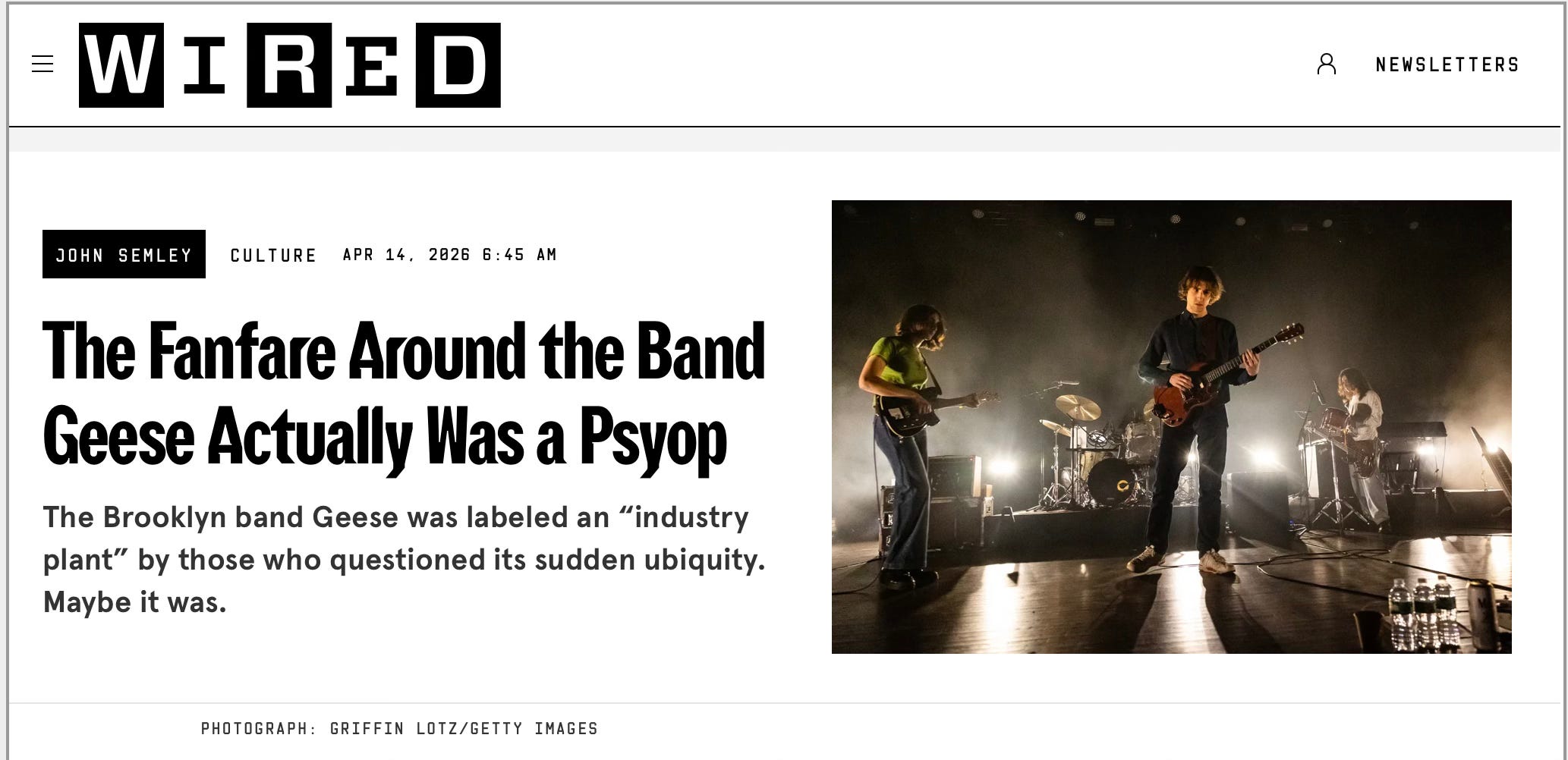
Two weeks after McLamb’s essay was published, on April 14, a story ran on Wired, written by John Semley titled “The Fanfare Around the Band Geese Actually Was a Psyop,” expanding on McLamb’s original reporting. The fact that Geese was named in the headline was already going to get the article attention, but calling them a “psyop” was an inflammatory clickbait tactic. McLamb did not even mention the band by name in her essay.
The response to the Wired article was swift and the backlash was not against Chaotic Good, but against Wired and Semley for their calling Geese a “psyop,” insinuating that anyone who engaged with or enjoyed the music of Geese had got got. The response included articles ranging from condescending, with titles “Congratulations, you discovered digital marketing” to the defensive “I don’t care that Geese was a psyop.”
But I’m here to argue this is not about Geese, not really. It’s not even really about the other artists named in McLamb’s original essay. What it is about is Chaotic Good and what their practices mean for the changing authentication process in the age of the internet.
Authentication is the expectation that the people who say they made this music actually did make it themselves; “that there is an element of originality or creativity present, along with connotations of seriousness, sincerity, and uniqueness.”1 There are also “perceptions of authenticity…to which performers and records as assimilated and legitimized by particular subcultures or communities.”2 Authenticity is not found in the sound of the music itself, but rather is “a matter of interpretation…made and fought for from within a cultural and…historicised [sic] position.3 The process for authenticating usually comes from live performances—if the recording is thought to be the original,4 then live performances are a chance for artists to prove to their audience that they can do what they say they can do.5 Ultimately it’s an evaluation tool to discern an artists’ legitimacy, if they’re in it for the quote unquote right reasons, and it is “used to bestow integrity, or its lack, on a performer, such that an ‘authentic’ performer exhibits realism, lack of pretence [sic], or the like.”6 It’s not something that once an artist has it, they have it forever. It’s performative, in the sense that artists must be “continuously citing in their music and performance styles the norms of authenticity…and these norms change.”7
The tricky thing about authenticity is that it’s not inscribed, but ascribed8 meaning that it’s dependent on whether or not the public believes you, and that belief can be lost.9 A famous example of an artist losing their authenticity is Milli Vanilli. The German duo was made up of Fab Morvan and Rob Pilatus and had won awards for their records, including a 1990 Grammy Award for Best New Artist, but in November 1990, after a dispute with their producer, it was revealed that they were not the voices on the records and had been lip-syncing in their live performances. Their Grammy was rescinded, the first and only time this has happened, and their name is forever tied to the scandal and invoked as a joke.
Additionally, once the label of inauthentic has been attached to an artist, it’s hard to shake it. It was advertised that the Monkees were not a real band, but one artificially created for a television show. But by the time the band released their third album, Headquarters in 1967, they had taken over writing, performing, and producing much of the music themselves, making them a real band. But the public’s knowledge of their manufactured origins made it so this new music, which had all the signs of authenticity, could not be authenticated.10 On the other hand, an artist can be authenticated even when they’ve been manufactured. The Clash are one of the greatest punk rock bands to ever exist and their authenticity has rarely, if ever, been questioned, but they were manufactured and formed by Bernie Rhodes as a response to the Sex Pistols.
Part of the process for authenticating bands and artists just starting out is two-fold: they must have “a history as a live performer, as someone who has paid those dues and whose current visibility is the result of earlier popularity with a local following,”11 and they must be “chosen to record by industry scouts on the basis of live performances. Subsequent moves from live performance at the local level to live performance at the national and international levels serve as indices of the musicians’ popularity.”12 Basically, they have to play live and play to bigger and bigger rooms, building their fanbase along the way. But how does that process work on the internet, when artists are no longer playing shows to get discovered, but are posting videos to online sites like YouTube and, especially post 2020 and post-lockdown, apps like TikTok? For one, the channels for discovery are even more oversaturated than ever before, and that can be both to the artists’ benefit and their detriment. On one hand, it increases their chances of “making it” without the traditional hurdles that come from the standard process of playing shows, gaining attention from labels, being signed, putting out an album, going on tour, rinse and repeat. But it also means that there’s that much more noise and competition to break through in order to be heard and find an audience. Which is where a company like Chaotic Good comes in.
In their attempt to “pump up online chatter to bolster the impression that their clients are at the center of the zeitgeist,” their practice of “trend simulation” consists of “flooding comment sections, running meme pages, and generating faux-viral trends.” So where a traditional label or management team might try to get their artists on a show like Saturday Night Live or an internet-based show like Tiny Desk or on radio like Triple J, after the performance they would “kind of wait for the comments,” but what Andrew Spelman said Chaotic Good advises is “the second SNL drops at midnight, you should post a hundred times saying that was the best performance of the year.” One of the ways they would do that for Geese is by using bots to “flood social media with artificial comments, posts, and views on Geese-related content…in the evidence-based hope users would be influenced by vibes.” Companies like Chaotic Good and their competitors have been known to use AI-driven accounts to “listen to artists’ tracks; this manufactures extra streaming numbers, and makes the artist more algorithm-friendly.” This is called stream inflation, which is not a new phenomenon. For about as long as streaming music platforms like Spotify have existed, so too have ways of gaming the system, from buying 1,000 streams for $2 on a microlabor platform like SEOClerks to labels and marketing agencies themselves building their own botnets.
Part of the defense of Chaotic Good has been that while what they’re doing may be grim, it’s not fraudulent and they’re not doing anything that a traditional label, a streaming platform like Spotify, or that blogs13 haven’t also done in the name of marketing their artists and reaching audiences. Chaotic Good claims not to have participated in stream manipulation and in fact, stream manipulation and inflation has been held up against what Chaotic Good has done as the real evil being done in the music industry. But that’s a false equivalency. Manipulating streams is bad, it’s actively robbing from artists, and it’s still bad when a label or a platform like Spotify does it. But the work that labels, Spotify, and blogs do are arguably part of standard music marketing. A label sending out a press release to 100 music press outlets is not the same as Chaotic Good posting “the same thought 100 times under 100 different names online.” The reason is that press outlets have editorial discretion. Even when they are all quoting from the same press release, leading to very similarly written articles, those outlets still have the final say in whether they decide to cover that artist, publish that press release, and what else they may want to include in the article. What sending out a press release is not is putting words in people’s mouths, which is what having a bot comment the same thing over and over under an artists’ TikTok video is doing.
Of course none of this kind of marketing in music is new. Practices such as payola, stream inflation, and bots14 have long existed in pursuit of reaching more listeners. Now those practices in the age of the internet involve “platforms, algorithms, and..games they demand we play.” But I would argue that what Chaotic Good is doing is going beyond music marketing as we have previously known it.
In creating fake fan accounts, Chaotic Good is cosplaying fandom under the guise of marketing, disrupting the authentication process and squeezing out real fans and the function of fandom. Fans, and fandoms as communities, do play a crucial function in the larger Musicking ecosystem. The concept of Musicking15 is that it’s not just the musicians on stage that create a musical performance, but it’s everyone involved— the band themselves, their guitar techs, the crew loading in and out, the merch sellers, the bartenders, the janitors, the venue manager, the booking agent, the tour manager, the label, the publicist, and the fans—that make up a musical experience. The role that fandoms play in that larger ecosystem is they’re part of authenticating the music and driving attention to it. Traditionally this looked like bringing friends to shows, going to multiple shows on a tour, requesting the music to play on local radio, creating posters, fan merch, and zines, joining and promoting fan clubs. Online, it can also include making fan accounts, posting clips of interviews and edits, voting in award shows, and holding streaming parties. Fans very often gain nothing from their involvement but do it simply for the love.
Because companies like Chaotic Good know that fandoms are essential to the authenticating process, they claim to be “protective and aware of the relationship between fan community and artist and [they] want to aid that connection.” And while they claim not to use “fake fan” accounts, but rather accounts which are “‘genuine’…bespoke, engineered, and overseen directly by the in-house PR team, working from their smartphones,” it is true that other companies and record labels’ in-house marketing teams do create label-sanctioned fan accounts, undermining the purpose and legitimacy of fan accounts.
If building a fanbase is foundational for authentication, then the manufacturing of fan activity to make it seem like there’s more than there actually is, is intending to mislead and create artificial buzz. Chaotic Good may not be using “any strategies that involve the artificial inflation of streaming or social media numbers” specifically for Geese, citing how the band has “worked hard building a real grassroots community,” but they had previously listed on their website their practice of having “‘thousands of pages’ manufacturing the appearance of grassroots enthusiasm.” Knowing that “you can create a fan through imitation,” Chaotic Good and their competitors have set out to impersonate fans in order to sway real fans, which is fraudulent. Because fan communities are “niche and complex, their tastes formed not only by the artists they listen to but by the opinions of other fans,” that trust amongst fans is being appropriated by outsiders.
What is doing Chaotic Good is also risky for the artists that hire them because the fan presence element in the authenticating process cannot be replicated. Sure, you do what you need to do to get your music out there. In the past you could “pay people to crowd the shows once or twice” and now you can hire a company to create bot accounts on your behalf. But as Eliza McLamb herself writes in her essay, “for any art worth your investment, you will eventually need real people to reliably, measureably, [sic] and genuinely care about it” and as we learned from with Milli Vanilli, you will be found out and inauthenticated. (It could, of course, be argued that there are no real consequences for being inauthentic, as Milli Vanilli still performs, albeit now it’s just Fab Morvan solo, but singing live with a band.)
Marketing isn’t entirely at odds with the process of authentication, in fact part of what we’re authenticating is the marketing itself. We’re asking ourselves if we believe the artist, if we believe what they say about themselves and how they’re being presented to us. And if we do believe the marketing, that adds to an artists’ authenticity as it’s what separates an artist from a product. This is important because while traditional authenticating understands “the commodity context in which all aspects of rock culture are produced” and any authenticity that “results from a calculated effort of the promotional apparatus does not prevent it from counting,”16 we generally don’t like to think of our artists as products. But music is a commercial enterprise and artists deserve to be paid and paid fairly for their work, and marketing is part of how they make the money to be paid.
Rock music as a genre presents itself as opposed to this truth of music being a business, which is why there are certain myths, particularly in rock music, like making art for art’s sake, not selling out, suffering for art, and the starving artist. Rock is also considered an inherently authentic genre, which is likely why Geese was called out in the Wired headline—because they are a rock band and beholden to this rock myth that rock musicians are somehow beyond commercialism17 and shouldn’t need to market themselves if the music is really that good. If Geese is assumed to be authentic just because they play rock music, then even the accusation of them being planted or inauthentic would be shocking. Even though there were other bands named in McLamb’s essay and on Chaotic Good’s roster, like Alex Warren and Sombr, the majority of those are pop acts, which pop is already assumed to be “entirely commercial” and therefore inherently inauthentic. Whether or not that assumption holds up is a discussion for another essay.18 But Geese’s positioning as an indie rock band means that their “ethos might seem incompatible with the mission of an agency like Chaotic Good.” It’s “expected” when a pop artist reveals the machine behind their success, but “there is sometimes a naive hope that ‘indie artists’ should be held to a different—perhaps higher—standard.”
We know that the “open secret” of the music industry is that “all the numbers—play counts, followers, stats—are fake or at least obfuscated” and that’s in large part due to stream inflation, streaming farms and bots. There is currently a RICO suit against Drake and his associates, including streamer Adin Ross, alleging that they conspired to profit from an illegal online casino and used the profits in a scheme to raise Drake’s streaming numbers through “a sprawling network of bot accounts.” It has also been reported in the last year that “for the first time, bot traffic exceeded human traffic across the Internet.” The report released by cybersecurity firm Human Security shows that “bot presence increased eight times faster than verifiable human presence, as more and more artificial users make comments, book hotels, and wage cyberattacks.” The knowledge of bots is not news and has been the subject of a longtime internet theory called the Dead Internet Theory, which started gaining traction around 2021. The theory supposes that the internet “died” a decade ago and “AI has successfully drowned out the majority of online human activity, reshaping the internet into a more controlled, algorithmic form that exists only to sell products and ideas.” Let’s be clear: despite the very real anxiety this theory is touching on, this is ultimately a conspiracy theory with Caroline Busta, co-founder of Berlin-based media channel New Models, calling much of the original post about Dead Internet Theory a “paranoid fantasy.”
But again the Chaotic Good situation has shown that, along with the general bot situation we already know exists, we can’t always be certain that the online buzz we’re seeing is legitimate and if it’s real people excited about an artist or if they’re bought. As the public becomes more and more suspicious of what they see online and question its validity, while their “mistrust was reserved for serious stuff, and not for legitimate artists,” how long until their mistrust extends to their music as well?
Because rock is presumed to be an inherently authentic genre, to see one of the biggest rock bands of the current moment named in this so-called scandal is a potential hit to their authenticity. But to Geese’s defense, they are not a psyop and they are not industry plants. The term industry plant assumes that an artist has sprung up overnight with the backing of a label, but presenting themselves as independent artists. But Geese have been playing together as a band and recording music for the past decade. They didn’t just spring up out of nowhere in the last six months, they’ve been quietly working their way up and just because you may not have heard of them until the last year doesn’t mean that they’re industry plants. Accusations have likewise been outside of country music about Ella Langley, but anyone inside of country music would tell you that she has also been working away, putting out music since 2017. Let me say it again for the people in the back—just because you haven’t heard of them doesn’t make them industry plants. But ultimately at the heart of the industry plant accusation is an accusation of inauthenticity.
Hurting Geese’s authenticity is the fact they weren’t consistently playing live, proving their authenticity until after they had been signed to Partisan Records. This goes against the traditional authentication process, in which they typically would have signed a deal because of their live shows and the fanbase they were building. And just like how the public’s knowledge of the Monkees’ inauthentic formation rendered them wholly inauthentic,19 unfortunately regardless of what the truth is of how Geese got to where they are, their public attachment to this scandal also means their authenticity is going to be questioned, not just now, but going forward. As authentication is ascribed, not inscribed, this is now part of the public perception and narrative around them and their authenticity may be forever tainted. However, the intense backlash to the Wired article has possibly shown that the damage to Geese’s reputation may be minimal, as many came to their defense and were adamant that they did become fans organically, which may mean that their authenticity is still in tact.
To those who would say who cares about any of this, here’s why we should care. For all the concern around industry plants and nepo babies, at the center of that is the fear that “bands gigging their asses off won’t get anywhere” and those who don’t have talent, but have access to money and their parents’ access will be platformed over those who come from humble backgrounds putting in the work. It feeds the idea that fame and success could happen for any of us if we just put in the work. But what the presence of a company like Chaotic Good represents is a peek behind the curtain, it’s showing artists who have the privilege to hire a company to do their marketing for them, to push them out further in the algorithm than those doing everything themselves. It’s a privilege to hire someone to manufacture authenticity by inflating the numbers when thousands of independent musicians who don’t come from wealth and privilege are on the internet every day trying to get the attention of an ever-changing algorithm. Some may bemoan the concept of authenticity and say it’s antiquated and no longer needed in our current music industry. And while it’s not without its problems, I see authenticity and use it as a tool to keep the industry honest.
Roy Shuker, Popular Music Culture: The Key Concepts (Routledge, 2012), 17.
Shuker, Popular Music Culture: The Key Concepts. 17.
This idea of what is the original, the thing we’re actually talking about and which all derivatives are mere copies, comes from Lydia Goehr’s concept of the Work Object. For more, see “The Imaginary Museum of Musical Works : An Essay in the Philosophy of Music : Goehr, Lydia : Free Download, Borrow, and Streaming : Internet Archive,” Internet Archive, 1992, https://archive.org/details/imaginarymuseumo0000goeh.
Rather than existing as an autonomous artwork, the rock recording calls up the desire for a live performance that will serve to authenticate the sounds on the recording. Philip Auslander, “TRYIN’ TO MAKE IT REAL: Live Performance, Simulation, and the Discourse of Authenticity in Rock Culture,” in Liveness: Performance in a Mediatized Culture, 3rd. (Routledge, 2002), 95, https://doi.org/10.4324/9780203006955-7.
Moore, “Authenticity as Authentication.” 210-211.
Auslander, “TRYIN’ TO MAKE IT REAL: Live Performance, Simulation, and the Discourse of Authenticity in Rock Culture.” 84.
Moore, “Authenticity as Authentication.” 209.
“Certification as authentic is also historically contingent: a recording can lose its certification as those histories are revised (e.g., as groups thought to be authentic are discovered not to be and vice versa), and the authentic music of the past becomes the inauthentic music of the present.” Auslander, “TRYIN’ TO MAKE IT REAL: Live Performance, Simulation, and the Discourse of Authenticity in Rock Culture.” 95-96.
Auslander, “TRYIN’ TO MAKE IT REAL: Live Performance, Simulation, and the Discourse of Authenticity in Rock Culture.” 87-88.
Auslander, “TRYIN’ TO MAKE IT REAL: Live Performance, Simulation, and the Discourse of Authenticity in Rock Culture.” 88.
Simon Frith, “Where Do Sounds Come From?,” in Performing Rites: Evaluating Popular Music (Oxford University Press, 1996), 99–122, https://doi.org/10.1093/oso/9780198163329.003.0005. quoted in Auslander, “TRYIN’ TO MAKE IT REAL: Live Performance, Simulation, and the Discourse of Authenticity in Rock Culture.” 88.
Auslander, “TRYIN’ TO MAKE IT REAL: Live Performance, Simulation, and the Discourse of Authenticity in Rock Culture.” 90.
“Rock ideology has always been exploited for marketing purposes… Without endorsing the manipulative tactics of marketers, I will say that I find Gracyk’s emphasis on the fact that rock music has always been produced in a commercial context salutary as a warning against slipping into a simplistic, romanticized opposition of ‘commodified’ and ‘non-commodified’ music. It is fair to say that rock, by definition, is always already commodified.” Auslander, “TRYIN’ TO MAKE IT REAL: Live Performance, Simulation, and the Discourse of Authenticity in Rock Culture.” 95.
“The scapegoating of Milli Vanilli…helped to extend the reach of that ideology to musical genres and artists with whom it would not previously have been associated. Pop singers such as [Paula] Abdul and [Mariah] Carey, for instance, would not previously have been called upon to adhere to standards of authenticity defined within rock culture; after Milli Vanilli, however, even they felt compelled to demonstrate their authenticity as singers.” Auslander, “TRYIN’ TO MAKE IT REAL: Live Performance, Simulation, and the Discourse of Authenticity in Rock Culture.” 125.
Auslander, “TRYIN’ TO MAKE IT REAL: Live Performance, Simulation, and the Discourse of Authenticity in Rock Culture.” 87-88.
No posts
Comments
Nothing yet. Say the first thing.
Sign in to join the conversation.