
Greetings, dear reader! The title of this month’s round up comes from Australian punk band Press Club’s song, “Wilt” (featured on this month’s mix tape, ofc), the refrain of which I've been singing nonstop since I first heard it. Yes, it’s overwhelming as fuck to be alive right now, but yes it’s a lot less overwhelming when you know you’re not the only one who feels that way.
Anyway, I wrote a lot this month (what else is new?), so let’s get into:
Is film photography a revolt against AI?;
Patrick Nathan’s The Future Was Color, Dylin Hardcastle’s A Language of Limbs, and a few other hot queer reads for the summer; and
The perfect track for your nü-metal nostalgia.
Onward, babes!


I was hoping to have a few more photos from Pride, dear reader, but when I went to drop off my film from this past weekend, my lab told me they’re way behind because they’ve been averaging 150 rolls per day. Maybe by pre-digital camera standards, that’s nothing, an easy day for a Walgreens in 1998. But for a medium digital photography was supposed to kill, bury, and dance on the grave of, 150 rolls – about 4,700 individual frames – per day through one lab in one American metro area is wild, just wild.
It seems too obvious to connect the trend toward film photography as a trend away from digital media, and I know it’s too simple to say people are picking up a very expensive and inconvenient craft solely for political reasons. After all, “revolt against digital society” is pretty far down my reasons for getting back into film. I shoot film because I like the intimacy and power in holding a camera, because I prefer the way light renders on film vs. in pixels, and because I appreciate how the limited nature of film forces me to pay attention to what I’m taking a photo of, rather than just shooting and figuring it out later. But whenever I get my photos back, they come with a charge, reminding me I’ve made a choice about what medium I’m using for my photography, that I still have that freedom to choose – and it’s fucking rad to know my choice works against the artificial future Sam Altman is trying to lure me into.
In a way, it sounds like a small rebellion, because, really, plain ol’ 20th century-style film versus all the gigawatts of OpenAI’s new 4o image generator? But the act of taking a photograph is one of many, many actions I take in a day, and to devalue my own actions would be absurd. Wouldn’t that just be giving Sam Altman exactly what he wants? Certainly, it would be easier for him to turn a massive profit if no one put up a fight against his evangelical desire to do so … (And if you’re intrigued by refocusing your attention as a political act in the 21st century, Jenny Odell’s How to do Nothing is a great book to get you scheming — er, sorry, thinking; don’t want the government’s AI bots getting the wrong idea about me or anything ...)
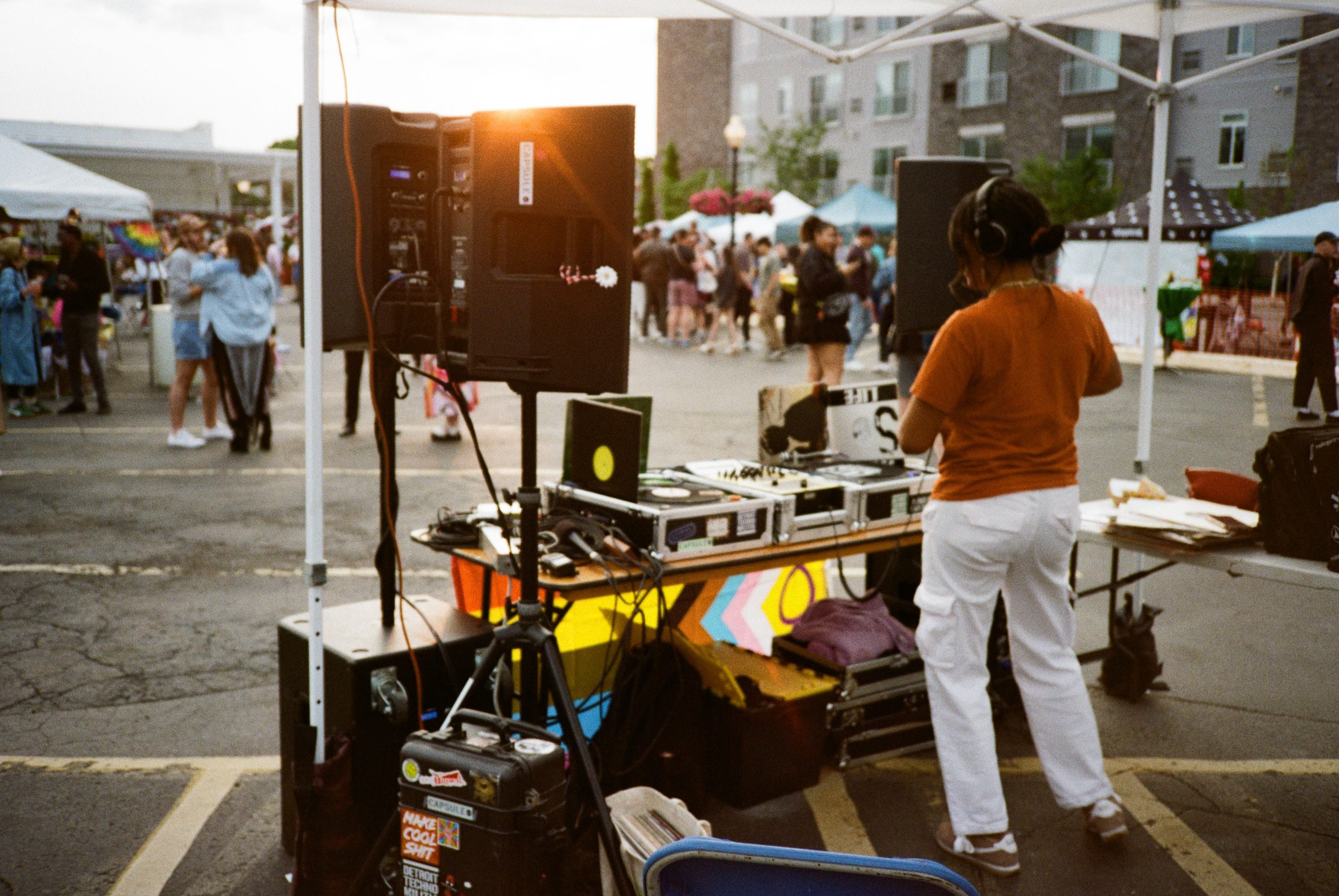
Anyway, we’ll see what else comes back from the lab in the next 9-10 business days, but for now, I’ll leave you with this shot. It’s perhaps a more subtle image of Pride than the corporatized media tends to show, but just because one (me) prefers neutral aesthetics over sparkling rainbows doesn’t mean one (me) isn’t proud as fuck to be queer. Plus, this photo comes close to capturing with Pride feels like to me: Relaxed, warm, and homey, with plenty of space for anyone who wants to show up and discover themselves at home here, too – oh, and with a great soundtrack. Happy Pride, y’all!

“In my final comments about George’s life before he left, with his new friends, for that long irreversible night in Las Vegas, I’d like to point out that history is not for everyone. Or perhaps it’s better to say that everyone is not for history, which is at best selectively amnesiac and, at worst, exclusive as Madeline’s yacht club. These people and their lives, their accomplishments, are not written about elsewhere because they are not the kind of people it is convenient for history – that is, by history, the conscious efforts of organizations, governments, and institutions with a politics of their own, however objective they claim to be, however unbiased – to record or remember. They are not, in a word, winners. And because they lost, it is their lives that are – or nearly were – lost to us.”
- Patrick Nathan, from The Future Was Color
As I alluded to last time, I can’t believe I haven’t written up Patrick Nathan’s novel, The Future Was Color, before now. It was one of my favorite reads of last summer, the kind of intellectually and emotionally sumptuous novel I chase across pages, but as I re-read it to write it up for you, it became one of my favorite reads of this summer, too. And perhaps it’s just as perfect to write up now, dear reader, because a) it’s fresh out in paperback this week, a welcome addition to your beach, etc., bag, and b) its thematic territory is unnervingly evergreen, but exceptionally urgent right now.
We meet The Future Was Color’s protagonist, George Curtis (born Gÿorgy Kertész) in one of the middle parts of his life: Writing monster movies in Hollywood, taking up with a troubled, melodramatic twink, and watching, alienated and helpless, as a revolution churns in his home country of Hungary. And because it’s 1956, the entwined horrors of McCarthyism and the Lavendar Scare loom over every one of George’s moves, even his thoughts. So, when an aging yet timeless actress, Madeline, offers George a room in her Malibu mansion to work on his next great idea, he jumps at the chance to get away from Hollywood – even if he finds Madeline’s drunken, drugged-up lifestyle grotesque and nihilistic. Things perk up when George’s co-worker, Jack, shows up at Madeline’s and leads George to believe the dangerous fantasies he's entertained might be coming to life, but can anyone really be trusted in these times?
Throughout the novel, Nathan (by way of a very effective unnamed narrator who is not George but still speaks in the first person; see the quote above for a sample passage) carries us through other parts of George’s life. We meet him as a young refugee during WWII, coming to New York without his family, growing up and falling in love around the downtown art scene, then later, long after the novel’s main action, in Paris. And while it’s a heady book that touches on many of the socio-political and existential crises of its era, it’s a pleasurable novel because it maps so authentically to George’s life and mind. There’s also a real and unresolvable tension about having one’s personal affairs and political opinions in the crosshairs of so many institutions, and I think Nathan lets us feel that sorrow, that anger, that perpetual discomfort, so beautifully in this novel — plus, it works its way to an uplifting, if not traditionally happy, ending. The Future of Color is a great beach, etc., read, but it would also make a perfect book club pick, as there’s a lot you’ll want to keep thinking about long after the final page.
#
“The purpose of story, Kai will say as he pours another glass of wine, is to remember. And when Giulia asks what he means by this, he will tell the story of an ancient god who was dismembered, his body thrown all around the world. To remember is to re-member the dis-membered body, some truth you forgot when you were blown apart. Storytelling is the act of piecing you back together.”
- Dylin Hardcastle, from A Language of Limbs
I have yet to recover from reading Dylin Hardcastle’s A Language of Limbs, and I don’t think I want to. This novel didn’t just get under my skin; it worked its way into my soul and undid me from the inside out. Like Andrea Lawlor’s Paul Takes the Form of a Mortal Girl and Henry Hoke’s Open Throat, it’s a novel that embodies the ineffable essence of queerness, a feat that cannot be pulled off through direct language alone. And A Language of Limbs managed to make me cry not just once or twice, but through almost its entire second half. Truly, my next-door neighbors must have been wondering what could make me sob so loudly in my yard on a gorgeous late May afternoon, but it was a worthwhile scene.
A Language of Limbs – written, set, and originally published in Australia – follows the entwining lives of two young women, referred to as Limb One and Limb Two, as they navigate queerness through the 1970s and 80s. Limb One is caught making love with another girl by her parents, who then beat her, evict her from their house, and abandon her to fend for herself. With the help of a truck driver, Limb One makes it to Sydney and makes her home in Uranian House, a queer collective and eventual family. Conversely, when Limb Two begins feeling sapphic desire in herself, she shuts it down, begins dating a boy at school, and orients the rest of her life toward marriage and, if her family and husband will support it, an education. Their lives brush up against each other through time, through the first Mardi Gras and the AIDS epidemic and Sydney’s art gallery scene, with parallels and collisions that give the novel its power, while thrilling and devastating me through its poetry-soaked prose.
And one of the many things I love about A Language of Limbs is how Hardcastle doesn’t treat Limb Two’s more heteronormative journey as some kind of “failed queerness.” On the contrary, Limb Two goes on to live as rich a life as Limb One, and it would spoil the plot to get into all the ways Limb Two’s heteronormative-sounding life encompasses queerness, too, but it’s true. Hardcastle wrote A Language of Limbs as part of their PhD in Creative Writing at UNSW, so there are some academic-y bits for dear readers who love biting into them, but I don’t want to overshadow what makes this novel spectacular: Its story, and the way it uses that story to construct what language alone can’t.
#
And while I have you here, another novel I’d recommend if you like queer literature is Gabriela Cabezón Cámara’s The Adventures of China Iron. It’s a queer, feminist, vividly post-colonial reworking of an old gaucho epic, and while I don’t know enough about gaucho culture on the Argentine pampas to write too deeply into its themes, it’s a wild ride to read. China Iron’s tale is a reclamation of a gaucho’s wife’s story, and its titular heroine goes on a wild, epic adventure in search of liberation, with rich language that pulled me straight to the vast, textured grasslands of Argentina. It’s another great book to slip in your beach, etc., bag before you head off on vacation, or just for an afternoon basking in the summer sun.
Got any other beach, etc., reads to suggest, dear reader? Drop ‘em in the comments! And don’t worry, they don’t have to be queer (this is just my month to be as gay as humanly possible, and I’m really feeling the urge to stick it to the right this year, especially after the Southern Baptist Convention called to officially try to undo the legalization of same-sex marriage).

OK I had a lot of gay thoughts, so we’ll keep this section short! This month’s mixtape is all ready to jam out to, and I’ve put together a lil microsite to collect all these playlists going forward. (Yes, I did learn a lesson from needing a whole afternoon to get my Bookshop storefront up to date …)
This month’s mix includes MUNA’s gay first kiss anthem, “Silk Chiffon,” Samia’s lyrical dexterity on “North Poles,” and while I resisted including any more Addison Rae (although Addison fucking slays), I couldn’t resist Lola Young’s subversive and raunchy as hell single, “One Thing.” I also included a song by 90s alt rockers Letters to Cleo, “Here and Now,” which is new to me and I love just as much as if it came out yesterday. Oh, and if you’ve been waiting for a gothic electro-pop x nü metal banger, check out Julia Wolf’s “Fingernails,” which wails and chugs and breaks down into a bridge I dare you not to thrash around to.

And, that’s a wrap for this month! Once again, HAPPY FUCKING PRIDE, dear readers, and I hope you find ways to celebrate in power not just this month, but always. Thanks for reading along, and I’ll see you again soon!
Cheers,
Emi
Books & Essays Referenced (note: if you choose to purchase any of these titles through Bookshop.org, I will receive a small commission as an affiliate, but as always, buy books wherever makes you happy, and support your local physical bookshops, too. You can check out a full list of books recommended in Emi on Earth over on my Bookshop storefront.)
The Art of Doing Nothing by Jenny Odell (2019)
The Future Was Color by Patrick Nathan (2024)
Patrick Nathan also writes a very thought-provoking Substack, Entertainment, Weakly ; one of my favorite essays of his is a recent one on “Sentimental Materialism,” or why it’s necessary, if dangerous, to revel in the physical and emotional excesses of our lives.
A Language of Limbs by Dylin Hardcastle (2024 AU / 2025 US)
Paul Takes the Form of a Mortal Girl by Andrea Lawlor (2017)
Andrea Lawlor also has a Substack, Pocket Hype — I may bitch about the Internet a lot, but I think this is all kinda worth it to get to read my favorite authors’ notes from their margins.
Open Throat by Henry Hoke (2023)
The Adventures of China Iron by Gabriela Cabezón Cámara (AR 2017 / US 2020)
No posts
Comments
Nothing yet. Say the first thing.
Sign in to join the conversation.