
The State Department is swiftly moving many organizations through a no-bid process for America First Global Health awards that will use a tricky, sometimes downright risky, funding approach called ‘fixed amount awards.’ Like so many things that State has gotten up to in its global health activities this year, the rationale is fairly solid; the process slippery as heck; and the likelihood of success incredibly country- and context-dependent.
Things got very real a few weeks ago, when the State Department sent out a raft of letters to organizations that currently get money from “greenlisted” USAID awards. These are awards that escaped destruction in 2025—either because they were never cancelled or because they were unfrozen after a period of review. The letters were a direct, sole-source invitation to submit a proposal for a scope of work that was also defined in each letter. The letters further explained that the funding would flow through “fixed amount awards,” lasting no more than six months, with payments tied to approved milestone plans that the recipients were to draft as part of their proposals which were, thanks in advance, due within a week.
Sole source procurement is a departure from the bedrock principle of US government contracting that free, fair, open competition should be used wherever possible to avoid waste, fraud and abuse. Whenever the US government uses sole source or no-bid procurement processes, it has to secure permission to do so. Usually, this permission is sought and granted on a case-by-case basis. But as an internal, sensitive but unclassified April 2026 PowerPoint slide deck from the State Department that I’ve reviewed shows, GHSD sought and obtained what it refers to as a “class waiver” that enabled a no-bid process to be applied to the 150 greenlisted awards.
AFGHS watchers have known this was coming. For me, the January 2026 implementing plan process guide made it clear that sole source procurement would be an inevitable, even welcome, part of the America First Global Health Strategy. Step One in that January guide was: review the existing implementing partners in your country and decide which ones should continue, which should stop, and what new roles, if any, might be needed.
If a country decided to keep going with a group previously funded by USAID, an agency that had been destroyed and which had no capacity to continue managing awards, then another agency like oh, say, the State Department, would need to take over management. If minimizing additional disruption and ensuring continuity of care was the goal, then the partner doing the work should be allowed to go on, without re-competing for the funds through an open process.1
Under these specific circumstances,2 a no-bid, sole source procurement approach that allowed existing implementing partners to keep being funded to do work in countries they were already working in, at the request of those very same countries, seemed like nothing less than the pinnacle of sanity.
According to the April PowerPoint presentation, the State Department obtained a “class waiver” that permitted sole source procurement for 150 greenlisted USAID awards without creating individual justifications for each of the awards.
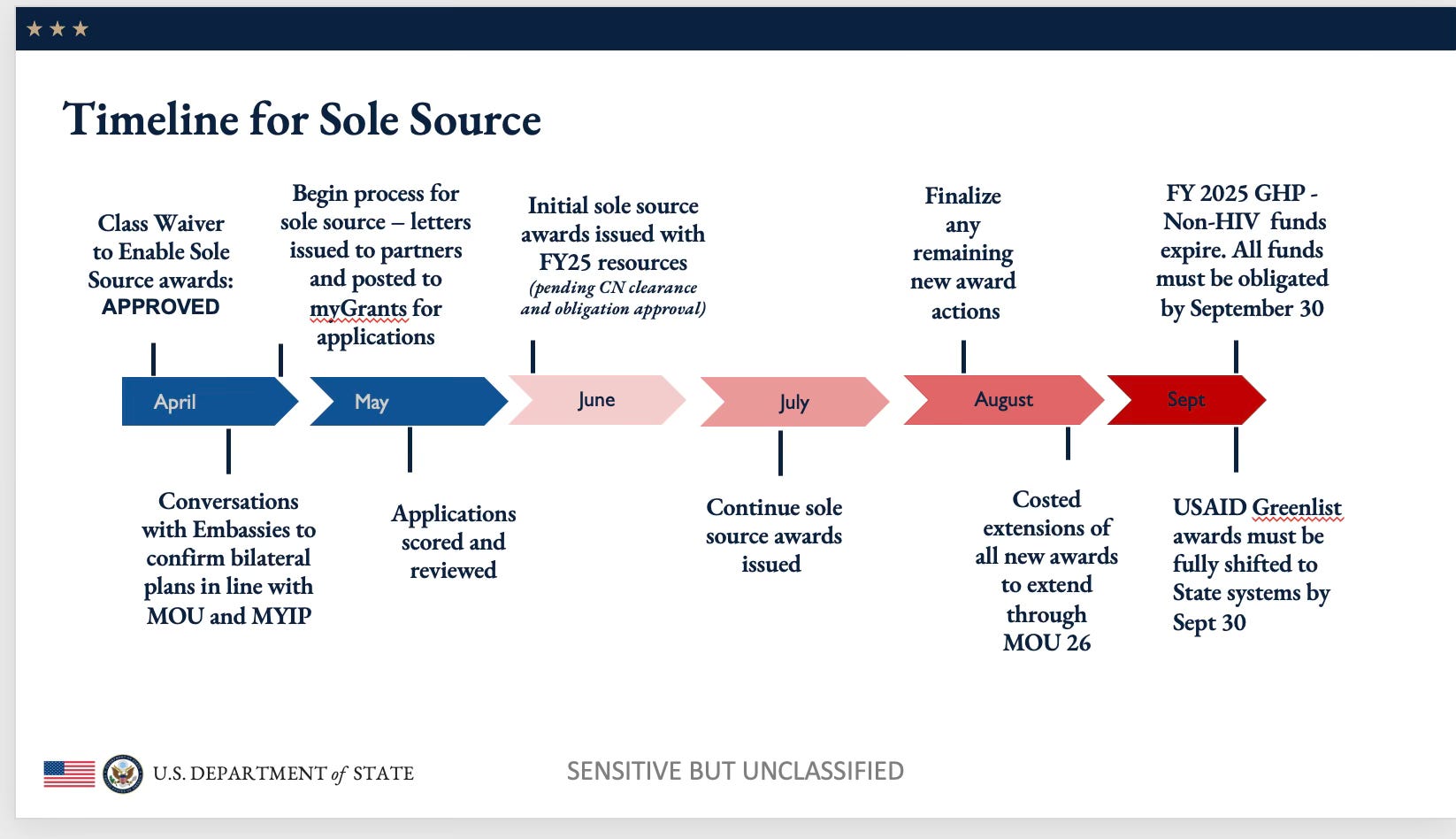
Alt text: A screen shot of a powerpoint slide showing the timeline, as of April 2026, for roll out of the sole source process. Are you a fan of GHSD timelines? I sure am. Stay tuned for news in an upcoming post about the very first item of Substack Swag—free for all paid subscribers, and anyone who finds me at AIDS2026 in Rio—that is a handy way to keep track of the dates when AGFHS will have clean data from PEPFAR and under the new MoUs. Speaking of free: this Substack always will be. No one will ever have to pay for what ever I have to share. And, if you can pay, please do. Please upgrade to a paid subscription and then come find me in Rio and tell me about it. Or message me and I’ll mail you your very own, soon-to-be-revealed, unicorn-free-for-now, loot.
I couldn't find a single US government employee—current or former—familiar with the concept of a class waiver. Blanket dispensation for a whole bunch of no-bid awards is, as far as I can tell, unicornishly rare.
But in my view, this isn’t actually where questions about the process arise. After all, given the mayhem and destruction of the preceding year, plenty of folks—especially people looking for affordable, acceptable, accessible and quality healthcare—would take continuity by any means necessary, including (especially?) on the back of a unicorn.3
The whole sole-source-to-ensure-continuity trajectory takes an unexpected turn in another slide from the April deck that explains that a class waiver can be used to “break up large consortia” and “spin off sub-awards” to qualified local partners. In other words, the waiver can be used to make new awards, with new scopes of work, and not just to continue the 150 existing greenlisted awards as they were.
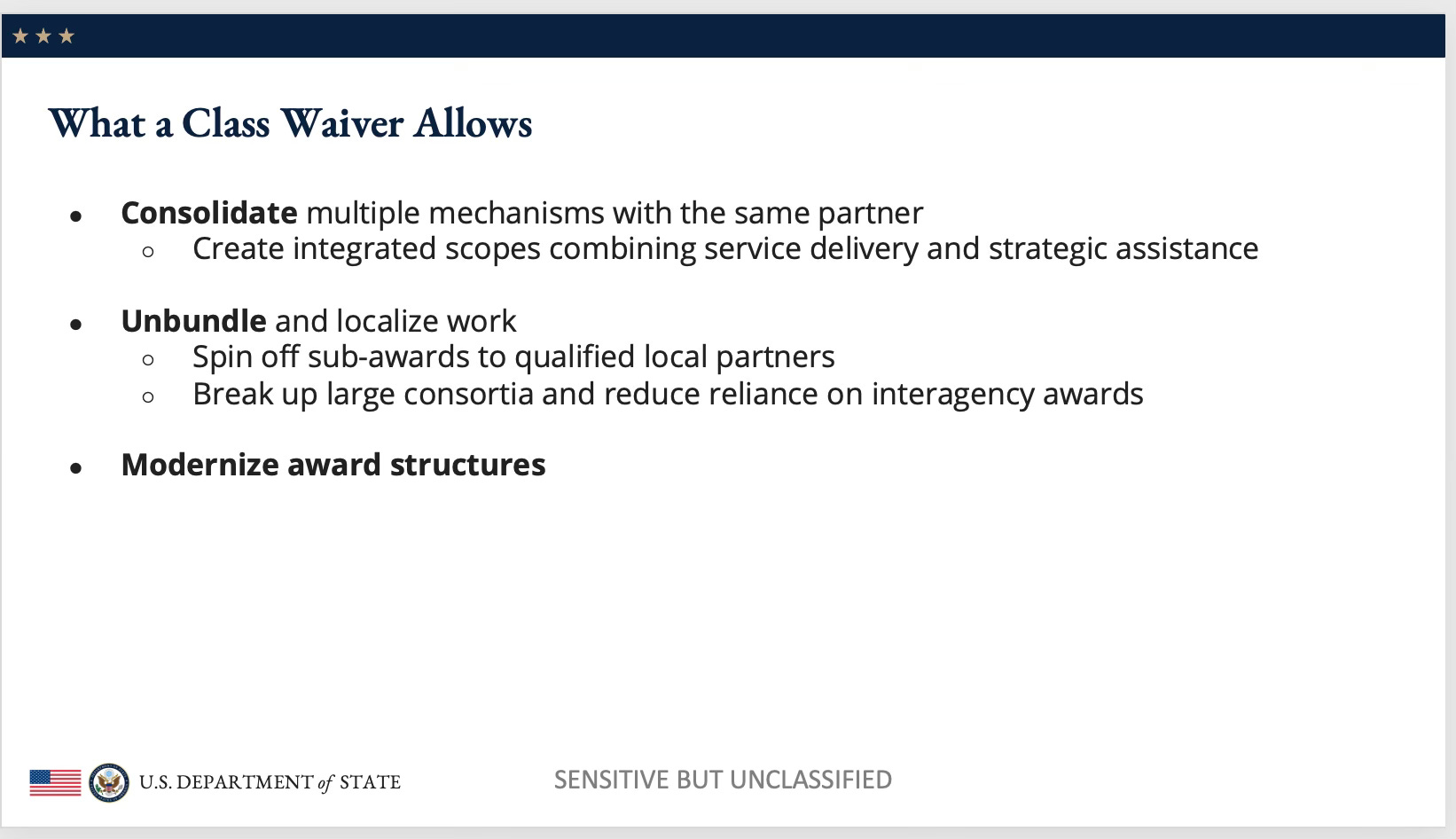
Alt text: Another slide from the April 2026 slide deck on sole source, in which, with great confidence and somewhat less attention to grammatical agreement, the State Department explains What a Class Waiver Allows: (1) Consolidate multiple mechanisms; (2) Unbundle and localize work; (3) Modernize award structures. There is a sandwich board sign outside a hair salon in my neighborhood that advertises “modern mullets.” I checked with my own hair stylist today because it’s AIDS2026 next week and I need to look presentable, and she said, Well, no, not really, a mullet is a mullet. A fixed amount award is a fixed amount award. It isn’t modern. Or a mullet.
Here, too, there’s procedural precedent: no-bid processes can be used for new government contracts, and not just the filtration system for the White House reflecting pool. A justification can be written up for a new individual award that, if the justification is accepted, is made without open bidding. Again, this is done for one award at a time.
I’ve spoken to people familiar with the contents of the letters and the sole source award development process at country level, and they confirm that the State Department is indeed using the class waiver to make new ‘consolidating’, ‘spin-off’ and ‘consortia-dismantling’ awards, including to entities that were not the prime award recipients, for scopes of work and even geographies beyond what was in their scope of work under the reenlisted award.
Given how little documentation there is of other (any) class waivers, it’s hard to say whether this is a normal or routine use.4 But what it isn’t is straight up continuity. State isn’t using the sole source class waiver to move a set of pre-existing awards from USAID over to its own shop. It’s using the waiver to make new awards with different scopes of work to entities that it, ultimately, has selected, albeit with country program input, via a no-bid process that’s usually reserved for special, individual occasions.
As tempting as it may be (wow is it tempting) to kick up a fuss about how unusual this appears to be, I believe that’s also probably unwise.
As I understand it at present, these no-bid awards for new scopes of work may be the best scenario for continuity of HIV services that have limped along for the past year, and for the timely flow of AFGHS funds for activities in non-HIV disease areas like maternal and child health, malaria or polio, where funding gaps and service quality declines may have been much worse.
The State Department is way behind the schedule laid out in the January Implementation Planning Progress Guide for finalizing the implementation plans and budgeting tools that are a pre-requisite for AFGHS funds to start flowing. The Guide declared that all of these implementation plans were to be done and dusted by April 1, with money flowing in this fiscal year. Before the ink was even dry on my copy of the doc, though, the architects of the AFGHS were backpedaling. Brad Smith reportedly started telling country teams that the plans would take the time they needed to take; Jeremy Lewin said, in a public forum, that State was aiming for MoU-directed funds to flow by the end of this fiscal year—September 30, 2026.
Some implementation plans are finalized; many more are not. The process of securing US government legal review and approval for government-to-government contracts is still time-consuming and complex. And even a country like Uganda, which has an approved implementation plan and everything, only has 55 percent of its year one funding via G2G agreements.5
If you’re careening toward September 30 with signed MoUs and wayward implementation plans, and know that a hefty portion of the money to be spent in any given country is still going to be given to groups in western or northern Virginia (read the footnotes, folks), and have a chunk of money that is going to expire if it is not obligated by the end of the fiscal year6, and/or care about continuity of care, then you use your class waiver as cover to move funds out the door for things the country says it wants.
Don’t you?
It’s a genuine question. This Pegasus of a procurement approach really doesn’t play by the rules. And it’s being run by the same State Department that, as ProPublica reported this week, is playing around with no-bid processes to make awards to “a British free-speech organization that has fought against bans on “gay conversion therapy” and an Afrikaner group run by a controversial figure who has called for self-governance of the white ethnic minority within South Africa.”7

Alt text: A playing card with a very angry looking unicorn on it. That’s Stabby the Unicorn. Stabby is a magical unicorn, not a basic unicorn that drinks pumpkin lattes and listens to Wilson Phillips (Holy Substack Soundtrack Cluephone Batman!) while cruising around Arlington, Virginia. The caption says “If this card is sacrificed or destroyed, you may DESTROY a Unicorn.” It is a card from the game Unstable Unicorns which everyone should play. Right now. But only with the cards. Not with procurement practices and fixed award amounts. Don’t make me destroy a unicorn.
Importantly, the groups getting invited to apply for no-bid AFGHS awards are not fringe-y, nor are they hand-selected by the Trump Administration. They won competitive bidding processes and have reported data and worked with countries and communities for years. In some instances, local partners (groups registered in and run by people from the co-signatory country) are going to get direct funding from State for the first time.
And yet it sets a precedent that should be watched—in the same way that the APS Addenda awards process should be watched. Members of Congress are reportedly getting private briefings about the State Department Bureau of Democracy, Human Rights and Labor sole source awards. This process—along with every other component of the AFGHS—should receive and remain under scrutiny.
The greenlisted USAID awards were, for the most part, cooperative agreements, or CoAgs that had some budgetary flexibility—ie ceilings and provisions for reimbursement for allowable costs. A cooperative agreement is “distinguished from a grant in that it provides for substantial involvement of the Federal agency or pass-through entity in carrying out the activity contemplated by the Federal award.”8
A Fixed Amount Award is a kind of cooperative agreement, in which “the Federal agency or pass-through entity provides a specific amount of funding without regard to actual costs incurred under the Federal award.” Payments are made against milestone achievements. There’s no submission of receipts, no financial auditing and, once an FAA is up and running, there may be limited involvement on the part of the US government, which sits back and waits for the results to trigger payment.
In theory, Fixed Amount Awards simplify administrative burden and record-keeping requirements for both the recipient or subrecipient and the federal agency or pass-through entity. Prior to 2025, USAID was already increasing its use of FAAs as part of its effort to support locally-led development.9
People I spoke with who’ve worked with FAAs stressed that this is a tool in the foreign aid toolbox that is best suited for specific conditions—and which can be totally inappropriate for others.
In particular, FAAs only work when the milestones that trigger payment cannot be impacted by factors beyond the award recipient’s control. Let’s say, for example, that the US government gives an FAA to a partner for strategic assistance for developing a technical guidance on Ebola quarantine facilities for US citizens in that country. If payment is tied to adoption of the guidance by the country in question, and the committee that needs to convene to approve the guidance doesn’t meet, or disbands, or refuses to consider the proposal, the partner doesn’t get paid.
Circumstances beyond the partner’s control can also mean that payments happen when they shouldn’t.
Let’s consider a hypothetical example in which a partner decides to adapt a milestone from the AFGHS Milestones Library strategic assistance section. Like: “the proportion of patients on treatment experiencing treatment interruption is less than [2]% of all patients on ART.”10 The partner could propose that it be paid if 14 facilities in five subnational units (provinces or districts) reported that 98 percent of patients returned for their medication refills on schedule. Or the partner could propose payment if those 14 facilities reported no more than two percent of people on ART disengaging from care—ie by missing appointments.
To accurately measure return and refill rates, or missed appointments, clinics need functional systems for capturing and tracking appointments (who is keeping them, who is missing them), refills (who got them, who skipped them), pharmacy stocks (was there enough medication for the prescribed refill). The clinic, health system and country also needs a standardized definition for “treatment interruption.” Is a person defined as having had a treatment interruption two weeks after a missed appointments? Or two months? Or six months? Is a patient defined as on treatment based on whether they saw a clinician or collected their refill?
Under the terms of a fixed amount award, the implementing partner would get paid whether the clinic systems are functional or not. One partner could support a clinic with fewer data entry clerks and a glitchy scheduling system; another could support a clinic with reliable, streamlined electronic medical records and tracking. Both could report that 100 percent of patients are keeping their appointments, though for completely different reasons. Both partners would get paid.
Everyone I spoke with who’d worked with FAAs also emphasized how long it takes to develop milestones that meet all the criteria: not impacted by conditions beyond the partner’s control; measurable in the timeframe of the award; relevant to the ultimate impact or objective of the program.
They also pointed out that there are ways the reduced administrative burden can be exploited. Under a Fixed Amount Award, a partner that meets the milestones can receive payment without providing receipts or detailed financial reporting. One former USAID staffer told me, “They [the partners] have an incentive to keep costs absolutely minimal so they can keep as much of the money as possible.”
Whose problem is this, really?
There are at least three different risks involved in ill-planned, hastily conceived fixed amount awards: risk to individual and community health and wellbeing; risk to national economies and social cohesion posed by resurgent health threats that are not managed because the funds don’t do what they are intended to; and the risk to US Congressional and taxpayer support for continued foreign assistance for global health.
The United States government is not equally responsible for all of these risks. The co-signatory government is primarily responsible for the health of the people living within its borders, and for seeking the stability that comes with robust, equitable, rights-based health care for all. In the scenario where a partner gets paid because the government systems are poor, proponents of decolonization, African sovereignty and the America First Global Health Strategy alike might say, “That’s not America’s problem” or “It’s time for African governments to take responsibility” or “It’s high time that America stopped its micromanagement.”
But the United States and, specifically, Secretary of State Marco Rubio and the senior officials shaping the America First Global Health Strategy are responsible for maintaining the trust and support of the US Congress and American taxpayers. Rubio promised that AFGHS will end waste, fraud and abuse. Specifically, he said,
[W]hy are we hiring American and international NGOs to go into other countries and run health care systems that are parallel and sometimes in conflict with the health care systems of the host country? If we’re trying to help countries, help the country, don’t help the NGO to go in and find a new line of business. And so that’s what – the model that we’re breaking.11
The sole source procurement currently underway is not breaking that model. It is literally finding new lines of business for American, international and local NGOs, and it is using a Fixed Amount Award approach that experts assess as high risk and ill-suited to many of the activities these funds will be paying for.
As long as continuity of services that reduces preventable deaths and needless suffering is preserved, I will not ding State on sticking with what’s left of the old model.
But Secretary of State Rubio and I are both old enough to remember that PEPFAR earned and sustained bipartisan support because it said what it was going to do, reported on what it did and, for the most part, stayed internally consistent. It earned support from Republicans who had no faith in USAID and its propensity to give money away without tracking outcomes tied to impacts, and by making awards that were subjected to waste, fraud and abuse. The State Department is risking the trust and good will of appropriators and authorizers who may like it when US foreign aid program leadership does what it says it is going to do, and can account for the money it spends.
It is the responsibility of Americans to name and try to mitigate this risk, including by consistently and accurately describing what AFGHS is actually doing, including to people who have heard and believe the talking points that this is all about country ownership and government financing. Let’s keep all the trust we can. That’s what I’m here for. Pick a card. It’s your turn.

Stack regulars may recall the Justification and Approval Memo that USAID drafted to secure an extension of the award to Chemonics for the Global Health Supply Chain and Procurement Support Management (GHSC-PSM) contract, when the transition process to a new supply chain system took longer than expected. The memo is a persuasive and systematic explanation of why Chemonics should get two more years of funding—without competing for the award through an open bidding process.
Let’s remember that the January 2026 implementation plan guide came out after 12 solid months of nonstop, make-it-stop crazy in which USAID was shredded, primary HIV prevention disappeared overnight for the groups who needed it the most, data tracking of a lethal global pandemic went dark, and Secretary of State Marco Rubio gave the impression that the PEPFAR program hadn’t been allowed to use email or cell phones in his remarks at the signing of the first MoU with Kenya, stating:
“[W]hat would happen is we would go to a country and say, ‘We’re going to help you with your health care needs.’ Then we would drive over to western – northern Virginian somewhere, find an NGO, one of these organizations, give them all the money, tell them go to this country and do their health care program for them.”
Let’s be sure we’re all following, okay. Back in the day, when PEPFAR was helping to bring the HIV epidemic to the brink of control as a public health threat in countries around the world, all that success happened because of State Department staff cruising around Arlington in their Kias their windows rolled down, crooning, “Whoa NGO, come take this bag of money out of my hand, we’re riding out tonight to case the promised land?” Got it? Good.
No, I am not using the first image that comes up when I search “Marco Rubio Unicorn.” I will not. But I won’t stop you from finding it yourself using the DuckDuckGo search engine. Nor can I stop you from reviewing the scene set in the previous footnote, and imagining all those cruising cars encountering a Rubiunicorn at a stop light. You ain’t a beauty but neigh you’re alright.
Here’s something that is documented: one in four unicorns can talk. https://magicalunicornlife.com/unicorn-facts/
I’ve reviewed but not (yet) published the detailed Uganda implementation plan budget from which this figure is drawn. Happy to discuss with folks more if you have questions.
I am dodging, for the moment, the question of how much funding is moving through these sole source awards. It will be trackable and deducible as USAspending.gov and other portals are updated with approved award information. Right now, we know that the letters specify that funding includes FY2025 GHP-USAID and GHP-State funds carried forward under the FY2025 continuing resolution, plus FY2026 GHP Funds under the FY2026 SFOAA [Senate Foreign Appropriations Act]. So this is not solely about expending expiring money. It is a proactive strategy.
https://www.propublica.org/article/human-rights-aid-right-wing-causes
https://www.ecfr.gov/current/title-2/subtitle-A/chapter-II/part-200/subpart-A/subject-group-ECFR2a6a0087862fd2c/section-200.1?utm_source=chatgpt.com
https://oig.usaid.gov/sites/default/files/2024-04/9-000-24-002-P.pdf (Like the PEPFAR shift to sustainability and an off-ramp for US funding, the shift to FAAs is another transition that was underway prior to start of Trump’s second term, with progress, institutional memory and lessons summarily and suddenly derailed and dismantled. I promise I will note when there a genuinely new idea about how to do aid emerges from this maelstrom)
This is another document I have, and have reviewed, but haven’t yet published. Again - happy to discuss.
This is also the speech in which he explained how PEPFAR used to involve so much driving around in Virginia. https://www.state.gov/releases/office-of-the-spokesperson/2025/12/secretary-of-state-marco-rubio-with-kenyan-president-william-ruto-at-the-signing-of-a-health-framework-of-cooperation
No posts
Comments
Nothing yet. Say the first thing.
Sign in to join the conversation.