
This weekend we get to experience the exquisite pleasure of showing a film we made to an audience of almost entirely strangers. We’re premiering Mr Jesus at the Oak Cliff Film Festival in Dallas Texas, a festival run and programmed by serious film lovers, and we will play in the theater made famous by being the place Lee Harvey Oswald was arrested.
Only our creativity allows us to type such a unique sentence! And soon after our premiere in Dallas, we will be playing in Birmingham (Sidewalk Film Festival), Breckenridge (Breck Film), and a few more I can’t announce just yet, but they’re mostly in the South. Our team has also been to many festivals for work or with previous projects and has applied to festivals that may not be on most filmmakers’ radar. That’s on purpose.
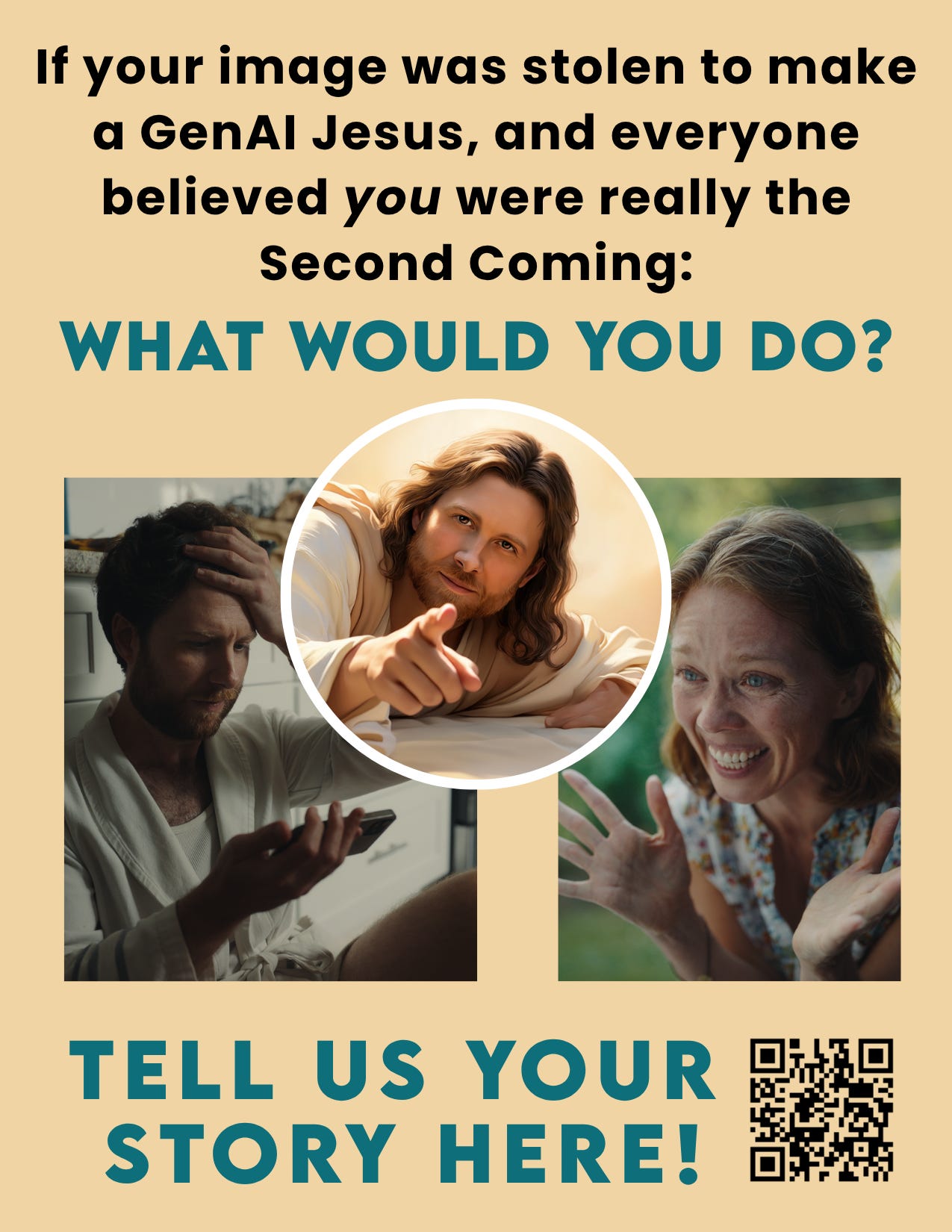
I have spent years traveling the country standing on the soap box of “filmmakers should built intentional distribution strategy before they finish their films” so when Mr Jesus was set to crowdfund last summer, I knew I needed a plan. Mr Jesus is a short film about a down-on-his-luck actor who wakes one morning to discover his image has been stolen to make a GenAI Jesus, and now everyone believes he’s really the Second Coming. We made it as a short but it’s styled like a pilot - with a cliffhanger ending that leaves the audience asking - WAIT WHAT HAPPENS NEXT?! That’s on purpose, too.
Mr Jesus is about a BIG world - the one we live in now where the proliferation of AI is making us look at ALL our systems. And it’s making strange bedfellows - across the country, divided communities are coming together to fight data centers, creative workers and software engineers are both being replaced by AI, and the tech world has started to infiltrate the faith space, claiming AI is effectively an almighty god we all must accept and serve. Even though the film came to us as a contained short, we knew this story would be best served over several seasons.
But we also have a few non-negotiables:
We would like to control who we work with. I am in a very privileged position that making movies is not my full time job, but that means that I make movies when I feel like it’s important to make them. That means I want to work with people who are deeply values aligned and with whom it is a pleasure to work. That means we’ll likely have to produce this independently.
We would like to control the timeline on which we make this show. I know from having enough friends in Hollywood whose shows are bought and either never made or delayed for years that we probably can’t make this show on Hollywood’s timeline and stay relevant (given how fast the landscape is moving).
We would like to retain creative control. This is not just entertainment for us. We would like to it join the canon of shows like Ted Lasso and Heated Rivalry that are both fun and deeply pro-social. We don’t have the industry clout of the team at Ted Lasso so we deeply admire the independent model used by Heated Rivalry. Is it way harder in the US where we don’t have public funding? Yeah. So…
We understand there are things WE have to be willing to do:
We have to build an undeniable audience for this show before we make it. That’s why we chose to apply to festivals where we believed we could create the most compelling community conversations (and to be clear, we’re not getting in to all of them!). We have a postcard with a QR code that invites audiences to participate in the storytelling, and we will encourage everyone we meet at festivals to join our mailing list. We gather information when they sign up about where they are located and where they watch things so we have comprehensive audience data that could be compelling for a distributor or a grant maker.
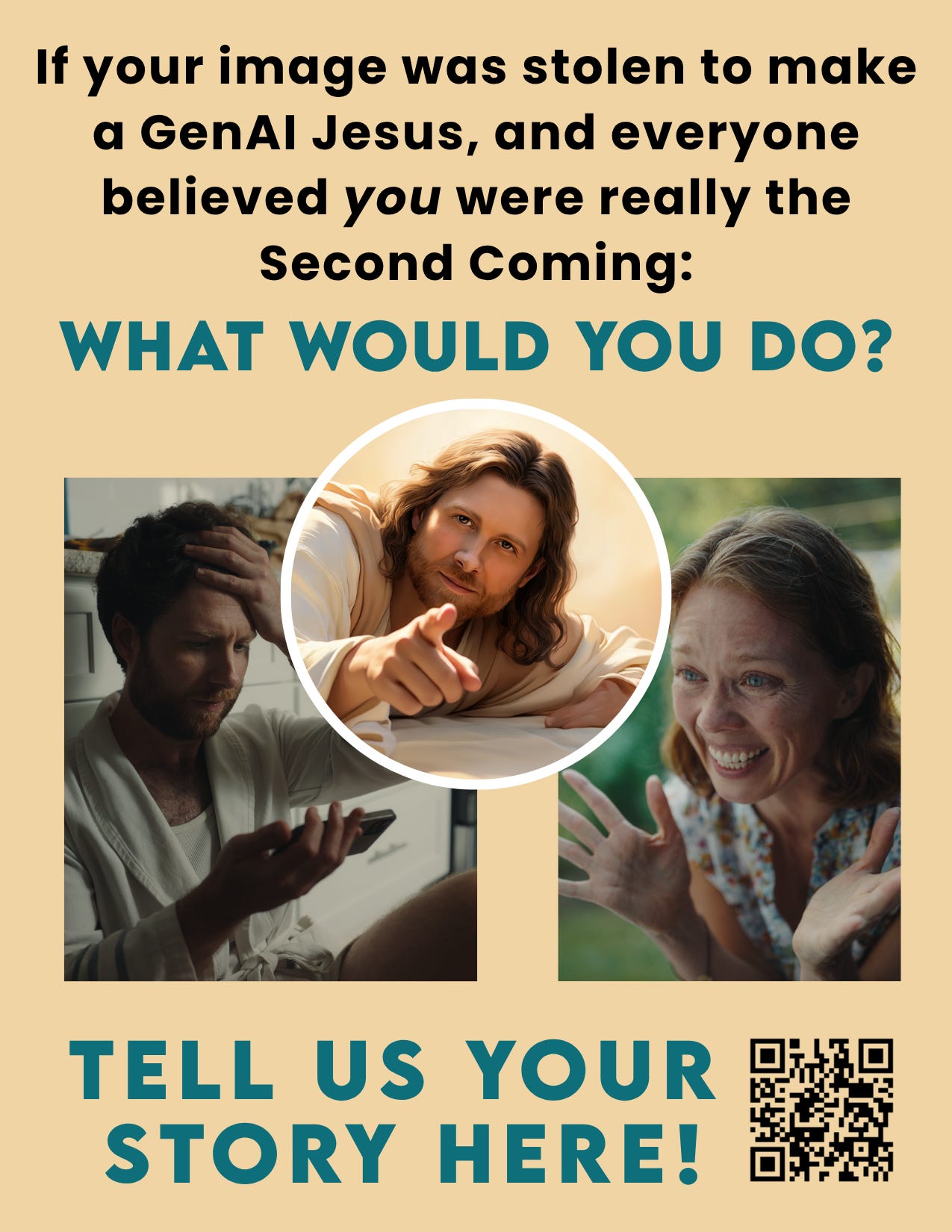
If you’d like to share your story with us now, you can do that here.
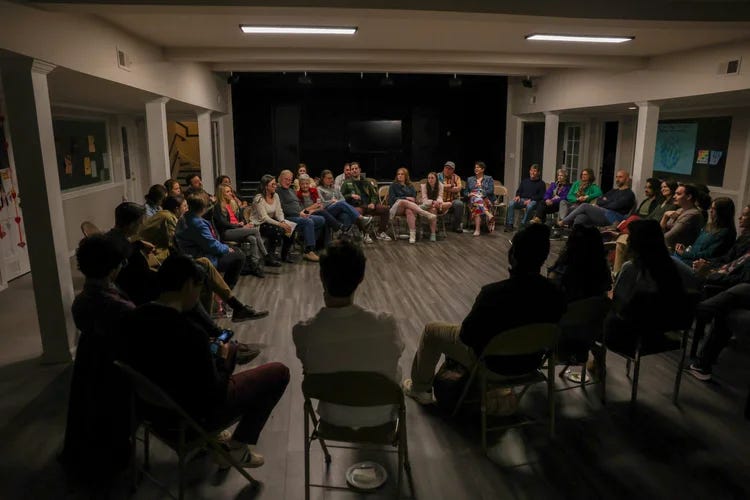
We have to create community conversation around this short to demonstrate the potential impact, and actually record some of that impact. This will make it possible for us to write compelling grants in place of government funding that other countries deploy. We have partnered with tech justice collective (m)otherboard (of which I am also a part), and worked with Biblical and faith scholars and leaders to develop discussion guides and connect with communities who can host screenings. We have to gather the strange bedfellows ourselves. And we can offer this as programming to film festivals as well as make these conversations happen on our own.

Independently organized community screening in the basement of Virginia Highlands Church - UCC, ATL.
We have to hand the tools to our most excited audiences. We are using Kinema to allow anyone, anywhere to host a private community screening, and once we’re deeper into our festival run we can open it up to the public on the platform. The discussion guides and marketing materials are built in to make it easy for a host to replicate what we do when we organize screenings + conversations ourselves.
We have to find the time to create really compelling materials to bring aboard the collaborators. And this show has to be GOOD. That’s quietly the hardest part. I know most creators think that the distribution part is the hardest part but making something that’s undeniably great is SO SO HARD. So we have amazing advisors and friends who look over everything and provide feedback. Will we pull it off? I don’t know.
We have to believe we can do it. And we have to be willing to put in the work to make it happen.
I have a day job, as I assume most of you know. My production company partner is my husband who when he is not working is the primary parent for our two feral kids. Our collaborators are also couples who are stewarding careers of their own. We have to divide responsibilities, hold each other accountable and also get the dang tax returns filed and 1099s sent out and whatnot.
None of this is easy, especially when it feels like the entire project scope belongs to us. AND: the entire project scope belongs to us, so nobody can tell us we can’t do it. We will have to take a beginners mindset. We haven’t made a TV show before. But everyone who has made TV shows before was where we are once. And now they’re not. And so far, the audiences we’ve shown it to so far like what we have done and seem to think we should keep going. Which is another intention for the festival circuit: to keep up our energy and the inspiration.
Part of your plan has to be how you keep the faith.
No posts
Comments
Nothing yet. Say the first thing.
Sign in to join the conversation.