
Welcome to my Substack. Here you’ll find articles on everything from literature and reading to how we engage with our world through art. Right now you can get an annual subscription for 25% off for a full year. The summer sale lasts for six weeks before returning to normal prices!
I’m also introducing a student discount! If you have an institutional email address, you get 20% off any paid subscription tier for as long as you are subscribed. I know it can be difficult to shell out cash when you’re in school, so I wanted to make it as affordable as possible for those of you in school.
Are you a reader who wants to expand your understanding of literature? How frequently do you see references to things like “feminist criticism” or “literary theory” without really knowing what’s being talked about?
Are you a student who wants to better understand literary theory? Or, have you always wanted to but never really known where to start?
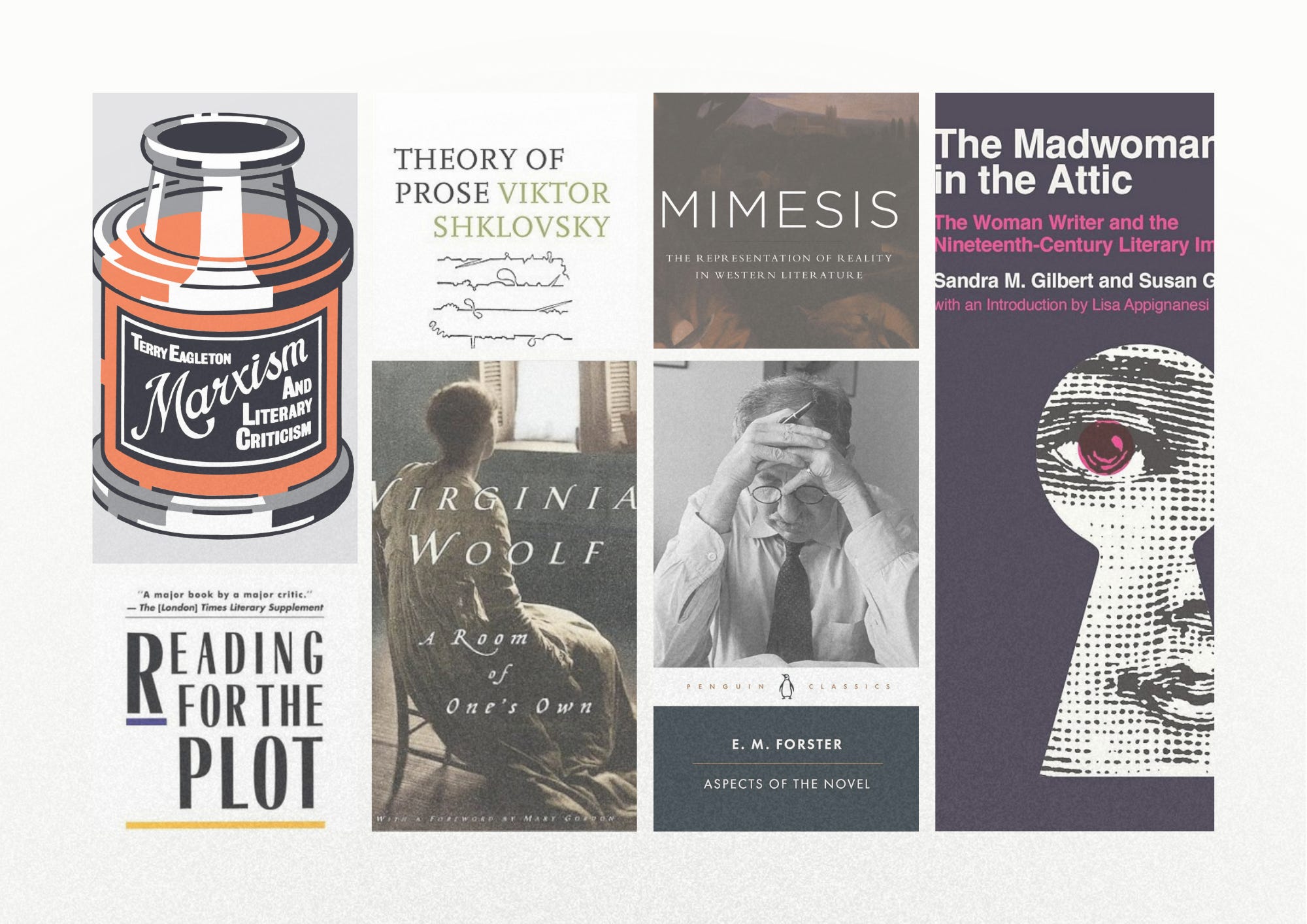
Have no fear! Here is a list of what I consider some of the best books on literary theory for absolute beginners. This list is by no means exhaustive, but it will serve as a sample-platter, of sorts, for getting into and understanding literary theory.

I can use my readings of narrative theory, for example, to take a look at the different plot arcs or narratives of film and television, which not only allows me to understand how media is plotted, but I can extend that further into my own writing. When I write creatively, how do I plot my book? Do I use writer’s toolbooks like Campbell’s Hero’s Journey, or do I look to Viktor Shklovsky to figure out how epic narratives work?
The same goes for theory-as-is, like Marxist or Feminist or Decolonial theory. These are words we hear thrown about constantly, usually as means by which to deride, but do those using these words pejoratively really understand what these theories do for readers? How do they help us contextualize our world?
More broadly, literary theory is a tool. Much as the welder needs his welding hood, his rods, and his torch to fuse metal together, the reader needs literary theory, criticism, and analytical tools in order to further the pursuit of knowledge. Humanistic education is often seen as “soft”; something that does not allow you to learn skills to use in “real life,” and universities have, for a long time now, placed theory on the altar of knowledge and made it inaccessible to the everyday reader.
That is why, in light of how much people value the literary terms you probably need to know tools, I’d like to provide you with a series of accessible reading lists to get you familiar with literary theory. These are texts I have read, engaged with, or used over the course of my education and career. The aim is not to force you immediately into post-structuralism, deep-cut semiotics, or diegetic levels, but instead to give you a list of approachable, accessible, and “more easy” texts to get you comfortable with literary theory.
This list is for anyone, regardless of age or educational status, who likes to read and wants to learn about the practical applications of theory. Do you want to understand the history of the novel? That’s great, I have a section for you. Are you interested in feminist criticism? Or want to decode what academics mean when they say they apply “Marxist critiques” to things? I have that, too.
Fundamentally, this list is one that aims to provide you with a new set of skills if you are making a personal curriculum, you want to expand your knowledge of literature, or, if you simply want to understand why the argument that “universities are turning our kids into communists” is relatively unfounded. These tools can be added to your kit, to provide you with analytical resources to look at more than just novels, though: they can help decode information from anywhere, whether that be television or film, the news, or your tiktok feed. When we live in an age of constant information, it is a good thing to have the tools at your disposal to analyze what you see.
With that being said, let’s get into it.
These are the texts that ask what the novel is, where it came from, and how it functions differently than other art forms.
George Lukacs, The Theory of the Novel (written 1914-15) — This is one of the earliest books on the novel as a form, and while it can be a bit dense at times, it is short, essayistic, and important to our understanding of the development of the novel: it is the form of a world abandoned by the Gods of the epic.
E.M. Forster, Aspects of the Novel (1927) — You may know Forster from his beautiful novels, but he was also a brilliant critic and theorist. This is a book based on essays given at Cambridge, and it is conversational in tone, compared to a lot of theory that feels drier and academic. This is the book that introduced the idea of “flat” and “round” characters.
Erich Auerbach, Mimesis (1946) — Do not let its size fool you! This book is phenomenal, and is probably the best place to start with theory of the novel. Written without access to a research library while Auerbach was in exile, it is a history of the representation of reality in Western literature, and stretches from Homer to Virginia Woolf.
Ian Watt, The Rise of the Novel (1957) — This is the seminal book on the rise of the English novel in particular. It is an intellectual history of the rise of the middle class, written through the valence of 18th-century novels.
The Cambridge Companion to the Novel (2018) — This edited book is an approachable and simple read, with fifteen sections each exploring the novel’s history as a genre. Each chapter takes an aspect of the novel, such as character, epic, modernity, realism, etc., and walks you through the history and theory of the novel as a genre in itself.
If you are to pick one to start with, I would pick Mimesis. It is a lucid and well-written work, and you won’t feel like you need a glossary to read it. Auerbach might talk about books you’ve never read, but that doesn’t matter all that much, because the theory of reality he expounds is one that explains how texts work, rather than jargonizes or specifies based on the text itself. Think of the examples he uses as samples of a larger whole.
The study of how stories are built or created: things like plot, voice, perspective, time, etc. How novels “work” on a structural, formal, or narrative level.
Viktor Shklovsky, On the Theory of Prose (1925) — Very readable. The origins of the term “defamiliarization” (also, estrangement) in literary theory. Shklovsky looks at how the sequence of the plot is separated from the actually story in itself. This is also a Russian Formalist book, a group out of Russia in the 1910s and 20s who studied the form of literature as a separate but integral part of its content.
Peter Brooks, Reading for the Plot (1984) — Brooks’ major contribution with this book is his articulation that “desire is the motor of narrative.” He analyzes how we read, why we read, but importantly, what makes a narrative worth reading, through close readings and analysis of some famous/canonical novels.
James Wood, How Fiction Works (2009) — The most approachable book on the narrative list, probably. This is a guide to things like free indirect style, character, detail, dialogue. With very little theoretical apparatus, it is more a book teaching you how these things work rather than where they fit in with your analytical readings. To get a better understanding of narrative technique before you dive into theory, read this first.
Kent Puckett, Narrative Theory: A Critical Introduction (2016) — Kent walks you through the various methodologies of narrative theory. Some of these will be more complex, but that’s okay (challenge is a good thing). It is both well-organized and compact, while also offering a broad-enough look at the way in which theories of narrative have evolved over the years.
Narrative theory is one of my favourite literary theories, and it is applicable to more than just novels. Digital media, internet content, and even the news are all “narratives,” so knowing what makes narrative work, why we keep reading and why we always tell stories, is a great tool to have.
Terry Eagleton, Marxism and Literary Criticism (1976) — At under 100 pages, this is probably the shortest book (not essay) on the overall list. Importantly, Eagleton is a witty and punchy writer who introduces the relationship between Marxism and Criticism with consistent readability. What Eagleton does best, I think, is stress that Marxism does not belong exclusively to the academe, but rather must be applied and taught more broadly for greater understanding of its importance.
Raymond Williams, Marxism and Literature (1978) — On the flip-side of Eagleton is Williams. This book is far more “textbook-like” than the rest, but it clarifies key concepts and information in a far more plain-spoken way than someone like Fredric Jameson, whose Marxist criticisms are more dense and structurally complex (though will feature on the next list!). I still would not recommend this as your first foray into Marxist criticism, though, as it can be daunting for first-time readers. That honor goes to Eagleton, and you should familiarize yourself (if not through reading them) with the main concepts of Marxist philosophy first.
Virginia Woolf, A Room of One’s Own (1929) — Woolf, despite her problems, is considered one of the seminal figures in the founding of feminist theory. This is a short, readable treatise and a wonderfully written essay. You may be familiar with the “Shakespeare’s sister” section, but I recommend reading all of it. The nice thing about it is that it articulates what many later feminist theorists put to page but without the typical academic language, mainly because it wasn’t yet a part of the vernacular.
Sandra Gilbert and Susan Gubar, The Madwoman in the Attic (1979) — Probably the most-famous, most-groundbreaking feminist work at the time of its publication. It is long, but it is also readable. The figure of the “madwoman” as a symbol for female authorship, identity, and rage in the 19th century. This work, though a bit dated now, helped set the stage for the countless other major works of feminist theory that follow from it. It’s also quite readable.
Roland Barthes, “The Death of the Author” (1967) — An essay, rather than a book, and one of the most important pieces of critical theory of the 20th century. Notably, the essay condemns the previously-held ideas that we should read a text based on the “intentions” or “biography” of the author (you know, the old “the curtains were blue” reading) and instead places the importance of reading on the primacy of the readerly interpretation. If you’re feeling brave, you can read S/Z, a much more complicated and extended application of this concept. I, however, would not recommend it until you’re intimately familiar with how Barthes operates. Instead, try Mythologies first.
Michel Foucault, “What Is an Author?” (1969) — Another essay, based on one of Foucault’s many lectures, but it is a good entry-point to his work and I would encourage you to read an attempt to understand it before jumping into anything like The Order of Things or Discipline and Punish. Foucault, extending Barthes’ idea, argues that the “author” of the text is not only the person who writes it, but an abstract idea that impacts interpretation of the text, and proposes that instead, texts should be viewed as networks of interpretive signs.
Edward Said, Orientalism (1978) — A bit more complex, but this text is one of the backbones for contemporary de- and post-colonial theory. Said’s seminal work gets into how exaggerated cliche’s of the “Orient” influenced perceptions of the Middle East and Asia in academic, literary, and cultural narratives.
This is the most fundamental reading list I’d recommend to an absolute beginner with theory. If you’re just dipping your toe in, I’d also suggest taking a look at Jonathan Culler’s Literary Theory: A Very Short Introduction, which is a part of the Oxford University Press’s Very Short Introduction series. Culler offers short definitions and descriptions of the various schools of literary theory, as well as the history of theory, and provides resources for further reading and a detailed bibliography in the back. It is tiny, portable, and you can use it as a diving-board of sorts before you decide what you want to look at.
Reading theory need not be overwhelming nor complicated. It is something that you have to train at. Your brain is a muscle that needs working, and the best way to do that is to challenge yourself to read. After all, reading books is one thing, but being able to understand how they work is another, and one of the many ways to get there is to read broadly and read closely, but theory helps you do those things, after you’ve spent enough time with it, without really thinking too deeply about it.
Not to mention, you don’t have to read each book in one go. Read a chapter, make some notes to remember where you’re at, and remember: if you don’t get it immediately, that’s okay. You can look up unfamiliar terms and definitions in any literary dictionary (here is where Baldick’s literary terminology dictionary is helpful) and in the OED or on the Stanford literary definitions site, which I also recommend. Take your time! Learning always, always, takes time and effort.
And, if not anything else, a really fun way to immediately isolate yourself from people at a party is to start talking about the depths of Foucault’s theories, or explain the function of the proairetic codes in Barthes’s S/Z.
There are more lists to come: some more intermediate texts and some advanced ones are on those. Hopefully, this list has helped demystify literary theory for you a little.
Join me for my new series Marginal Notes, where I walk you through the history of the European novel through close readings and the marginal notes that make up the readerly experience. Right now, we’re working through the French Novel, and once we’re done, I’ll be writing up a timeline, as well as an analysis of the thematic development and structural shifts in the French novel over time. After France, we’re hopping over to Spain. This series is available to paid subs only, but I try to make it as affordable as possible. Take advantage of the summer sale or my student discount if you want to follow along.
My posts always aim to be accessible, but with the changing nature of academia and the current job-market, I have had to paywall some of my content. Writing for Substack takes time, effort, and study—all of which amount to hours at a time per post. While posts like this will remain free-to-access, other posts like Grad School Diaries, and more specific analyses of novels are paywalled.
Paid Subscribers get the following benefits:
Subscriber-only posts
Access to the chat feature (where you can always ask me questions or discuss readings)
My full archive
New feature for paid subs: custom reading recommendations, lists, and access to digital pdf versions of my graphics for Marginal Notes, my reading lists, and outlines based on my notes
Founding Member Subscribers get the same things, plus:
Personal, one-one-one chats (either over Zoom or DM) about writing, reading, and literary pursuits. I’ll even help you edit your own writing, at your request.
Thanks as always for the support for this page. It means a lot that people actually want to read my articles!
Comments
Nothing yet. Say the first thing.
Sign in to join the conversation.