
Spring has been busy! Across the quarter, we’ve grown the Reframe Venture Emerging Markets community, developed new resources, and run six events with partners across three regions. Here’s a roundup of what we’ve been working on.
One of the questions we hear most from members is: where do we even start with ESG, and what should we tackle first?
In March, we launched the Responsible Investment Maturity Matrix to help answer exactly that. Rather than presenting a do-everything-at-once framework, the tool is designed to help GPs and LPs gradually strengthen their RI practice while aligning LP expectations on priority actions. The tool was developed through consultations with over 25 institutional LPs and with 34 funds across LatAm and Africa as part of our ongoing collaboration with GIZ’s CATAL1.5°T initiative.
Like all our tooling, we’re committed to revising it annually. If you’ve used it and have thoughts, please do share them with us at emergingmarkets@reframeventure.com.
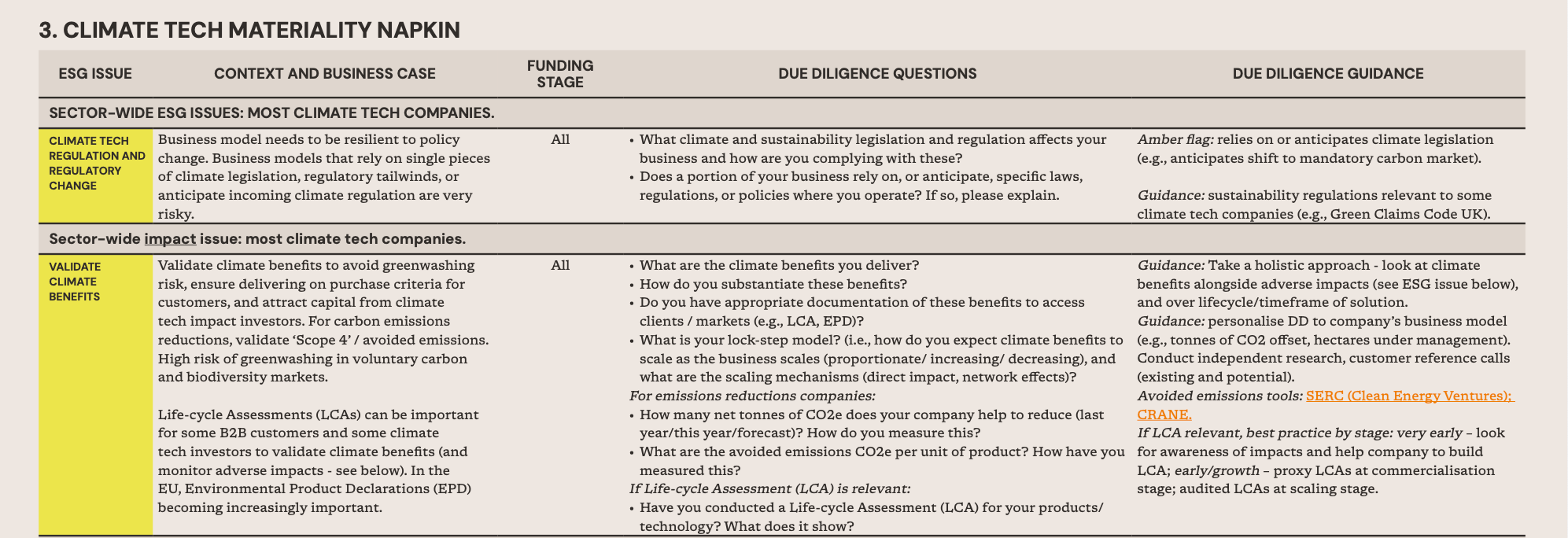
This summer, we’re conducting a series of 45-minute interviews with GPs and LPs to develop the Emerging Markets Materiality Napkins: a set of sector-specific due diligence frameworks designed to help VC investors identify and mitigate material risks in LatAm, Africa, and APAC.
Building on our existing North American and European frameworks (see the redacted sample of our Climate Tech napkin below), this new resource will ensure materiality assessments reflect the operational realities of emerging markets. No prior preparation is needed, participation is entirely voluntary, and all input is confidential.
Interested? Sign up here.
In April and May, we co-hosted six events across APAC and Africa, including two APAC community calls and two thematic deep dives. Below are selected takeaways, with co-hosts noted in brackets.
Zeroing in on Human Rights, Anti-Modern Slavery and Tech across APAC
APAC Community Call: Human Rights and Technology (Ben Pitler, UN B-Tech Project)
Human rights risks are material, not just ethical. Violations can trigger reputational damage, litigation exposure, regulatory penalties, and lost enterprise partnerships, and the same business model can carry very different risk profiles depending on market context (think gig-economy delivery work in Southeast Asia versus Europe).
In practice, members are embedding human rights considerations into manager appointments and mandates, applying exclusion policies, conducting diligence on co-shareholders and board members, running site visits, and sharing best practices with portfolio companies. For more resources to get started, please consult: B-Tech’s Primer on human rights risks for venture investors, GP toolkit, and LP toolkit.
Modern Slavery in Private Markets (Sonia Auld, QIC)
Modern slavery remains prevalent in private markets, and identifying it requires recognising behavioural warning signs — restricted movement, deception over working conditions and pay, debt bondage, threats of deportation or coercion — alongside contextual ones. Legal obligations vary by jurisdiction, with Australia’s Modern Slavery Act 2018 being one reference point. The Red Cross has a series of resources for businesses on assessing modern slavery risks.
Offshored and professional services in lower-protection jurisdictions are a commonly overlooked exposure, especially for tech companies relying on remote staff or outsourced providers. QIC uses tools like Fair Supply to map inherent risk by sector and geography, overlaid with adverse media monitoring to surface company-specific concerns. Their most recent Modern Slavery Statement is available here.
What Does Climate Investing Look Like for EM?
Deep Dive: Running a Climate Fund (Colaborativo, Climate Resilient Africa Fund, Swedfund)
DFI climate financing is growing, and it’s creating real opportunities for EM fund managers. Swedfund noted that 40% of its portfolio is now tagged as contributing to climate mitigation or adaptation. GPs shared practical advice on how to capitalise on this momentum: build fund verticals in industries that saw significant success in comparative markets such as India; create feeder funds aligned to international investors’ requirements; use founder referrals to source deals; and consider hybrid fund and credit-based financing structures when traditional exit pathways aren’t available. For those seeking DFI qualification, clear impact taxonomies and robust measurement systems are non-negotiable.
Doing ‘E’ as a Non-Climate Specialist (Samuel Monteiro, Partech)
Climate reporting remains one of the biggest practical hurdles for African funds. Many non-climate specialists apply light ESG due diligence at the early stage, focusing primarily on carbon footprints and basic governance via internal surveys. Getting buy-in from investment teams and portfolio companies, particularly around e-waste and green IT, remains a real challenge, with electronic waste still significantly underweighted as a risk. LP requirements continue to be the primary driver of climate consideration, more so than internal conviction. B2C companies are generally more proactive on sustainability than B2B.
How to Raise More LP Money Amid Tightening Financial Markets?
Diversifying Your LP Base (Vineet Rai, Aavishkaar & Natnael Asmerom, Launch Africa Ventures)
“Offer something that investors don’t think they know enough about — curiosity is how the first step of any relationship starts.”
Between them, Aavishkaar and Launch Africa have raised from expat and diaspora networks, HNWIs, foundations, DFIs, financial institutions, endowments, and family offices. Their practical takeaways: fundraising is relationship- and thesis-driven; you need a public, differentiated point of view. Accessing opaque or untapped capital pools (Japan, China, India, family offices) requires sustained, long-term relationship building. Rather than expensive conferences or distributors, start by leveraging your existing investors’ networks and incentivising introductions. Local HNWIs and family offices are increasingly important, particularly in Africa. Aavishkaar struggled to raise domestically in India for years, but once its first local investor came on board, fundraising momentum shifted significantly. Local capital now makes up 50% of its latest fund.
Access Session Recordings on our Notion.
Are you a GP or LP developing a responsible investment practice, tool, or resource you’d be willing to share with the community? Reach out to our Emerging Markets Lead, Alexandrine, at alexandrine@reframeventure.com. We’d love to feature your work in an upcoming Deep Dive or Community Call.
Reframe Venture is, first and foremost, a practitioner community. In May, we put that into practice by launching a dedicated WhatsApp group for EM-focused VCs, LPs, and professionals. It’s a space to share what you’re seeing on the ground, shape our research agenda, and connect with peers navigating similar terrain.
Interested in joining? Sign up here.
Bloomberg reports that international shocks are pushing Africa’s financiers to turn to domestic capital.
The case for Africa-led investment is also coming from the top: IFC Managing Director Makhtar Diop and Aliko Dangote, founder of the Dangote Group, set out their thinking on building the continent’s economic future in this fireside chat.
The IFC‘s latest handbook offers guidance on accelerating AI investment in emerging markets.
The Global Centre on AI Governance examines the potential harms of the AI boom in a new report on tech justice in Africa.
On nature-financing, an area of growing investor interest, Malaysia’s central bank (BNM), the World Bank Group and UNDP’s Biodiversity Finance Initiative (BIOFIN) have published a guide for financial firms on nature-related risks and opportunities.
Bain & Company, in their newest report, sizes Southeast Asia’s green economy at $430 billion by 2030, while flagging that meeting rising electricity demand and capturing a larger share of global EV production remain significant challenges.
Harvard Business Review, drawing on a six-year study across seven African countries, has released a piece on How to Deliver on ESG Initiatives in Emerging Markets, emphasising the need to engage local stakeholders as partners.
Talstack has partnered with British International Investment and Ventures Platform to launch an ESG programme tailored to African ventures. Read more via TechCabal.
BII‘s new 2026–2031 strategy, Building Markets, Transforming Lives, seeks to target over £15 billion in financing for developing economies across Africa and Asia, with climate (via the newly launched British Climate Partners) and least-developed countries as priority sectors and geographies.
The Emerging Markets team will be taking a quieter summer on events to focus on developing new tools and resources for the autumn.
Alongside the Materiality Napkins, look out for:
Our next Africa Community Call, ‘An Investor’s Lens on Responsible AI’, on 14 July 2026 at 3pm BST. We’ll also be running a series of responsible AI-themed calls later in the year, so watch this space.
Our Responsible AI Framework for Emerging Markets: a due diligence tool to help funds identify and assess the material risks embedded in AI-based ventures, tailored to the EM context. This tool is expected to be released in October 2026.
If you’re a VC and not yet a member, contact alexandrine@reframeventure.com for more information on how to join! We would love to have you on board.
If you are an LP, reach out to Johannes directly at johannes@reframeventure.com, and we will bring you into our community of 120+ institutional LPs to push the ecosystem forward together.
No posts
Comments
Nothing yet. Say the first thing.
Sign in to join the conversation.