
We are excited to share our latest tool for the Emerging Markets (EM) community: the Responsible Investment Maturity Matrix. This framework is designed to support venture capital funds and their limited partners (LPs) in assessing responsible investment (RI) practices.
The matrix was developed through extensive consultation with LP working groups comprising 25 large institutional investors across the EU/UK, North America, and Emerging Market Development Finance Institutions (DFIs). It aligns LP expectations around ‘investment readiness’, with complementary perspectives drawn from emerging best practices on the VC side.
For the EM-specific insights, we drew on observations from our research, stakeholder discussions, and, most critically, six training sessions conducted in 2024 and 2025 with 34 funds across Latin America and Africa, supported by GIZ’s CATAL1.5°T Initiative. Building on the trainings, a subsequent effort to assess ESG integration across trained funds directly informed the development of this matrix as a first-of-its-kind guideline for the emerging market VC ecosystem.
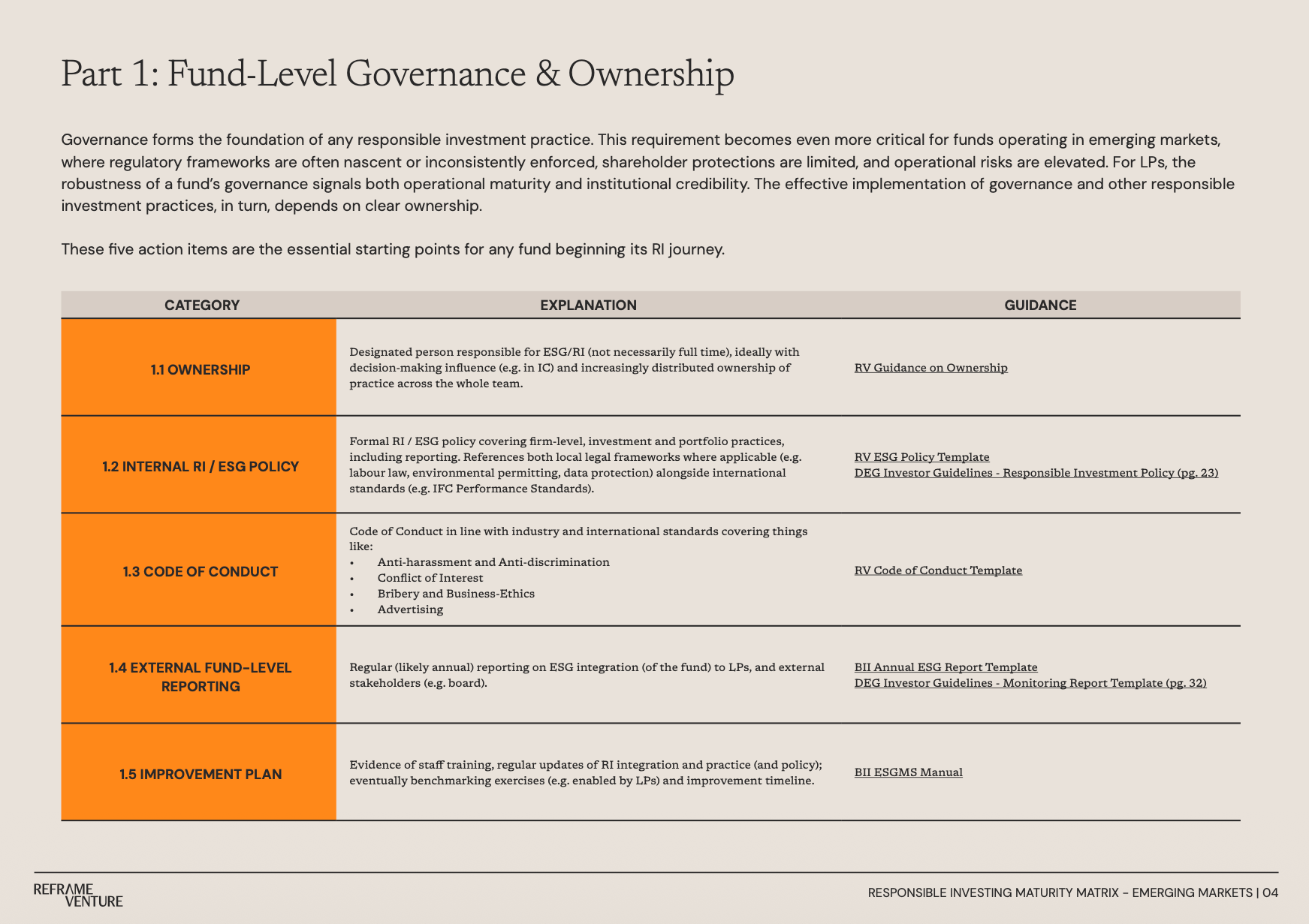
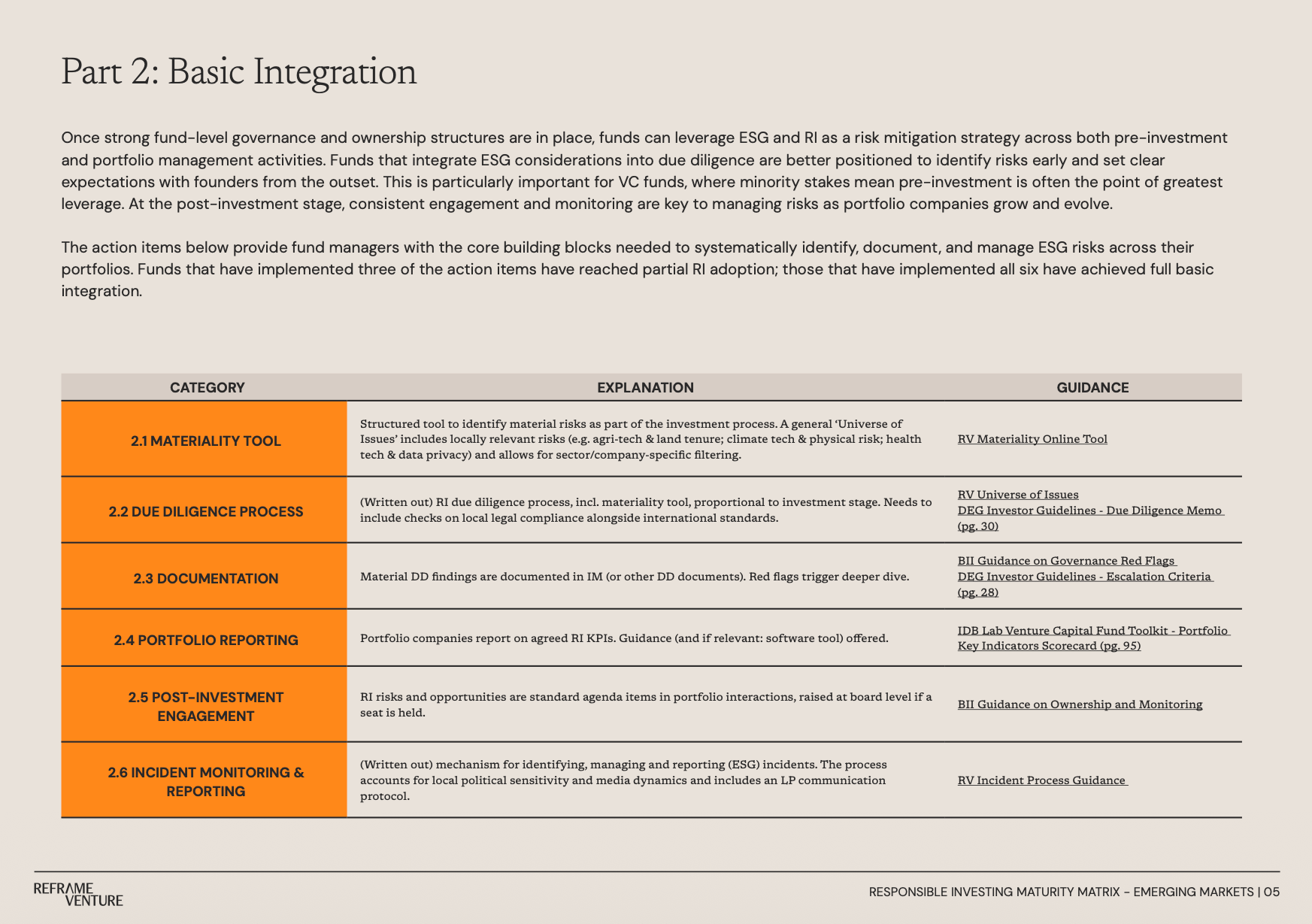
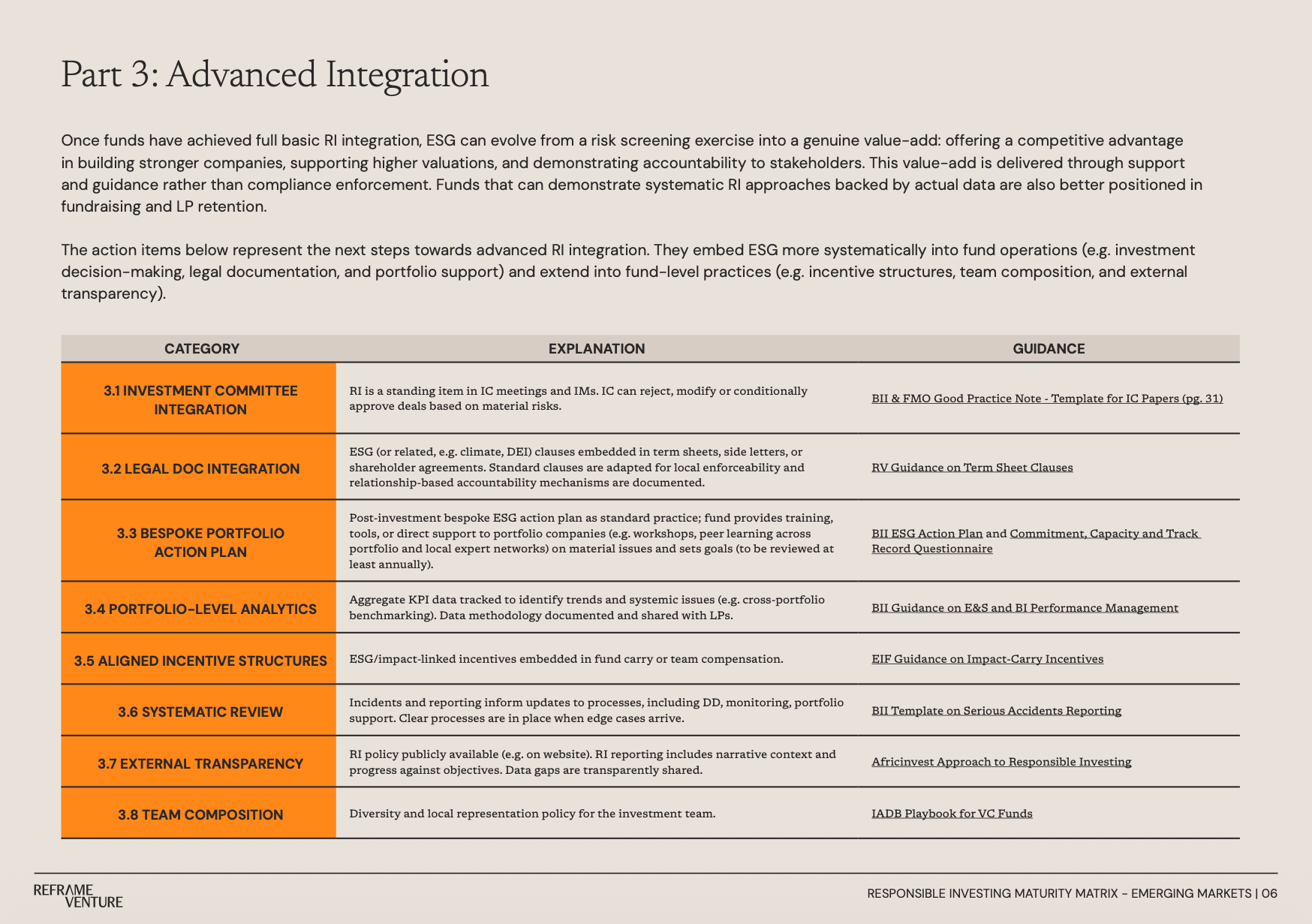
The Maturity Matrix is designed to serve multiple use cases for both GPs and LPs, supporting stronger RI integration and contributing to the development of a context-specific industry standards for emerging markets. We have identified at least four use cases for the tool:
GP Measurement Tool: a self-assessment framework enabling GPs to evaluate their current level of ESG integration.
GP Peer Learning: a structured foundation for knowledge exchange and coordination among GPs at similar stages of their responsible investment journey.
LP Due Diligence and Benchmarking: a standardised tool for LPs to assess and compare GP maturity in ESG practices.
LP Coordination and Capacity Building: a mechanism to improve alignment, harmonisation, and collaboration among LPs.
Across our training programs and engagement with emerging market VCs and LPs over the last two years, we found that the majority of fund managers in Latin America and Africa lacked a fully integrated approach to responsible investing, both within their own fund structures and across their portfolio companies.
Survey data from 21 of our trained funds reinforced this finding: only 15 had incorporated ESG practices into their operations. Out of the 15, three funds had achieved ‘full RI integration’ across their funds’ operations.
When pressed on why RI adoption was lacking, fund managers identified recurring barriers:
Lean fund structures and limited internal capacity
Frameworks designed primarily for European and U.S. markets, which are often not contextually appropriate for emerging markets
A lack of accessible, practical guidance on how to initiate RI integration
High costs associated with engaging external expert ESG specialists
Despite these challenges, fund managers consistently recognised the value of integrating proportionate RI practices as both a risk mitigation strategy and a driver of value creation. The core issue is not a lack of commitment, but rather constraints in time, resources, and internal capacity, which make it challenging for GPs to navigate the complex landscape of RI and ESG frameworks and identify what is most relevant to the fund and portfolio.
Even more established firms, such as those on their second or third funds employing dedicated ESG or RI specialists, reported adopting a ‘Frankenstein approach’: combining multiple ESG frameworks to construct a tailored system that is both proportionate and materially relevant to their investment context. This practice further underscores the need for a coherent, EM-specific reference point.
Alongside our work on a European/American version, we have developed the Maturity Matrix with input from some of the largest European DFIs to address this gap. The resulting tool is designed to enable emerging market fund managers, including those with lean structures, to initiate and progressively strengthen their RI practices. Critically, it is built to be iterative and process-driven, and not a static compliance checklist.
For each RI action point, the matrix provides further guidance and tools that cut through the noise. A cheat sheet included at the end of the matrix offers practical tips on execution and implementation, while an appendix maps each action point to the expectations of leading DFIs.
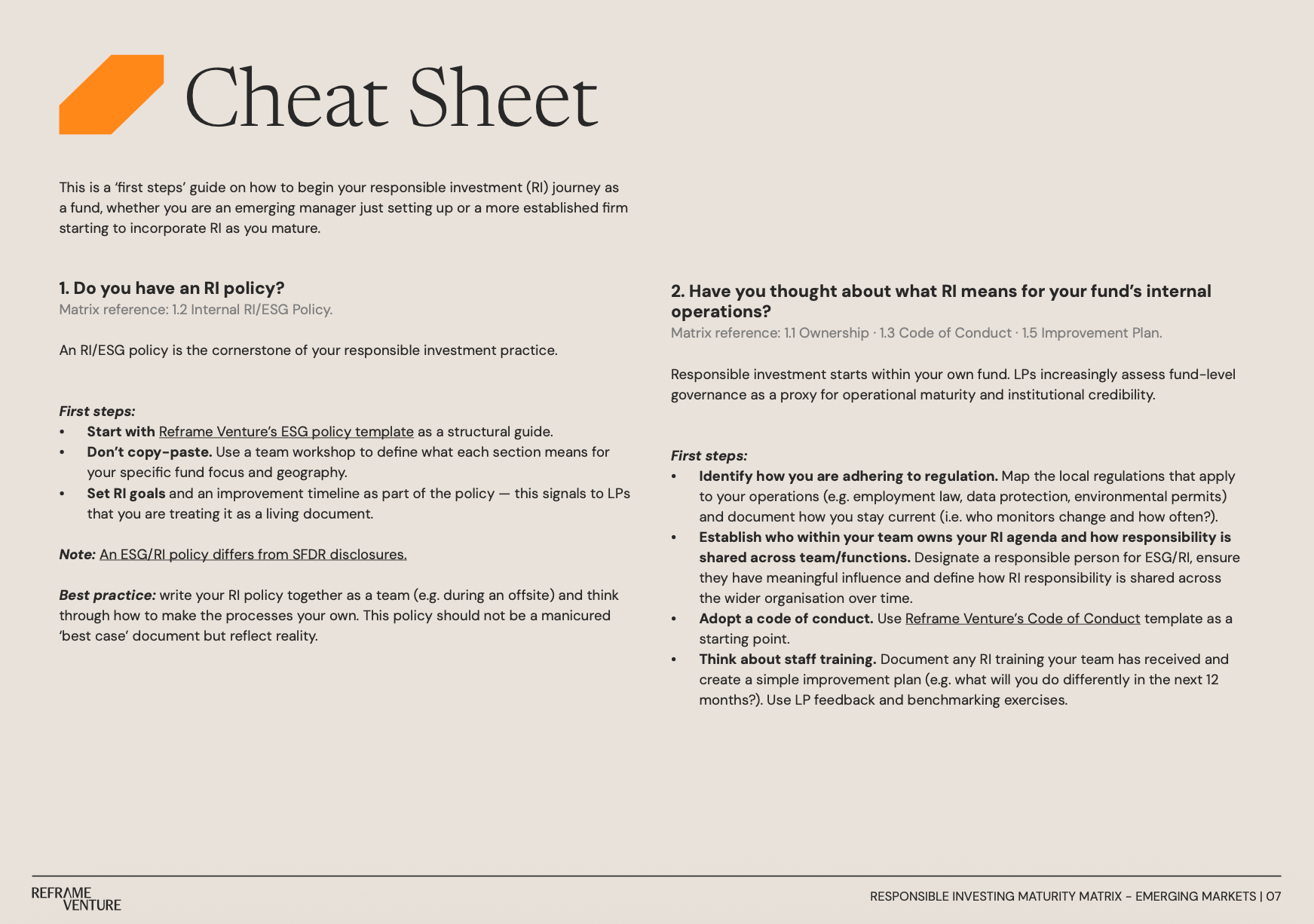
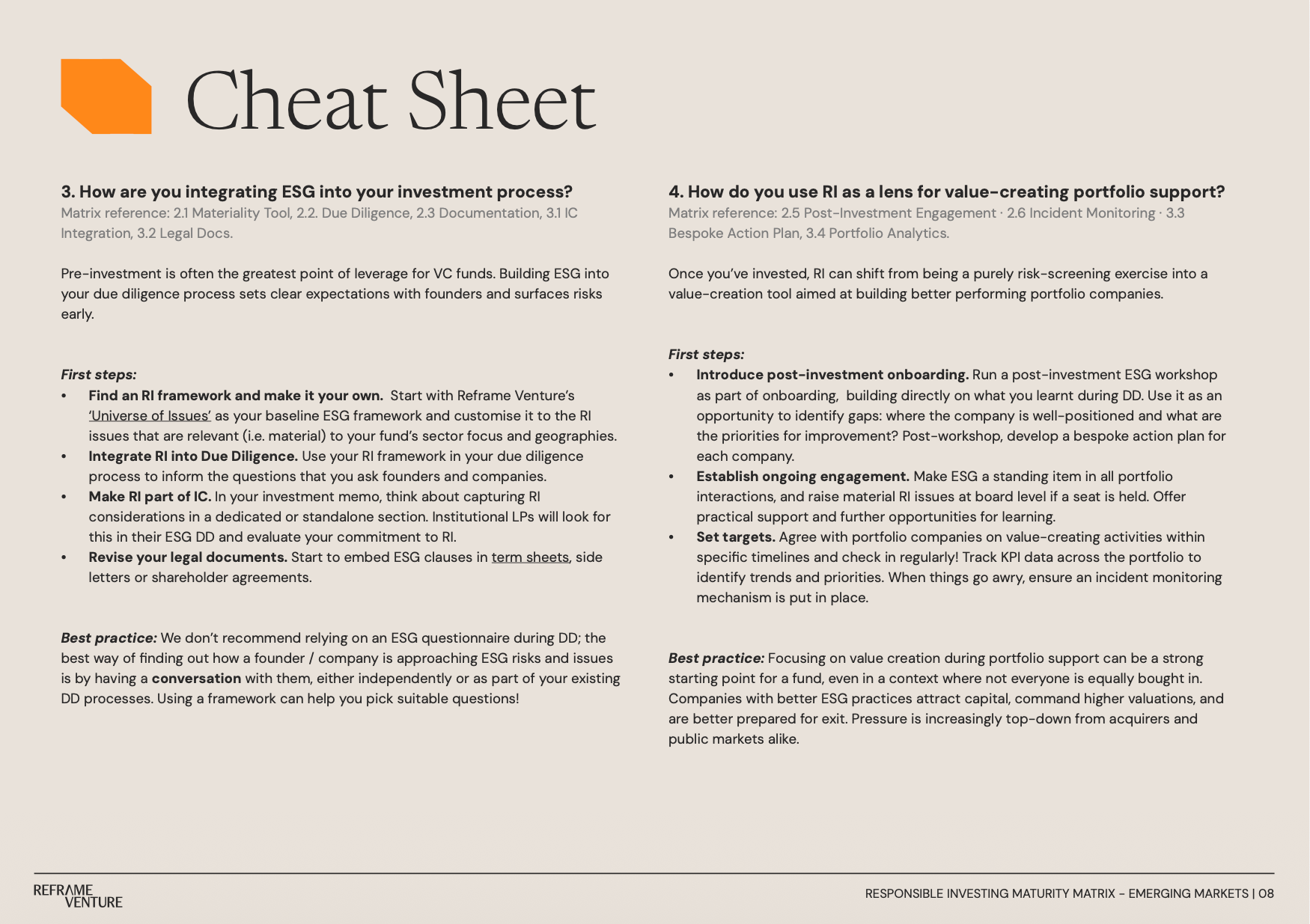
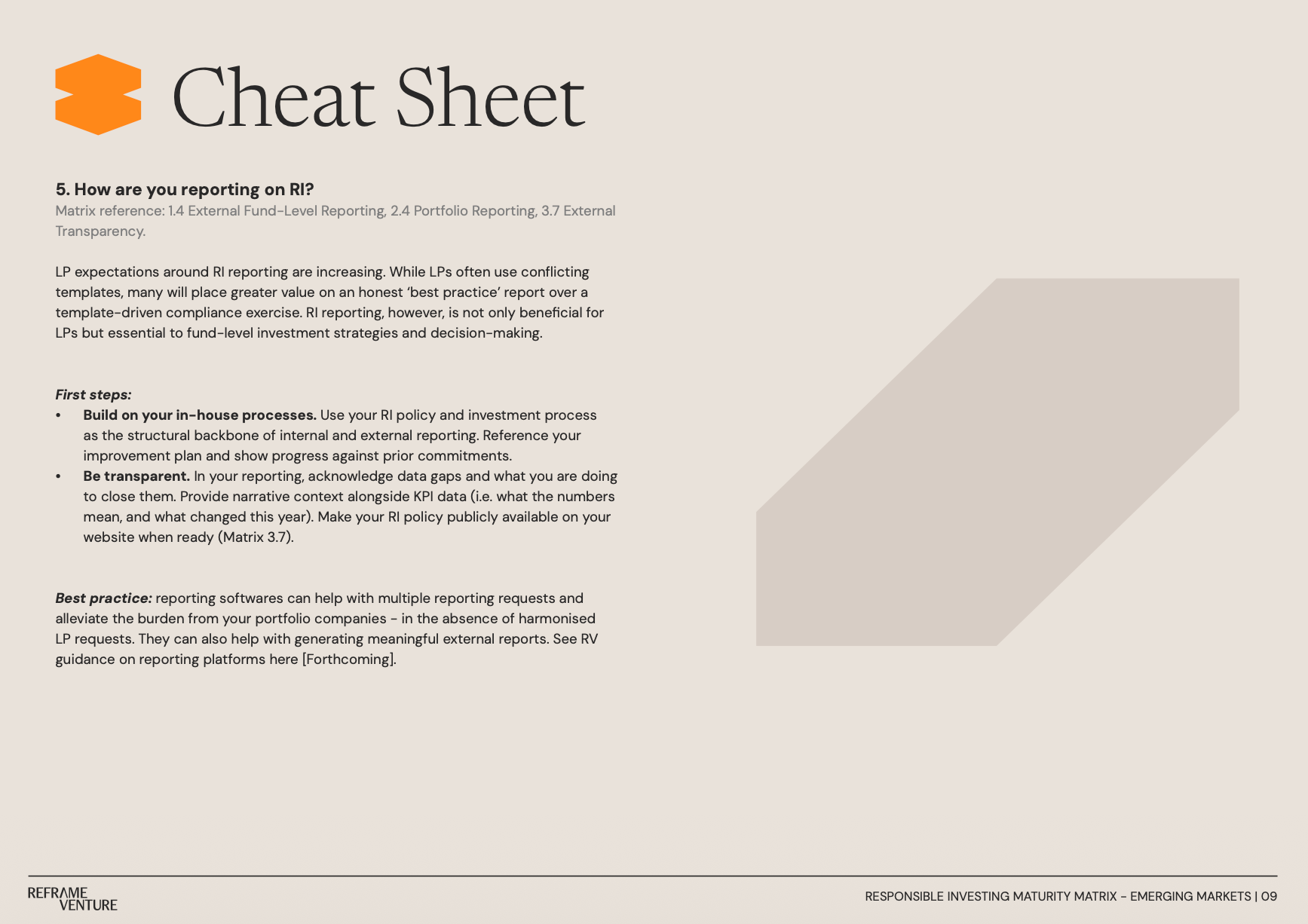
The EM Maturity Matrix is a starting point, not a finish line. We expect it to evolve as more GPs engage with it, as LP expectations continue to develop, and as emerging market contexts shift and new risk classes emerge. We invite fund managers and LPs to use, stress-test, and openly share their feedback on what works with us. At Reframe, we are committed to revising this matrix on an annual basis.

If you’re interested in joining the EM community or participating in our research interviews, please reach out to alexandrine@reframeventure.com.
No posts
Comments
Nothing yet. Say the first thing.
Sign in to join the conversation.