
🍃 Cut Too Early from the Fruit Tree
This piece was written before the heartbreaking tragedy that unfolded in the Texas Hill Country, where devastating floods claimed the lives of children and adults—lives gone far too soon.
As I reflect on the themes of timing, care, and legacy in this article, I cannot help but pause to honor those lost. My heart aches for the children whose laughter once echoed in the Texas Hill Country I love, and for the families and communities now left grieving.
Over the course of my five decades, I can recall another Fourth of July tragedy I witnessed first hand involving a child. It often rains this time of year—sometimes softly, sometimes with force. This year, that rain brought a sorrow that words can’t fully hold.
These precious souls may be gone from this world, but their spirits live on—in the love they gave, the memories they left, and the people who carry them forward. May they rest in eternal peace.
🎆 Happy 4th of July Weekend—and Happy Birthday to Me!
It’s my birthday weekend, and it’s summer— one of my favorite times of the year. School’s out, families are vacationing, and visiting friends feels a little more possible. I’ve always loved the mix of fireworks, parades, and time with people I care about. Some years, I can remember exactly which small town we were in, what festival was happening, and who was at the table when the cake came out. Those are the kinds of memories I like to carry with me.
Just last month, we visited a little town in Colorado that reminded me of those types of celebrations—kids running around, music in the park, everyone just... being present. It reminded me how summer gives us permission to slow down and see life—and our choices—with fresh eyes.


Not long ago, I was sitting in a small church in Colorado on a quiet summer morning. The sermon wasn’t about money, but one line struck me hard:
“Cut too early from the fruit tree.”
It was spiritual advice, but in my heart, it had another meaning. It reminded me of moments in my financial life—when I sold too soon, bought too fast, or failed to tend to something that needed more time. Being invested for decades can wash away so many of those financial sins. But the pains of cutting too soon are still there.
When we cut too early, we miss the sweetest part of the fruit. And that’s true whether we’re talking about money, decisions, relationships, or long-term investments.
I recently attended two Chinese tea ceremonies—beautiful, slow, intentional experiences. I didn’t expect to walk away with a life lesson, but I did.
The tea we drank came from trees over 500 years old, tended by monks with reverence and care. The tea leaves had been picked and fermented in 1999 and 2007. These trees aren’t mass-harvested. They’re protected. The leaves are picked mindfully—not for speed, but with care—as a gift to the next generation.
It reminded me that great things grow slowly. That when you treat something with care—whether it’s a tree, a relationship, a purchase, or an investment—it can serve you and others for a lifetime. That kind of tending is sacred.
I had a hard time imagining trees living for over 500 years. Then I remembered seeing a tree cross-section at a museum in New York this past December—the rings of life, preserved in time. So special.
It got me wondering: what other trees grow and produce like that? When we’re young, we don’t always know which trees to plant—or which ones to keep. We go with what’s familiar, what looks good, or what others around us are doing. I know I did.
I didn’t grow up with wealth or formal investment guidance. I had to learn by doing—and thankfully, I had people along the way who shared their wisdom. Some of it came from their own kitchen or dining room tables. Those conversations shaped my decisions in subtle ways, mixing with my own values, preferences, and experiences.
Eventually, I began making decisions based on quality, consistency, and long-term thinking—three principles that changed the trajectory of my financial life.
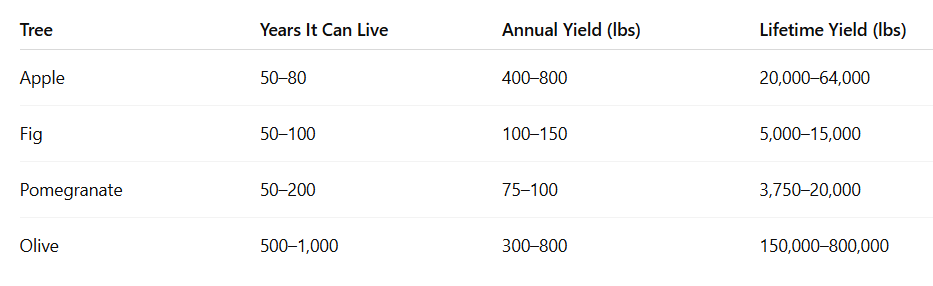
Here’s one thing I learned:
At first glance, the apple tree looks like the obvious choice. It grows fast, produces quickly and abundantly, and is well-known. But the olive tree—the one that takes patience and decades of tending—offers the greatest yield over time.
I had no idea until I saw the data. Can you imagine investing in a company that functions like an olive tree? It may not sound exciting at first glance, but if it continues to produce for generations—quietly and steadily—that’s exciting to me.
So if monks tend to these ancient rooted trees, maybe we treat our investments similar to the way monks treat ancient tea trees:
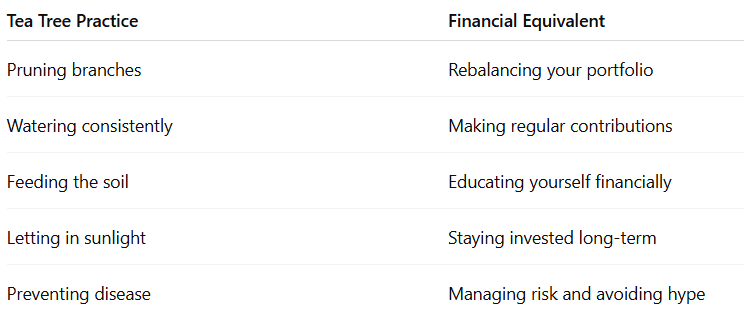
And the biggest mistake of all? Harvesting too early.
When we sell out of impatience—or worse, fear—we cut the fruit before it has ripened. We interrupt compounding. We rob ourselves—and maybe even the next generation—of the full reward of the hard work of all the employees and company leaders who are creating real value in the world, solving real problems, creating amazing experiences for others, or taking care of basic needs.
I didn’t always know this. Like most people, I didn’t have a monk or wise elder who taught me the spiritual side of money or the beauty of time.
But I had people who nudged me onto that path—often unexpectedly. One friend told me to consider a Toyota Camry—a car with longevity and timeless design—over a trendier option. That car is still with me today. It’s well-maintained and has low mileage. A valet recently offered to buy it on the spot. We politely declined.
Another lesson came from my Kenmore washer and dryer, bought in 1994 and reluctantly replaced in 2020 for more energy-efficient models. Over the years, I watched neighbors go through multiple appliances while mine kept working. The money I didn’t spend—and what I invested instead—made a noticeable difference.
I also purchased some timeless furniture from a North Carolina maker (now sadly out of business). These pieces cost a pretty penny, but they’re still beautiful and in excellent condition. That decision didn’t just save money—it saved decision-making energy. And that, I’ve learned, is priceless.
When I ran the numbers for my niece, I showed her how one purposeful car purchase—and delaying future ones—could potentially be worth over $1 million by retirement. That’s when the lightbulb really turned on. The full potential of buying well and buying less often was suddenly clear.
I’ve owned three homes in my life. For a long time, I thought I should’ve kept the first two and rented them out.
But once I ran the numbers—factoring in repairs, cap rates, and illiquidity—I realized, for me, I was better off putting that money into strong compounding businesses and, more recently, a well-constructed bond portfolio.
According to my calculations, the combined cap rate was around 4.6% with professional property management expense, or 5.3% if I self-managed. When you factor in lifestyle priorities and financial returns, it becomes easier to make a decision based on what really works for you.
This exercise reinforced a truth I’ve held for years:
A home is an asset—but that doesn’t automatically make it an investment.
And not every “good idea” is good for you—unless the emotional and financial math checks out. When I crunched the numbers for this article, I realized this long held belief I had was not true after all —for me. I can now let that go.
I didn’t learn all this overnight. I didn’t come from a background that handed me a playbook. But I read a lot of books over the 35 years, and I listened. I asked questions. I paid attention when people with wisdom shared their stories. I also listened to my own heart, especially when life got quiet.
Over time, those little pieces came together. They interleaved and shaped how I spend, how I invest, and how I see possibilities for the future.
Whether it’s a fruit tree, a tea tree, a car, or an investment account—the real question is:
Will you tend to it with care, or cut it too early?
If you choose quality, nurture it over time, and give it space to grow—you may be surprised at how much fruit you’ll gather. Not just for yourself, but for those who come after you.
And that, to me, is what real generational wealth looks like:
Taking care of what you have now, teaching others to do the same, and leaving behind more than money. You leave messages. You leave memories. You leave a new path forward.
That’s the tending that matters most.
That’s the part that will outlive us.
Prayers to those who are suffering today and prayers to each of you for good health and prosperity.
Comments
Nothing yet. Say the first thing.
Sign in to join the conversation.