
Hi friend—happy early fall. 🍂 I finally pulled the trigger on a new HVAC after three years of considering it. Why did I wait? Because my HVAC team—the folks I trust—told me I could likely get another one to three years out of my old unit if I stayed on top of maintenance.
Three years ago, most vendors I priced were trying to pressure or upsell me. My current vendor didn’t. So instead of replacing, I stuck with it: filter changes on schedule, bi-annual checks before summer and winter, and keeping the condensate line clear in hot months (something I just learned and now handle myself).
That bought me more time for my money to compound and let me replace the unit on a scheduled timeline, not in a summer-in-Texas panic. I’m also hoping my electric bills will be a little better. More tonnage offsets the higher SEER2 ratings. Either way, I now have peace of mind—which is worth a tremendous amount to me.
All of this got me thinking a lot about personal finances. I suspect it’s also because of AI and the changes we’re all living through. More specifically: how personal finance either accelerates our freedom—or quietly hold on to it.
And that leads to the bigger question I’ve been wrestling with lately, especially with today’s high interest rates, high home prices, and rising homeowners insurance:
Is your home really an investment—or is it an asset that costs you money?





Note: These Irish Castles and the Abbey were once homes -what storied histories. The house on the grounds is still someone’s home thanks to the Guinness family.
An investment pays you: rent, dividends, interest, royalties—cash you can live on or reinvest.
A home (your personal residence) usually consumes cash: taxes, insurance, routine maintenance, and big-ticket capital expenditures (CapEx) like HVAC, roof, water heater, exterior paint, windows, kitchen appliances, and more.
Owning is meaningful—but it’s not a cash-producing asset by default.
When people say “I’m building equity,” that’s true—but it’s not the full story. We often forget the hidden outflows not evident in our mortgage payment.
Here’s the fuller picture for a $400,000 home:
Mortgage interest: 30-year at 6.1% = $472,600 in interest (effectively paying more than double the house price). 15-year at 6.1% = $211,500 in interest.
Property taxes: ~1%–3% annually = $4,000–$12,000/yr (and if values rise, taxes rise too).
Homeowners insurance: Typically $2,000–$4,000/yr (sometimes more).
Maintenance: Rule of thumb is 1%–2% = $4,000–$8,000/yr.
CapEx: Roof ($20k+), HVAC ($10k+), water heater (~$2k), appliances, paint, gutters, windows = $8,000–$10,000/yr.
👉 Bottom line: comparing “rent” to “mortgage” without these costs is misleading. Ownership can be wonderful—let’s just count all the dollars.
For a $400,000 home in Richardson, TX:
Base (P&I + Taxes + Insurance): $2,921/month
Maintenance: $333–$667/month
CapEx reserves: $670–$800/month
👉 Total monthly cost: $3,924–$4,388/month
If rent for a comparable property is $2,500, then the “real” monthly cost of ownership is $1,424–$1,888 higher.
Instead of saving for a roof, appliances, or HVAC, one could argue you could rent and invest those dollars into an equity or bond fund that compounds and grows over time.
One of the most overlooked differences between a home and true investments is liquidity—your ability to access cash when you need it.
You can’t sell a bedroom if you suddenly need $7,500. With a home, your only options are:
Sell the entire house (and pay realtor fees, closing costs, moving expenses, and face months of disruption), or
Borrow through a HELOC or cash-out refinance (and pay interest, often at higher rates).
By contrast, with a brokerage account, you can sell just what you need—sometimes as little as a few hundred dollars. Funds usually settle in 1–2 days.
That flexibility is worth real money. It’s the difference between:
Paying an unexpected medical bill from reserves vs. putting it on a credit card.
Jumping on an investment opportunity vs. missing it because your cash is trapped in drywall.
Sleeping soundly because you know you can handle surprises without derailing retirement.
Home equity is like money locked in a vault where you don’t hold the key. Investments in liquid accounts? They’re like soldiers at the ready—deployable the moment you call.
I manage my home like a commercial property. That starts with a CapEx reserve schedule.
Two ways to calculate:
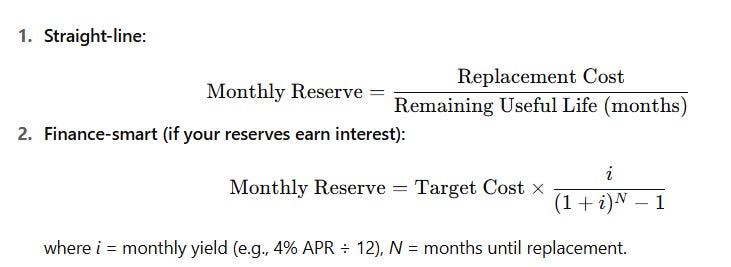
Where to park reserves?
Short horizon (≤5 years): money market/T-Bills.
Long horizon: broad index fund (only if volatility won’t force a sale at the wrong time).
For me, I auto-transfer the first week of January into a dedicated “House Reserves” account, invested based on time horizon, and escalate annually for inflation.
Boring? Yes. Nerdy? Absolutely. Calming? Most definitely.
No—it’s simply solving for a different outcome. Yes, rent pays someone else’s mortgage. But your mortgage pays the bank—and the interest is massive, effectively doubling the house price.
Renters avoid property taxes, insurance hikes, and CapEx, and can redirect those dollars into liquid investments.
I’ve seen this up close. Someone dear sold their house and now rents in a well-managed building (trash pickup at the door, responsive maintenance, thoughtful upgrades). Rent increases have been modest because the landlord values stability. The money they’re not spending on taxes/CapEx is compounding in the market.
Renting works best when your landlord is a professional:
Pride of ownership, consistent maintenance, and making the space feel like home.
Avoid nickel-and-dimers chasing short-term profit.
I’ve been on both sides. Years ago, I rented out a Class-A property with white-glove service. My annual return was modest (~5%) once I factored in all the costs of ownership, but I had the best neighbors. When I sold, I sold to them.
Rethink: A landlord is someone you choose to bring into your life. It could become a long-term relationship, so choose as if it will be. You may see your decision differently under that lens.
Home purchases are not just financial—they’re emotional. A home is where you may raise your children, host family gatherings, care for aging parents, or simply kick your feet up after one of those stressful days when an early night’s sleep feels like the best medicine. (I’ve had my share of those days.)
I love my home and am very happy with the purchase I made. At the same time, I now look at any future purchase through another lens: Would this property be desirable to others if I ever needed to sell or rent it?
Some questions worth asking:
Is it in a walkable neighborhood, near amenities that people value?
Is it in a school district families want to be in?
Is the size balanced—big enough for life, but not so big that it prices out much of America from ownership or rentership?
Does the layout allow for flexibility (multi-generational living, work-from-home space, or even conversion to a rental unit)?
Is the home in an area with strong job growth, infrastructure, or transit connections that will hold demand?
Could it support short-term or mid-term rentals if life circumstances change?
These aren’t questions meant to take the joy out of buying a home. Quite the opposite: they help ensure that while you’re building your beautiful life inside its walls, you’re also protecting your financial flexibility for the future.
With Boomers passing trillions to the next generation, inherited property can change the calculus. If it’s free and clear, the biggest cost—the purchase—is behind you, and replacement costs today are far higher than the home you would inherit. In other words, you cannot rebuild for the cost of the home you might otherwise inherit.
Handled properly—with reserves, maintenance, and tenant care—an inherited home could become a true investment.
Ask yourself:
Is it in a highly desirable area?
Is the net return on equity ≥12%? (If yes, consider holding. If <10%, selling may be smarter.)
Will you ever use it personally?
If you sell, how will you redeploy the equity (especially with a step-up in basis eliminating most taxes)?
And remember: no one wants an inheritance more than they want their loved ones to still be here. Give yourself time. When ready, make decisions with clarity and honor their gift.
At the end of the day, your home is an asset—a meaningful one where memories are made, but it comes at a cost.
If you buy, treat it like a business.
If you rent, you’re not “throwing money away.”
If you inherit, you may have a genuine wealth-builder.
When you factor in hidden costs—mortgage interest, higher taxes, rising insurance, maintenance, CapEx—you may rethink the size of your “dream home.” Sometimes the dream is a home that brings joy without holding back your future. Smaller can mean fun. And those saved dollars? Put your soldiers to work earning interest, dividends, capital gains, and other income.
In this era of AI, managing your personal finances—and making sure the dollars you earn work as hard as possible for you—is more important than ever. As technology reshapes roles—some shifting to part-time, some changing completely, some slowly going away—you’ll want investments working on your behalf.
Be clear about what’s a true investment versus an asset with hidden costs.
Think of every dollar you earn as a soldier. Instead of just spending them—deploy them to generate interest, dividends, royalties, rental income, or capital gains. That way, if your role changes or disappears in the coming decade, your financial soldiers will still be out in the world working for you, creating stability and freedom to carry you through.
And in a way, it’s not unlike AI. In the near future, AI will keep working in the background—an assistant running 24/7, compounding your efforts. Your dollars can (and should) be doing the same: working on your behalf, multiplying quietly in the background, even while you sleep.
Until next time, keep creating financial flexibility and freedom to embrace any future.
Comments
Nothing yet. Say the first thing.
Sign in to join the conversation.